
Et al. is a Latin abbreviation that means “and others,” and in academic writing, it appears when a source has more authors than a citation needs to list every single time.
The main thing students usually need to know is when to use et al., because APA, MLA, and Chicago handle that rule a little differently. In APA, for instance, an in-text citation may look like this: (Garcia et al., 2024). That tells the reader that Garcia is the first listed author and that other people also wrote the source.
This article explains the meaning, the basic usage, and the main citation-style differences.
What Is the Et Al. Meaning?
The term et al. comes through Latin, specifically through et alia, which means “and others.”
In research papers, it gives writers a shorter way to cite a source with several authors without dragging every name into the sentence.
A simple use of et al in a sentence would be: Vossler et al. argue that citation habits affect how readers judge research credibility. The period goes after al. because that part is shortened. Et stays without a period because it is already a complete word.


Get Tasks Done Right
Spend 5 minutes to match with a professional who can take over any of your academic papers.
When Should You Use Et Al.?
You should use et al. when a source has multiple authors and the citation style you are following allows the author list to be shortened. That last part is important, since APA, MLA, and Chicago do not apply the rule in exactly the same way. Still, the general pattern is easy enough when using et al in a sentence. You keep the first author’s last name, add et al., and then follow the citation format required by your style guide.
- Use et al. when a source has several authors and the required style guide permits a shortened citation.
- Keep the first listed author’s last name before et al.
- Place the period after al., since al. is the abbreviated part.
- Leave et without a period, because it is a full Latin word.
- Use the same form each time your citation style calls for it.
- Check reference-list rules separately, since bibliography entries may require more author names.
- Treat the phrase as part of the author name: Caldewick et al. found a clear pattern in the survey results.
General Rules on How to Use Et Al.
Writers use et al. as a practical shortcut in academic citations, especially when naming every author would slow the sentence down for no useful reason. The full credit still appears through the reference entry, so the shortened in-text citation does not erase the other authors. A lot of students also wonder about et. al or et al, and the correct version is et al. There is no period after et. This is what all essay writers must know:
- Write the first author’s last name first.
- Add et al. directly after that name.
- Follow the date, page-number, or note rule required by the citation style.
- Keep the full author information in the reference list or bibliography when your style guide requires it.
- Avoid et al. for a source with only one author.
- Do not use et al. as a casual stand-in for “people,” “writers,” or “researchers” outside a citation context.
An et al usage example looks like this: Merriton et al. explain that citation rules help readers trace the original source more easily.
How to Use Et Al. in APA?
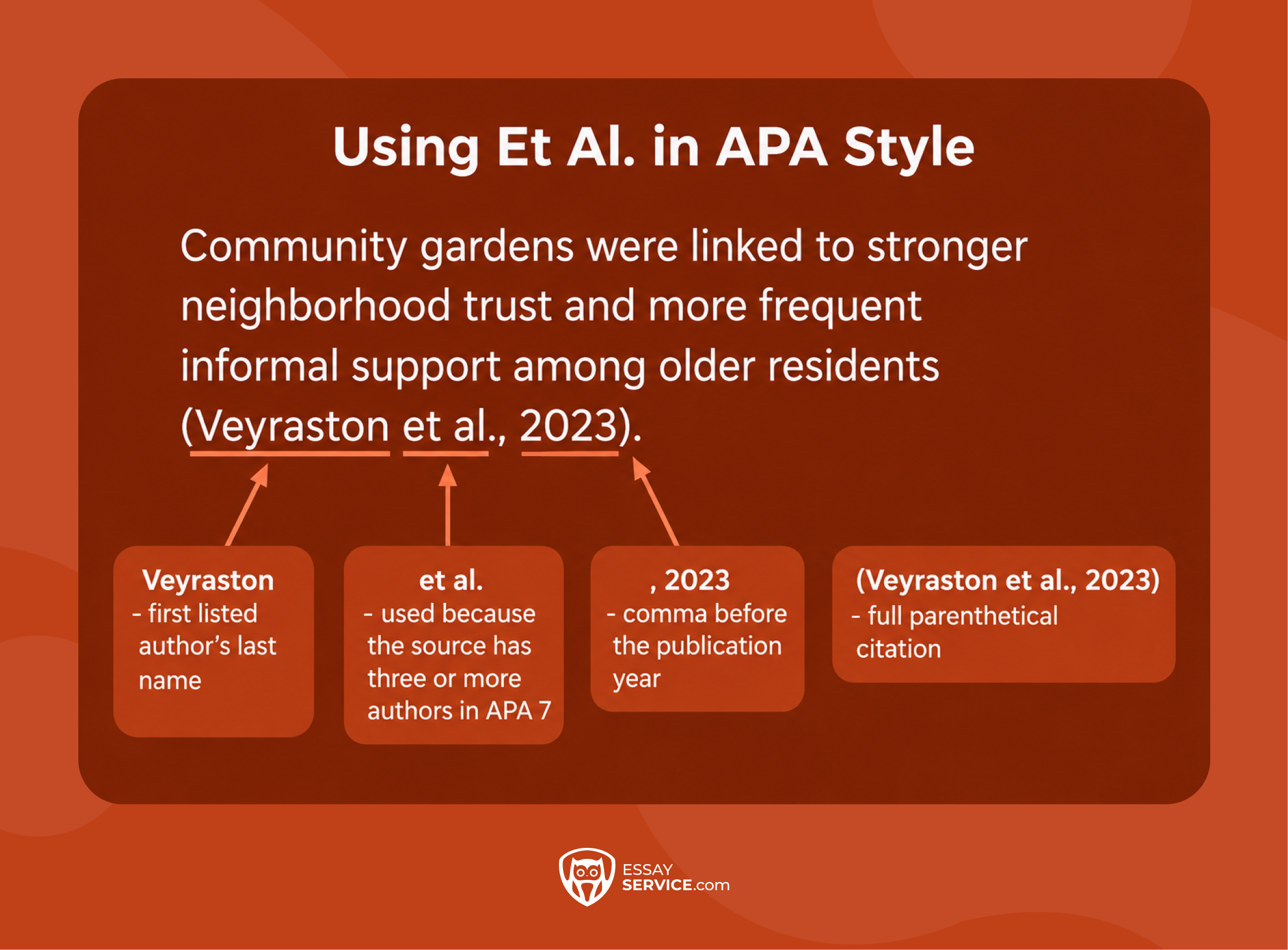
In APA Style, et al. appears in in-text citations when a source has three or more authors. These APA et al rules follow the 7th edition of the APA Publication Manual, which is worth saying clearly because the older APA approach handled author numbers differently. In the current rule, APA keeps the in-text citation short quite early. You write the first author’s last name, then et al., then the year. Simple enough, though students still lose points over the period placement.
The reference list follows a different rule, so the shortened in-text citation should not be copied into the full source entry.
Examples of usage:
Wrong: (Halverin, Oakesby, Thornevale, 2024)
Correct: (Halverin et al., 2024)
Wrong: Halverin et. al (2024) identified the same pattern.
Correct: Halverin et al. (2024) identified the same pattern.
Wrong: (Halverin et al, 2024)
Correct: (Halverin et al., 2024)
How to Use Et Al. in MLA?
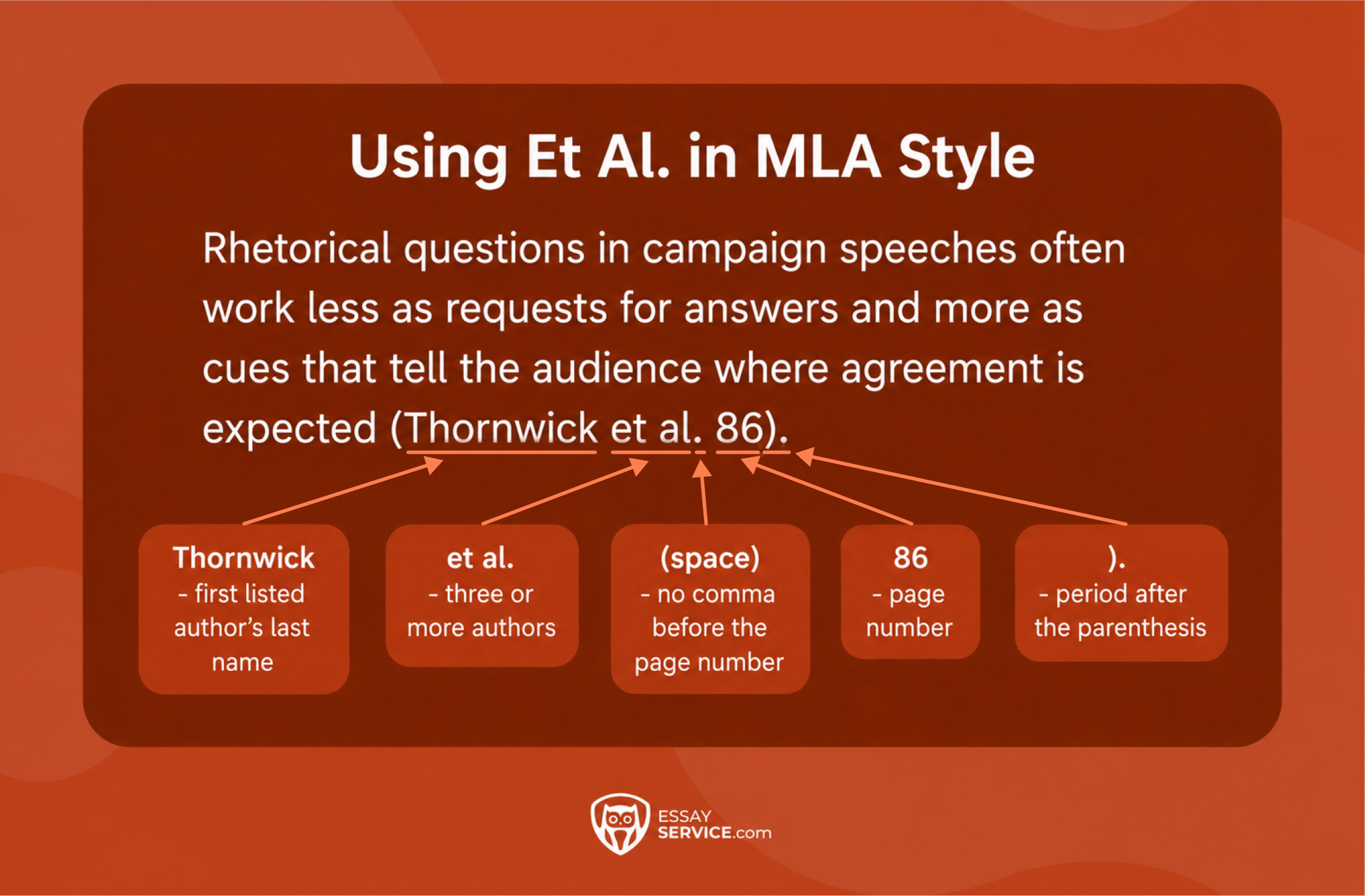
In MLA Style, et al. is used when a source has three or more authors, and these rules follow the 9th edition of the MLA Handbook. The phrase appears in two places: the in-text citation and the Works Cited page, which students sometimes call the references page, though MLA uses Works Cited as the correct label. For in-text citations, MLA et al usage means writing the first author’s last name, adding et al., and then placing the page number after it.
On the Works Cited page, the entry starts with the first author’s name, followed by et al., then the title and publication details.
How to Use Et Al. in Chicago?
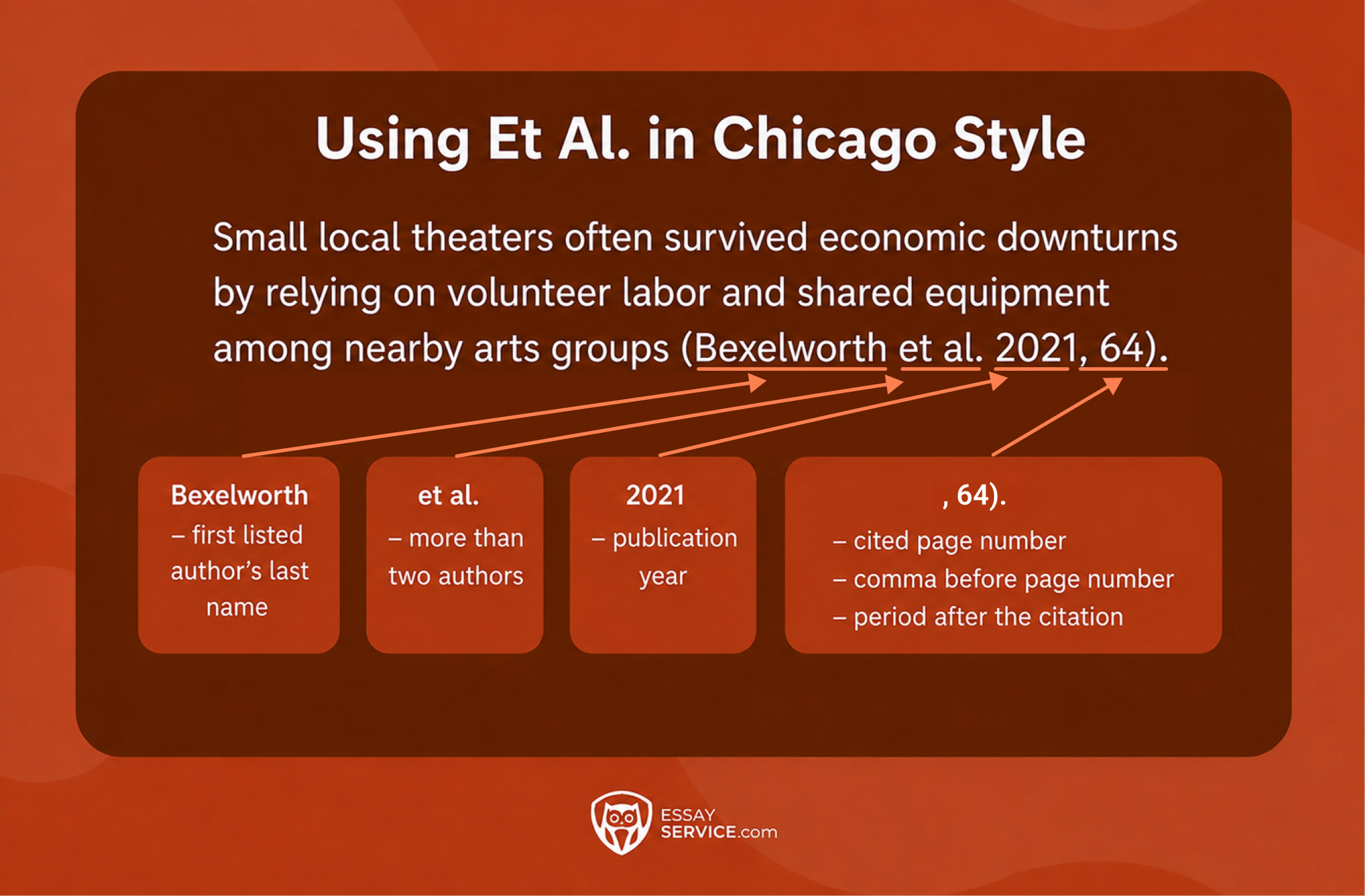
In Chicago Style, et al. depends on the citation system assigned for the paper, which is where the confusion usually starts. Chicago uses the notes-bibliography style in many humanities courses, while the author-date style appears more often in social science writing. In notes and author-date text citations, Chicago gives up to two author names. When the source has more than two authors, the citation keeps the first author’s surname and adds et al. Bibliography and reference list entries work differently. They give fuller author information, so sources with up to six authors list every author. For seven or more authors, Chicago lists the first three authors, then et al.
Examples of usage:
Wrong: Haverstoke, Ellaby, and Cranforde, 44.
Correct: Haverstoke et al., 44.
Wrong: (Haverstoke, Ellaby, and Cranforde 2023, 44)
Correct: (Haverstoke et al. 2023, 44)
Common Mistakes in Using Et Al. in Papers
The usual problems involve punctuation, author count, and citation style rules. A student may know what the phrase means and still place the period in the wrong spot, use it too early, or copy an APA pattern into MLA. That is the part that gets messy.
Writing Et. Al Instead of Et Al.
Et al punctuation is probably the most common mistake we make. The period belongs after al. only. Et is a full Latin word, so a period after it is wrong.
Wrong: Alderweiss et. al found a similar result.
Correct: Alderweiss et al. found a similar result.
Forgetting the Period After Al.
Since al. is abbreviated, the period has to stay. Without it, the citation is technically incomplete.
Wrong: (Alderweiss et al 2024)
Correct: (Alderweiss et al., 2024)
Using Et Al. With One Author
The phrase means “and others,” so it should never appear with a single-author source. One author means one name.
Wrong: (Vanderholt et al., 2022) for a source by Vanderholt only.
Correct: (Vanderholt, 2022)
Applying One Citation Style Everywhere
APA, MLA, and Chicago shorten author names under different conditions. The same source may need a year in APA, a page number in MLA, and a note format in Chicago. Tiny formatting habits, honestly, travel badly between styles.
Wrong: (Marloweck et al., 2021) in MLA.
Correct: (Marloweck et al. 51)
We understand that formatting details can be the source of additional stress when you're deep in sources and drafts. You can always buy an essay from EssayService if you want some extra help.
Formatting Details Handled
You spend enough time writing. Let an expert take care of other academic details.
Final Thoughts
Et al. is a small citation term, but it does real work in academic writing. It shortens citations with multiple authors, keeps sentences readable, and still points readers toward the full source entry. The main rule is to use et al. only when the required citation style allows it. APA, MLA, and Chicago each handle author numbers in their own way, so the safest approach is to check the style first, then apply the punctuation correctly: no period after et, period after al.
Frequently Asked Questions
What Does Et Al. Mean?
How Do You Use Et Al. in a Sentence?
Is There a Period After Et Al.?
When Do You Use Et Al. in APA?
When Do You Use Et Al. in MLA?

Jennifer is a student currently pursuing a Journalism major. She oversees the EssayService blog team and uses her journalism skills to ensure all blog posts are accurate, trustworthy, and engaging.
- CITING MULTIPLE AUTHORS AND USING “ET AL.” (n.d.). Retrieved June 9, 2026, from https://www.regent.edu/wp-content/uploads/2023/07/Regent-Writing-Resources-Formatting-Citing-Multiple-Authors-and-Using-Et-al.pdf
- American Psychological Association. (2017). Author–Date Citation System. https://apastyle.apa.org/. https://apastyle.apa.org/style-grammar-guidelines/citations/basic-principles/author-date
- When do I use et al with author names when using the Cite Them Right Harvard referencing style? - Library Help. (2023). https://libhelp.ncl.ac.uk/. https://libhelp.ncl.ac.uk/faq/246838



New posts to your inbox
Your submission has been received!