
A poetry analysis essay examines how the author constructs meaning in the poem by examining the use of language, structure, sound, imagery, speaker, and tone. From here, the analysis looks at the work from a technical standpoint, before showing what the work implies and how different choices affect this meaning.
To understand how to write a poetry analysis essay, you should read the poem closely first and mark repeated words, as well as any instances of line breaks. Use images that are unusual, sharp, or emotionally charged to reveal insight into the author's intent. Next, use this information to develop a concise thesis statement that is supported by quotes from the poem.
This poem analysis essay guide covers what this kind of essay looks like and how to write it, as well as a real analysis example so you have a blueprint to follow.
What Is a Poetry Analysis Essay?
A poetry analysis essay is a focused explanation of how a poem works. It studies the poet’s craft, such as word choice, rhythm, rhyme, figurative language, symbolism, punctuation, structure, and shifts in tone.
The purpose of the poetry analysis is to use evidence to support your interpretation of the poem's meaning. For example, you might argue, "This poem is about sadness." This will make for a very weak essay. A stronger essay would demonstrate how the author expresses feelings of sadness by using short lines, harsh imagery, repetitive sounds, or having a speaker who never directly confesses.
Poetry analysis trains careful attention, which is why professors often assign this task to students. The author uses literary devices to condense the meaning of his or her work, and even the most basic of sentences can change the entire mood; thus, reading these texts attentively and accurately explaining your reasoning with examples is crucial.


Professional Help, Ready
Get practical support with your papers that turns scattered ideas into a cleaner, stronger paper.
How to Choose the Right Poem for the Analysis?
The right poem gives you something to examine. Look for a piece with vivid images, noticeable sound, emotional pressure, unusual structure, or a speaker whose voice leaves room for questions. A poem that gives away everything in one reading usually leaves you with a meaningless essay. Use these steps before you commit:
- What literary techniques can you see? Look for metaphors, symbols, repetitions, rhymes, line breaks, punctuation, or strong image descriptions.
- Is there tension in the poem? Many good poems contain some kind of tension, either through sadness, fear, remembrance, regret, amazement, or uncertainty. Tension in the poem allows your paper to have a point of direction.
- How long is the poem? In most cases, 12 to 40 lines work best. In this range, there is generally enough material to work with for a paper without crossing the thin line of making your paper a one-line-per-line.
- Is there one clear meaning to the poem? If a poem tells you all its meaning the first time you read it, you are likely to have nothing but a summary when writing the analysis. Try to pick poems that have several themes to work with.
- Does the poem contain lines you can quote? You need to have specific words and phrases to analyze. You can always go to another poem if you do not find concrete quotes you are willing to use.
- Can you clearly explain the poem? You want to have something of interest for you, but you also need enough confidence to create your thesis statement, create a well-organized body paragraph, and finally connect each quote back to your thesis statement.
If you are struggling to analyze poetic devices, structure, and themes, you can simply pay for essay assistance from academic experts.
Poetry Analysis Essay Outline
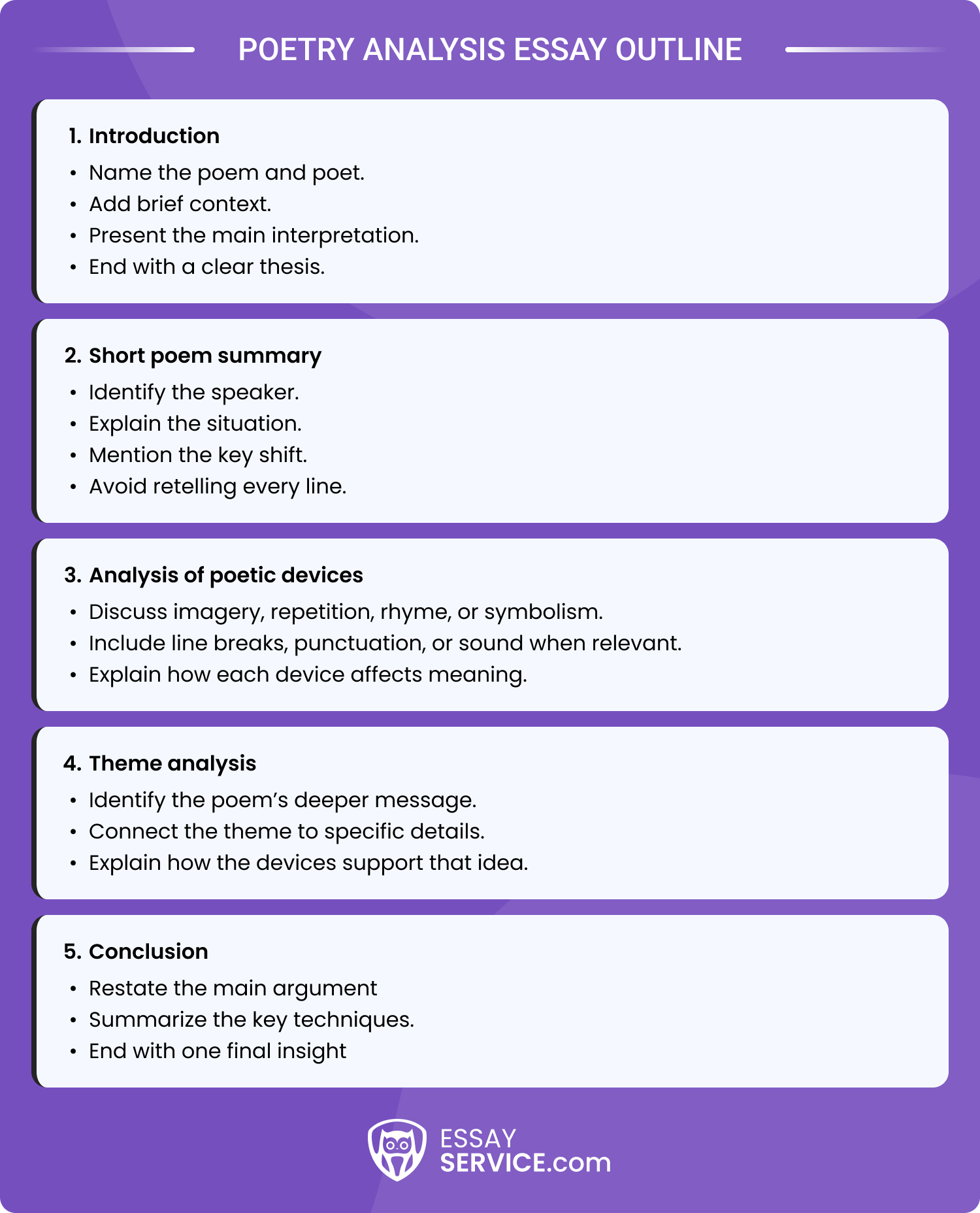
To write a strong poetry analysis essay, you need a logical order first. A balanced poetry analysis essay usually follows a classic 5-paragraph structure. That structure keeps the paper clear while leaving enough space for close reading.
- Paragraph 1: Introduction with the poem, poet, and thesis
- Paragraph 2: Short poem summary
- Paragraph 3: Analysis of poetic devices
- Paragraph 4: Theme analysis
- Paragraph 5: Conclusion
Introduction
In the introduction, state the title of the poem you're going to be analyzing, the author's name, and briefly explain what this poem is conveying. You should avoid cliché statements such as "poetry is a universal language" because by doing this, you are saying nothing about the work, the author, or poetry in general. The second sentence should describe the speaker, the situation, and the emotional setting between the two. Finally, write a thesis statement describing what the poem conveys and how the techniques used in that poem produce such meaning.
Example: In Elizabeth Bishop’s “One Art,” the speaker presents loss as something people can practice and control. Through repetition, escalating examples, and a careful tone that starts to crack, Bishop shows how grief resists neat explanation.
Poem Summary
The summary of the poem should be concise and brief to avoid being overwhelming. The purpose of the summary is to give the reader enough information needed to understand your analysis; you should not be restating every line of the poem.
For example, a summary of Elizabeth Bishop’s “One Art” might explain that the speaker lists small losses first, like keys and wasted hours, then moves toward deeper personal loss. That is more than enough. The real analysis begins when you explain why those details matter.
A useful summary also notices changes. In “One Art,” lost keys are harmless. Lost cities and a lost person are not. That jump shows the essay where to focus: the poem treats loss like a skill, but the examples become too serious for that claim to hold.
Analysis of Devices
In this paragraph, you are to analyze the craft of the poem. You select the literary devices used by the poet that support your thesis. You should not list every single poetic device you find because if you do this, your paragraph will be a vocabulary exercise instead of an analysis. You might use the following as a guide:
- Imagery: What kind of pictures are created by the poet?
- Sound: How do rhyme, rhythm, or any repeated sound within a line create the mood?
- Line break: In what areas does the poet choose to break lines/interrupt the flow?
- Figurative Language: Does the use of a metaphor and/or other symbols add meaning?
Example: Bishop repeats the phrase “the art of losing” to make loss sound like a skill someone can practice. At first, that idea almost works because the speaker mentions small things, like keys. By the time the poem reaches lost cities and a lost person, the repeated phrase sounds less confident and more like self-control under pressure.
Theme Analysis
Theme analysis explains the larger idea behind the poem. This paragraph should connect your device analysis to a clear interpretation. Avoid vague claims like “the poem is about loss” or “the poem shows sadness.” Those statements are too broad to carry a paragraph.
A stronger theme claim explains the poem’s attitude toward its subject. In “One Art,” the speaker treats loss like something manageable and almost routine. The examples keep getting larger and more important, though. Lost objects turn into lost places and relationships. That pattern exposes the gap between what the speaker says and what the poem actually reveals about grief.
Conclusion
The conclusion should return to the thesis in fresh words. Mention the main techniques, then close with the poem’s larger meaning. Keep it firm and short.
Example: Bishop’s poem stays powerful because its control keeps cracking. The repeated phrase, careful examples, and final admission show a speaker trying to make loss sound manageable. By the end, the poem makes one thing clear: some losses refuse to behave like lessons.
How to Write a Poem Analysis Correctly?
A strong poetry analysis is written in layers. First, understand the literal meaning. After that, examine how emotion, pressure, rhythm, and theme through technical choices are built. The best essays explain why a repeated word matters, why a line suddenly breaks, or why a calm tone starts sounding forced halfway through the poem. Now, let's look at poetry analysis essay techniques in writing step-by-step.
Title
Conducting poetry analysis essays starts with the title before reading too deeply into symbolism. A title usually gives the poem’s first direction. Some titles identify a subject directly. Others quietly mislead the reader.
Look at the literal meaning first. In Elizabeth Bishop’s “One Art,” the title sounds instructional, almost practical. It suggests mastery and control. That matters because the speaker keeps pretending that loss can be managed through discipline.
Then move into symbolism and interpretation. By the end of the poem, the title feels strained. The speaker claims loss is an art, yet the examples become more painful and personal. The title starts sounding defensive instead of confident.
Structure
Structure controls pacing, emphasis, tension, and clarity. Do not simply identify technical features. Explain what they do.
- Rhyme scheme: Regular rhyme can create control, routine, or artificial calm. Broken rhyme can signal emotional instability or interruption.
- Line breaks: A line break can isolate a word, delay meaning, or create double interpretation. If a sentence continues across lines, ask why the poet interrupted the flow there.
- Stanza length: Short stanzas may create pressure or fragmentation. Long stanzas can feel overwhelming, obsessive, or continuous.
- Punctuation: Heavy punctuation slows the reading pace. Sparse punctuation can make the voice feel breathless or uncontrolled.
- Repetition: Repeated words or phrases often signal fixation, denial, ritual, memory, or emotional pressure.
- Shift points: Notice where the poem changes direction. The tone, rhythm, imagery, or argument may suddenly move somewhere darker or more personal.
Tone and Interpretation
Tone reveals the speaker’s attitude toward the subject. It may sound controlled, bitter, detached, exhausted, hopeful, mocking, or intimate. Tone can also shift. Those shifts usually contain the poem’s most important moments.
Look closely at the speaker’s language. A poem that sounds calm on the surface may still carry panic underneath. In “One Art,” the speaker uses casual phrases like “Lose something every day.” The sentence sounds practical, almost cheerful. Later examples make that tone harder to believe.
Interpretation begins when you explain the gap between the speaker’s voice and the emotional reality underneath it. Pay attention to these areas:
- Word choice: Repeated words, formal language, blunt verbs, and emotionally loaded phrases can change the poem’s emotional weight.
- Figurative language: Metaphors and symbols often reveal feelings the speaker avoids stating directly.
- Syntax: Long, tangled sentences may suggest emotional spiraling. Short statements may sound controlled, numb, or defensive.
Purpose
Purpose explains what the poem ultimately communicates and how its techniques support that meaning. This section should connect the theme, literary devices, context, and emotional effect into one argument. Focus on these elements:
- Identify the central subject clearly: Name the poem’s real focus. Do not stop at broad topics like “love” or “death.” Define the exact issue the poem examines.
- Define the theme precisely: A theme is not a single word. In “One Art,” the theme is not simply loss. The poem examines the failure of emotional control after repeated loss.
- Connect devices to meaning: Explain how the poem’s techniques support the theme. Repetition in “One Art” keeps trying to stabilize the speaker emotionally. The repeated line weakens as the losses become more serious.
- Study contradictions inside the poem: Many poems say one thing while emotionally revealing another. That tension often becomes the center of analysis.
- Consider historical or personal context carefully: If the poet’s background directly affects the poem, use it. Do not force biography into every interpretation.
- Track emotional progression: Ask how the speaker changes during the poem. Does the confidence collapse? Does denial become confession? Does distance become intimacy?
- Explain the reader’s response through evidence: Do not say “the poem feels emotional.” Explain which details create that reaction.
Imagery
Imagery gives the poem physical texture. It creates emotional meaning through concrete detail instead of direct explanation. Look for recurring objects, settings, weather, colors, or physical sensations. These details often reveal emotional conditions without naming them directly.
In Sylvia Plath’s “Tulips,” the hospital room feels white, sterile, and almost erased. Then the tulips arrive. Their color suddenly feels aggressive and alive. That contrast changes the emotional atmosphere of the poem without requiring direct explanation.
Strong imagery analysis asks specific questions. What kind of environment does the poem create? Which objects repeat? Which sensory details feel uncomfortable, cold, crowded, fragile, or exposed?
Do not summarize the image. Explain its effect.
Music
Poetry carries meaning through sound as much as through definition. Read the poem aloud at least once before analyzing it. Focus on these sound elements:
- Rhythm: Smooth rhythm can create calm, ritual, or emotional restraint. Uneven rhythm may create anxiety or instability.
- Alliteration and consonance: Repeated consonant sounds can make lines feel sharp, heavy, soft, or tense.
- Assonance: Repeated vowel sounds often slow the pace or create emotional softness.
- Internal rhyme: Words echoing inside a line can make certain phrases feel trapped together.
- Sound breaks: A sudden disruption in rhythm or sound pattern usually signals emotional change.
- Repeated phrases: Repetition can sound comforting at first, then obsessive or desperate later.
When deadlines are approaching, simply request ‘write an essay for me’ to get help with organizing ideas and developing a strong analysis.
Vocabulary for Poetry Analysis Essay
Nothing flattens your writing faster than using "this shows" in every paragraph. A stronger essay uses precise language that matches the poem’s actual effect. The right sentence starters also help organize interpretation. They create cleaner transitions between evidence and explanation, especially when you are breaking down tone, imagery, structure, or symbolism. Take a look at a table below, and you'll see exactly what I mean:
Poetry Analysis Essay Template
A template helps organize your ideas before the draft turns messy. You do not need to fill every blank perfectly on the first try. The goal is structure. Once the main argument exists on the page, revision becomes much easier. Here is a simple fill-in-the-blank structure you can copy directly into your draft:
Introduction
In the poem “__________” by __________, the speaker explores the idea of __________. Through the use of __________, __________, and __________, the poem suggests that ________________________.
Poem Summary
The poem describes ________________________. Early in the poem, ________________________. Later, ________________________. This shift becomes important because ________________________.
Body Paragraph 1 - Structure or Literary Device
One important technique in the poem is . The line “_______________” shows this clearly. This detail matters because ________________________. The structure/device helps create a feeling of ________________________.
Body Paragraph 2 - Tone or Imagery
The tone of the poem feels ________________________. The speaker’s language changes when ________________. The image of “” suggests ________________________. This moment reveals ________________________.
Body Paragraph 3 - Theme and Purpose
The central theme of the poem is ________________________. The poem presents this idea through ________________________. The speaker seems to realize that ________________________. This affects the reader by ________________________.
Conclusion
Overall, “__________” uses ________________________ and ________________________ to examine ________________________. The poem remains effective because ________________________.
Poetry Analysis Essay Example
Looking at real poetry analysis essay examples will help you make better sense of this assignment. The poem discussed below, Gwendolyn Brooks’ “We Real Cool,” gives students plenty to analyze.
[Introduction]
In “We Real Cool,” Gwendolyn Brooks presents a group of young speakers who sound confident at first, but that confidence quickly begins to feel fragile. The poem uses clipped lines, repeated “we” sounds, and abrupt phrasing to show how rebellion can become a performance. What looks like swagger in the opening lines slowly turns into a warning about wasted time and self-destruction.
[Poem Summary]
The poem follows a group of young people who have left school and gathered at a pool hall. They describe themselves through short, bold statements: they “lurk late,” “strike straight,” and “sing sin.” The final line, “We / Die soon,” changes the meaning of everything before it. Their coolness suddenly feels temporary.
[Analysis of Devices]
Brooks places “We” at the end of most lines, which makes the word feel exposed. The speakers keep repeating their group identity, almost like they need to prove it. The short lines also create a sharp rhythm, close to a chant. That rhythm makes the poem sound confident, but the broken phrasing adds pressure. The voice feels rehearsed, not stable.
[Theme Analysis]
The poem suggests that social performance can hide fear, emptiness, or danger. The speakers present themselves as bold, free, and untouchable. Yet the final line removes that illusion. Their repeated “we” creates unity, but it also traps them inside the same fate. Brooks shows how rebellion can look powerful while still leading toward loss.
[Conclusion]
“We Real Cool” works because it says very little and makes every word carry weight. Brooks uses rhythm, repetition, and line breaks to turn confidence into warning. The poem leaves the reader with a hard truth: a voice can sound fearless and still be moving toward damage.
Common Mistakes We Make in Poetry Analysis
Poetry analysis usually falls apart in small ways, not dramatic ones. Most weak essays contain decent observations buried under vague explanation, unnecessary summary, or disconnected evidence. These mistakes show up constantly:
- Retelling the poem instead of analyzing it. Many students summarize every stanza and never explain why the details matter.
- Mentioning devices without explaining their effect. Writing “the poem uses imagery” means nothing unless you explain what the imagery changes emotionally or thematically.
- Forcing symbolism into random objects. Not every bird represents freedom, and not every rainstorm represents sadness. Use evidence before assigning symbolic meaning.
- Ignoring shifts in tone. Poems often change direction halfway through. Students miss those turns and write one flat interpretation.
- Using giant quotes with little explanation. A long quotation does not strengthen analysis by itself. One important phrase explained carefully usually works better.
- Writing vague thesis statements. “The poem shows emotion through literary devices” says almost nothing. A thesis needs a clear argument about meaning.
- Ignoring structure and sound. Students often focus only on theme and imagery while skipping line breaks, repetition, rhythm, and punctuation.
- Overusing abstract words like “deep” or “powerful.” Those words avoid explanation instead of providing it. Show exactly what creates the effect.
Drafts Made Clear
Bring your rough notes and deadline stress, and get help building a paper that reads right.
Tips for Writing a Poetry Analysis Essay
Good poetry analysis depends on attention and organization. Small habits usually improve the essay more than “advanced” vocabulary does.
- Mark repeated words immediately. Repetition often points directly at the poem’s emotional pressure or central idea.
- Underline the line where the poem changes direction. Many poems contain a turn where the tone, speaker, or meaning shifts sharply.
- Keep quotes short. Analyze key phrases instead of pasting entire stanzas into the paragraph.
- Separate summary from interpretation. First, explain what happens. Then explain why it matters.
- Use one paragraph per major idea. Do not jump between tone, imagery, structure, and symbolism in the same paragraph.
- Study punctuation carefully. A dash, comma, or full stop can completely change pacing and emotional tone.
- Replace vague verbs with precise ones. Words like “reveals,” “distorts,” “softens,” “hides,” or “intensifies” usually create stronger analysis than “shows.”
- End paragraphs by connecting evidence back to the thesis. Do not leave quotations hanging without interpretation.
Final Thoughts
Strong poetry analysis depends on close reading, precise interpretation, and careful structure. A good essay explains how the poem creates meaning through tone, imagery, sound, structure, and theme. The strongest analyses stay specific. They move beyond summary, connect evidence clearly, and explain why the poem’s details matter instead of simply naming literary devices without interpretation.
Frequently Asked Questions
What Is the Purpose of a Poetry Analysis Essay?
How to Start a Poetry Analysis Essay?
How to Structure a Poetry Analysis Essay?
How to Conclude a Poetry Analysis Essay?

Phil spends his working days teaching international trade. He contributes to our blog as a freelancer, leveraging his experience with MBA students to advise on academic writing, studying abroad, and securing funds.
- Developing a Thesis for a Critical Analysis of a Poem Developing a Thesis for a Critical Analysis of a Poem. (n.d.). Retrieved May 22, 2026, from https://www.dawsoncollege.qc.ca/writing/wp-content/uploads/sites/196/Elmslie-Developing-a-Thesis-for-a-Critical-Analysis-of-a-Poem-freewrite.pdf
- Smith, Z. (2025, September 22). The Art of the Impersonal Essay, by Zadie Smith. The New Yorker. https://www.newyorker.com/magazine/2025/09/29/the-art-of-the-impersonal-essay



New posts to your inbox
Your submission has been received!