
The descriptive essay conveys a subject or experience to the reader through precise language and details related to the five senses. Doing this effectively requires you to:
- Select an experience or subject worthy of description
- Develop your topic through all five senses, rather than just what you can see
- Employ descriptive language without over-writing your topic
Here, we discuss how to write a descriptive essay with effective techniques, examples you can learn from, and common mistakes to avoid that can flatten the writing.
What Is a Descriptive Essay?
A descriptive essay is a form of writing that describes a subject in vivid detail. It can be about a person, a place, a memory, or an object. Whatever your subject, you shouldn't just summarise what you know. Rather, you should use words and details so effectively that your reader feels they are there experiencing what you're writing about firsthand. Good description reads like storytelling. Its purpose is to create a strong lasting impression. Not to argue or inform, but to make the reader see, hear and feel something through the writing.


Master Descriptive Writing
EssayService professionals help you build clear structure and powerful imagery.
Elements that Make a Descriptive Essay Work
Writing descriptive essays seems simple enough until you have to write it yourself. Here are a handful of elements that strong essays consistently get right.
- A specific sensory detail: Good description goes beyond just telling what something looks like. Using details about sound, texture, smell, temperature and taste immerse your reader in a way that sight alone can’t.
- One thing you care about: Every strong descriptive essay is built around one subject worth examining closely. Trying to describe too much at once produces writing that feels scattered and lands nowhere.
- Language with intent: Description is a place where word choice really matters. Words like “beautiful” or “interesting” are useless. You want words that are precise and fresh.
- Organized manner: Organized description moves your reader through your scene, whether it’s through space, time, or perspective.
- A dominant impression: There should be one feeling or idea that you want your reader to walk away with about the subject you’re describing.
Strong essays rely on precise descriptive words that help readers visualize people, places, objects, and experiences.
Descriptive Essay Format
A descriptive essay writing format is similar to the general one of introduction, body, and conclusion. However, the contents of those three sections function differently. Throughout each section you want to continue painting a full picture, rather than making an argument.
Introduction: Set the Scene
Your introduction both tells the reader what your essay will be about and hooks them immediately. Don’t start with broad statements. Try starting a descriptive essay right next to your topic with a detail, image, or moment. This will set the tone for the rest of your description. Then finish with a thesis that outlines the dominant impression your essay will conclude with. Don’t simply list what you will describe. Imply or state what you hope to accomplish with your description.
Example: The market appeared every Saturday on the same corner, rain or not. Wooden tables squeezed together under canvas covers, the smell of ground coffee mixing with something fried and sweet nearby. It was loud in a way that felt deliberate, like the noise itself was part of what was being sold. This essay describes a place that had no reason to feel like home but somehow did.
Body Paragraphs: Use Sensory Language
Each body paragraph centers on one facet of the topic and explores it completely. Don't attempt to cover all the senses at once. Move through your subject methodically by sense, by physical location or by shifting viewpoint so your details build upon each other rather than stack up. Each paragraph should expand on the dominant impression you set up in your introduction, not continue listing observations.
Example: The sound was the first thing that changed when you stepped inside. Outside, the street noise was general and forgettable. In here it sharpened into something specific: the low knock of ceramic mugs on wooden surfaces, a conversation in a language that was not yours, the particular quiet that appears in rooms where people are reading. The walls held it all in, and the effect was less like silence than like the volume of everything had been turned down just enough.
Conclusion: Close the Experience
The conclusion should not recap what you just described. It completes the experience. Pull back from the specifics and allow your dominant impression to distill into something the reader can take away with them. Many good descriptive conclusions zoom out just a little, linking the particular subject to a larger idea, a sensation, a reminiscence, or an epiphany. Just don't push it. Try finishing with a sentence that leaves your essay feeling "closed."
Example: The market was gone by early afternoon, tables folded, canvas rolled up, the corner returned to ordinary pavement. But the smell of coffee and the particular weight of that noise stayed longer than expected. Some places are not really about the place at all. They are about what it feels like to belong somewhere for an hour without having to explain why.
The Six Layers of Descriptive Depth
Strong descriptive writing leans on the five senses. Sight helps you describe color, shape, light, and movement. Sound captures whispers, traffic hum, or sudden laughter. Smell can shift a mood instantly, whether it is a sweet scent drifting through a kitchen or a sharp odor in a hallway. Taste adds depth, even in small details like cool water on a hot day. Touch grounds the scene through texture, pressure, or temperature.
Then there is the sixth sense: internal emotion. Ask yourself how the setting makes you feel: calm, uneasy, nostalgic? That feeling guides your word choices.
See sensory word suggestions below:
How to Write a Descriptive Essay?
In order to write a descriptive essay, you don’t have to be artsy or have a "knack" for description. Instead, it is about taking a process that will help ensure your writing stays on track and that your details have a reason for being there. Each step below will progress your descriptive essay outline chronologically. Jumping ahead will only cause you to return and rework areas that were never developed.
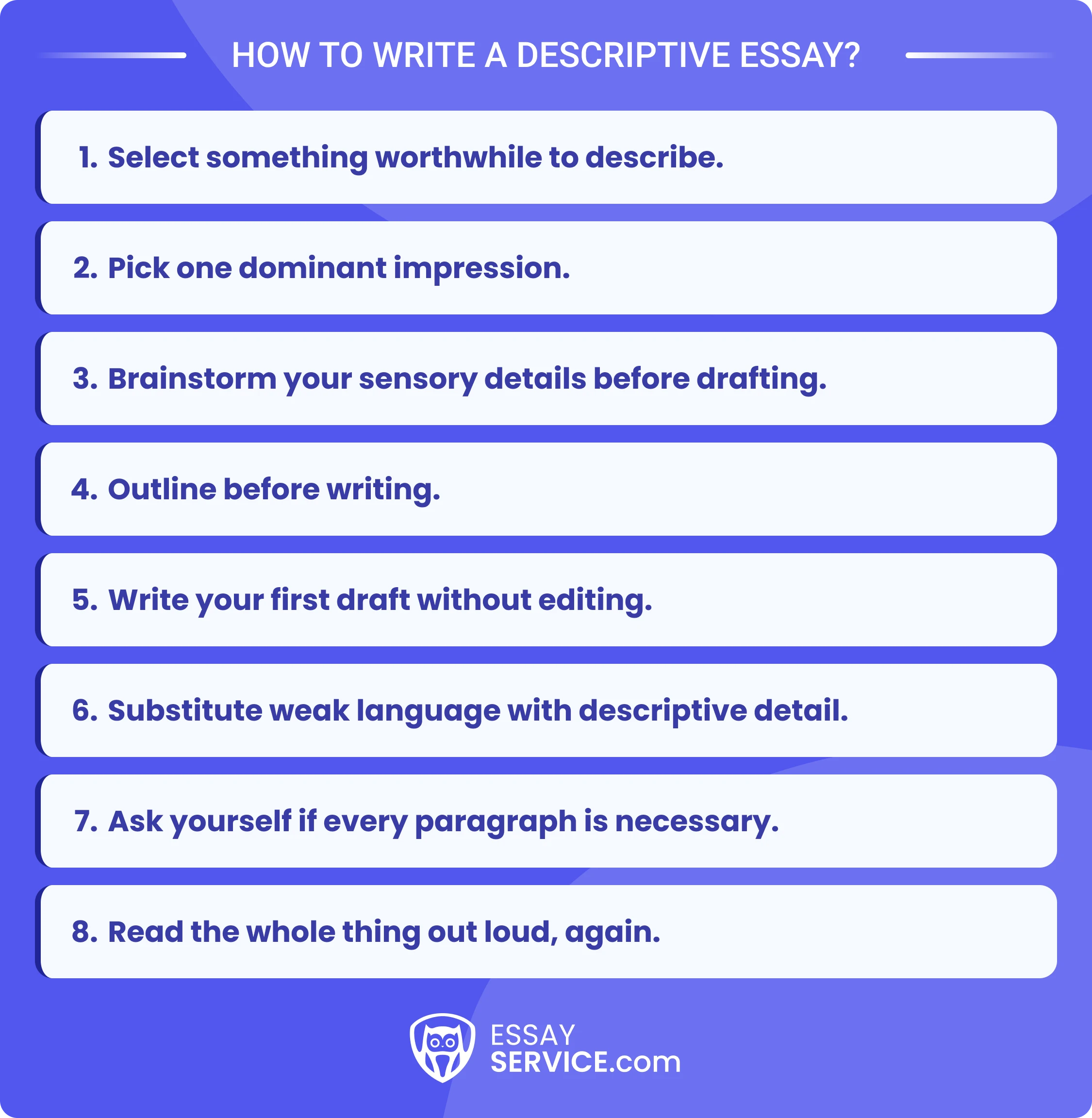
1. Select something worthwhile to describe.
Pick something narrow enough that you can really dive into it. Your childhood bedroom. Your favorite street corner. Someone you know well. It doesn’t have to be cinematic or extraordinary. It just needs enough detail to fill a page or two without feeling stretched thin.
Too general: “A city park.”
Specific enough: “The park bench I sat on while drinking coffee every morning before work for three years.”
2. Pick one dominant impression.
Before you start writing, ask yourself: What feeling or idea do you want your reader to come away with? This is your guiding light. Every detail you mention should point back toward that idea. When writers skip this step, descriptive essays turn into catalogs of interesting details that lead nowhere.
Example: If you’re describing your childhood kitchen, it may lead to feelings of warmth and safety. Maybe it points toward feelings of chaos. Or maybe your dominant impression is the unique tension between family members that you only felt around the table during Sunday dinner. Either way works. Just pick one and keep it in mind as you write.
3. Brainstorm your sensory details before drafting.
Strong descriptive essays tap into all five senses. But most writers only consider sight. Make notes on how your subject sounds. What it smells like. What it feels like (texture). What it tastes like. Whatever you include from this list, make sure you expand on those details in the final draft. Your brainstorm is where you’ll come up with ideas and when writing your draft, expand on those ideas.
Example: Street Market.
Sound: people talking over each other, footsteps bumping over cobblestones
Smell: sea air mixed with frying meat
Touch: sticky from spilled soda underfoot, scratches from a fishing-net purse
Sight: colored tents like plugs of gelato in an ice cream shop
4. Outline before writing.
Decide how you will move through the description. Some pieces move through physical space, starting at one part of a building, moving clockwise around until you’ve covered everything. Some move methodically through the senses, detailing all sounds before launching into smells. Others start with the subject’s present and take the reader on a journey through time. Choose whatever will create a clear, intentional picture in the reader’s mind. Stop and quickly outline with one line per paragraph before drafting.
Example:
Intro: the market as you run across the finish line to get there
Body paragraph 1: sounds and smells you experience when you get there
Body paragraph 2: run down physical details that make it special
Body paragraph 3: one food you eat or a vendor that sums it all up
Conclusion: what being there means to you, or what you realized about yourself.
5. Write your first draft without editing.
Don’t delete sentences as you go. Sure, go back and add any notes that come to mind. But if you start cutting as you write your first draft, you’ll never finish. Descriptive writing suffers most from premature editing because as soon as your fingers stop moving, your brain wants to go back and tighten up. Let yourself write bad sentences and weird patches of purple prose. You can fix it later.
6. Substitute weak language with descriptive detail.
Return to your draft and highlight any adjectives that don’t really do much work. Beautiful. Nice. Interesting. Strange. Your descriptions should allow your reader to draw their own feelings about the subject. Don’t simply tell your reader something felt lonely or was exciting. Show them details that make the reader feel that way.
Weak: “The room felt lonely.”
Descriptive: “One chair sat pushed slightly away from the table, like someone hurried out for work that morning and no one had bothered to scoot it back.”
7. Ask yourself if every paragraph is necessary.
Read through each body paragraph and ask yourself if it adds something new to the intended impression. Each paragraph should expand upon or alter the picture you’re painting for the reader. If you find two paragraphs that are essentially telling the reader the same thing, either combine them or cut one. Description becomes boring when you start adding more details just for the sake of length.
8. Read the whole thing out loud, again.
Trust us, you want to do this. Read your essay out loud from start to finish before you hand it in or click the “submit” button. Something about speaking words you’ve written automatically forces you to notice problems. Sentences that sound as though you were pulled up short and started again. Words you’ve spelled correctly but that aren’t actually saying what you wanted them to say. Transitional phrases that don’t sound like English when they’re read aloud. Reading out loud helps you catch them. If it sounds weird when you say it, fix it.
If you need help developing ideas or improving organization, a paper writing service can provide academic writing support.
Exhausted and Short on Time?
EssayService writers are ready to step in when you need reliable support.
Words That Sharpen Description
Readers remember action and imagery more easily than labels. That’s why a strong description comes from choosing better nouns and verbs. When a word carries meaning on its own, the sentence becomes clearer and shorter at the same time.
For example:
❌ Very bright light
✅ The lamp burned straight into my eyes
Here are common weak words that flatten description, along with stronger replacements that create sharper images:
Common Pitfalls in a Descriptive Essay
Below are the most frequent problems that weaken a descriptive essay and make the image less clear:
- Adjective overload: Too many modifiers blur the image. Replace clusters of modifiers with one specific detail or action.
- Metaphor abuse: Constant comparisons weaken impact. Keep figurative language only where it sharpens the picture.
- Wandering focus: The description shifts unpredictably within the scene. Follow one clear spatial order so the reader can orient themselves.
- Accidental storytelling: Events start replacing description. Stay in a single moment instead of narrating what happens next.
If you’re unsure what to write about, you can browse our list of descriptive essay topics.
Final Thoughts
Descriptive writing depends on observation, organized structure, and careful word choice. Notice carefully, choose details with intent, and keep every sentence serving the same impression. When the words feel natural and the scene stays steady, the description stops being a task and becomes memorable to the reader.
Frequently Asked Questions
What Is the Purpose of a Descriptive Essay?
What Can You Focus on in a Descriptive Essay?
How Long Should a Descriptive Essay Be?
How Can I Show Instead of Tell Without Piling on Adjectives?
Must Every Paragraph Include All Five Senses?

Jennifer is a student currently pursuing a Journalism major. She oversees the EssayService blog team and uses her journalism skills to ensure all blog posts are accurate, trustworthy, and engaging.
- Austin Peay State University Writing Center. (2024). Descriptive essay. Retrieved from https://www.apsu.edu/writingcenter/writing-resources/Descriptive-Essay-2024.pdf
- University of Michigan, Sweetland Center for Writing. (n.d.). How can I write more descriptively? https://lsa.umich.edu/sweetland/undergraduates/writing-guides/how-can-i-write-more-descriptively.html
- Indiana University of Pennsylvania Writing Center. (n.d.). Descriptive writing: Organization and structure. https://www.iup.edu/writingcenter/writing-resources/organization-and-structure/descriptive-writing.html



New posts to your inbox
Your submission has been received!