
To write an explanatory essay, choose a focused question, gather facts, build an outline, draft the sections, and then revise for clarity. The purpose of an explanatory essay is, as the name suggests, to inform and report what is true about a subject/process.
Writing an explanatory essay can become far easier once you have a clear method. This guide covers the five steps we mentioned above in order, the standard format of the paper, along with practical tips for writing good explanatory essays.
What Is an Explanatory Essay?
An explanatory essay is a short informative paper that presents facts, examples, and explanations in a neutral tone. Expository writing is one of four common essay modes, alongside description, narration, and argumentation. The main purpose of an explanatory essay is to answer a how or why question with evidence.
3 types of essays, argumentative, descriptive, and explanatory, get confused. The simple distinction is:
- Argumentative essays defend a position with evidence
- Descriptive essays paint a scene with sensory detail
- Explanatory essays report established facts/clarify a process
Many writing guides treat these as interchangeable terms for the same task. A teacher might assign any of the three and expect identical work. One habit matters most when writing explanatory essays: stay objective and let the facts do the talking. Opinion words and emotional appeals belong in a different assignment.


Stuck on Your Explanatory Essay?
Get expert help with structure, research, and clear academic writing.
What is the Explanatory Essay Format?
The usual five-paragraph explanatory essay uses an intro, three body paragraphs, and 1 conclusion. That same consistent explanatory essay structure can be stretched and adapted for longer assignments by increasing the number of body paragraphs.
Introduction
The introduction is the opening paragraph that frames the topic and states the thesis.
A hook is a surprising fact/short question. It is followed by 2-3 sentences of background information for the reader to obtain context. The third part, the thesis statement, closes the section by naming the exact question the essay sets out to answer. The thesis has its own writing rules, namely, it should be narrowed down to the assignment as much as possible, so each later paragraph can be kept on track.
The introduction should be roughly a 10% of the total essay length. For a 1,000-word essay, that’s about 100 words. So, you don’t have a lot of words to waste. State the topic, explain why it matters, and hand the reader a clear thesis to follow.
Body Paragraphs
Body paragraphs are the middle sections that present evidence and explain the topic. 5-paragraph essays have 3 of those, though longer papers add more. No matter the amount, each one follows the same four-part pattern:
- Open with a topic sentence that states the paragraph's one point. "Photosynthesis depends on three inputs."
- Evidence backs that point, be it a statistic, a peer-reviewed study, a primary document, or a worked example.
- Directly after, explain how the evidence answers the section question in 2-3 sentences of your own analysis.
- With a short transition, hand the reader the next idea and tie this point to the one ahead.
One point per paragraph is the general rule, with 100-200 words each, because a paragraph that juggles three ideas can’t discuss any one properly. Order the paragraphs by logic, such as time order for a process.
An explanatory essay reports what is known, so unsupported claims have no place in it. Each piece of evidence needs a source that the reader can check and confirm on their own.
Conclusion
The conclusion is the final paragraph that restates the thesis and adds no new facts. It pulls the main points together into one clear takeaway. Then it leaves the reader with a final thought that answers the essay's central question in full. Like the introduction, the conclusion is also about 10% of the entire word count. A 1,000-word essay ends in about 100 words. Follow the sequence:
- Restate the thesis in fresh phrasing, never a copy-paste of the introduction.
- Briefly, pull the two or three biggest points from the body into one line.
- Significance closes the essay by spelling out why the explanation matters to the reader.
Conclusion is no place for new evidence or any new claims. Each fact you feel the need to present should go in the body paragraphs. The final sentence should answer the central question one last time.
How to Write an Explanatory Essay in 5 Steps
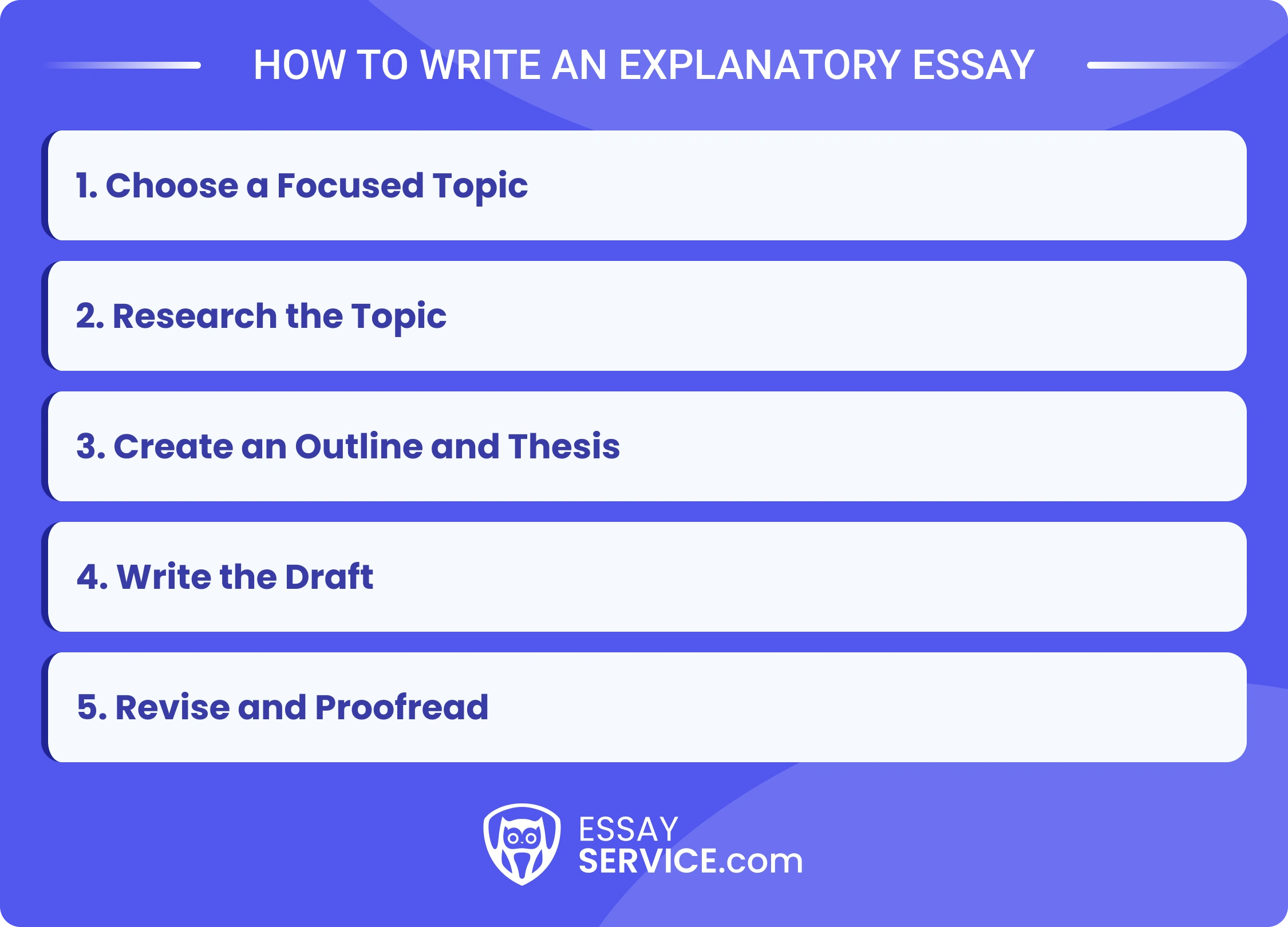
To write an explanatory essay you need five stages: pick a focused topic, research it, outline the structure with a thesis, write the draft, then revise and proofread. These five essential explanatory essay steps turn a blank page into a finished paper. Budget an hour or two per step for a 1,000-word assignment.
1. Choose a Focused Topic
A focused topic answers one question a reader could ask in a single sentence. Take “climate change,” for example, a subject that can easily fill up a library. Where does 1,000 words even start? Now, look here:
"Climate change" → "How carbon dioxide traps heat in the atmosphere"
There’s one mechanism to explain, a clear answer to build toward, and maybe four solid sources to pull from. The fix was in narrowing the scope.
Use our paper topic generator to come up with an idea and run it through the same test before committing. Ask whether 3 body paragraphs can actually explain it. If the honest answer is no, keep trimming until it turns into a yes.
2. Research the Topic
Research is gathering facts from sources a reader would trust. Start with the assignment's required reading, then widen the net:
- Library databases for scholarly articles
- Government sites for official data and statistics
- Peer-reviewed journals for verified findings
Explanatory essays involve less research than argumentative papers, so four or five strong sources usually cover a 1,000-word piece. Collect more evidence than the essay will use. A ratio of three sources found for every one cited leaves room to drop weak material. Save every citation the moment you find it, and record four details for each one:
- Author
- Title
- Date
- URL or page number
Note the exact page or timestamp beside each fact, since a reader may want to check it later.
3. Create an Outline and Thesis
An outline maps the explanatory essay structure. List the thesis at the top, then one line for each body paragraph. Every line should include two things:
- The paragraph's single main point
- The strongest piece of evidence for it
Building the skeleton will help you expose any gaps in logic early on. In a 3-point outline, a body paragraph with no evidence will immediately stand out. Write the thesis as one sentence that names the question and previews the answer.
"This essay explains how vaccines train the immune system in three stages," tells the reader exactly what follows.
4. Write the Draft
The draft begins with the body when writing your explanatory essay, because the middle paragraphs hold the facts. Draft the sections in this order:
- Body paragraphs, while the research is fresh in memory
- Conclusion, once the evidence is on the page
- Introduction last, since the working thesis often shifts as the body takes form
Follow the outline paragraph by paragraph, and resist the urge to polish each sentence as it lands. A first draft exists to get ideas onto the page. Don't waste time correcting commas in sentences that will most likely end up cut later. Aim for a complete rough version in one session, gaps and all.
5. Revise and Proofread
Revision and proofreading are two separate passes. Revise first for the big picture. Three checks matter most at this stage:
- Confirm each paragraph answers its own question
- Check the explanatory essay format holds across introduction, body, and conclusion
- Verify the evidence supports the thesis
Proofread second for surface errors in spelling, grammar, and punctuation. Read the draft aloud, one of the most effective ways to catch clumsy sentences. Handle one type of error per pass, since one sweep seldom catches everything. Wait a day between finishing and revising, so the text reads with fresh eyes. Distance turns invisible mistakes visible.
You can also pay for essay online if all of these steps and techniques are too time-consuming for you.
Explanatory Essay Example
An example of explanatory essay writing shows every part working together on the page. The sample below explains how caffeine keeps a person awake, a process most people feel every morning without knowing the mechanism behind it. Each element is labeled in brackets, so the structure stays visible as you read.
Topic: Why Caffeine Keeps People Awake
[Hook] Around 80% of adults in the United States consume caffeine every day, and worldwide it is the most widely used psychoactive substance. [Background] Caffeine was first isolated in 1819 by the German chemist Friedlieb Ferdinand Runge, who extracted it from coffee beans. It occurs naturally in more than 60 plants, such as coffee, tea, and cacao. A standard 8-ounce cup of brewed coffee delivers about 95 milligrams. The drug reaches the bloodstream within 45 minutes and travels to the brain, where its real work happens. [Thesis] Caffeine keeps a person awake in three steps: adenosine builds up and causes drowsiness, caffeine blocks the receptors that adenosine uses, and alertness holds until the body clears the dose.
[Topic sentence] The first step happens without any caffeine at all, as a molecule called adenosine builds up during waking hours. [Supporting detail] Every hour a person is awake, brain cells produce adenosine as a byproduct of energy use. The molecule binds to receptors called A1 and A2A, and each binding sends a signal that slows nerve activity. More adenosine means more of these signals, and the result is the heavy, drowsy feeling that grows across a long day. By bedtime, adenosine levels peak. [Transition] This is the exact system that caffeine interrupts.
[Topic sentence] The second step is the block, where caffeine takes adenosine's place. [Supporting detail] Caffeine has a molecular structure close enough to adenosine that it fits the same A1 and A2A receptors. It slots into them and stays put without triggering the slow-down signal. The fit is imperfect, so caffeine cannot copy adenosine's calming effect. It simply holds the spot. [Supporting detail] With the receptors occupied, adenosine has nowhere to dock, so its drowsiness signal never fires. The brain's own stimulants, dopamine and glutamate, then operate without the usual brake. Alertness climbs, focus sharpens, and reaction time improves. [Transition] The effect lasts only as long as the caffeine stays in the system.
[Topic sentence] The third step is the fade, as the body breaks caffeine down. [Supporting detail] The liver metabolizes caffeine at a steady rate, and its half-life in a healthy adult is about 5 hours. A 200-milligram dose at 9 a.m. leaves roughly 100 milligrams in the blood by 2 p.m. As the level drops, adenosine returns to its receptors and drowsiness creeps back. Genetics and pregnancy can stretch that half-life to 8 hours or more, so one cup can last a person all night. [Supporting detail] Regular users build extra adenosine receptors over weeks, so the same dose does less. That change is caffeine tolerance.
[Conclusion] Caffeine keeps a person awake through a simple swap. It stands in for adenosine, holds the receptors shut, and delays the drowsiness signal until the liver clears the dose. The mechanism runs in three predictable stages, and the timing of each one is why a late-afternoon coffee can still disrupt sleep at midnight. The U.S. Food and Drug Administration puts 400 milligrams a day, about four to five cups, as the safe ceiling for most adults. The chemistry is simple. The receptors do not know the difference between the molecule the body makes and the one in the mug.
Why this example works: The features of an explanatory essay in this sample all pull toward one goal, for the reader to understand the mechanism of caffeine by the end. The three-step thesis sets expectations, so nothing feels out of order. One idea per paragraph keeps each stage separate and easy to hold. Transitions hand the reader from cause to effect. Concrete numbers make every claim checkable, which is what earns trust in an explanation.
Order an essay from our professionals if you’d rather have a licensed writer handle the structure.
Turn Your Ideas Into a Clear Explanatory Essay
Get help organizing your points, evidence, and explanations into a strong draft.
Tips for Writing a Strong Explanatory Essay
Strong explanatory essays share a few habits that go past structure alone. The backbone of a good explanatory essay is clarity, which lets a reader with no background follow every point. The tips below cover craft details that a formatting guide skips, and each takes under five minutes to apply.
- Write for a stranger. Define every technical term the first time it shows up. A reader from outside the subject cannot follow jargon they have never met.
- Ruthlessly cut filler. Delete redundant words, drop empty qualifiers like "very" and "really," and trim long prepositional chains.
- Transition words matter. "The second cause" or "as a result" shows the reader the logic moving from one point to the next.
- After the rough draft, reverse-outline it: write one sentence that sums up each paragraph, then read that list on its own. Weak or repeated points show up fast.
- Real numbers anchor a claim. Whenever a source gives an exact figure, put it in the sentence. "2.5 million users" gives the reader something specific to hold.
- Cite as you go. Log each source the moment you use it. A borrowed fact with no attribution is accidental plagiarism.
- Neutral tone is the goal. Strip opinion words like "amazing" or "terrible." An explanatory essay reports, so the facts need no adjectives that pick a side.
- Against the rubric, check every requirement before submitting. One missed instruction costs easy marks.
- Hand the essay to a friend and ask them to explain the topic back. Any gap in their retelling marks a gap in the writing.
- The read-aloud test. Read the whole essay out loud at a normal speaking pace. Any sentence that trips your tongue will trip the reader too.
A short “Write my essay for me” message is all it stands between you and a coherent paper written by a professional.
Final Thoughts
An explanatory essay works when it explains a topic clearly and backs every claim with evidence. The five steps run in order: choose a focused topic, research it, outline with a thesis, draft the body first, then revise and proofread in separate passes. Clarity and neutrality hold the whole essay together.
Frequently Asked Questions
How to Start an Explanatory Essay?
How Many Paragraphs in an Explanatory Essay?
How to Write a Conclusion for an Explanatory Essay?

Phil spends his working days teaching international trade. He contributes to our blog as a freelancer, leveraging his experience with MBA students to advise on academic writing, studying abroad, and securing funds.



New posts to your inbox
Your submission has been received!