
I recall clearly the first time I was given an assignment in college. I sat in front of a blank page for an hour, wondering where to begin. After much trial and error, I discovered that an assignment is nothing more than a formalized writing project in which you conduct research on a given topic, organize your thoughts, and write convincing arguments to accomplish an objective.
Writing assignments involves five steps: reading the prompt, conducting research, outlining, writing, and editing/revising. Understanding these steps will clarify the process.
Today, I’ll explain each step of how to write an assignment. I’ll point out some of the mistakes that I learned from firsthand experience, and provide helpful tips that’ll make your assignment writing journey as painless as possible.
What Is an Assignment?
An assignment is a particular academic task that your teacher assigns to assess your knowledge about a topic and develop certain skills. It can be an essay, a research paper, a case study, a problem set or even a presentation. The difference between everyday writing and an assignment is that your teacher will provide you with certain instructions: word count, citation style and due date. And of course, it will be graded using a rubric. An assignment is a formal way for you to demonstrate what you know and practice problem-solving independently.


Need Help With a Tough Assignment
Get expert support with research, writing, editing, and formatting for any subject.
How Assignments are Used?
Assignments pop up in all areas of academia. You’re assigned homework in high school, college, and grad school. You complete them in every major class you take, from English to chemistry. Teachers may give them weekly to reinforce what you’re learning, midway through the semester to evaluate your progress, or at the end of the course to incorporate everything you’ve learned.
Paragraph assignments are even featured outside of class time. During summer school, online classes, or even when studying for industry-specific certificates, you will need to complete assignments. Any time a teacher needs an easy way to test your knowledge and ability to use what you learn, they will create an assignment for you to take.
Students managing multiple deadlines can request ‘do my assignment’ support to stay on track with their coursework.
Subject and Length of Assignments
Assignments span all academic disciplines: math worksheets, history journals, chemistry lab assignments, literature essays and business cases.
Length varies widely across disciplines and academic levels. You may have 1-2 page assignments for a high school course, but a graduate-level assignment may be 15-20+ pages. Some classes rely on small, frequent assignments, such as weekly reaction papers for a sociology course. Other classes focus on a single large assignment per quarter/semester, such as a semester-long engineering design document. There is no universal norm here, so refer to your course syllabus or ask your professor.
Assignments vs. Essays and Research Papers: What Sets Them Apart
Firstly, an essay is one kind of assignment. Specifically, it's an academic piece that advances a single argument or perspective. A research paper is another kind of assignment that requires significantly more intensive research into other sources and data. "Assignment" itself is the general term. Essays and research papers fall under that category. So do problem sets, lab reports, presentations, and reflection journals. Essentially, the difference is intent and scale: an essay argues a point, research papers are meant to explore a question with significant depth, and assignments can be either or anything else the teacher needs you to do.
Assignment Structure
Every paper assignment I’ve ever completed has pretty much the same basic structure underneath, regardless of the topic at hand. Once you understand the framework that pretty much all essays fit into, outlining and beginning your work is less daunting. Below is a handy road map for writing an assignment:
- Introduction: Introduce your topic. Provide some background information if necessary. Finish your intro with a thesis statement or purpose statement.
- Body Paragraphs: Devote a paragraph to each of your main points. Each main point should be supported by evidence, examples, or data from outside sources.
- Analysis: Provide an explanation as to why your supporting information is valid and how it connects to your thesis.
- Conclusion: Restate your thesis in a new way. Do not introduce any new information in your conclusion. Briefly summarize the main points.
- References: Include a reference list with each source you used correctly formatted in whatever style your professor wants (APA, MLA, Chicago, etc)
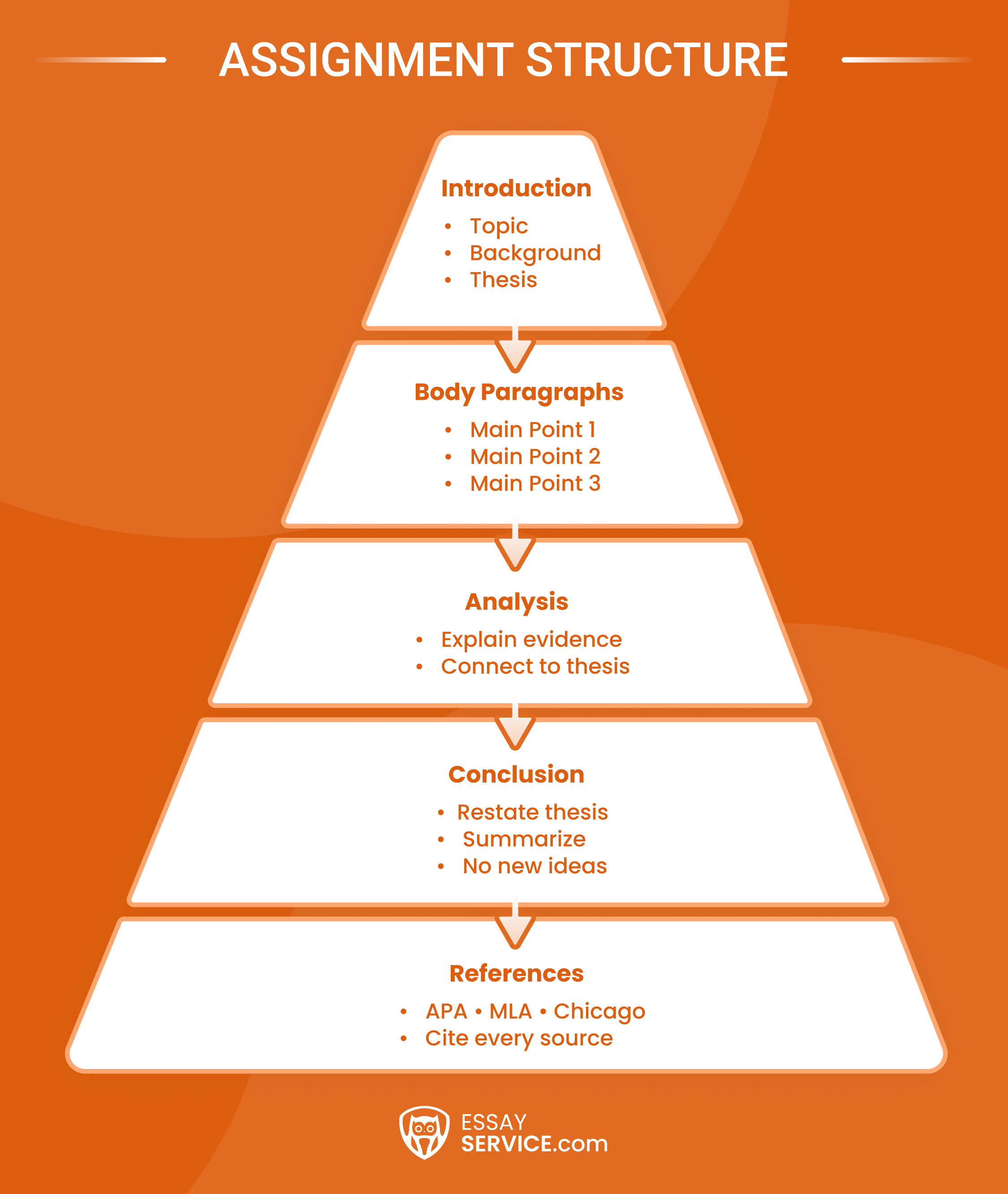
Keep in mind that this format will flex based on the type of assignment you’re working on. But from research papers to narrative essays, the formula of introduction, support, analysis and conclusion applies to nearly everything.
College Assignment Format
Most academic writing follows the same standard formatting guidelines. Here’s a complete set of instructions that apply to nearly any assignment:
How to Write an Assignment?
Every essay has become easier to write for me ever since I learned to break down assignments into steps instead of viewing them as one large monolithic thing to fear. When students ask me for advice on where or how to start an assignment, I walk them through the process I use, from reading the prompt to hitting submit. Here it is.
- Read the grading rubric. The rubric is usually provided with the assignment prompt and explains how the instructor will grade your paper. Read it so you know what they’ll be looking for (e.g., thorough analysis, properly formatted citations, strong intro/body/ conclusion) and so that you won’t be wasting time wondering how you’ll earn partial credit for something.
- Read the prompt. Read the directions two or three times. Circle the verbs. Verbs like “analyze,” “compare,” and “evaluate” require different types of answers, so it’s important to know what you’ll be expected to do with the topic you choose.
- Pick or refine your topic. If you’re allowed to choose your own topic, make sure it’s not too broad to explain thoroughly in the required number of words. It’s more difficult writing assignments about “Climate Change” than it is to talk about how cities are preparing for rising sea levels. Additionally, choose your topic early so that you have plenty of time to find sources.
- Research. Use scholarly articles, books, and credible websites to research your topic. Take notes as you go and record your sources so you don’t panic when it comes time to cite them.
- Outline. Write out your intro, body, and conclusion. Outlining prevents you from getting stuck midway through writing the essay and helps to ensure that your argument proceeds in a linear fashion.
- Write the essay. Don’t agonize over word choice and phrasing. Tell my students to just write, and that applies to anybody. You can polish things up later, but you can’t edit a blank page.
- Revise. Read your essay and ask yourself if your argument makes sense from beginning to end. Delete parts of your essay that don’t help you make your point and rewrite wordy sentences.
- Edit. Double-check spelling, grammar, and your citation style. Grammars aren’t your friends. Small mistakes like these can really bog you down in the eyes of a grader.
- Turn it in early. If at all possible, complete your assignment the day before it’s due. You’ll thank yourself later if your computer crashes or your essay doesn’t format properly when you’re uploading it to Turnitin or Blackboard.
Our professional assignment writing service can help you with research, structure, formatting, and editing across a wide range of subjects.
Finding and Using Sources the Right Way
Research can save time or consume it. Here’s how I approach it.
- Begin at academic databases: Your library’s database, Google Scholar, or JSTOR are better places to start than a basic search engine. You’ll be provided with scholarly sources as opposed to a blog’s opinion on it.
- Evaluate your source: Check the author’s credentials, date of publication, and if the source is peer-reviewed. If you’re unsure who wrote it or when it was written, toss it.
- Take Notes: Write down the main idea of each source along with the page number or paragraph. You’ll thank yourself later when you don’t have to skim through pages of notes to find it.
- Create a running bibliography: Make sure you keep a growing list of sources that you use with full citation info. Waiting till the end to do them all at once is where most students mess up.
- Don’t overuse a single source: Pull ideas from multiple sources so your paper shows more than one author’s perspective on a topic.
- Paraphrase: It’s tempting to cut and paste straight from an article when you're writing a long paper. But try to paraphrase ideas into your own notes. This will help prevent accidental plagiarism and make you actually read what you’re reading.
- Cite while you write: Insert in-text citations as you write your draft so you’re not left scrambling at the end to find things to cite.
Finalizing and Submitting Your Assignment
Your hard work pays off by this point. Now you just have to make sure it shows.
- Take a break before you review: Walk away for a few hours, or better yet, overnight. You’ll catch errors way more easily.
- Read it out loud: Another great way to spot awkward sentences and run-ons that your eyes will skip over.
- Review the rubric: Revisit the grading guidelines again, and ensure you've included everything.
- Double-check formatting/citations: Margins, font, spacing, and citations should all be checked one last time to ensure they’re how your teacher specified.
- Check for plagiarism: Run your paper through Turnitin/Grammarly if you have access to it, just to be safe.
- Save and upload in the specified format: Make sure you’re saving as the correct file type, and submit with time to cool off.
Finish Your Assignment With Confidence
Work with professional writers to submit a clear, original, and well-structured paper on time
10 Expert Tips for Assignment Writing
Here are some tips on how to write an assignment analytically that I've developed over the years. These are things I tell every student who walks into my office seeking help to improve their paper.
- Question your sources. Don't accept something as true just because it's published. Ask: Who wrote this? Why? What evidence supports it?
- Find two sources that disagree. Explain to your reader why they disagree.
- After every sentence, ask "So what?" If the fact doesn't relate to your argument, either explain how it does or remove it.
- Analyze, don't summarize. You don't have to tell me what something says; you have to tell me what it means and why it matters.
- Find assumptions in every argument, including your own. Test whether they're valid.
- Support your voice with evidence. Use quotes and stats to reinforce what you say, not to replace your argument.
- Connect your sources. Compare and contrast how the researchers' work agrees or disagrees.
- Address your counterargument. Identify the best argument against your view and answer it.
- Revise your thesis as you research. If you discover something new, let your argument reflect it.
- Question yourself before submitting. Ask if you truly believe your argument. Did you prove your point or just repeat yourself?
If you're writing a research-based assignment, understanding random assignment vs random sampling is essential for explaining your study design accurately.
Final Advice
Assignment writing can be manageable when you see it as a process: read the prompt carefully, research your topic, create an outline, write a draft, and edit. Have faith in the process, allow yourself ample time, and remember that every great writer was once a beginner.
Frequently Asked Questions
How Do You Start Writing an Assignment?
How to Make Assignment?
How to Format an Assignment?

Anna has been helping students become more productive learners for 20+ years now. Her experience, combined with a Master’s degree in psychology, ensures her blog posts contain only valuable insights.
- “How to Write the Perfect Assignment from Oxford Learning College.” Oxford Learning College, 9 Mar. 2022, https://www.oxfordcollege.ac/news/write-perfect-assignment/
- “Steps for Writing Assignments.” My.UQ, 8 Sept. 2021, https://my.uq.edu.au/information-and-services/student-support/study-skills-and-learning-advice/study-skills-and-learning-advice-overview/assignment-writing/steps-writing-assignments
- “Subject Guides: Academic Writing: A Practical Guide: The Writing Process.” The Writing Process - Academic Writing: A Practical Guide - Subject Guides at University of York, https://subjectguides.york.ac.uk/academic-writing/process

New posts to your inbox
Your submission has been received!