
Key takeaways
- To remove one animation in PowerPoint, select the object, open the Animations tab, and choose None, or right-click the effect in the Animation Pane and select Remove.
- To clear a whole slide, click an object, press Ctrl+A (Command+A on Mac), then choose None, and repeat on each slide.
- Remove transitions on the Transitions tab with None, then Apply to All for the full deck.
- Hide effects without deleting them via Slide Show > Set Up Slide Show > Show without animation.
To remove animations from PowerPoint, select an animated object, open the Animations tab, and choose None in the animation gallery. To delete a specific effect from an object with several animations, open the Animation Pane, select the effect, and remove it.
The walkthrough below covers the animation controls used by our powerpoint presentation writing service team, including how to clear a slide, turn off animations for a slide show, and remove slide transitions.
How to remove animations from PowerPoint in 5 simple steps
These five steps explain how to remove an individual animation in PowerPoint for Windows. Instructions for Mac and PowerPoint for the web appear alongside the relevant controls below.
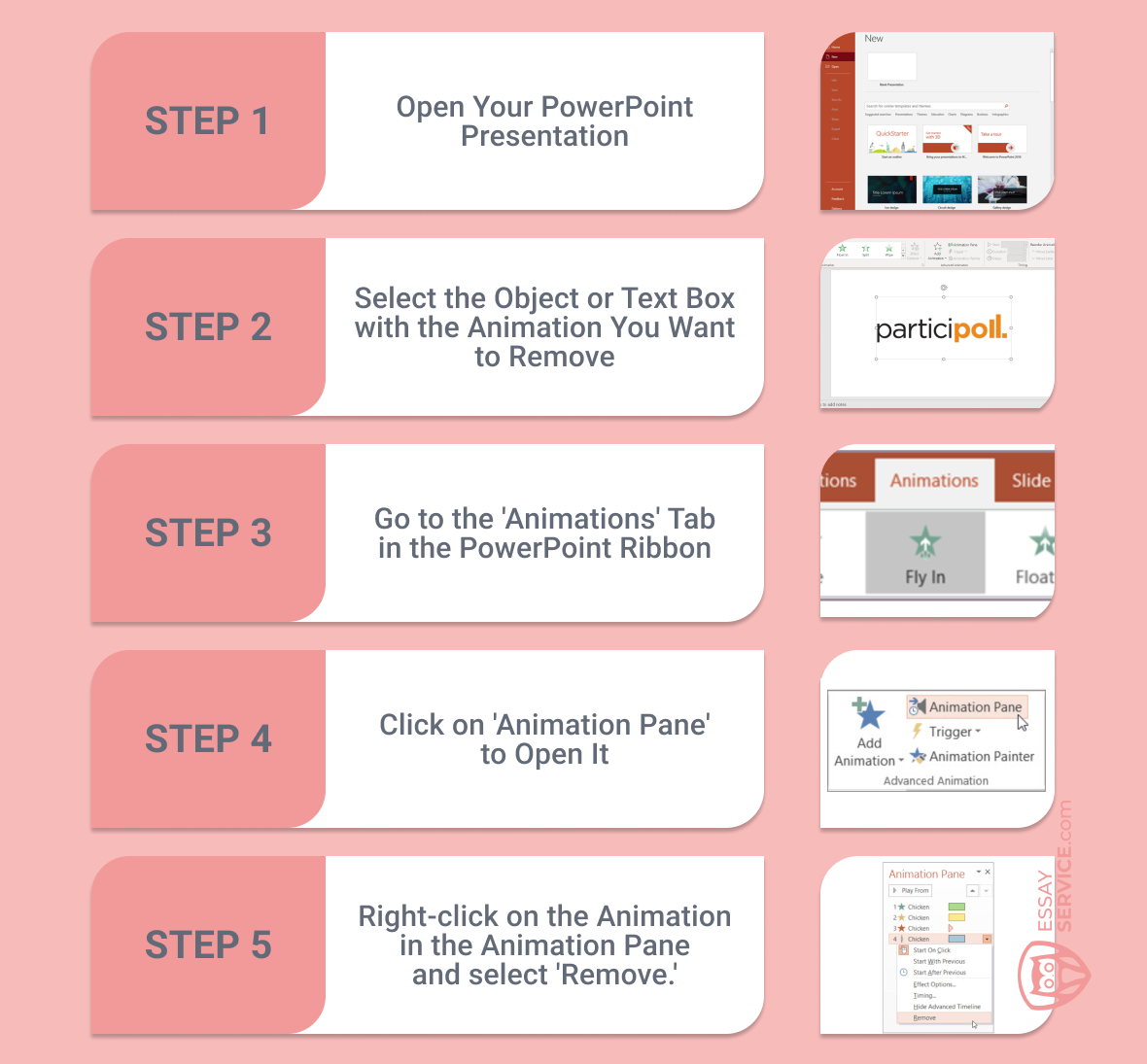
- Open your PowerPoint presentation.
- Select the object or text box with the animation you want to remove.
- Open the Animations tab.
- Select Animation Pane.
- Right-click the animation effect in the pane and select Remove.
1. Open your PowerPoint presentation
Open your presentation in PowerPoint and select the slide you want to edit from the thumbnail pane on the left.
First, identify which type of movement you want to remove:
- Object animations affect text, pictures, shapes, charts, and other elements within a slide. Manage these on the Animations tab.
- Slide transitions control how one slide changes to the next. Manage these on the Transitions tab.
If you want to preserve the animated version, save a separate copy before you begin. In PowerPoint for the web, changes save automatically, so create your copy before editing.
2. Select the object or text box with the animation you want to remove
Click the animated object on the slide. For a text box, click its border so the entire box is selected.
To remove every animation from that object, open Animations and choose None in the animation gallery. Expand the gallery if None is hidden.
You can also remove animations from multiple objects on the current slide:
- Click an object on the slide to place the selection focus in the slide area.
- Press Ctrl+A on Windows or Command+A on Mac to select all objects on that slide.
- Open Animations and choose None.
If you are editing text, press Esc to leave text-editing mode before selecting all objects.
Repeat this process on each slide to permanently remove object animations throughout the presentation. Selecting every slide thumbnail does not select every animated object in the file.
3. Open the Animations tab
Select Animations in the ribbon at the top of PowerPoint. This tab contains the animation gallery and controls for managing effects.
In PowerPoint for the web, select the animated object, open Animations, and choose None to clear its animations. Repeat for other objects or slides as needed.
To remove slide transitions, use the separate Transitions tab:
- Select a slide.
- Open Transitions.
- Choose None.
- Select Apply to All to remove transitions throughout the presentation.
For a single slide, choose None and leave Apply to All untouched. A transition belongs to the slide that appears after the transition, so select the incoming slide when removing a particular effect.
4. Select Animation Pane to open it
In PowerPoint for Windows, select Animations > Animation Pane. The pane opens beside the slide and lists its animation effects in playback order.
PowerPoint for Mac also provides an Animation Pane on the Animations tab. Select an effect in that pane to manage it.
An object can have several effects, such as an entrance, emphasis, and exit animation. Review the entries before deleting one. Numbered markers on the slide help you match effects to their objects, and clicking an entry identifies the associated object.
To turn off animations for an entire slide show in PowerPoint for Windows, use the slide show settings:
- Open the Slide Show tab.
- Select Set Up Slide Show.
- Under Show options, select Show without animation.
- Select OK.
This setting preserves the animation effects in the file and suppresses them during the slide show. Clear the checkbox when you want them to play again. Use Transitions > None > Apply to All as well if you want to remove slide transitions.
5. Remove the selected animation and check the result
In the Windows Animation Pane, right-click the effect you want to delete and select Remove. You can also select an effect in the pane and press Delete.
On Mac, select the effect in the Animation Pane and press Delete. Keep the pane entry selected when using the keyboard so you remove the animation effect.
After removing an effect:
- Check the remaining sequence. Removing an entrance or exit effect changes when an object becomes visible or disappears.
- Preview the slide. Use Preview on the Animations tab to review the effects that remain.
- Run the slide show. Check the presentation from the beginning to confirm that object animations and slide transitions behave as intended.
- Save your changes. If you removed an effect accidentally, use Ctrl+Z on Windows or Command+Z on Mac to undo it.
For a fully static presentation, finish by checking every slide for object animations and applying None to all slide transitions.


Your Deadlines, Finally Covered
Skilled academic writers tackle your toughest assignments so you can take a deserved break.
Final thoughts
Removing animations in PowerPoint comes down to a few controls: choose None on the Animations tab or delete effects in the Animation Pane, clear transitions on the Transitions tab, and use Show without animation to suppress effects temporarily. Check each slide, preview, and run the show to confirm a clean result.
Frequently Asked Questions

Eugene has spent the past 15+ years editing and proofreading articles for academic journals, newspapers, and magazines. His attention to detail and experience power actionable advice on citations, tone of voice, and more.



New posts to your inbox
Your submission has been received!