
To write a nursing research paper, read the assignment instructions, choose a topic, write a thesis, gather evidence, build an outline, draft the introduction, the body paragraphs, write the conclusion, add citations in the required style, and proofread. Each step feeds the next.
This guide covers the structure of a nursing research paper, how to write each section, how to outline before drafting, and the common mistakes that pull grades down.
What is a nursing research paper?
A nursing research paper is an academic document that examines a clinical or healthcare question using published evidence. It follows a formal structure, cites peer-reviewed sources, and backs every claim with data from nursing and medical literature.
Common topics fall within practice: patient outcomes, treatment protocols, safety standards, and care models. Nursing programs assign these papers to build the skills the job demands. Students learn to read studies, judge the quality of evidence, and apply findings to patient care. The assignment also trains APA citation and academic writing, both of which return in capstones and theses.
Check out a list of colleges with good nursing programs if you’re still on the fence about where to continue your studies.


Stuck on your nursing paper?
Get a focused, well-sourced paper from a nursing writer.
Thesis-driven vs. study-based nursing research papers
Nursing research papers split into thesis-driven, arguing a position and defending it with existing literature, and study-based, which reports original research the writer conducted and follows the IMRaD format. The table below breaks down how they differ.
Format for nursing research paper
The nursing research paper format rests on the citation style and the overall structure. Most programs require APA 7th edition. Study-based papers then follow the IMRaD format, with Introduction, methods, results, and discussion. Thesis-driven papers follow a plainer introduction, body, and conclusion order. Both types include a title page and a reference list.
Structure of a study-based (IMRaD) paper
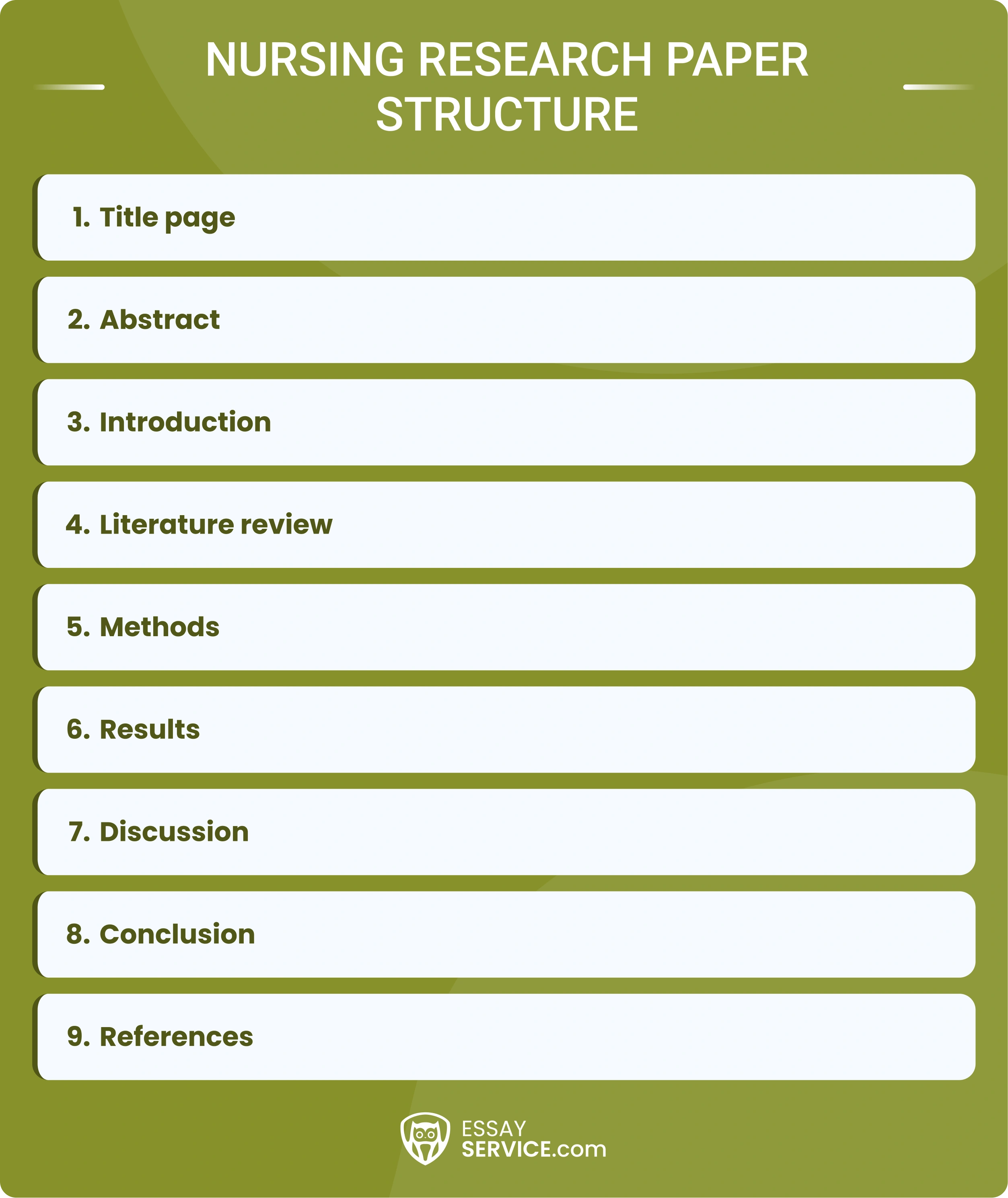
The nursing research paper structure for a study-based paper follows nine parts in a fixed order:
- Title page: Lists the title, author name, course, instructor, and date on a dedicated first page.
- Abstract: Summarizes the full paper in between 150 and 250 words, including the question and main finding.
- Introduction: States the clinical problem, relevant background, and the research question.
- Literature review: Surveys existing studies and identifies the gap the paper addresses.
- Methods: Describes the study design, sample, setting, and data collection steps.
- Results: Reports the findings in plain terms, often with tables or figures.
- Discussion: Interprets what the results mean and connects them to earlier research.
- Conclusion: Restates the key findings and recommends next steps for practice.
- References: Lists every cited source in APA 7 style on a separate page.
Structure of a thesis-driven paper
A thesis-driven paper uses a shorter structure that centers on a single argument. It runs five or six parts, and the abstract appears only when the rubric calls for one.
- Title page: The standard, with title, author, and course details.
- Abstract: Only when the assignment requires it.
- Introduction: Background information first, the thesis or PICOT question next.
- Body sections: Fall under headings that match the grading rubric.
- Conclusion: Summary of the argument and its meaning for patient care.
- References: Lists every source in APA 7 format.
APA 7 formatting rules for nursing papers
The APA format for a nursing paper sets rules for layout, type, and headings. Most student work follows the student-paper variant. These are the core rules:
- Title page: The student version lists the title, author, course, instructor, and date; the professional version adds an author note.
- Font: 12-point Times New Roman, or an APA-approved alternative such as Calibri 11-point, 11-point Arial, or Georgia 11-point.
- Spacing: Double-space the entire paper, including the reference list.
- Margins: 1 inch on all four sides.
- Page numbers: Top-right corner of every page.
- Headings: Levels 1-3 to organize most nursing papers.
- Running head: Required on professional papers only.
The structure of a research paper completely differs from that of a care plan. Check out nursing care plans examples so you can adapt the format to your own writing.
How to write a nursing research paper in 9 steps
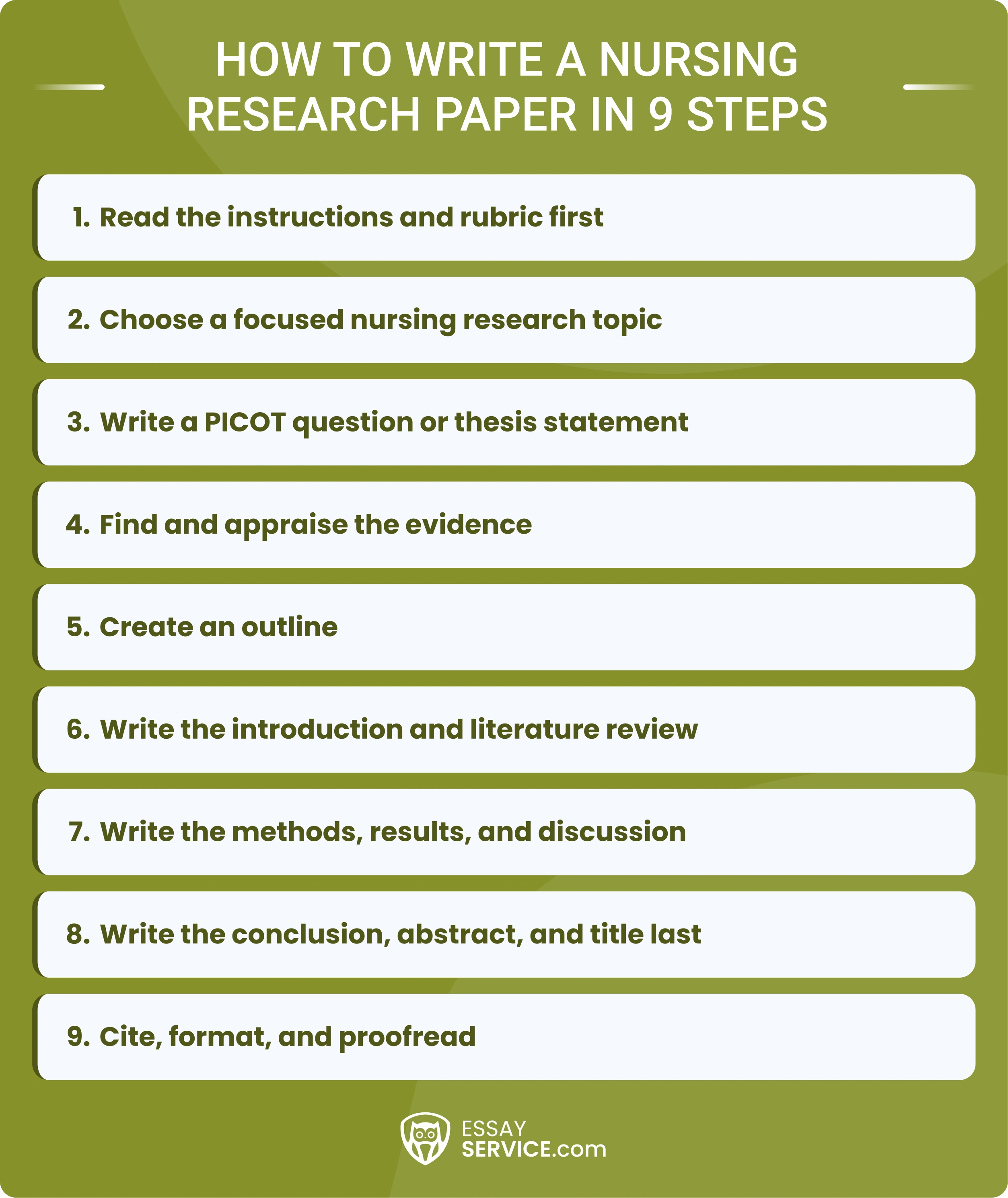
Writing a nursing research paper takes nine steps to complete:
- Read the rubric
- Choose a focused topic
- Build a PICOT question/thesis
- Appraise the evidence
- Outline
- Draft the introduction and literature review
- Write the methods through discussion
- Finish the conclusion and abstract
- Cite and proofread
Step 1: Read the instructions and rubric first
The rubric decides the grade, so read it before anything else. Note five things in the instructions: what type is the paper(thesis-driven or study-based), the required length, the number and age of sources allowed, the required sections, and the deadline. Then turn each rubric criterion into a heading in a blank document. A rubric that rewards "synthesis of evidence" becomes a section with exactly that job. This step takes ten minutes and prevents the most expensive mistake: a well-written paper that answers the wrong assignment.
Expert Tip (nursing reviewer): "The easiest points to lose are the ones tied straight to the rubric. I deduct marks when a paper skips a required section before I even reach the argument. Match every heading to the rubric and you protect a whole grade band."
Step 2: Choose a focused nursing research topic
A strong nursing topic meets three criteria: it matters to patient care, it is narrow enough to cover in the page limit, and it has enough peer-reviewed evidence from the last five years. Broad topics sink papers. "Nurse burnout" holds thousands of studies and no clear argument. Narrow down. Keep doing it until you have a question the paper can answer and a body of sources it can realistically cite. Aim for one population, one intervention, and one outcome. The table below shows how to tighten three common topics into researchable ones.
Step 3: Write a PICOT question or thesis statement
PICOT is a formula that turns a clinical interest into an answerable research question: Population, Intervention, Comparison, Outcome, and Time. Most evidence-based assignments want a PICO nursing research paper built on this structure. Fill in each, then string them into one sentence.
Final question: In adult ICU patients with a central venous catheter (P), how does daily chlorhexidine gluconate bathing (I) versus standard soap-and-water bathing (C) affect the CLABSI rate (O) over six months (T)?
Thesis-driven papers restate the answer as a claim. The same question becomes a thesis: daily chlorhexidine bathing lowers CLABSI rates in adult ICU patients with central lines and belongs in standard critical-care practice.
Step 4: Find and appraise the evidence
Three databases hold most nursing evidence:
CINAHL indexes nursing and allied health journals, which makes it the first stop for most assignments. Start there. An open web search drags in sources that fail a grading rubric. Build the query from the PICOT terms and connect them with Boolean operators. For the CLABSI question, a working string looks like this:
("hourly rounding" OR "intentional rounding") AND ("fall*" OR "fall prevention") AND (older adult* OR elderly)
The asterisk truncates word endings, so "infection*" catches infection and infections. Apply two filters next: peer-reviewed, and a publication date within the last five years. That alone clears out most weak results. Then read what survives. Check each study for a clear method, a sample that matches the population, and findings that transfer to the clinical question. A peer-reviewed label sets a floor and still needs a second look.
Evidence varies in strength, and nursing ranks it with the Melnyk and Fineout-Overholt hierarchy. Bernadette Mazurek Melnyk and Ellen Fineout-Overholt set out seven levels in their textbook Evidence-Based Practice in Nursing & Healthcare: A Guide to Best Practice, and most nursing programs teach it as the default standard. The seven levels rank in order of strength:
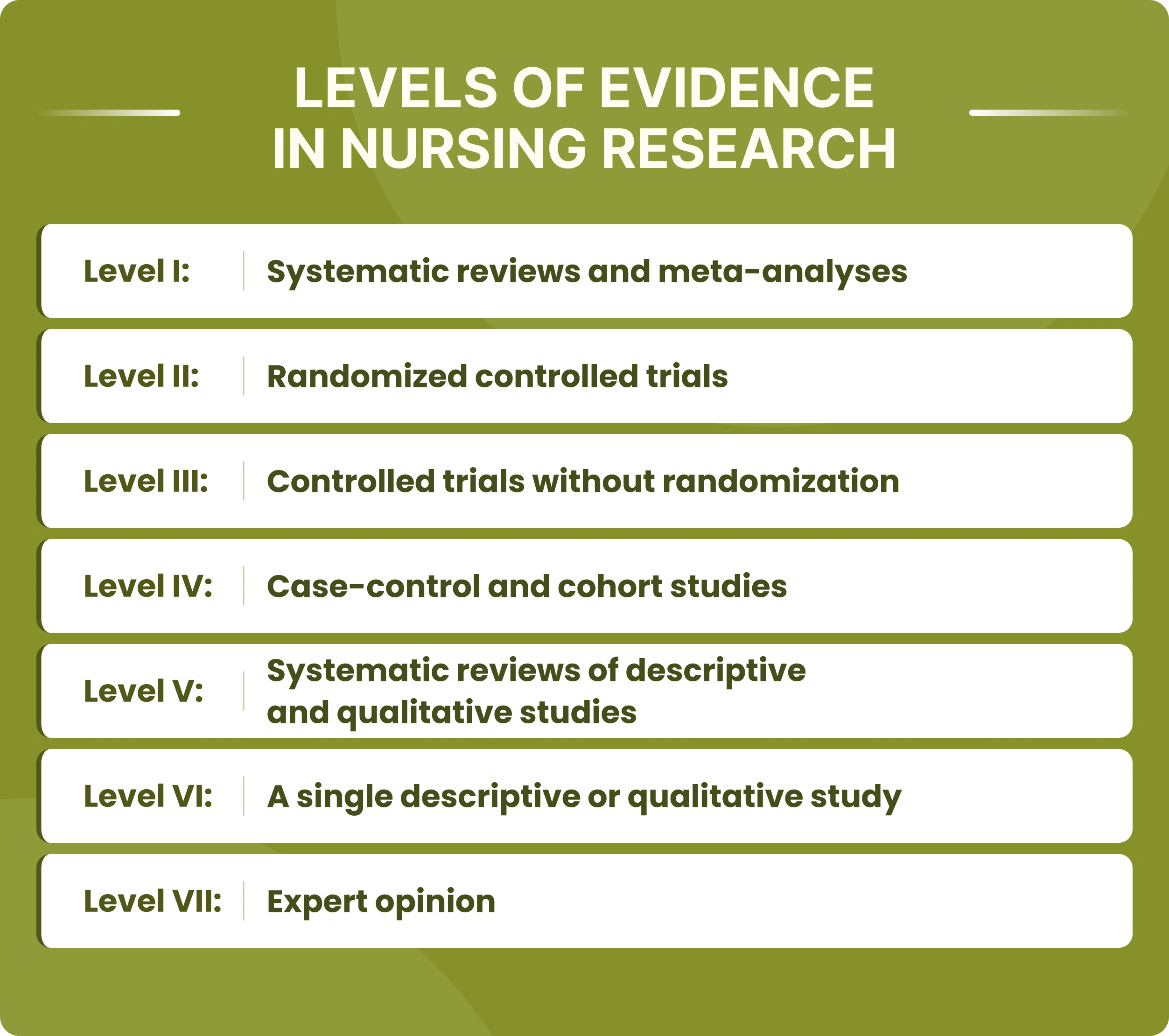
- Level I: Systematic reviews and meta-analyses of randomized controlled trials
- Level II: Randomized controlled trials
- Level III: Controlled trials without randomization, such as quasi-experimental studies
- Level IV: Case-control and cohort studies
- Level V: Systematic reviews of descriptive and qualitative studies
- Level VI: A single descriptive or qualitative study
- Level VII: Expert opinion
The CLABSI study in this guide uses a quasi-experimental design, which lands at Level III. Build the paper on the highest levels available, and note the level of each source as you read.
Step 5: Create an outline
A nursing research paper outline maps every source to a section before the drafting starts. Group the studies by theme first. 3 or 4 themes usually emerge: for the falls question, those might be rounding protocols, staff compliance, and patient outcomes. Each theme becomes a block in the literature review. Then assign the strongest sources to the sections that need them: methods evidence to methods, outcome data to results. A full outline example appears later in this guide. 10 minutes of mapping saves hours of rewriting, because gaps show up on the outline, where they cost nothing to fix.
Step 6: Write the introduction and literature review
The nursing research paper introduction has four jobs in roughly one page: give background on the clinical problem, state the problem itself, explain why it matters for patient care, and end with the PICOT question or thesis. A strong introduction also names the gap the paper fills in one sentence. Skip the flashy hook. A nursing paper opens with context and a clear statement of the problem. Academic readers want the question fast.
The literature review calls for synthesis. A summary lists what each study found, one entry after another. Synthesis groups studies by theme and shows how their findings relate. The two versions below show the difference:
- Summary: Smith (2022) found rounding reduced falls. Jones (2023) found the same.
- Synthesis: Two studies link hourly rounding to lower fall rates, though each measured staff compliance differently (Smith, 2022; Jones, 2023).
Write every source in your own words. Paraphrase the finding and cite it. Phrases like "the article says" or "this study talks about" signal weak analysis and drag the grade down. Name the authors, report what they measured, and connect it to the next study.
Step 7: Write the methods, results, and discussion
These three sections form the IMRaD core of a study-based paper. Each one has a single job. The methods section documents the study so another researcher could repeat it, the results section reports the data without comment, and the discussion section explains what the findings mean.
The five methods elements carry the most weight with graders, so spell out each one:
- Design: the study type, such as a quasi-experimental or descriptive design.
- Sample: who took part, how many, and the setting.
- Data collection: the tools and the timeline.
- Analysis: the statistical or thematic method used.
- Ethics: IRB approval and informed consent, named in full.
Thesis-driven papers skip IMRaD. They replace these three sections with body sections that fall under rubric headings, and each section develops one part of the argument with cited evidence.
Step 8: Write the conclusion, abstract, and title last
Three parts come together only after the body is done. Write them last. The conclusion, the abstract, and the title all depend on finished content, and an early draft of any of them almost never survives to submission.
The title does the most work for the least space, so make it concrete:
- Strong: "Hourly Rounding and Fall Rates in Hospitalized Adults 65 and Older"
- Weak: "A Study on Falls"
Step 9: Cite, format, and proofread
The final pass covers three jobs: citations, formatting, and proofreading. Every APA 7 journal reference follows one pattern:
Author, A. A., & Author, B. B. (Year). Title of the article. Journal Name, Volume(Issue), page range. https://doi.org/xxxxx
A filled example looks like this:
Mitchell, R. A., & Delgado, C. (2024). Hourly rounding and fall rates in acute care. Journal of Nursing Care Quality, 39(1), 22-29.
Include the DOI as a full https link when the article has one. Check that every in-text citation has a matching entry in the reference list, and the reverse. Proofread for person-first language. Replace labels like "diabetics" with "patients who have diabetes." Then read the paper against the rubric one last time and confirm each criterion is met.
Expert Tip (nursing reviewer): "Most deductions I write are mechanical. Citations that don't match the reference list, a missing DOI, the odd 'diabetic' that slips past a spell-check. Run a line-by-line citation match before you submit. It recovers points that have nothing to do with how good the paper actually is."
It’s easy to understand why someone would prefer for a professional to handle all the ins and outs of this project. A nursing essay writing service online can step in and take over at any time.
Nursing research paper outline example
A full outline sets out nine sections before any drafting begins. Build it early. The version below maps to IMRaD and APA 7th edition, and it runs on the CLABSI question from Step 3, so every heading already knows which studies belong under it.
- Title Page
- Title, author, course, instructor, date
- Abstract
- 150 to 250 words, written last
- Introduction
- Background on CLABSI in adult ICU patients
- Problem statement with current infection rates
- Significance for patient safety and hospital cost
- The PICOT question
- Literature Review
- CHG bathing protocols
- Nurse adherence and the barriers to it
- Infection outcomes across studies
- The gap in current evidence
- Methods
- Study design (quasi-experimental)
- Sample and ICU setting
- Data collection tools and timeline
- Analysis plan
- Ethics: IRB approval and informed consent
- Results
- CLABSI rates by group
- Supporting tables and figures
- Discussion
- Interpretation of the findings
- Study limitations
- Implications for critical-care practice
- Conclusion
- Key findings and practice recommendations
- References
- Every source in APA 7 format
A note from the grading side: the nurse-adherence bullet under the literature review is where most CLABSI papers fall short, because adherence data appears far less often than outcome data. Draft that block first, and log each source in a manager like Zotero as you read, so the reference list builds itself by the end.
Mistakes to avoid in a nursing research paper
The same errors cost points term after term:
- A literature review that only summarizes. Each study gets its own entry, and the paper never links the findings. Synthesis is the graded skill.
- Secondary sources where primary ones belong. Textbooks and review articles replace the original trials, though nursing rubrics reward Level 1 and 2 evidence on the Melnyk hierarchy.
- Citations that miss the reference list. APA 7 flags every mismatch, in both directions.
- No appraisal of evidence quality. A peer-reviewed tag passes as proof, with no check of the study's level or sample size.
- Ethics left out of the methods. IRB approval and informed consent go unstated, which graders treat as a serious gap.
- Labels in place of person-first language. "Diabetics" appears where "patients with diabetes" belongs, against APA 7 bias-free guidelines.
Learn also nursing essay mistakes and the most practical ways to avoid/fix them.
Need a nursing expert?
From PICOT to APA, our expert writers can handle the details.
Final thoughts
A nursing research paper comes down to structure and evidence. Ten steps, one standard: APA 7th edition. Read the rubric, narrow the topic to a single PICOT question, appraise the sources against the Melnyk levels, outline, then draft each section in sequence. Cite as you write. The structure earns the grade.
Frequently Asked Questions
How long is a nursing research paper?
How many sources does a nursing research paper need?
What is the difference between a nursing research paper and a literature review?
.png)
Jaroslav specializes in helping students unlock their creative side and let it shine. Armed with his Bachelor’s degree in creative writing, he imparts his advice on making communication effective and engaging.



New posts to your inbox
Your submission has been received!