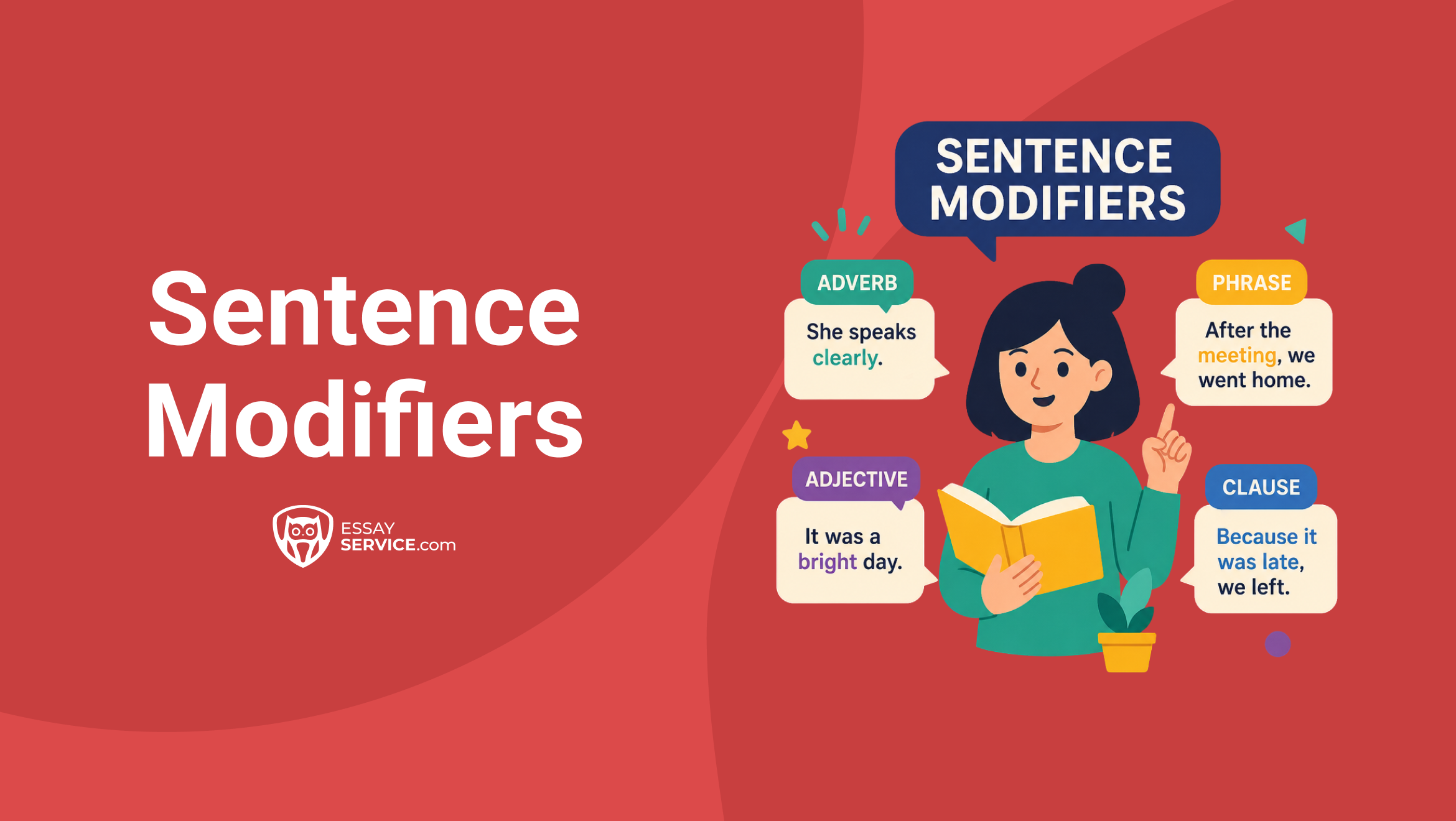
A modifier is a word, phrase, or clause that adds detail to another part of a sentence. It tells you which person the sentence refers to, or what kind of object. It can also point to how an action happened or how strongly an idea should be read.
In The tired nurse checked the chart carefully, both tired and carefully are important because we do not know any details without them. That is exactly what modifiers do.
I decided to create this article for those of you who have struggled to fully understand this part of speech. We will cover the main modifier types and modifiers in sentences examples, as well as common mistakes and ways to clear up confusing sentences.
What Is a Modifier in a Sentence?
A modifier in a sentence gives extra information about a noun, verb, adjective, adverb, phrase, or full idea. Its purpose is precision. Without them, writing can sound unfinished because nothing is specific enough. Add a modifier in the correct place, and see how the sentence instantly becomes more detailed and understandable.
For example, let's take The student answered. This gives the basic action. Anything else? Not really. The anxious student answered with hesitation adds more mood and pace to the same idea. Modifier placement is just as important because Only Daniel reviewed the essay and Daniel reviewed only the essay mean completely different things - one says that Daniel alone reviewed it, the second points the attention toward the essay itself.


Need Support in Writing?
Work with experienced writers who can make your paper grammatically and structurally correct.
Types of Modifiers in a Sentence
Modifiers can be sorted by the work they do, the place they take in a sentence, and the structure they use. The main types are part-of-speech modifiers, position-based modifiers, and structure-based modifiers. The breakdown below from the professional from our writing services gives you the types of modifiers with examples, plus the small placement rules that actually affect sentence clarity.
By Part of Speech
The most familiar ones are adjectives and adverbs. Students often underestimate their importance precisely because we run into them so often. One misplaced “only” can change the full meaning of a sentence, and one vague adjective can make an otherwise decent paragraph feel underdeveloped.
- Let's start with an adjective modifier. It describes a noun or pronoun. It can identify which one, what kind, how many, or whose. In the sentence “The revised paragraph sounds clearer,” the word “revised” modifies “paragraph.” In “Several nervous speakers waited outside,” “several” gives number, and “nervous” gives condition. Both words help the reader understand the noun with more accuracy.
Adjective modifiers can appear before a noun, as in “a detailed outline,” or after a linking verb, as in “the outline seems detailed.” The grammatical job stays the same because “detailed” still describes “outline.” Students sometimes miss that second version because it feels less obvious, but it is still a modification. The following sentences will help you understand adjective modifiers more clearly:
- The final paragraph needs a stronger transition.
- Her careful explanation helped the group follow the idea.
- The answer sounded reasonable after revision.
- Three recent sources support the argument.
A practical rule for adjective modifiers is to check punctuation when two or more adjectives come before the same noun. If each adjective describes the noun separately, use a comma: “a clear, detailed explanation.” The test is simple: place “and” between the adjectives. “A clear and detailed explanation” still works, so the comma is correct. If the first adjective is part of a fixed unit with the noun, leave the comma out.
- An adverb modifier describes a verb, adjective, adverb, or sometimes the full sentence idea. It can explain how, when, how often, where something happened, or how strongly a description should be understood.
Adverbs need stricter attention than they usually get. Words like “only,” “almost,” “nearly,” “just,” and “even” should sit beside the word they modify. Compare these three sentences:
- Only Marcus submitted the report. - This says that no one but Marcus submitted it.
- Marcus only submitted the report. - Submitting the report was the only thing that Marcus did.
- Marcus submitted only the report. - The report was the only thing that Marcus submitted.
Move one word, and the entire claim changes. A useful editing tip is to circle every limiting adverb in a draft and check the word next to it. If the adverb is not next to the exact word it controls, move it.
By Position in Sentence
Position-based modifiers are sorted by their place in the sentence, by how close they appear to the word they describe. Readers attach the modifiers to the nearest word that would make sense, naturally, so this category is important. A sentence can follow grammar rules and create an unclear reading when the modifier ends up in the wrong spot.
- A pre-modifier, as the name suggests, comes before the word it modifies. “A narrow topic,” “an early draft,” “three examples,” “her strongest point...” They work best when the detail stays short. The phrase can remain compact:
- A narrow hallway led to the back door.
- The silver watch stopped before noon.
- A fresh coat of paint covered the old scratches.
Some pre-modifiers are nouns before another noun. In “chicken soup recipe,” “chicken” modifies “soup,” and “soup” modifies “recipe.” This format is convenient, but it becomes heavy when several nouns are packed together.
Takes a second to process: “Kitchen cabinet door handle repair kit” takes a second to process.
Clearer: “A repair kit for kitchen cabinet door handles.”
- A post-modifier comes after the word it modifies. Post-modifiers often appear as prepositional phrases, adjective phrases, infinitive phrases, and relative clauses.
- The article about sleep habits used recent data.
- The student with the missing citation stayed after class.
Post-modifiers are useful, but they cause attachment problems. If you want to avoid this, remember a simple rule to place the post-modifier directly after the word it describes. This rule works in all cases unless the sentence needs a rearrangement for clarity.
Take this sentence: “The courier delivered the vase to the customer with a cracked handle.” The problem is small, and still, it changes the reading. Since “with a cracked handle” follows “customer,” the sentence briefly suggests that the customer has the cracked handle. I’d revise it as “The courier delivered the customer the vase with a cracked handle.” A tighter version is “The courier delivered the cracked-handled vase to the customer.”
Commas can change post-modifiers too. “The cars that had expired registrations were towed” means only those cars. “The cars, which had expired registrations, were towed” means all of them.
By Structure
A structure-based modifier is classified by its size and internal grammar. Some modifiers are one word. Some are phrases. Some are full clauses. This category matters because longer modifiers create more chances for confusion, especially in essays where students keep adding detail after detail without checking what each detail attaches to.
- A single-word modifier is the easiest to recognize. It uses one adjective or adverb to sharpen the sentence. In “a precise claim,” “precise” modifies “claim.” In “the speaker paused briefly,” “briefly” modifies “paused.” These small words do a lot when they are chosen carefully.
- The central argument appears in the final sentence.
- She answered slowly after rereading the prompt.
- The second example fits the point better.
- The method worked well in a small group.
The technical advice here is to keep a single-word modifier only when it earns its place. “A written essay” usually wastes a word because essays are already written. “A personal opinion” often repeats the idea of opinion. A modifier should add a distinction. If it does not, the sentence gets longer without becoming clearer.
- A phrase modifier uses a group of words without its own subject-verb pair. Prepositional phrases are common: “on the desk,” “after the lecture,” “with several citations.” Infinitive phrases also modify: “to improve the conclusion,” “to answer the research question.” Adjective phrases appear too, as in “ready for review” or “full of useful examples.”
Here, the main test is attachment. Ask, “What exact word does this phrase describe?” If the answer is not obvious, revise.
“I saw a classmate with a telescope” is less stable because the phrase “with a telescope” may describe the speaker’s tool or the classmate. A clearer version would be “I used a telescope to see a classmate,” if that is the intended meaning. Another version would be “I saw a classmate who was carrying a telescope.”
- A modifier clause contains a subject and a verb. Relative clauses often begin with “who,” “whom,” “whose,” “which,” or “that.” Adverb clauses often begin with words such as “because,” “when,” “after,” or “since.” These clauses let the writer add fuller information without cutting the sentence into several short lines.
- The jacket that hung near the door belonged to Lena.
- The room felt warmer after the curtains were closed.
Relative clauses should usually stand right after the noun they modify. “I found an article in the database that explained modifier placement” can sound as if the database explained modifier placement. The intended version is probably “I found an article that explained modifier placement in the database,” though even that may need revision if “in the database” modifies “found.” A cleaner sentence would be “In the database, I found an article that explained modifier placement.”
The final rule is the one students can use fastest: after adding a modifier, read the sentence as if you have no idea what you meant. If your mind attaches the detail to the wrong word, chances are the reader will also go there.
Common Sentence Modifier Errors to Avoid
Modifier errors confuse readers because one detail attaches to the wrong sentence part. The reader pauses, rereads, and sometimes chooses the meaning you never intended. These errors rarely look dramatic. One loose phrase can distort the whole line.
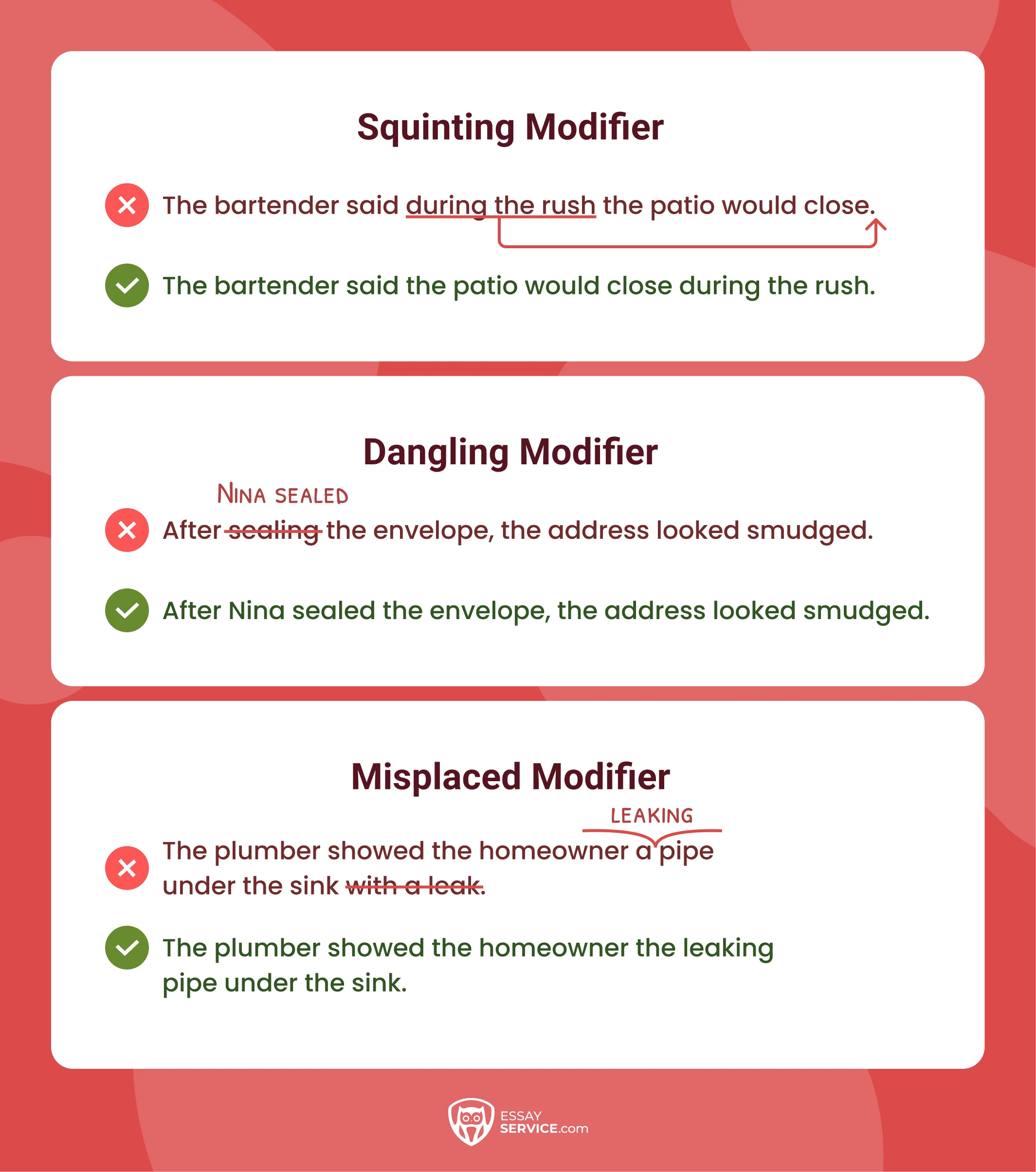
Squinting Modifiers
A squinting modifier is a word or phrase placed between two sentence parts, where it can modify either side. The sentence does not fully break, which is why this error slips through. It leaves the reader with two possible readings.
Take this sentence: “The manager said after lunch the bakery would close early.” The phrase “after lunch” is doing too much work. Did the manager speak after lunch, or did the bakery close after lunch?
Clearer versions:
“The manager said the bakery would close early after lunch.”
“After lunch, the manager said the bakery would close early.”
Fix tips:
- Move the modifier beside the action it explains.
- Check time words first: “often,” “soon,” “after dinner,” “on Friday.”
- Read the sentence with the modifier attached backward, then attached forward.
Dangling Modifiers
A dangling modifier describes an action, but the sentence does not name the person or thing doing that action. The missing actor creates the error. The sentence then pushes the action onto the next noun, even when that noun cannot logically do it.
“After tightening the jar lid, the sauce stopped leaking” is an error because a person, not the sauce, tightened the lid.
The correct version would be to say “After Lena tightened the jar lid, the sauce stopped leaking,” or “After tightening the jar lid, Lena noticed that the sauce stopped leaking.”
Fix tips:
- Name the actor clearly.
- Place the actor after the opening modifier when that phrasing works.
- Turn the modifier into a full clause if the short version sounds awkward.
Misplaced Modifiers
A misplaced modifier is a descriptive word or phrase placed too far away from the word it modifies. The intended meaning may be obvious to the writer, I know, but readers follow grammar before intention.
Error: “The florist handed the bouquet to the bride with torn ribbon.” This makes “with torn ribbon” point toward “bride.”
Better: “The florist handed the bride the bouquet with torn ribbon.”
Even better: “The florist handed the bride the torn-ribbon bouquet.”
Fix tips:
- Put descriptive phrases beside the noun they describe.
- Watch phrases that begin with “with,” “near,” “under,” and “beside.”
- Use a direct subject and verb when the sentence feels patched together.
Examples of Modifiers
Modifier examples are easier to understand when you can see both the modifier itself and the word it changes. In the examples below, the modifier is bolded, and the word it modifies is named right after the sentence.
Placing Modifiers in a Sentence
Proper modification placement is a minor grammatical decision that can make a huge impact on the overall meaning of the sentence. Modifiers can come at the beginning or end of the sentence, or interrupt it, but the reader should always know what word the modifier relates to by contextual clues.
- At the Beginning: The opening modifier commonly gives time, condition, or context of a situation to prepare for the main action. “After the power cut, the restaurant switched to candles.”
- In the Middle: The middle modifiers work best when they are placed close to the noun or verb they describe. “The coat with wooden buttons belonged to my aunt.” In this case, the reader has no issues telling which noun the modifier describes.
- At the End: The ending modifier informs the reader right after the subject has completed the main action. “The cat slept beside the warm radiator.” The placement here provides the reader with a contextual reference related to the action, place, or object identified in the main verb of the sentence.
Get Your Essays Right
Get expert support when your assignment needs better structure, cleaner wording, and stronger academic flow.
How to Use Sentence Modifiers Effectively?
Effective modifiers do more than add description. They control meaning, reduce confusion, and help a sentence say exactly what you meant without forcing the reader to repair it later again.
- Name the target: Decide which word is receiving the modifying phrase. If you cannot name a word, then your sentence is too loose and needs a fix.
- Move it closer: Place the modifying detail about the target word immediately next to it. “The man carried the box with the blue label” works only if the label is on the box.
- Watch limiting words: Words such as "only", "almost", "just", "nearly", "even" should be placed directly next to the word(s) they control. Depending on their placement, the entire claim can be altered.
- Test the wrong reading: Read the sentence from an uninformed perspective, as if you know nothing about the intended meaning of the sentence. A phrase that can point to the wrong noun needs repair.
- Remove empty detail: Keep only those modifiers that provide relevant information to the reader. Eliminate those that repeat a noun, weaken the verb, or otherwise add filler to the sentence unnecessarily.
Final Thoughts
Modifiers in writing express the kind of detail about what is being described, limited, intensified, or explained that helps the reader understand the overall meaning of the sentence better. Modifiers can describe nouns or actions, appear before or after the word they modify, and take the form of single words, phrases, or full clauses. Each type works differently, but the goal of clearer, more exact meaning stays the same. The general rule of thumb is, before rushing to complete a draft, identify the word being modified, keep that description as close to it as possible, and check again for dangling, misplaced, or squinting modifiers.
Frequently Asked Questions
What Is a Sentence Modifier?
What are the Different Types of Modifiers?
What Is a Dangling Modifier in a Sentence?
What Is a Misplaced Modifier in a Sentence?

Essie isn’t just an educator with a Bachelor’s in English: she’s passionate about writing. She uses her experience in grading papers to write comprehensive guides for our blog.
- Lab, P. W. (n.d.). Dangling Modifiers and How To Correct Them // Purdue Writing Lab. Purdue Writing Lab. https://owl.purdue.edu/owl/general_writing/mechanics/dangling_modifiers_and_how_to_correct_them.html
- Modifiers and How to Use Them | SASS. (n.d.). https://sass.queensu.ca/resources/online/modifiers
- Modifiers | MLA Style Center. (2020, July 22). MLA Style Center. https://style.mla.org/modifiers/



New posts to your inbox
Your submission has been received!