A nursing essay is a paper where an aspiring healthcare worker has to show their reasoning and clinical thinking in their work, as opposed to general talk.
The problem with writing a nursing essay, for many students, is that the topics might seem simple and familiar at the start, but they realize what the essay requires (careful judgment about care, evidence, patient needs, and professional responsibility) a bit later on. Avoidable mistakes often happen because of this very reason.
Exactly because these issues are avoidable, students can prevent them from happening in the first place by understanding the mistakes in nursing essays that are most often made.
I wrote this article with precisely that in mind. Keep reading if you want to understand what weakens your work and how to reach research-backed decisions without making your writing stiff.
Clinical Reasoning Mistakes
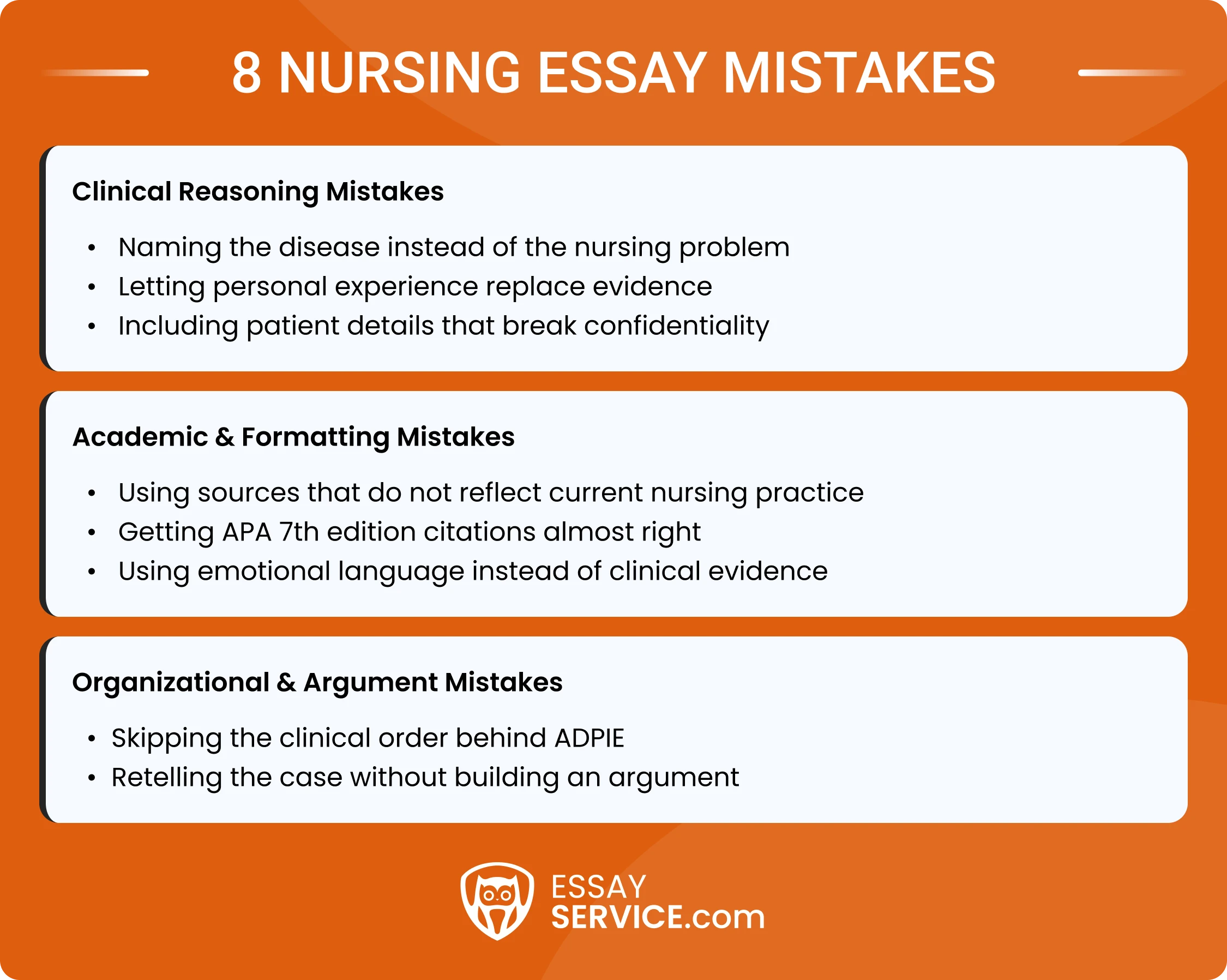
The most common mistakes in nursing essays come down to weak clinical focus: treating medical diagnoses as nursing diagnoses, using personal stories instead of evidence-based practice, and exposing patient details that should stay private. A nursing paper needs patient-centered reasoning, current sources, and confidentiality, not broad medical description with clinical wording.
Before we get into the details of nursing essay mistakes, check out the best schools for pediatric nursing if caring for children is what you're most interested in.
Naming the Disease Instead of the Nursing Problem
Students often make the mistake of treating medical and nursing diagnoses as the same thing. A medical diagnosis names the condition, a nursing diagnosis looks at how the patient responds to it. Nurses do not write “the patient has pneumonia” in an essay. They assess the patient’s oxygen saturation, breath sounds, energy/fatigue levels, fluid intake, and activity tolerance, listen to the patient’s anxiety level, and how much the patient understands the care instructions.
Weak version: "The nursing diagnosis is pneumonia." Too broad, doesn't show nursing reasoning.
Strong version: “Impaired gas exchange related to alveolar inflammation as evidenced by oxygen saturation of 89%, shortness of breath, and crackles on auscultation.”
The fix is to ask what the patient is experiencing and which details the nurse can assess, monitor, support, teach, or evaluate. When an assignment asks to use NANDA type wording, be mindful and use it properly.
Letting Personal Experience Replace Evidence
Sometimes a personal story can help ground a nursing paper, especially when the student has seen a similar patient situation during clinical practice. Still, that story cannot carry the argument. Nursing papers need peer-reviewed research, current clinical guidelines, and evidence-based practice. A personal observation may belong in a reflection section, if the assignment asks for one, but it should not replace clinical evidence.
For example, a student may write, “My aunt had diabetes and walked regularly, so nurses should tell all diabetic patients to walk every day.” The idea is not useless, but it is too broad. A better response would explain how physical activity can support glycemic control, then connect that point to a current diabetes guideline or credible nursing source.
The correction is to treat every intervention like a claim that needs proof. If the paper recommends care, it should explain the rationale, expected response, and source.
Including Patient Details That Break Confidentiality
Violating patient confidentiality is an ethical issue that could change a well-written nursing paper into a serious problem, even when the essay doesn't go outside of the classroom. Common errors students make is including patient identifiers, such as:
- Names
- Specific ages
- Hospital units
- Room numbers
- Dates
- Place of employment
- Unique medical history
In a potentially risky example, the nursing student states, “Mr. L, 42 years old, teacher at Lincoln High School, came to the emergency department on March 3 after a seizure caused by using substances.” This sentence contains too much identifying information. For safety, this should read: “A middle aged adult patient was admitted after experiencing a seizure related to substance use.”
The correction is to remove and/or change identifying data. Symptoms, assessment findings, interventions that were completed, how the patient responded to interventions - all of this is necessary to include.


Your Energy Matters
Our writing service supports nursing students who need help after long clinical hours.
Academic and Formatting Mistakes
Writing mistakes in nursing essays often come from poor academic handling. Students may understand the patient’s condition, then lose marks through outdated or non-nursing sources, messy APA 7th edition citations, or emotional language that sounds more personal than clinical. A strong paper needs current evidence, accurate references, and controlled academic wording.
Using Sources That Do Not Reflect Current Nursing Practice
Using an outdated article as a source in a nursing paper weakens the argument almost immediately. Students often select the first reference they find during a database search, especially when a deadline is close, and build the paper without checking the publication date, the author’s qualifications, or the source’s connection to nursing care. This becomes a bigger issue in topics like patient safety, infection control, medication teaching, chronic disease management, and discharge planning, because clinical recommendations change.
For example, a student may use a 2009 wellness blog to discuss fall prevention in older patients. The information may seem reasonable, but it lacks sufficient academic or clinical weight. Recent peer-reviewed nursing articles, practice guidelines, or reputable healthcare publications fit the task much better.
Before using a source, check the date, author credentials, publication type, and nursing relevance. Older sources should appear only when the paper needs historical context.
Getting APA 7th Edition Citations Almost Right
Minor APA 7th edition errors can accumulate to create an overall impression of badly done research. Professors won’t miss these. Some examples of APA 7th edition citation errors are:
Check citations in sets of two. Then, check that your in-text citation matches the reference list and that each reference entry has a purpose for being included in the list. Citation generators can assist in the process, but a manual review of each citation prior to submission is essential.
Using Emotional Language Instead of Clinical Evidence
Nursing is an emotional profession, so nursing topics can easily bring out strong reactions. Patient pain, fear, family stress, poor communication, or an unsafe treatment plan may push students toward emotionally loaded wording. The problem begins when those words replace assessment data. A clinical paper should show what happened, what the nurse observed, and how that observation supports the response.
Take this sentence: “The patient was obviously terrified, and the nurse failed badly because she did not comfort her enough.” This sentence gives judgment first, with no evidence. The same point works better with clinical detail: “The patient avoided eye contact, asked repeated questions about the procedure, and stated that she felt nervous. The nurse should have assessed anxiety, explained the procedure in plain language, and documented the patient’s response.”
Keep control of the discussion. Remove judgment, use observable details, and let compassion appear through professional care rather than emotional wording.
Organization and Argument Mistakes
Structural issues can weaken a nursing essay even when the student understands the case. Two nursing essays mistakes usually cause it: ignoring the ADPIE order and retelling the patient's situation without analysis. A strong paper should move through assessment, priorities, care decisions, and evaluation with clear clinical reasoning.
Skipping the Clinical Order Behind ADPIE
When the nursing process is treated as background knowledge rather than the organizational structure of the document, the paper becomes difficult to follow. The ADPIE framework - Assessment, diagnosis, plan, implementation, and evaluation - is the sequence the student must follow. A failure to do so might cause the argument to start in a completely wrong place.
For example, when discussing a patient's wound care, the nurse may describe the wound dressing changes and provide patient teaching before talking about the incision draining, redness, amount of pain, temperature, diabetes as a healing risk, etc. Thus, the reader is forced to guess the clinical reasoning.
Prior to writing the paper, the student should create an organizational outline using the clinical reasoning path for each of the major paragraphs by establishing the following:
- What the patient was assessed for
- What the patient's problem was and how it was identified
- What the nursing care goal was
- What nursing interventions were conducted
- How the patient demonstrated the expected clinical response to nursing care.
Retelling the Case Without Building an Argument
Some nursing papers read as summaries because the writer simply presents the events in order, believing that it counts as analysis. This is not enough. A summary may be sufficient in the beginning of the clinical documentation to allow the reader to understand previous clinical history of the patient; however, there needs to be an explanation of how the clinical incidents all fit into the overall nursing care.
The statement: “The patient had pain, the nurse administered a pain medication, and then the patient felt better” does not reveal the nurse's clinical reasoning. You should provide the pain score, type of pain, dosage of pain medication, safety checks prior to administration, timing of reassessment, any therapies used to decrease pain, and the patient’s understanding of the pain medication.
Question every important detail after drafting. Otherwise, the paragraph stays descriptive and earns less credit than it could.
A nursing paper writing service on our platform can help you connect with a professional who will take over your tasks while you rest after your rotations.
A Final Nursing Essay Checklist Before Submission
Before submission, a nursing essay needs one last read with a practical eye. Follow this checklist to make sure you meet all the academic (formatting or clinical reasoning) requirements:
- I have shown the nurse’s role clearly, not just described the medical condition.
- I have used a nursing diagnosis where the assignment requires one.
- I have connected care decisions to patient data.
- I have supported key claims with current nursing evidence.
- I have removed personal opinion that does not belong in the assignment.
- I have checked that patient details protect confidentiality.
- I have followed a clear order, especially if ADPIE fits the task.
- I have analyzed clinical details instead of only retelling the case.
- I have checked every APA 7th edition in-text citation.
- I have made sure every reference list source appears in the paper.
Nurses Need Rest Too
When long shifts leave you drained, our service helps write your papers.
Final Thoughts
A strong nursing essay shows clinical reasoning, not general healthcare talk. The paper should use current evidence, protect patient confidentiality, follow APA 7th edition rules, and organize care decisions in a logical order. Students lose marks when they summarize, cite carelessly, or write through emotion. Careful revision fixes most of these problems before submission.
Frequently Asked Questions
What Mistakes Do Students Make in a Nursing Essay?
Why Do Schools Strictly Require APA 7th Edition for a Nursing Essay?
How Should I Organize My Nursing Essay?

John spends his days studying the impact of language. He uses his deep understanding of linguistics and research experience to help students communicate more effectively and craft immaculate research-intensive papers.
- Brennan, M. J. (1995). Essay writing in nursing: alerting students and teachers to the educational benefits. Nurse Education Today, 15(5), 351–356. https://www.sciencedirect.com/science/article/pii/S0260691795800085?via%3Dihub
- Nursing, N. U. (2014, November 5). The Nursing School Essay: Application Tips Part I | Northeastern. Northeastern ABSN. https://absn.northeastern.edu/blog/nursing-school-essay/
- Deshaies, S. (2020, June 3). Writing Guide for Nurses. NurseJournal. https://nursejournal.org/resources/writing-guide-for-nurses/


New posts to your inbox
Your submission has been received!