
An MBA personal statement is a 500-1,000-word essay in which applicants explain their professional experience and goals and why they want to pursue an MBA at that particular program.
Personal statements offer admissions committees something numbers on an application cannot: insight into who you are and how you think.
In this article, we analyze 7 successful MBA personal statement examples. We’ll discuss what makes each stand out, the common structure, and how to incorporate detail, a unique story, and your voice. Read them to see the format brought to life before starting your own.
What Reviewers Are Expecting in a MBA Personal Statement?
Personal statements carry significant weight in MBA programs because transcripts and resumes show only what you’ve accomplished, not how you think, lead, or deal with failure. They use your essay to assess your leadership abilities, self-awareness, career objectives, and whether you would truly enrich their classroom environment, the qualities no GPA or GMAT score can capture.
Many top schools take it one step further. Harvard Business School, Wharton, and Stanford GSB all ask for a personal statement to determine how you react to failure, the quantifiable impact you’ve created in your positions, and what unique perspective you would contribute to the classroom.


Strengthen Your MBA Application
Get expert help writing a compelling MBA personal statement that stands out.
The Three-Part Formula Behind a Strong MBA Personal Statement
A successful MBA personal statement sample follows one basic formula. The way it’s written, the tone it conveys, and the details of the stories it includes will vary for everyone. But if you learn this formula, it’s far less scary to sit down and write your own because you have a framework to work with; you just need to plug in your own information.
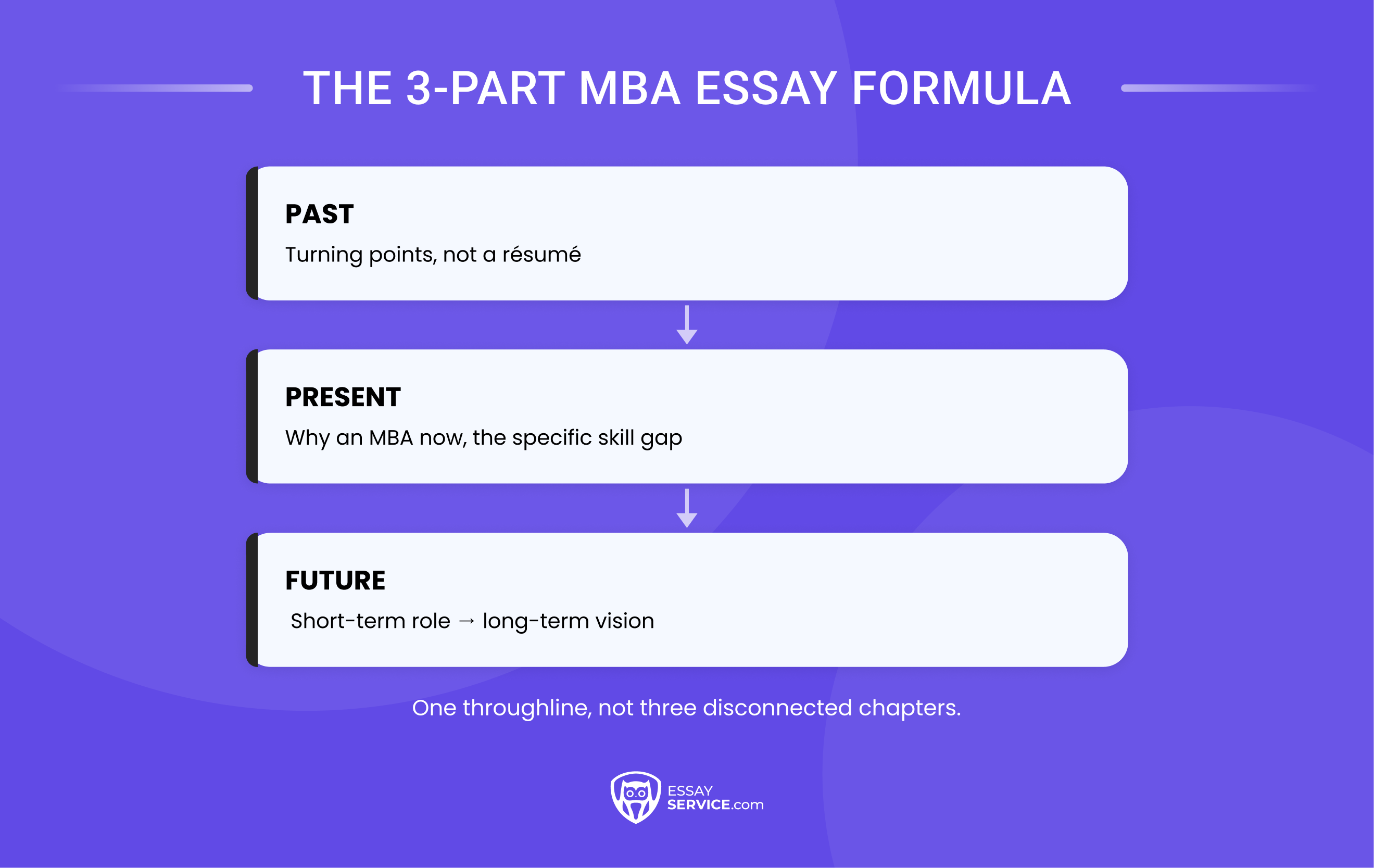
Begin with Past: To show the career achievements, key life experiences, and leadership opportunities that have actually led to the goals you’re trying to reach, select the turning points in your life. This isn’t a recounting of your resume. Choose a project you managed, an epic fail, or an ah-ha! The moment that led you to where you are today.
Move to Present: To show why you need an MBA now, not someday or in five years, identify the skill gaps such as technical, strategic, and leadership, that are preventing your next move, and explain why going back to school for an MBA is the ideal solution.
Finish with Future: To create a narrative that spans all three periods, show where you see yourself going career-wise right after graduation and where you ultimately see that job leading you in the future, 10–15 years from now.
If you need help refining your personal statement and presenting your experience in the strongest possible way, use our MBA essay writing service.
What Makes a Strong MBA Personal Statement Example?
To get the most from an example of MBA personal statement, start by focusing on structure rather than superficial details. Look for an introduction and narrative, hard numbers (revenue growth x%, teams led, etc.), and introspection rather than bragging. You’re not trying to mimic someone’s writing style or steal their story; you’re trying to recognize the formula that makes an essay work.
Most effective essays follow a similar structure:
- Hook: A sentence or opening anecdote that grabs the reader’s attention from the start.
- Context: A brief background that informs the reader of what’s at stake.
- Action: What you did, decided, or contributed.
- Impact: The result of your action is quantified or described
- MBA Connection: This story should answer the “tell us about yourself” question and show why you want to attend the X MBA program right now
If it dives into context and impact without describing the action you took, it will feel flat, no matter how strong the impact sounds.
MBA Personal Statement Examples
A good example doesn't hand you a script to copy, it shows you the pattern working in a real, specific voice. As you read these seven examples, notice how each one opens with something concrete rather than a general statement, moves through a real decision or action rather than a vague description of "growth," and lands on a specific, well-researched reason for pursuing an MBA right now. Each example below addresses a different common prompt type, followed by a short breakdown of why it works.
MBA Personal Statement Example 1
Type: Career Goals & Vision Prompt
"The factory floor went quiet at 2 a.m. when our main production line failed for the third time that month, and I was the only engineer on shift who understood the legacy control system well enough to bring it back online. I fixed it in forty minutes. I also realized, standing there, that I'd spent three years becoming indispensable to a system I didn't believe in.
I joined Meridian Manufacturing as a process engineer because I wanted to build things that mattered. I left convinced that the real bottleneck wasn't equipment, it was decision-making. Our plant ran on instinct and tenure, not data. So I taught myself SQL on weekends, built a predictive maintenance dashboard nobody asked for, and used it to cut unplanned downtime by 22% over eighteen months. That project got noticed. It also showed me exactly where my skills ran out: I could build the tool, but I couldn't make the business case that would get it funded company-wide.
That gap is why I need an MBA now, not in five years. I want [School]'s Operations Management concentration and its strong ties to industrial manufacturing recruiters to help me move from fixing individual plants to redesigning how mid-sized manufacturers adopt data-driven operations at scale. In ten years, I want to run operations for a manufacturing company undergoing exactly the transformation I started at Meridian, this time with the strategic and financial fluency to make it stick."
Why it works: The hook drops you into a specific, sensory moment (a failing production line at 2 a.m.) rather than opening with "I have always been passionate about manufacturing." The metrics (22% downtime reduction) provide evidence, not just claims, and the essay ends by naming a specific program feature tied directly to the applicant's stated gap.
MBA Personal Statement Example 2
Type: Leadership Experience Prompt
"Six weeks before launch, half my team quit.
I was leading a five-person product team at a fintech startup, tasked with shipping a new lending feature ahead of a board demo. When our lead designer and two engineers left within the same month, citing burnout, I had a choice: push the remaining team harder to hit the deadline, or tell leadership we needed to slip the launch.
I chose the second option, and it was the hardest conversation of my career. I walked into our CEO's office with a revised timeline, a staffing plan, and an honest account of what had gone wrong on my end, I'd been so focused on the roadmap that I'd missed how thin the team had stretched. We pushed the launch three weeks. I redistributed scope, brought in a contractor for design support, and instituted weekly check-ins focused specifically on workload, not just progress. We launched successfully, and more importantly, no one else left the team that quarter.
That experience taught me that leadership often means absorbing short-term discomfort to protect long-term outcomes, a lesson I want to formalize through [School]'s leadership curriculum, particularly its emphasis on organizational behavior. I want to build teams that don't just hit deadlines, but stay intact doing it."
Why it works: This example embraces a genuine setback rather than a manufactured "leadership triumph." The action taken (delaying the launch, redistributing scope) is specific and shows real decision-making under pressure, and the reflection connects directly to a named program feature rather than a generic "I'll learn to be a better leader" statement.
If you're balancing work and graduate school, explore the best part time MBA programs to find an option that fits your schedule.
MBA Personal Statement Example 3
Type: Failure and Resilience Prompt
"My startup failed, and I found out from a Slack message.
I'd co-founded a direct-to-consumer skincare brand during my final year of college, and by our second year, we had real revenue, a small but loyal customer base, and a co-founder relationship that was quietly falling apart. I was so focused on marketing and growth that I missed how badly we'd mismanaged cash flow. When my co-founder messaged the team that we were shutting down, I hadn't even seen it coming.
The failure forced an uncomfortable inventory: I was good at building excitement around a product, but I'd never learned to read a balance sheet closely enough to catch the warning signs. I spent the next year working in a finance-adjacent role at a retail analytics firm specifically to close that gap, and I've since helped two friends' startups build basic financial models before they needed them.
I'm not applying to business school to avoid failing again, failure taught me things a smooth path wouldn't have. I'm applying because I want the financial and strategic rigor I lacked the first time, specifically [School]'s required corporate finance sequence and its startup-focused electives, so that my next venture survives its own difficult year."
Why it works: The essay doesn't sanitize the failure or rush past it to a tidy lesson. It names the specific skill gap (financial literacy) that caused the failure and shows concrete follow-up action, then ties the applicant's future intentions to specific coursework rather than a vague "I'll be better prepared."
MBA Personal Statement Example 4
Type: "Why This School" Prompt
"I sat in on a recorded lecture from [School]'s Social Enterprise course last spring, expecting a standard case study discussion. Instead, I watched forty students debate, genuinely disagree, about whether a microfinance institution's growth targets were undermining its original mission. Nobody in that room seemed interested in a comfortable consensus.
That tension is exactly what I've been missing. I've spent four years managing microloan portfolios for a nonprofit lender in East Africa, and I've watched firsthand how growth pressure and mission alignment pull against each other in ways textbooks rarely capture honestly. I don't want a program that teaches me to resolve that tension neatly; I want one that trains me to sit inside it and make better decisions anyway.
Beyond that course, [School]'s dual-degree option with the School of Public Policy would let me formally combine the financial modeling skills I need with the policy fluency I've been building informally through six years of grant-funded lending work. I've also connected with two second-year students through [School]'s Social Impact Club, both of whom described a curriculum that pushes students to defend uncomfortable trade-offs rather than avoid them, exactly the kind of rigor I'm looking for."
Why it works: The specifics here (a named course, a described class dynamic, a real dual-degree program, conversations with current students) are things that can only be written by someone who actually researched the school, not generic praise that could apply anywhere.
MBA Personal Statement Example 5
Type: Diversity and Contribution Prompt
"I've translated for my parents at doctor's appointments since I was nine years old, learning medical terminology in two languages before I learned algebra.
That early experience shaped how I move through professional spaces now. As one of the only bilingual analysts on my team at a healthcare consulting firm, I've been repeatedly pulled into client meetings specifically because I can translate not just language, but context, helping non-English-speaking hospital administrators understand recommendations that would otherwise get lost in translation, literally and culturally.
I plan to bring that same instinct into the classroom. In study groups, I've noticed I'm often the person who slows a conversation down to make sure someone's half-formed idea gets fully heard before the group moves on, a habit that comes directly from years of translating incomplete sentences into full meaning. At [School], I'd want to contribute that same attentiveness to cross-cultural communication within case study teams, particularly given the program's emphasis on global immersion trips, where exactly this kind of translation, between languages, but also between assumptions, tends to matter most."
Why it works: The essay grounds "diversity" in a specific, lived skill (literal and cultural translation) rather than a checklist of identity markers, and connects that skill directly to a concrete way the applicant would show up in the school's specific program structure.
Before drafting your statement, review these MBA essay tips to understand what admissions committees expect.
MBA Personal Statement Example 6
Type: Career Change or Pivot Prompt
"I spent four years as a high school physics teacher before I ever considered business school, and I almost didn't apply because I worried my background would look like a mismatch.
Then I looked at what I'd actually been doing for those four years: managing a $40,000 department budget, negotiating with administrators for lab equipment funding, and redesigning a curriculum that raised our school's AP Physics pass rate from 61% to 84% over two years. I hadn't been thinking of it as business experience, but it was, resource allocation, stakeholder negotiation, and measurable outcome improvement, just without the vocabulary.
What's missing is formal training in scaling that kind of impact beyond one classroom. I've since taken on a part-time role helping our district evaluate edtech vendor contracts, which showed me how much I enjoy the analytical, cross-functional side of education operations. I want [School]'s MBA, specifically its social sector concentration, to give me the financial modeling and strategic frameworks to move into educational technology or ed-focused nonprofit leadership, where I can apply the same resource-constrained problem-solving at a much larger scale."
Why it works: Instead of apologizing for an unconventional background, the essay reframes the applicant's teaching experience in terms an admissions committee already values (budget management, measurable outcomes) and shows a clear, logical bridge to the specific field they want to enter next.
Our essay writing service can provide expert feedback on structure, clarity, and overall impact before you submit your application.
MBA Personal Statement Example 7
Type: Ethical Dilemma or Values Prompt
"My manager asked me to backdate a vendor contract by two weeks to make our quarterly numbers look better. It would have taken five minutes, and almost certainly no one would have noticed.
I was eighteen months into my first job in procurement, still trying to prove myself, and saying no felt genuinely risky. I did it anyway, explaining that I wasn't comfortable altering the date, and offered instead to flag the shortfall transparently in our quarterly report along with a plan to close the gap the following month. My manager wasn't happy in the moment. Three months later, when a similar situation came up on another team and resulted in a compliance investigation, I was asked to help redesign our contract approval workflow specifically because I'd pushed back earlier.
That experience taught me that integrity often costs something upfront and pays off in ways you can't predict at the time. I want to study business ethics formally at [School], particularly through its required Leadership and Corporate Accountability course, because I've realized that knowing the right thing to do isn't the hard part, building systems and cultures that make it easier for other people to do the right thing is."
Why it works: The dilemma is specific and genuinely uncomfortable, not a softball "I always do the right thing" anecdote, and the reflection moves past personal virtue into a broader, more mature insight about systems and culture, exactly the kind of thinking admissions committees are looking for.
Impress Admissions Committees
Work with professional writers to craft a memorable MBA application essay.
Wrapping Up
Strong MBA personal statements share a formula: specific stories, real metrics, honest reflection, and a clear line connecting past experience to future goals. Study the examples above for structure and voice, not phrasing to copy, then build your own narrative around what genuinely shaped your path forward.
Frequently Asked Questions
What Should an MBA Personal Statement Include?
What Does a Strong MBA Personal Statement Example Look Like?
What Should You Avoid When Writing an MBA Personal Statement?

Phil spends his working days teaching international trade. He contributes to our blog as a freelancer, leveraging his experience with MBA students to advise on academic writing, studying abroad, and securing funds.



New posts to your inbox
Your submission has been received!