
The discussion section of a research paper interprets the results and explains what they mean for the field. To write a discussion section for a research paper, summarize the key findings, interpret them, compare them with prior studies, address the limitations, and suggest future research.
This guide covers the definition, the elements that belong in a strong discussion, a structure template, and the common mistakes that weaken the section. Each part answers one question and reads on its own, so readers can jump straight to the relevant stage of a draft. The sections below work for most fields and most journal formats.
What is the discussion section of a research paper?
The discussion section is the part of a research paper where the author interprets the results and explains their meaning. The purpose of the discussion section in a research paper is to answer the question raised in the introduction and show how the findings fit with existing knowledge.
In the standard IMRaD structure (Introduction, Methods, Results, and Discussion), the discussion comes right after the results and the methods section of a research paper. Results report the facts. The discussion explains what those facts mean for the research question and the wider field. Placement matters here, because readers reach the discussion already holding the data, so the section has one job, which is to add meaning to numbers the reader has seen.
Some journals and fields combine Results and Discussion into one section, or split the conclusion out on its own.


Let experts do the writing
Our professional writers deliver custom, well-researched papers that match your academic standards.
Discussion vs. results vs. conclusion
These three sections often blur together in early drafts, so a quick comparison helps keep each one in its lane. The table below shows what separates the results, the discussion, and the conclusion.
What goes in the discussion section of a research paper
A discussion section includes seven core elements: a summary of the key findings, an interpretation of those findings, a comparison with previous research, an explanation of any unexpected results, the implications, the limitations, and recommendations for future research. Together these elements turn raw data into reasoned meaning. Each one does a specific job, and a strong discussion covers all seven in some form.
- Recap of the main results: Put the main results back in plain words, and skip the heavy statistical detail already given in the results section.
- What the findings mean: Say what the data tells readers about the research question and why that answer counts for the field.
- Links to earlier studies: Point out where the results back up, add to, or push against past work on the topic.
- Reasons for surprises: Address odd or conflicting findings and give believable reasons behind them.
- Why it matters (theory and practice): Lay out what the results mean for theory and for practical choices, applications, or policy.
- Study constraints: Flag the factors that limit the results, such as sample size, design, or scope.
- Next steps for research: Propose concrete studies or questions that could build on the findings.
What does not belong here: brand-new results, a line-by-line repeat of the full results section, or exaggerated claims the data cannot support.
Discussion section structure
A discussion section in a research paper typically follows a seven-part structure. The section opens with a short recap of the main findings, moves into interpretation and comparison with other studies, then handles limitations before it closes with recommendations for future work. Most discussions follow this order across fields, which makes the structure of a discussion section in a research paper fairly predictable once the pattern clicks.
This order works as a flexible guide. Short papers compress several points into one or two paragraphs, and longer theses give each point its own subheading. The typical structure looks like this:
- Restate the key findings: Begin with one or two sentences that summarize the most important results in direct language.
- Interpret the findings: Explain what the results mean and how they answer the research question posed in the introduction.
- Compare with existing research: Connect the findings to prior studies and note where they agree or diverge.
- Explain unexpected results: Address anything that did not match expectations and give reasoned explanations.
- Discuss limitations: State the constraints of the study honestly, such as sample, design, or measurement.
- Give implications: Describe what the findings mean for theory, practice, or policy.
- Recommend future research: End with concrete directions for the next study.
The number of paragraphs scales with the length of the paper and the rules of the target journal.
Discussion section template
Paragraph 1: Summary of key findings
- One sentence restating the research question.
- The main finding that answers it, in plain terms.
Paragraph 2: Interpretation
- What the findings mean.
- How they relate to the original hypothesis.
Paragraph 3: Comparison with previous research
- Two or three studies that support the findings.
- One point where the results extend or differ from earlier work.
Paragraph 4: Unexpected results (if any)
- The surprising finding.
- A plausible explanation.
Paragraph 5: Limitations
- Two or three honest constraints of the study.
Paragraph 6: Implications
- What the findings mean for theory.
- What they mean for practice or policy.
Paragraph 7: Recommendations for future research
- One or two specific next studies.
How to write a discussion section for a research paper?
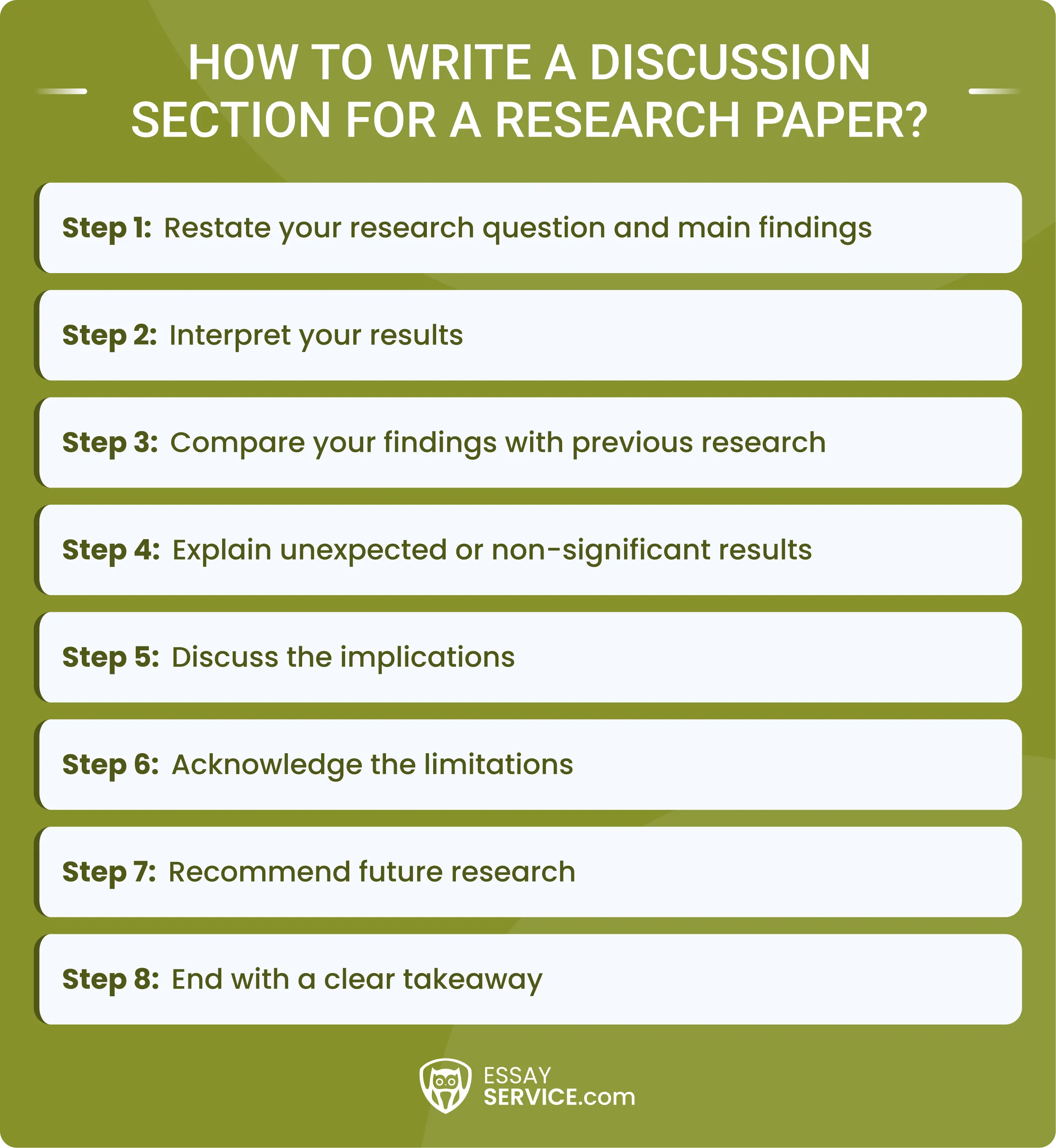
The method for how to write a discussion for a research paper breaks into eight repeatable steps. The sequence opens with a restatement of the findings and closes with a clear takeaway. The numbered list below shows all eight, and each step is worked through with the same running example underneath.
- Restate the research question and main findings
- Interpret the results
- Compare the findings with previous research
- Explain unexpected or non-significant results
- Discuss the implications
- Acknowledge the limitations
- Recommend future research
- End with a clear takeaway
For the following steps, we will use the same example: a study of 120 first-year students testing if a 10-minute mindfulness exercise before an exam lowers test anxiety.
Step 1: Restate your research question and main findings
Open the discussion by reminding readers of the question and the headline result in one or two sentences. Keep it short, because the full data already appeared in the results section. Avoid new numbers here; one representative figure is enough if a figure helps the point land.
For the mindfulness study, the opening would state:
- The research question: Does a 10-minute mindfulness exercise before an exam lower test anxiety in first-year students?
- The main finding: The mindfulness group reported lower anxiety scores than the control group.
- The scope: 120 first-year students across one semester.
Step 2: Interpret your results
Explain what the main finding means in the context of the research question. State the mechanism the data points to, and keep each claim tied to a specific result.
For the mindfulness study, the interpretation could cover:
- The likely cause: A short calming routine may lower physiological arousal before testing.
- The direct answer: Brief mindfulness does reduce reported anxiety in first-year students.
- The strength of the effect: A moderate drop in anxiety scores.
One claim per point keeps the logic easy to follow. Say what the result supports, and avoid stretching the data past what it shows.
Step 3: Compare your findings with previous research
Place the findings next to earlier studies so readers see where the work fits. Note agreements, extensions, and conflicts, and cite each comparison study by name.
For the mindfulness study, a comparison table makes the pattern clear:
Keep the comparison focused on results that speak to the same question. Three or four well-chosen studies beat a long, shallow list.
Step 4: Explain unexpected or non-significant results
Address any result that did not match the hypothesis, and give a plausible, honest reason for it. Label each reason as a possibility the data can actually support. A discussion earns trust when it faces awkward findings and backs every explanation with a stated basis. For the mindfulness study, one result needs explaining:
- The surprise: Anxiety dropped, and exam scores did not improve by a significant margin.
- A plausible reason: Lower anxiety may need more than one session to affect performance.
- A second option: Exam difficulty may have masked any small gain.
Step 5: Discuss the implications
Spell out what the findings mean beyond the study itself, across theory, practice, and policy. Give each level one concrete point that ties to the actual result, and keep every claim proportional. A small anxiety effect justifies a modest classroom suggestion and nothing larger. For the mindfulness study, the implications split cleanly:
Step 6: Acknowledge the limitations
List the real constraints that limit how far the results generalize, and state the effect of each one plainly. An honest limitations list strengthens credibility and guides the next study, so skip the empty line that a study simply has limitations. For the mindfulness study, the main limits are:
- Sample: 120 students at one university, so the results may not hold elsewhere.
- Measure: Anxiety was self-reported, which can bias the scores.
- Design: No long-term follow-up, so lasting effects stay unknown.
- Scope: One exam, one subject, one semester.
Step 7: Recommend future research
Turn each limitation into a concrete next study that targets this study’s gaps, so the recommendations feel earned. Point to specific designs, samples, or measures, and name the question each one answers, because generic calls for more research help no reader. For the mindfulness study, future work could follow this order:
- Run a multi-site trial across several universities for wider samples.
- Add objective anxiety measures, such as heart-rate data, beside self-reports.
- Include a long-term follow-up to test effects on later exams.
- Test different session lengths to find an effective dose.
Step 8: End with a clear takeaway
Close with one or two sentences that state the answer and its limit in plain terms. Leave the full-paper summary for the conclusion. A good takeaway gives readers the single line they will remember and quote. Keep the language direct, and let the result stand as the last word.
For the mindfulness study, the takeaway could read:
- The answer: A 10-minute mindfulness exercise lowers test anxiety in first-year students.
- The limit: The same exercise did not produce a significant gain in exam scores.
- The practical note: Short mindfulness sessions suit anxiety support, with grade effects still open.
Discussion section example
The example of a discussion section of a research paper below uses a hypothetical retrieval-practice study, where 90 undergraduates practiced with quizzing or with rereading before a delayed test. Each paragraph has a bracketed label so you can easily learn how to organize a research paper.
[Main finding] This study asked if retrieval practice improves long-term retention more than rereading among undergraduates. The results answered the question directly. Students in the retrieval-practice group scored 18 percentage points higher on the two-week delayed test than the rereading group. The advantage held for both factual and conceptual items, which confirms that active recall supported durable learning across this sample of 90 students.
[Interpretation] The size of the gap points to a clear mechanism. Each act of recall appears to strengthen the memory trace, which makes the information easier to retrieve later. The pattern fits the idea that effortful retrieval demands more cognitive work and produces stronger memory. Because the advantage grew across the two-week delay, the data suggests that retrieval practice protects against forgetting over time, with the gap widening as the delay stretched on.
[Comparison with previous research] These results line up with earlier work on the testing effect. Roediger and Karpicke (2006) reported similar retention gains from repeated quizzing in college students, and the current findings extend that pattern to a mixed set of factual and conceptual items. The effect size here sits slightly above the classroom averages reported in later reviews, which may reflect the spaced schedule used in this study. No major conflict with prior literature appeared in the data.
[Unexpected results] One result did not match the hypothesis. The low-confidence students gained the most from retrieval practice. The high-confidence students showed almost no difference between the two conditions. A plausible explanation is that confident students already used self-testing on their own, so the structured quizzing added little. This reading stays a possibility, since the study did not measure prior study habits directly.
[Implications] The findings have practical value for teaching. Instructors can replace some rereading time with short, low-stakes quizzes to raise retention at almost no cost. On the theoretical side, the results support models that treat memory as strengthened through use. The effect was moderate, so the sensible recommendation is a modest move toward regular quizzing within existing lessons, and nothing more sweeping.
[Limitations and future research] Several limitations affect how far these results travel. The sample included 90 students at one university, the retention window stopped at two weeks, and the outcome relied on a single test format. Future studies could run the design across multiple campuses, extend the delay to a full semester, and add varied question types. The core takeaway holds: retrieval practice produced stronger long-term retention than rereading, and short quizzes offer a low-cost way to apply it.
Why this example works:
- Each paragraph answers one of the eight steps, so the section stays complete and never drifts off task.
- The main finding comes first with a concrete number (18 percentage points), which gives readers an immediate anchor.
- The unexpected result gets a labeled, honest explanation with a clear basis for the claim.
- The limitations connect directly to the future research suggestions, so every recommendation answers a real gap.
Useful phrases for a research paper discussion section
Discussion section phrases are set academic expressions that signal interpretation, comparison, and caution to the reader. The right phrase signals when a sentence explains a result, links it to prior work, or limits a claim, which keeps the argument precise and easy to follow. The table below groups usable phrases by purpose.
Tips for writing a strong discussion section
These discussion section tips cover the habits that keep an interpretation precise and credible.
- Use the right tense: Write results in past tense, and keep interpretations and established knowledge in present tense. This small consistency makes the argument easier to follow.
- Hedge appropriately: Use “suggests” or “may indicate” when the evidence is limited. Overstated verbs invite reviewer pushback.
- Lead with your most important finding: Open the section with the result that answers the research question. Readers should meet the headline before the detail.
- Keep the focus on your research question: Tie every paragraph back to the original question. Tangents dilute the argument and add length.
- Be concise, and skip a replay of the results section: Interpret the numbers, and reference a key figure only once. Repetition wastes the reader’s time.
- Check your target journal’s or instructor’s guidelines: Confirm the required structure and length before drafting. Each journal sets its own limits.
Your paper, handled by experts
Get custom academic writing built around your brief, backed by solid research and on-time delivery.
Mistakes to avoid when writing a discussion section
These discussion section mistakes show up in drafts across every field, and each one has a direct fix.
- Repeating the results without interpretation: The section restates numbers already given and adds no meaning. Fix it by explaining what each key result reveals about the research question.
- Introducing new results: Fresh data appears for the first time in the discussion, which confuses the reader. Move any new finding back to the results section and interpret it here.
- Overstating findings or claiming causation without support: Strong causal language runs past what correlational data can prove. Match the verb to the evidence, and use “associated with” when causation is unproven.
- Ignoring unexpected or contradictory results: The draft hides findings that clash with the hypothesis, which weakens trust. Address each odd result and offer a plausible reason.
- Listing limitations without explaining their impact: A bare list names constraints and skips their effect. State how each limitation affects the interpretation.
- Vague future research suggestions: Generic calls for more study give the reader nothing to act on. Name a specific design, sample, or question for the next study.
If you have to start or reply to a board in your college assignment, you can request with us, ‘Write my discussion post for me.’
Final thoughts
A strong discussion interprets results, connects findings to prior work, and faces limitations honestly. The eight-step structure keeps the section complete: restate, interpret, compare, explain surprises, draw implications, note limits, recommend next steps, and close with a clear takeaway. Precise phrasing and claims that match the evidence do the rest.
Frequently Asked Questions
What to include in a discussion section of a research paper?
How long is the discussion section of a research paper?
How to write a good discussion section in a research paper?

Eugene has spent the past 15+ years editing and proofreading articles for academic journals, newspapers, and magazines. His attention to detail and experience power actionable advice on citations, tone of voice, and more.



New posts to your inbox
Your submission has been received!