.webp)
A report is a document that presents some kind of information that the writer has previously gathered. Any kind of a report starts by defining its purpose and gathering information by researching, then, little by little, creating an outline, drafting the report according to it, and revising everything to meet all standards. And don’t forget report formatting, either, because a reader who opens a report and finds walls of unbroken text, no headers, no logic to the order, will assume the content underneath is just as disorganized.
For this article, I tried to gather all the necessary information you may need if you’re learning how to write a report. We’ll move through the main types, key components, writing steps, and general best practices for writing a successful one.
What Is a Report?
A report takes something raw, data, an observation, a set of research results, and turns it into a document someone else can act on without having to dig through your notes themselves. A lab report tells your professor that an experiment produced a valid result. A business report tells a manager where the quarter's numbers landed (these are just examples off the top of my head; we’ll get into the different report types in the next section). The length and the purpose of a report changes on the course you’re writing it for and, of course, the field. But the main skeleton underneath mostly stays unchanged and includes an introduction, body paragraphs split into logical sections, and a conclusion.


Reports Due Tomorrow?
Get a professional to handle the research, structure, and polish while you focus on everything else.
Types of Reports
Years of reading and writing taught me one very important thing, that just because a progress and lab reports are both called “reports” doesn’t mean that they share a fixed format. They come in different shapes and forms. Past that surface similarity that we just talked about above, the distinct documents have little in common. Here are six types of reports you'll run into most often, along with what each is built to do and where you'll typically be asked to produce one.
Standard Report Format
A full report writing format typically runs through nine parts: title page, abstract, table of contents, introduction, methodology, findings, discussion, conclusion, and references/appendices. Shorter reports drop what they don't need, a progress update doesn’t bother with an abstract, but longer research reports tend to keep every piece in order.
.png)
Title Page
The reader needs to know what they’re reading first, and who wrote it. Include:
- Title
- Your name
- Date
- Course/organization
A cluttered title page creates a bad first impression, and it does so before the reader even reaches your introduction.
Abstract
An abstract, or as some assignments call it, an executive summary, is a brief block of about 150-200 words that covers the purpose, methodology, and key findings of your report. You put it on the first page, but anyone experienced (myself included) will tell you to write it last, because drafting it before you write the actual report tends to produce something vague and half-formed.
Table of Contents
Lists each section alongside its page number. Required once a report crosses roughly ten pages. Optional below that. Most word processors build this automatically once headings are applied correctly, so there's really no excuse for typing one out by hand in 2026.
Introduction
States the topic, the purpose, and what's coming. A solid introduction, in my experience, answers three questions without dragging them out:
- What problem or subject does the report address?
- Why should the reader care?
- What will they find in the sections ahead?
Methodology
Explains how the information got gathered in the first place. This section carries the most weight in lab reports and research reports, where a reader needs enough detail to judge whether the process held up. The methods section could include:
- Data sources (surveys, interviews, databases, lab observations)
- Sample size and how participants or samples were selected
- Tools or instruments used (software, lab equipment, measurement devices)
- Timeframe over which the data was collected
- Step-by-step procedure, especially in lab reports where replication matters
- Limitations of the process
Findings
Presents results, not opinions. Numbers, observations, raw data, nothing dressed up yet. Interpretation comes later. Resist the urge to explain everything right here. A table often does this better than a paragraph:
Discussion
Interpretation happens now. What do the numbers actually mean? What patterns surfaced, and did any of them surprise you? I've read reports that jumped straight from data to conclusion, skipping this section altogether, and the gap always shows up somewhere, usually right where the reader needed a bridge and didn't get one.
Conclusion
Restates the main findings and their significance, and nothing else. No new information belongs here, ever. A student once asked whether a late-breaking data point could slide into the conclusion. It couldn't, and it still can't.
References & Appendices
The last part of the report structure references list every cited source, formatted to whatever style the field demands, APA, MLA, Chicago, take your pick. Appendices hold the overflow: raw data, survey questions, extended calculations, anything too bulky for the main body but still worth keeping nearby.
How to Write a Report in 6 Steps
The key to simplifying the report writing process is the same as for any complex academic paper, which is to just break the thing down into stages. Define your purpose, research the topic, outline, draft, revise, then proofread. Skip one of these, and it tends to show up later, usually right when you're least prepared to fix it.
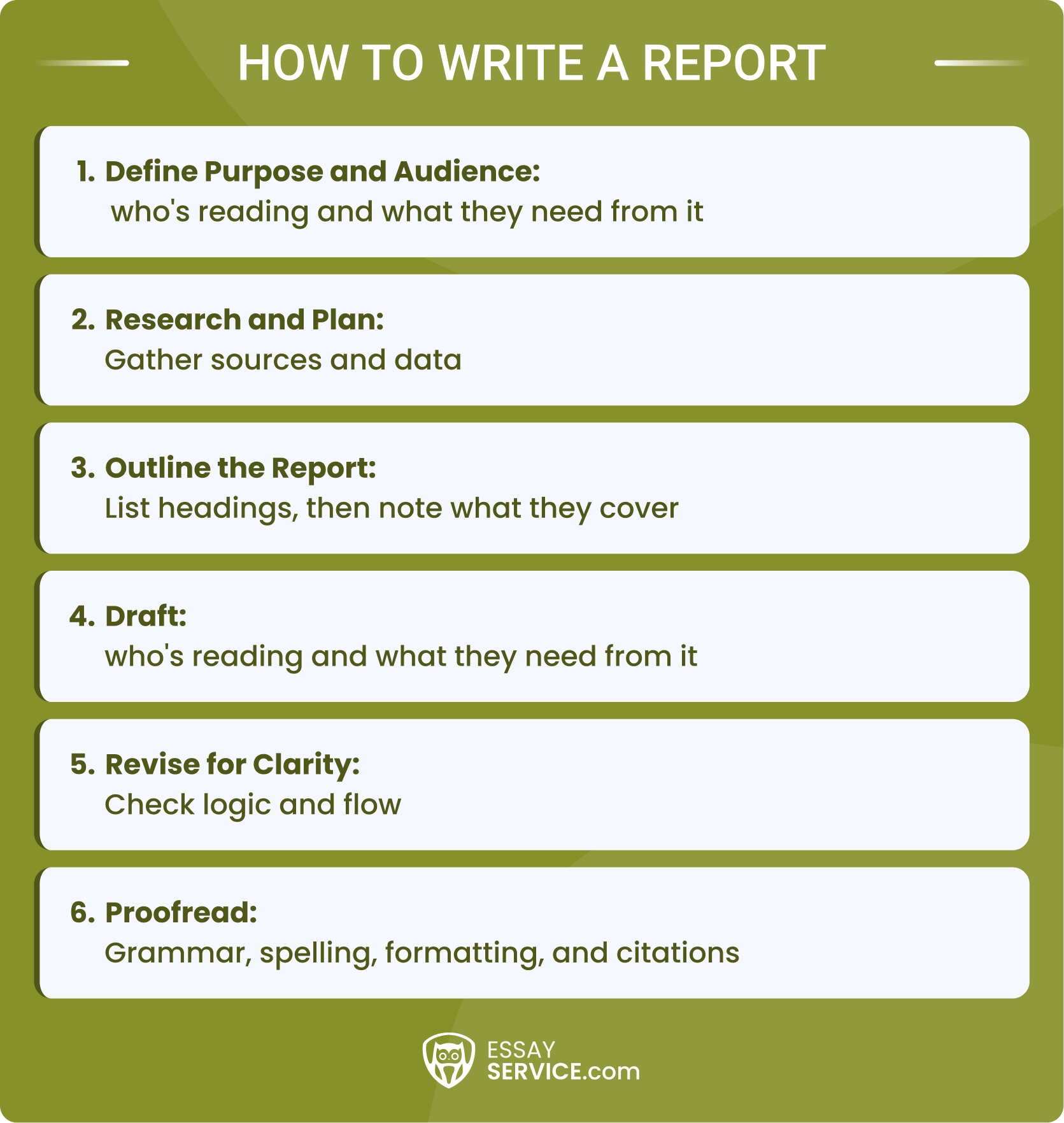
Define Purpose and Audience
The first question you should ask yourself is “Who is going to read this?” A report written for a professor doesn't read the same as one written for a client, or a manager skimming it between meetings. Ask a few questions upfront:
- What decision or action should the reader take after finishing it?
- How much background does the reader already bring to the topic?
- What tone actually fits, formal, technical, something more conversational?
Gather Information and Plan
Gather sources before organizing anything, and gather more than feels necessary at first. Pull from journals, verified databases, and primary data collected firsthand where possible. Track citations as you go rather than after the fact, because reconstructing a source list at 2 am, the night before something's due, ranks among the worst ways to spend an evening. A simple table keeps this manageable:
Outline the Report
Map the report layout before a single paragraph of real content gets written. List headings first, then drop two or three bullet points under each covering what that section needs to accomplish. This step, of everything on this list, saves the most time down the line. A rough book report outline, for instance, might run something like:
- Introduction: title, author, brief context
- Summary: main plot points, key events
- Character Analysis: main characters, their motivations
- Themes: central ideas the book explores
- Conclusion: personal evaluation, overall impression
Create a Draft
Start writing a report with the body paragraphs. Save the introduction and conclusion for last, since introducing a report gets a lot easier once you actually know what it says. Don't edit while drafting. That's a separate task entirely, and blending the two only slows both down.
Revise
Read through once for logic and flow, not grammar, not yet. At this point, all sections must support the ones before them, and you should cut anything that circles back to a point already made. Hand it to a classmate if the deadline allows for that. A second pair of eyes tends to catch gaps a writer stops noticing after the third read-through.
Proofread
Grammar, spelling, formatting, citation style, all of it, last. Read the report aloud, or backward, sentence by sentence. Either method catches errors that eyes slide right past when reading normally, front to back, at a reasonable pace.
And lastly, if you need an extra set of eyes to go through your writing and catch all the small details you could have missed, you can always contact someone from our report writing service.
Report Examples
Writing reports successfully includes following the structure without skipping steps, stating the purpose early, and backing every claim with actual evidence instead of vague statements. Below are three examples, each a different type, each built the way a strong report should look once it reaches a reader's desk.
Report Example #1: Business Report
Q2 Sales Performance Review: Northeast Region
This report reviews Q2 sales performance for the Northeast region, comparing results against Q1 and against the annual target. The goal is to identify what drove growth and where the team fell short, so leadership can adjust Q3 strategy accordingly.
Revenue exceeded target by 3.9%. New client acquisition grew 57% over Q1, largely from the referral program launched in April. The referral program drove most of the client growth, not the paid ad campaign, which underperformed its cost projections. Retention improved slightly, likely tied to the new account manager check-in process rolled out in May.
Q2 outperformed target on all three metrics. Recommend reallocating ad spend toward the referral program for Q3, and extending the check-in process to the Southeast region.
Report Example #2: Lab Report
Effect of Light Intensity on Photosynthetic Rate in Spinach Leaves
This experiment measures how varying light intensity affects the rate of photosynthesis in spinach leaves, using oxygen bubble production as a proxy measurement.
Spinach leaf discs were submerged in a sodium bicarbonate solution and exposed to light at four intensities (200, 400, 600, 800 lux), measured with a light meter positioned 15 cm from the sample. Oxygen production was recorded via bubble count over five-minute intervals, three trials per intensity level.
Bubble production increased with light intensity up to 600 lux, then plateaued, suggesting the leaf discs reached maximum photosynthetic capacity around that point. This lines up with the expected saturation curve, where another limiting factor, likely CO2 availability, takes over.
Light intensity affects photosynthetic rate up to a saturation point near 600 lux, beyond which other factors constrain the reaction.
If you need to write something similar to the example above and are struggling with the contents, our custom lab report writing service can help you out.
Report Example #3: Academic/Research Report
The Impact of Remote Work on Employee Productivity: A Review of 2023–2025 Studies
This report reviews existing research on remote work and productivity published between 2023 and 2025. It finds mixed results depending on job type, management style, and employee autonomy, with no single consistent trend across industries.
Remote work adoption expanded rapidly following 2020, and researchers have since produced conflicting findings on its effect on output. This report synthesizes that research to identify patterns worth further study. Twelve peer-reviewed studies published between 2023 and 2025 were reviewed, selected for sample sizes above 200 participants and industries spanning tech, finance, and healthcare administration.
Eight of twelve studies reported productivity gains in roles with clearly defined, individual tasks. Four reported declines in collaborative, team-dependent roles, citing communication delays as the primary factor. The split suggests productivity outcomes depend more on job structure than on remote work itself. Roles requiring frequent real-time collaboration appear more vulnerable to the format's drawbacks than solitary, output-based roles.
Remote work's effect on productivity isn't uniform. Future research should isolate job type as a variable rather than treating remote work as a single, consistent condition across roles.
Out Of Time To Write?
Hand your report over to us and get a polished draft back before your deadline.
Extra Tips for Effective Report Writing
A handful of habits separate a report that actually gets read from one that gets skimmed and shelved. None of these are rules exactly. They're just things that keep working, assignment after assignment:
- Keep paragraphs short, three to five sentences tends to work best, especially in business and technical reports
- Lead each section with its main point first, then support it, not the reverse
- Reach for a table or a chart once a data set passes three or four numbers
- Write the executive summary or abstract last
- Cut adjectives that aren't doing any work. "Significant increase" says less than an actual number does
- Number your pages, and once you cross ten of them, add a table of contents
- Read the report as your intended audience would, not as the person who wrote it, before you submit anything
What to Avoid When Writing a Report
Most weak reports fail for a small set of recurring reasons, and rarely because the underlying research was bad. Watch for these:
- Burying the main finding somewhere in paragraph four, instead of stating it up front where it belongs
- Letting opinion slip into the findings section, when it should wait for discussion
- Writing an abstract that promises results the report never actually delivers
- Skipping methodology in a lab or research report, which leaves the reader with no way to judge whether your process held up
- Leaning on passive voice so heavily that nobody can tell who actually did what
- Padding the word count with filler instead of tightening the argument down to what matters
- Formatting inconsistently, mismatched fonts, uneven spacing, headers that don't follow a clear hierarchy from one section to the next
- Submitting without proofreading. Spelling errors undercut credibility faster than most students expect
Final Thoughts
A report works when its structure, purpose, and evidence actually line up with each other. Know your report structure, match the type to the assignment, follow the six steps in order, and proofread before you submit. Get that right, and the format takes care of itself.
Frequently Asked Questions
What Does a Report Look Like?
How Long Is a Report?
How to Start a Report?
How to Structure a Report?

- Report. (n.d.). In Student Academic Success. https://www.monash.edu/student-academic-success/excel-at-writing/how-to-write/report
- Writing the report | Australian National University. (2020). In https://www.anu.edu.au/students/academic-skills/writing-assessment/report-writing/writing-the-report
- Scotland - English and Literacy - Factual Writing - Report - P2, P3, P4, P5, P6, P7 - First and Second Level classroom and home learning for Curriculum for Excellence with BBC Bitesize Scotland. (n.d.). In BBC Bitesize. https://www.bbc.co.uk/bitesize/articles/zffy92p



New posts to your inbox
Your submission has been received!