Key Takeaways
- SFWA says a short story can be anything under 7500 words. Most classes will require you to write 1000-3000 words.
- It should have one conflict, probably one or two characters, and happen over the course of a short amount of time.
- The short story is a work of fiction. The narrative essay is based on fact. This is where most people get confused.
- Most stories fail the same way: too many characters, too much backstory, a late-starting scene.
- If your story is less than 1000 words it is considered a Flash Fiction piece.
A short story, unlike a novel, is fiction built around a core conflict, often with a limited cast of one or two characters and a concentrated timeframe, designed for a single sitting. That’s why getting short story writing right is so tricky. You have to condense everything you want to say into your piece.
This article explains how to write a short story with the proper short story format, and the steps with examples. Whether this is your first attempt or your tenth revision, here's what you need to know.
What is a short story?
A short story is a complete work of fiction built around one central conflict, resolved within a single, relatively short narrative, usually read in one sitting. Unlike a novel, it doesn't have room for multiple subplots or a large cast of characters; instead, it draws its power from focus, one significant event, one turning point, one meaningful change explored in depth.
Length is where a lot of confusion starts when learning how to write a short story, since the term covers a fairly wide range depending on the publication or assignment.
Most class assignments fall on the shorter end of that short story range, so always confirm the expected length before you start drafting.
How long should a short story be?
Length comes down whether you're writing for a class or to publish.
- If you're writing for a class, it should be around 1,000-3,000 words. This will always vary depending on your teacher's prompt. If your teacher says write a story 1,500 words long, then that's how long you should make it.
- If you're trying to get published, most publications will call for 2,000-5,000 words. Many have the maximum submission length at 7,500 words, which is the standard SFWA length. There are publications that will call for shorter lengths (under 1,000 words) or occasionally longer, but most will fall within the 2,000-5,000-word range.
Always check the prompt if you’re wondering how to write a short story for a class. And if you're writing to submit, check the guidelines they provide.


Stuck through a draft?
EssayService's writers can help you finish a draft into something submission-ready.
Short story vs. narrative essay
A lot of students get short story writing and narrative essays mixed up, even though they're really not the same.
The key differentiator is truth. A short story can borrow from real life, but it doesn't have to answer to it; characters, events, and outcomes are yours to invent. A narrative essay is bound by what actually happened, and it typically requires you to step back and explicitly reflect on what that experience meant. Mixing the two up, writing a personal narrative when fiction was assigned, is one of the most common ways students lose points on this kind of assignment.
Elements of a short story
Here are the main elements of short story writing you need to know:
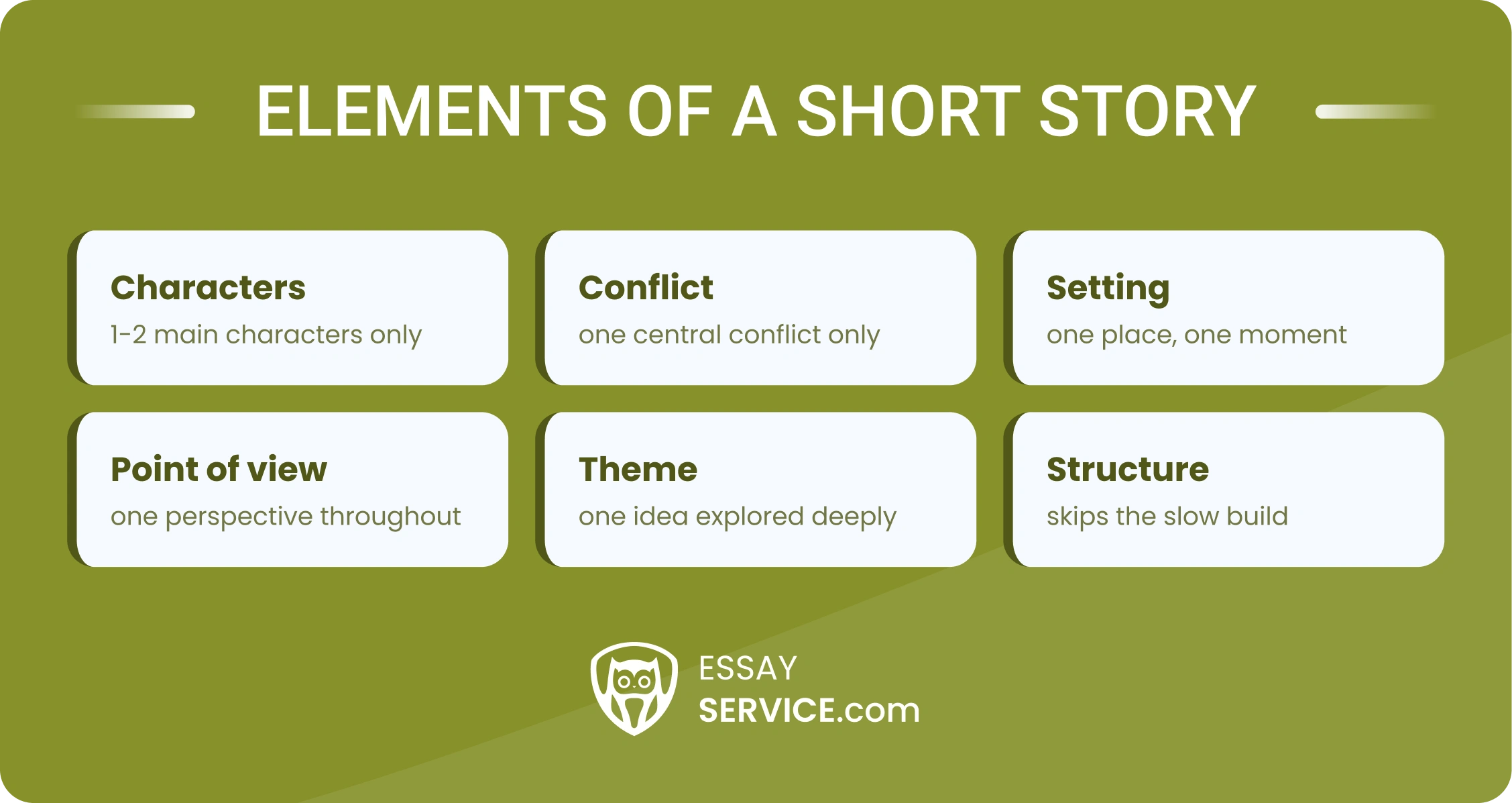
- Characters: You will normally only have one or two main characters in a short story. As opposed to having many in a novel. There's not enough time to spend on your characters if they are going to be used. No filler characters allowed.
- Conflict: Your story should focus on one major conflict. Not like you would have in a novel with multiple conflicts playing out through your story. Which is what makes your short story unique.
- Setting: You will most likely stick to one setting in your short story. Maybe even just one area in that setting, and not jump around to different settings and years. You will have more in-depth detail because you're not jumping around.
- Point of View: Only one point of view will be used. Just like how you would use many points of view throughout your novel.
- Theme: Similar to having only one point of view, you will want to focus on one theme in your short story. There's not enough time to cover many themes.
- Structure: Most short stories skip this step that you would find in your novels. You will get right into the heart of your story.
Short story format
It's important to know what a short story format looks like when completed. There is a general format used in the publication world. Even if you're only trying to submit to your class, it's good to know what it should look like.
- Font: 12pt serif font, typically Times New Roman or Courier.
- Spacing: Double-spaced throughout, no exceptions.
- Margins: 1-inch margins on all sides.
- Header: Your last name, the story's title, and page number in the top corner of every page; word count usually appears on the first page alongside your contact information.
- Paragraphs: First line of each paragraph indented, no extra space between paragraphs.
- Scene breaks: Marked with a centered symbol, often a "#" or "***", signaling a shift in time or place without a full chapter break.
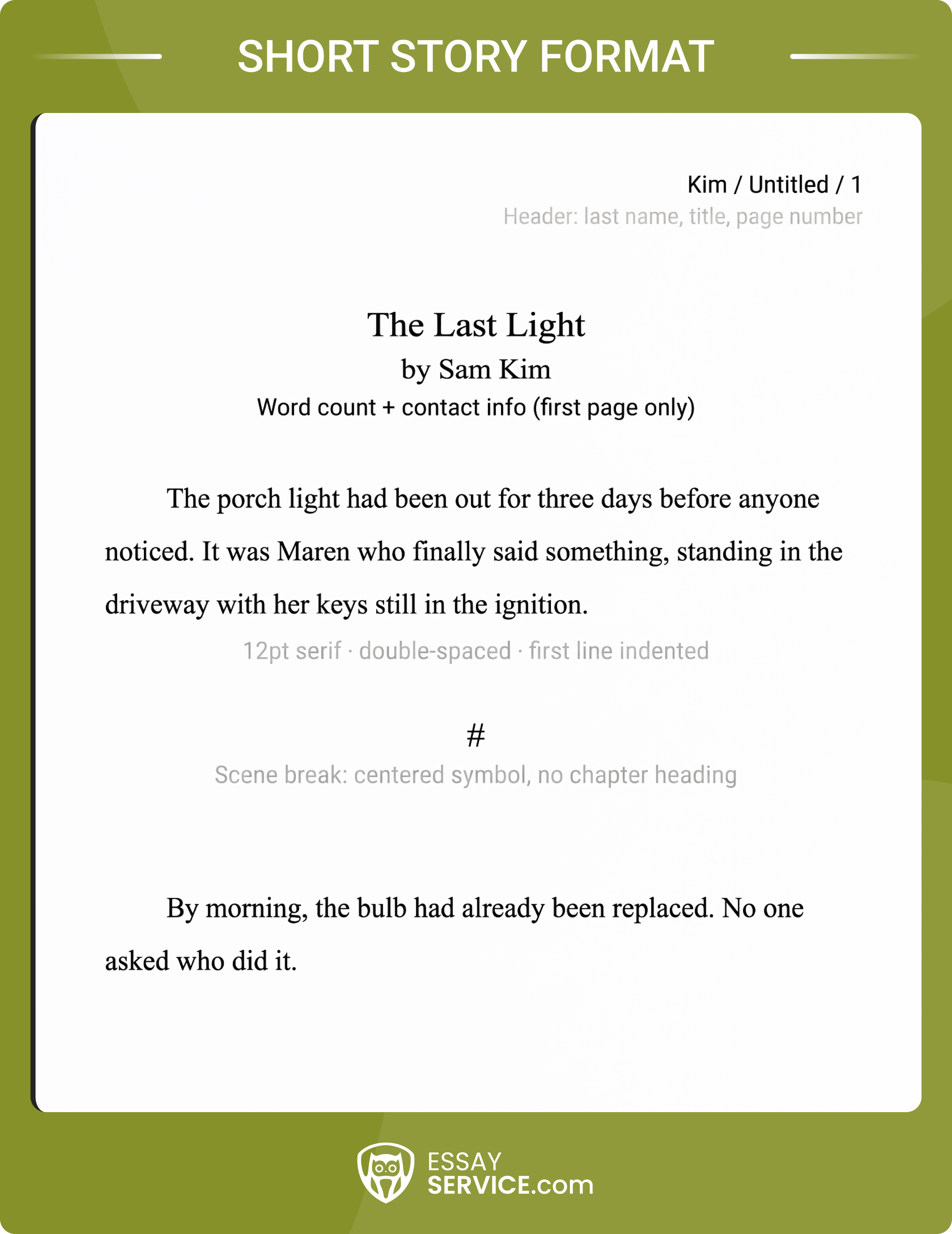
Most people call it the standard manuscript format, or simply Shunn. Most publications will ask you to follow this when submitting your work to them or an agent. For a class assignment, you may not have to follow all of these rules. Most will require you to double-space and have proper margins. But you probably won't need to include your name, address, etc., at the top of your page or know what symbol to put between scenes. Always check your assignment instructions for any requested format.
How to write a short story in 8 steps
Knowing how to write a short story is a process you can work through deliberately, step by step. Here's exactly how to do it.
1. Start with a single idea, not a plot
Every short story starts with one spark: a moment, a question, a "what if," not a fully mapped-out plot. If you try to plan every event before writing, the story can read like a summary instead of a scene. So focus on the one thing you actually want to explore: a character facing a decision, a relationship at a breaking point, or a single consequence of one choice. Everything else should serve that idea. If you can't state your core idea in one sentence, it's still too vague to start drafting.
Concrete tip: Write your idea as a single sentence before you write anything else: "A woman discovers her late mother's letters the night before selling the house."
2. Choose one central conflict
When writing a short story, you only want to focus on one conflict at a time. It can be an internal conflict (guilt), an external conflict (against another character), or both; just make sure it's only one. Most of the time, if you're trying to have more than one conflict, your story will end up with no resolution to any of them. Your conflict should be able to describe what the conflict is and have meaning to your story.
Concrete tip: A solid way to frame your conflict is: "[character] desires [something], yet [obstacle]." If you're struggling to fill in those blanks, you haven't yet pinpointed your conflict.
3. Limit your cast to one or two characters
Each character you create takes up room in your story that you probably don't have. Short stories should only have 1 main character and maybe 1 other. If you go over that, your story will start to feel like you're just throwing names out. You can have smaller characters, but they should not require any development. When editing, you should always be looking for characters to remove. It's better to remove them than leave them in.
Concrete tip: Have a list of all the characters in your story. If that character does not play a role in your conflict or how your story ends, remove them or make them faceless.
4. Choose your point of view and stick with it
Decide if you're going to use first person or third person. Once you choose, stick with it for the whole story. It’s better to stay consistent because switching can make your story seem disjointed. You don't have enough space in your story to explain to the reader why you're writing from another person's point of view. Some stories are better suited to first-person narration, while others will flow better in the third person. Just know what your story requires.
Concrete tip: If your reader needs to understand how your character feels, write in first person.
5. Start as close to the key moment as possible
There isn't much time to ease into a short story. Skip the beginning that most novels start with. Get your reader as close as possible to where your conflict starts. If you find yourself introducing what happened before your story takes place on your first page, you probably started too far back. Your reader will learn what's going on once your story gets rolling.
Concrete tip: Try removing your first paragraph from your story. Most of the time, you will realize that your story started at paragraph two.
6. Use dialogue and action instead of exposition
Try showing your characters by having them speak or act out their traits rather than describing who they are. A good example is using a snappy one-liner or having them perform a specific action that would otherwise require a whole paragraph of explanation. Showing them who they are can help speed up your story and allow your reader to infer some information. With so little room in a short story, revealing character through action and speech is superior to lengthy exposition.
Concrete tip: If a sentence describes how someone feels, show them doing or saying something instead.
7. Build toward a single, earned turning point
All stories have some sort of climax or epiphany that your character will experience. Whether it's learning something, making a decision or reaping consequences from their actions. You want this to come as no surprise to your reader; if you can do that, then your story has flow. Don't try to fit too many climaxes into your short story. One strong climax will go further than you think.
Concrete tip: Make sure you find that one sentence in your story that leads to your ending. Everything before that sentence should lead to it.
8. Revise for compression, not just correction
When you have your draft complete, you should edit with the goal of removing anything that does not further your conflict, such as backstory, descriptive information and unimportant characters. The process of refining a short story is much like stripping away the unnecessary. If something would be fine in a novel, take it out of your short story. Chances are, a scene that does not contribute to the central conflict can be removed.
Concrete tip: Take each paragraph and ask yourself if I removed this, would my story change? If not, remove it and see what happens.
How to start a short story
To understand how to start a short story, you should begin with something happening rather than leading up to it. Here are some examples that will always work.
- Mid-action: "She grabbed onto the rope and began climbing."
- Mid-dialogue: "I told you not to come here."
- A disrupted routine: "Maren noticed her coffee was already made that morning."
- A stated oddity: "It was now Tuesday, and no one was speaking of the lost dog."
All of these will make your reader want to know more.
Avoid starting your story with a character waking up. Don't get bogged down in weather descriptions or backstory either. Your reader isn't interested in the minutiae of your character's morning routine. Get straight to it, because they need to grasp the situation.
How to end a short story
There are typically 3 types of endings to short stories.
- Resolution is when you know for sure how the conflict ends.
- Revelation occurs when someone learns something that may change their perspective on the story.
- An open ending, which can be many things and leave the reader to decide.
Your ending, no matter what type you decide to use, should never come as a surprise to your reader. But it should make them feel as if they knew how it would end from the start of the story. You want your reader to think, "Oh, I knew that would happen," once they read your ending.
Don't force your interpretation of the story upon the reader. Doing so will spoil the effectiveness of your story's conclusion. Have your character state what the moral of the story is, or have your narrator. This is key to understanding how to write a short story right.
How short stories are graded
Florida International University's own published Assessment Rubric for Creative Writing Papers grades students for short story writing on 7 categories listed below. They are all graded as either Strong, Competent or Weak.
- Language: Using the English language effectively at a sentence level.
- Style/Voice: The ability to write with your own unique style/voice. Not bland writing.
- Sense of Genre: Knowing what genre your story fits under.
- Creative and Original: How creative is your idea?
- Theme: How deep your theme goes. "The Profundity and complexity of themes (separate from creativity and originality)." So you can have an original idea, but no deep meaning to it.
- Structure: "How well the student applies and expands upon linear and/or non-linear structures." As well as "depth and coherency."
- Reflection on craft decisions: If they require reflection on your work, this is used to grade them on their knowledge of what they did well and what they could improve.
What’s interesting is how originality and theme are graded separately. You can have an original story, but no meaningful message to go with it. Structure is also graded on coherency, so even if you have all the right beats in your story, if they don't make sense together, it's pointless.
Short story ideas
The best short story ideas start as a specific situation, not an abstract theme. "A story about regret" gives you nothing to actually write; "a man finds a voicemail he can't bring himself to delete" gives you a scene. Here are 12 to get you started, each with a note on the length it tends to suit best.
- A woman finds her late mother's handwriting on a grocery list still stuck to the fridge. (Best for: flash fiction, under 1,000 words)
- A babysitter realizes the child she's watching knows something she doesn't. (Best for: 2,000-5,000 words)
- Two former best friends end up seated next to each other on a delayed flight. (Best for: 3,000-5,000 words)
- A man discovers his neighbor has been feeding his dog for months without telling him. (Best for: 1,000-2,000 words)
- A daughter finds a locked drawer in her recently deceased father's desk. (Best for: 2,000-4,000 words)
- A cashier recognizes a customer from a night neither of them wants to talk about. (Best for: flash fiction to 2,000 words)
- Two strangers get stuck in an elevator during the one conversation both were avoiding. (Best for: 1,500-3,000 words)
- A teacher receives a letter from a former student, years too late to matter. (Best for: 2,000-3,500 words)
- A man returns a borrowed item and realizes the person who lent it to him has moved away without telling him. (Best for: flash fiction, under 1,500 words)
- Siblings clean out their childhood home and disagree about what's worth keeping. (Best for: 3,000-5,000 words)
- A woman keeps receiving mail for the person who used to live in her apartment. (Best for: 2,000-4,000 words)
- A father teaches his child to ride a bike the same week he receives bad news he hasn't shared yet. (Best for: 2,500-4,000 words)
- Two coworkers are the last ones in the office the night the company announces layoffs. (Best for: 1,500-3,000 words)
Common short story mistakes
While understanding how to write a short story, there are certain mistakes that can shorten your piece. Here are some examples to be aware of:
- Having too many characters: If you're trying to write like it's a novel, you're going to overpopulate your story with characters. Don't have more characters than can be worked into 2000 words. If they're not affecting the conflict, remove them.
- Going into too much detail: Your first line should jump right into your story, not go into why your character woke up that morning or something. Cut all unnecessary information.
- Explaining emotions: Instead of telling the reader that your character is angry, show them how they feel angry. If you're describing a scene, try to limit yourself to actions rather than emotions.
- Background: Same thing with background information. If you go into too much detail on the background, you will drag your story down. Show background while your story is progressing.
- More than one conflict: If you're writing about multiple conflicts, your readers will become confused about which one to focus on. Stick to one conflict when writing short stories.
- Telling your moral: If you state the moral of your story, you take away from the point you're trying to make.
- Point of view: Changing your point of view can mess up your readers' experience with your story.
Short stories worth reading
Reading closely is one of the fastest ways to internalize what actually works in short fiction. These four short story examples are all legally free to read in full.
- "Hills Like White Elephants" by Ernest Hemingway — read it via the University of Virginia's digital text archive. Almost the entire story unfolds through dialogue alone, a masterclass in revealing conflict without a single line of direct exposition.
- "The Yellow Wallpaper" by Charlotte Perkins Gilman — read it via Project Gutenberg. A tight, sustained first-person narration that shows a character's psychological state deteriorating through what she notices, not through the narrator telling you outright.
- "The Gift of the Magi" by O. Henry — read it via Project Gutenberg. A compact two-character story built entirely around one earned, ironic turning point that reframes everything that came before it.
- "The Tell-Tale Heart" by Edgar Allan Poe — read it via Project Gutenberg. A single sustained conflict carried by an unreliable narrator, showing how tightly a short story can wind tension around one voice and one obsession.
Want a second pair of eyes?
EssayService can review your story against the same criteria instructors grade
Final Words
When writing a short story, you want to have 1 conflict and maybe 2 characters. You don't need an introduction or an ending that they can't see coming. Follow these formatting tips, the 8 steps and how to use the rubric to your advantage when writing your short story. Finally, mentor texts will help you understand all of these tips.
Frequently Asked Questions
How long should a short story be?
How do you start a short story?
What are the elements of a short story?
What's the difference between a short story and a narrative essay?
How many characters should a short story have?
What format should a short story be in?
Can a short story be based on a true story?
How do you come up with short story ideas?

Jennifer is a student currently pursuing a Journalism major. She oversees the EssayService blog team and uses her journalism skills to ensure all blog posts are accurate, trustworthy, and engaging.


New posts to your inbox
Your submission has been received!