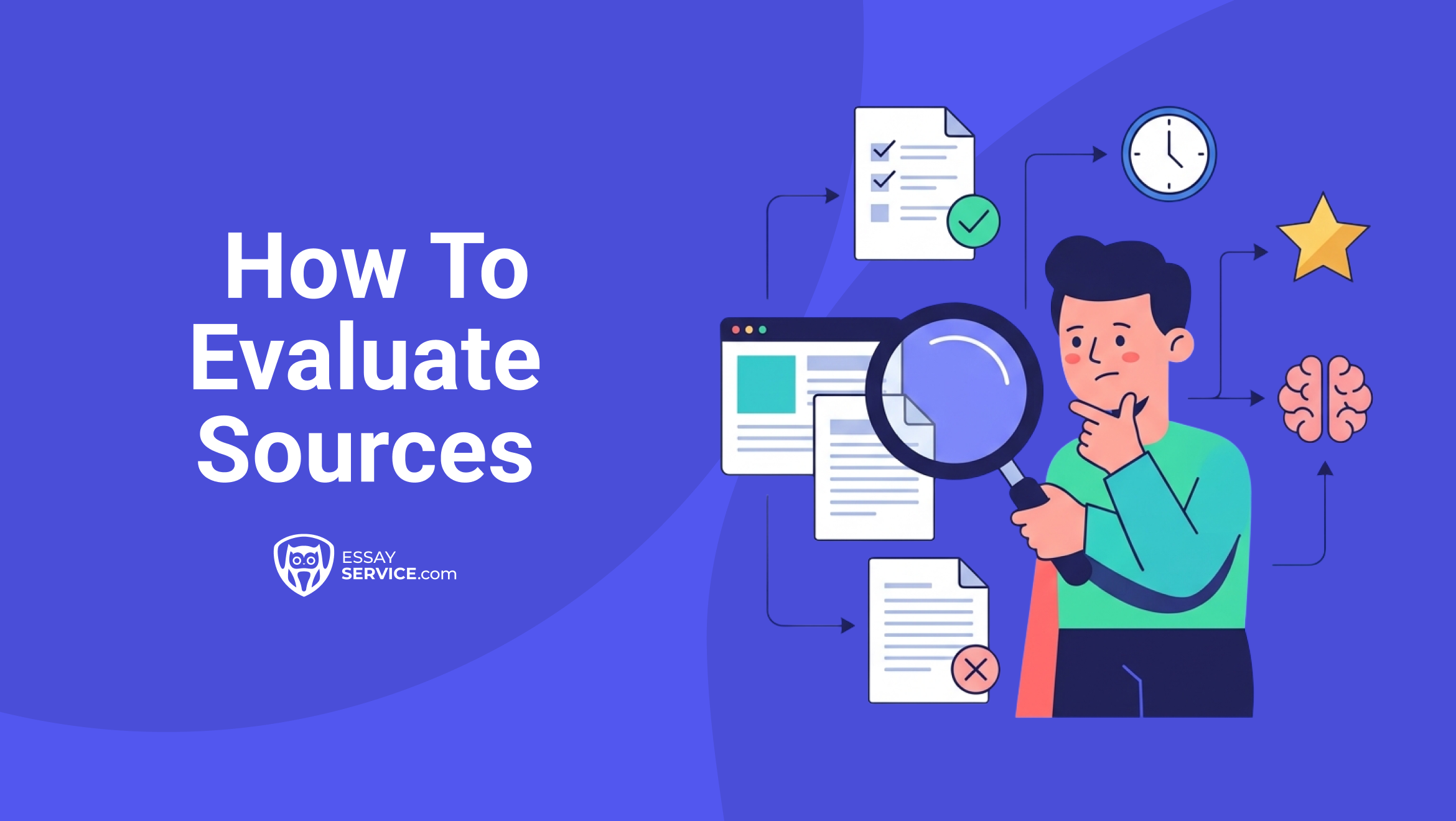
Type a research question into any search bar and you'll have millions of results before you've finished blinking. That number is the whole problem. Somewhere in there you can find exactly what you’re looking for, buried under pages that are biased, years out of date, or just wrong in ways nobody caught.
So what's a reliable source? The honest and brief answer is that it comes from a qualified author or institution, it shows its evidence, and it survives a cross-check against other credible websites. This guide walks through what makes credible sources for research worth your time.


Research Made Easy
Our writers dig through the credible sources for you and turn them into a paper with the right citations.
What Is a Credible Source?
A credible source hands you accurate, well-supported information from someone who actually has the authority to speak on the subject. You can see who wrote it. The publisher has a reputation, and the claims trace back to evidence you're able to inspect for yourself, which is really the test that matters most. That's your floor for any reliable source for research.
.webp)
Now, sources come in three types, and I'd argue that recognizing which one you're holding matters more than most people give it credit for.
Why Is It Important to Use Credible Sources in Research?
Any conclusion is only as strong as the material that it’s standing on. The moment you choose your evidence, that ceiling of strength is already fixed. Base your argument on a random blog post with no one credible behind it, and it won’t even need much pressing from a professor before you’ll see its faults. Good credible research sources, besides the obvious benefit of improving your grade, also protect your name and the trust of whoever reads your work (which is arguably the most important in academia). There is also a person somewhere down the line who will cite you, and keeping them from repeating something false is its own kind of favor.
How Do You Know if a Source Is Credible?
The first question worth asking before you decide whether or not to use a source is who wrote it and what qualifies them. Then, of course, the date, because a statistic from 2009 can undo an otherwise perfect paper. In fact, some fields consider sources from even 5 years ago not trustworthy, so check carefully. After that, check whether the claims in the source have actual evidence that you’ll also see in a few other places. An identified expert, current data, no agenda being pushed - these are usually safe.
Are Gov and .Edu Websites Considered Credible?
Most of the time, yes, because addresses ending in .gov or .edu trace back to a government body or an accredited school, and that pedigree makes them more trustworthy sources you'll come across. A .edu domain can still occasionally host some student’s personal page from 2011, so I’d still run my due diligence. Plus, official government figures have a way of going stale if the same research isn’t conducted regularly.
What Are Non-Credible Sources?
The most noticeable patterns about non-credible sources are:
- No way to verify its claims (no hard evidence)
- You can’t see who the author is
- Serves an interest other than informing
- Outdated content
Here are the most frequent ones were seen among the non credible sources examples:
- Anonymous blog posts
- Social media threads
- Wikipedia pages
- Clickbait news outlets
- Corporate pages
- Personal forums
I'd add unreviewed AI output to that list, since it has become a common trap. Few of these are useless in every context, and building serious work on them invites problems.
How to Evaluate Sources Using the CRAAP Test?
The CRAAP test came out of a university library back in the mid-2000s, and the mere fact that we keep using it after 20 years says something about how it holds up. Each letter of the abbreviation poses a question everyone must ask about the source before extending any trust.
1. Currency: start with the date. When was the piece published/last revised? In medicine or technology, or any other field that moves so quickly, anything past 3-4 years deserves a more careful look. The same isn’t true, obviously, for a subject like Renaissance history. A page with no date at all has already told you something about the care behind it.
2. Relevance: confirm it answers your actual question. Even the most perfect, data-heavy article will not help you if it does nothing but slightly brush against your topic. A simplified explainer and a peer-reviewed study both contain real information, yet only one belongs in a university paper.
3. Authority: establish who is speaking. Does the author actually have the relevant qualifications to write on the subject? Pay attention, also, to who runs the publication, because credible websites name their contributors and make their expertise easy to find. The domain matters as well, and addresses ending in .gov or .edu tend to carry more institutional weight.
4. Accuracy: put the claims under pressure. A trustworthy source links out to any evidence it uses. Check its assertions and confirm that other reputable outlets also confirm them independently.
5. Purpose: ask why the page exists. Inform, persuade, sometimes nothing beyond your click or your wallet - every source has an intention behind its creation. Once that intention comes into view, whatever bias runs through the writing tends to surface, and you can read the content with clearer eyes.
List of Credible Sources for Students
Below you'll find handpicked examples of reliable sources sorted into five buckets: general research databases, history archives, medical references, scientific publications, and statistics portals. Each site earns its place through named authorship, institutional backing, and a record you can actually verify.
Most Reliable Websites for Research Paper
- Google Scholar: A free search engine from Google that indexes scholarly articles, theses, and conference papers across nearly every discipline, complete with citation counts to gauge influence.
- JSTOR: Run by the nonprofit ITHAKA, this digital library archives back issues of academic journals and books, and it's especially strong in the humanities and social sciences.
- PubMed: The National Library of Medicine maintains this database of more than 35 million biomedical citations, making it the first stop for anything health or life-science related.
- ScienceDirect: Elsevier's platform hosts full-text articles from thousands of peer-reviewed journals spanning physical sciences, engineering, and medicine, though much of it sits behind a paywall.
- ERIC: Sponsored by the U.S. Department of Education, the Education Resources Information Center gathers reports, papers, and journal articles for anyone researching teaching and learning.
- Semantic Scholar: Built by the Allen Institute for AI, this free tool uses machine learning to surface the most relevant papers and pull out key findings for you.
- Project MUSE: Johns Hopkins University Press operates this collection, which delivers peer-reviewed journals and books concentrated in the humanities and social sciences.
- Directory of Open Access Journals: DOAJ is a community-curated index that lists tens of thousands of vetted, freely accessible journals, so nothing here hides behind a subscription.
- CORE: Aggregating open-access research from repositories worldwide, CORE gives students millions of full-text papers without a login, backed by the UK's Open University.
- BASE: Bielefeld University in Germany runs this academic search engine, which reaches into repositories that standard search engines often miss entirely.
Most Reliable Historical Websites
- Library of Congress: The research arm of the U.S. Congress and the largest library on earth, offering digitized manuscripts, photographs, maps, and newspapers going back centuries.
- National Archives: Original American government records live here, from the Declaration of Independence to census rolls and military files, all preserved by the federal archival agency.
- Internet History Sourcebooks: Fordham University assembled this collection of public-domain primary texts, ideal when you need actual documents from the ancient, medieval, or modern eras.
- The British Library: Britain's national library has digitized illuminated manuscripts, historic maps, and rare printed works, and its online galleries come with expert commentary attached.
- Avalon Project: Hosted by Yale Law School, this archive publishes primary documents in law, history, and diplomacy, organized cleanly by time period from antiquity onward.
- Europeana: Funded by the European Union, the platform pulls together digitized art, artifacts, and records contributed by thousands of galleries, libraries, and museums across the continent.
- Digital Public Library of America: DPLA is a nonprofit that connects the collections of American libraries and archives into one searchable portal, free for everyone.
- Perseus Digital Library: A Tufts University project focused on the classical world, Perseus provides original Greek and Latin texts alongside translations and study tools.
- Smithsonian: The world's largest museum and research complex shares digitized collections spanning natural history, culture, and American life, drawn from its many institutions.
- HathiTrust: A partnership of academic and research libraries, HathiTrust preserves millions of digitized volumes, a large share of them full-text and in the public domain.
Most Reliable Medical Websites
- MedlinePlus: Produced by the National Library of Medicine, this plain-language site explains conditions, medications, and tests for patients rather than clinicians, with no advertising.
- Mayo Clinic: One of the most respected nonprofit medical centers in the U.S. publishes symptom guides and treatment overviews written and reviewed by its own physicians.
- Cochrane Library: Cochrane is an international nonprofit whose systematic reviews sit at the top of the evidence hierarchy, synthesizing many studies into one reliable conclusion.
- World Health Organization: The WHO, a United Nations agency, releases global health data, disease guidance, and reports that shape public health policy worldwide.
- Centers for Disease Control and Prevention: America's national public health institute posts current statistics, prevention guidance, and outbreak updates that carry serious institutional authority.
- National Institutes of Health: As the primary U.S. agency for medical research, the NIH offers findings, clinical trial information, and health topics across its many institutes.
- Cleveland Clinic: This academic medical center runs a large health library where its clinicians break down diseases, procedures, and treatments in accessible terms.
- The BMJ: Published by the British Medical Association's publishing group, The BMJ is a peer-reviewed journal known for rigorous research and clinical evidence.
- NHS: Britain's National Health Service maintains a health information site covering symptoms, conditions, and treatments, all vetted by medical professionals and free of commercial interest.
- PubMed Central: A free full-text archive from the National Library of Medicine, PMC lets you read complete biomedical papers rather than abstracts alone.
Most Reliable Scientific Websites
- Nature: A flagship peer-reviewed journal published by Springer Nature, Nature reports landmark research across the sciences and remains one of the most cited titles in the world.
- Science: The American Association for the Advancement of Science puts out this weekly journal, which pairs original research with news and analysis for a broad scientific audience.
- PLOS: The Public Library of Science is a nonprofit open-access publisher, so its peer-reviewed journals can be read in full by anyone at no cost.
- arXiv: Cornell University operates this open repository where physicists, mathematicians, and computer scientists share preprints, often months before formal publication elsewhere.
- NASA: The U.S. space agency publishes data, imagery, and research on astronomy, earth science, and space exploration, much of it usable directly in student work.
- bioRxiv: Cold Spring Harbor Laboratory runs this preprint server for the life sciences, giving early access to biology research still awaiting peer review.
- SpringerLink: Springer Nature's platform provides access to a vast catalog of scientific journals, books, and reference works, a portion of it open and the rest subscription-based.
- Scientific American: The oldest continuously published magazine in the U.S. translates complex research into readable articles, frequently written by the scientists doing the work.
- Wiley Online Library: Publisher Wiley hosts thousands of peer-reviewed journals and reference titles here, covering everything from chemistry to the social sciences.
- National Science Foundation: This independent U.S. government agency funds research and shares reports, data, and discoveries across nearly all non-medical fields of science.
Most Reliable Statistics Websites
- U.S. Census Bureau: The federal agency responsible for the national census offers detailed demographic, housing, and economic data that researchers rely on constantly.
- Bureau of Labor Statistics: Part of the U.S. Department of Labor, the BLS tracks employment, wages, inflation, and productivity, releasing figures on a regular published schedule.
- Pew Research Center: A nonpartisan nonprofit based in Washington, Pew conducts public opinion polling and demographic studies on politics, technology, religion, and social trends.
- World Bank Open Data: The World Bank makes its global development indicators freely available, covering economies, population, and poverty across nearly every country.
- OECD: The Organisation for Economic Co-operation and Development compiles comparative statistics on its member nations, useful for economics, education, and policy research.
- Our World in Data: A collaboration tied to the University of Oxford, this project presents long-run data on global problems through clear charts and thorough explanations.
- Statista: A German company that consolidates statistics from thousands of sources into ready-to-use charts, though its fuller features require a paid account.
- Eurostat: The statistical office of the European Union publishes harmonized data on its member states, spanning the economy, population, trade, and the environment.
- FRED: Maintained by the Federal Reserve Bank of St. Louis, FRED houses hundreds of thousands of economic time-series that you can chart and download instantly.
- Gallup: Known for its long-running polls, this analytics firm measures public opinion and workplace trends across the globe, with decades of data behind its name.
A professional essay writing service such as ours can help you identify the right sources and use them to give you a hand in building structured, well-researched papers.
Deadline Closing In?
Hand your assignment to seasoned writers and get a polished, original paper back on time.
Final Thoughts
Credible sources come from qualified authors, show their evidence, and hold up when you cross-check them. Run any page through the CRAAP test before citing it, lean on vetted databases and .gov or .edu sites, and always confirm the author and date yourself.
Frequently Asked Questions
What Are Credible Sources for Research?
Is .edu Reliable?
Is .com a Credible Source?
Is .org Reliable for Research?
.png)
Jaroslav specializes in helping students unlock their creative side and let it shine. Armed with his Bachelor’s degree in creative writing, he imparts his advice on making communication effective and engaging.
New posts to your inbox
Your submission has been received!