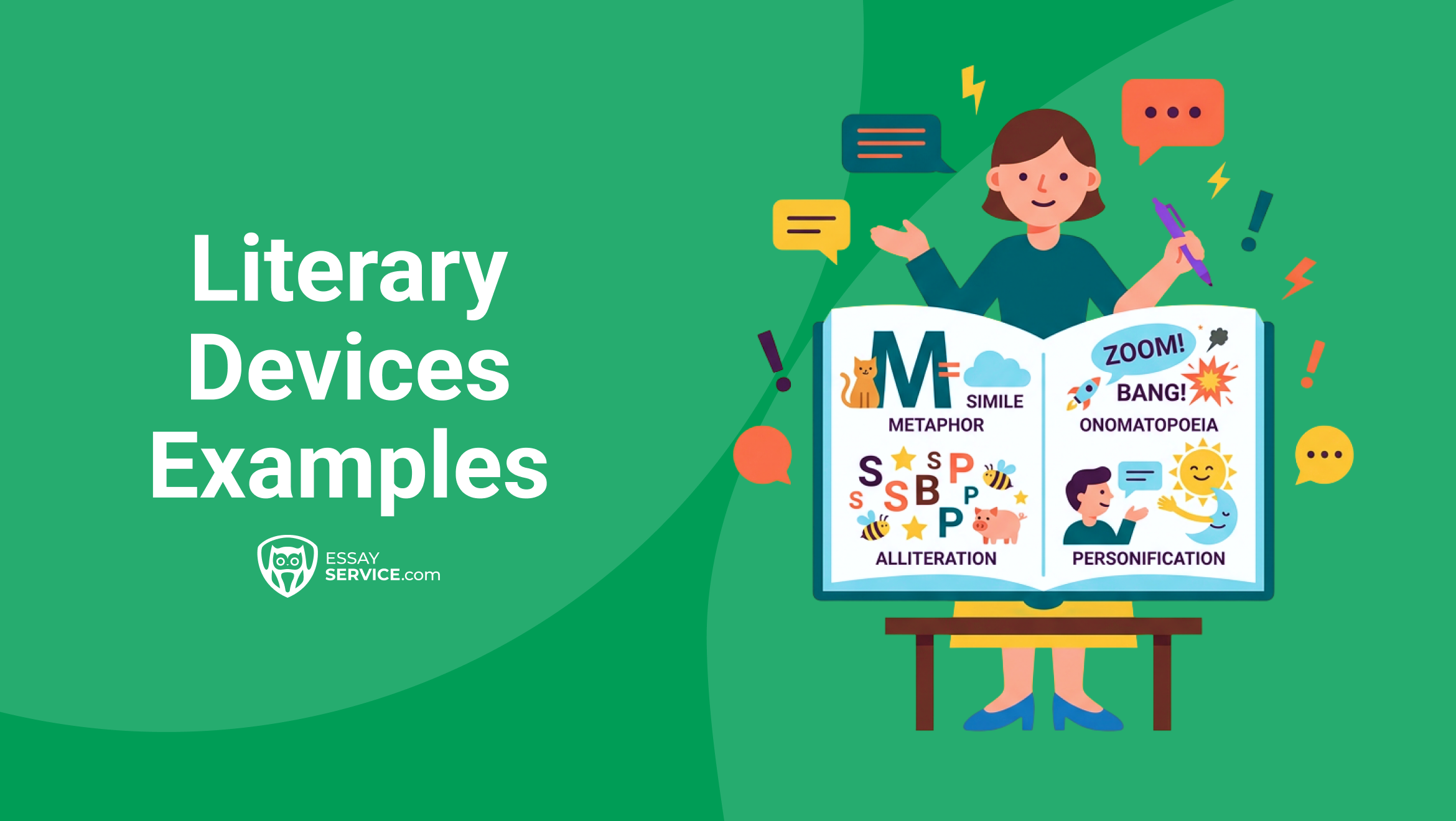
William Shakespeare could have written: “Life proceeds along a predetermined course.” But no, he had to say it like this: “the slings and arrows of outrageous fortune.” That space between what’s simply said and what’s brilliantly written is what literary devices bridge.
The problem is that most students can recognize a well-written line but don’t know what it’s called. Wait… Was that a metaphor or a simile? Foreshadowing or irony? Personification or symbolism? Too many of these terms get confused quickly, plus most passages use more than one device.
So in this article, we’ll go through the most common literary devices examples, give you easy definitions and real examples so you can know (and use!) them with confidence.
What are literary devices?
Literary devices control the flow of a text. They dictate how meaning is implied underneath the words on the page, how emotion is evoked at just the right time, how time expands or contracts in a story, and how a character can show the reader who they are without the narrator explicitly telling them.
If a simple sentence can tell you that something is true, a literary device can help you feel it, remember it, or see something you didn't realize was there. Literary devices matter because they allow us to read multidimensional texts that captivate us as readers, rather than one-dimensional texts that merely inform. Literary devices can even do structural work.
They develop characters by showing rather than telling what a character is like through their actions or words. They build plots by creating suspense, hinting at what is to come, or making connections within a story that may feel disjointed at times.
Literary devices vs. literary elements vs. literary techniques
Literary devices are the umbrella term. Literary elements and literary techniques are subsets of literary devices.
- Literary elements are "large-scale" literary devices that apply to a work as a whole. These devices shape the whole work, not a single moment. Point of view, tone, and conflict are literary elements because they shape the story as a whole, rather than a specific sentence.
- Literary techniques are literary devices that function at the word or sentence level. These devices are used within the story, not across the entire work. Metaphor, hyperbole, and onomatopoeia are literary techniques because you would find them in one line rather than encompassing the whole story.
Think of the distinction this way. You'll see why some literary devices refer to the story's structure, while others describe one cool sentence. They happen at different levels within the story.


Need Help Analyzing Literary Texts?
Get expert support with literary analysis, essays, research papers, and literature reviews.
24 common literary devices and examples
Certain literary devices are prevalent enough throughout novels, poems, and speeches that you'll know them automatically after reading a few solid examples. Here are 24 of the most common literary devices examples, complete with a simple definition and an actual excerpt demonstrating how it's used.
1. Metaphor
- Definition: A direct comparison between two unrelated things, stating one IS the other (no "like" or "as")
- Example from Literature: "The fog comes on little cat feet" — Fog by Carl Sandburg
- Modern Example: "Time is a thief" — one of the most common examples of literary devices used across countless modern songs and films to describe how quickly time slips away
- Why It Matters: A metaphor doesn't just decorate a sentence, it reshapes how the reader understands the thing being described, forcing two unrelated concepts to merge into one
- Student Tip: A strong metaphor should carry real weight in the passage; if removing it wouldn't change the meaning, it's likely just filler
Understanding literature review structure can also improve your ability to analyze literary texts and discuss scholarly sources.
2. Simile
- Definition: A comparison between two unlike things using "like" or "as," keeping them distinct rather than merging them into one
- Example from Literature: "Curley was flopping like a fish on a line" — Of Mice and Men by John Steinbeck
- Modern Example: "Life is like a box of chocolates" — Forrest Gump (1994)
- Why It Matters: Similes let writers draw a vivid connection while keeping both sides of the comparison visible, so the reader feels the likeness without losing sight of either object
- Student Tip: Reach for a simile when you want the comparison itself to be noticed, not fully merged into one image
3. Hyperbole
- Definition: Deliberate exaggeration used for emphasis, not meant to be taken literally
- Example from Literature: "The whole world has gone after him" — John 12:19, King James Bible
- Modern Example: "I've told you a million times" — a common, everyday hyperbole
- Why It Matters: Hyperbole signals emotional intensity quickly, letting a writer skip subtlety when the moment calls for something bigger than life
- Student Tip: Use hyperbole sparingly; overusing it dulls its impact and can make serious moments feel cartoonish
4. Foreshadowing
- Definition: Hints or clues planted early in a story that suggest what's coming later
- Example from Literature: "Something wicked this way comes" — Macbeth by William Shakespeare
- Modern Example: "I have a bad feeling about this" — Star Wars
- Why It Matters: Foreshadowing rewards attentive readers on a second read and builds tension by planting a seed whose payoff isn't obvious yet
- Student Tip: Plant foreshadowing lightly; if it's too obvious, it spoils the reveal instead of enriching it
5. Personification
- Definition: Giving human qualities, feelings, or actions to something non-human, an object, animal, or abstract idea
- Example from Literature: "Hill House, not sane, stood by itself against its hills" — The Haunting of Hill House by Shirley Jackson
- Modern Example: "Here is a small fact: you are going to die" — The Book Thief by Markus Zusak, narrated by Death
- Why It Matters: Personification makes the inanimate feel alive and threatening or comforting, shaping atmosphere without a single human character present
- Student Tip: Use it when a setting or object needs to feel like an active force in the story, not just a backdrop
A literature review template is a useful starting point when organizing research for literature-based assignments.
6. Irony
- Definition: A contrast between what's expected and what actually happens, or between what's said and what's meant
- Example from Literature: "For what do we live, but to make sport for our neighbours?" — Pride and Prejudice by Jane Austen
- Modern Example: A fire station burning down — a classic example of situational irony
- Why It Matters: Irony creates a gap between appearance and reality that can be humorous, tragic, or both, depending on how it's used
- Student Tip: Distinguish verbal irony (saying one thing, meaning another) from situational irony (an outcome that contradicts expectation); mixing them up is a common error
7. Symbolism
- Definition: Using an object, person, or color to represent an idea beyond its literal meaning
- Example from Literature: "the green light, the orgastic future that year by year recedes before us" — The Great Gatsby by F. Scott Fitzgerald
- Modern Example: The One Ring representing corrupting power — The Lord of the Rings by J.R.R. Tolkien
- Why It Matters: Symbolism lets abstract themes, hope, corruption, mortality, live inside a concrete, repeatable image the reader can track across a story
- Student Tip: A symbol should recur or shift meaning over the story; a single mention rarely counts as true symbolism
8. Allegory
- Definition: A story in which characters, settings, and events represent broader ideas, often moral, political, or religious
- Example from Literature: Farm animals representing figures from the Russian Revolution — Animal Farm by George Orwell
- Modern Example: A dystopian competition critiquing class inequality and media spectacle — The Hunger Games by Suzanne Collins
- Why It Matters: Allegory lets writers critique real systems or ideas indirectly, often making a pointed argument safer or more digestible through fiction
- Student Tip: If every major element in a story maps onto something real, you're likely looking at allegory, not just symbolism
9. Alliteration
- Definition: Repetition of the same consonant sound at the start of nearby words
- Example from Literature: "Peter Piper picked a peck of pickled peppers" — traditional English tongue twister
- Modern Example: "She sells seashells by the seashore" — traditional English tongue twister
- Why It Matters: Alliteration creates rhythm and musicality, making phrases more memorable and often reinforcing a specific mood through sound
- Student Tip: Use alliteration for emphasis or rhythm, but avoid stacking too many alliterative words in a row, it can start to feel gimmicky
10. Onomatopoeia
- Definition: A word that imitates the sound it describes
- Example from Literature: Descriptive buzzing, hissing, and crackling sounds used across countless Gothic and adventure novels to build atmosphere
- Modern Example: "Boom! Crash! Bang!" — common comic book sound effects
- Why It Matters: Onomatopoeia adds a sensory, auditory layer to writing, letting readers "hear" a scene rather than just picture it
- Student Tip: Use it to heighten action scenes or comedic moments; it tends to feel out of place in quiet, reflective passages
11. Imagery
- Definition: Descriptive language that appeals to the five senses to create a vivid mental picture
- Example from Literature: The detailed sensory description of the sea, the marlin, and physical exhaustion in The Old Man and the Sea by Ernest Hemingway
- Modern Example: A detailed description of rain-soaked city streets under neon light — a common noir-style technique
- Why It Matters: Imagery immerses readers directly in a scene's atmosphere, making a setting feel lived-in rather than just described
- Student Tip: Focus on one or two strong sensory details rather than overloading a passage with every sense at once
12. Juxtaposition
- Definition: Placing two contrasting elements side by side to highlight their differences
- Example from Literature: "It was the best of times, it was the worst of times" — A Tale of Two Cities by Charles Dickens
- Modern Example: A war scene cut against a wedding scene in the same sequence — a common film editing technique
- Why It Matters: Juxtaposition sharpens meaning by contrast; a quality often becomes more visible when placed directly against its opposite
- Student Tip: The contrast should serve the theme, juxtaposition without a clear purpose just feels like random contrast
13. Oxymoron
- Definition: A combination of two contradictory terms used together for effect
- Example from Literature: "Parting is such sweet sorrow" — Romeo and Juliet by William Shakespeare
- Modern Example: "Jumbo shrimp" — a common everyday oxymoron
- Why It Matters: Oxymorons capture complex, conflicting emotions in a compact phrase, showing that two opposite truths can coexist
- Student Tip: Keep oxymorons short and punchy; their power as a literary device comes from compression, not elaboration
14. Paradox
- Definition: A statement that seems self-contradictory but reveals a deeper truth on reflection
- Example from Literature: "War is peace. Freedom is slavery. Ignorance is strength." — 1984 by George Orwell
- Modern Example: "The only way to win is not to play" — WarGames (1983)
- Why It Matters: Paradox forces readers to slow down and reconcile an apparent contradiction, often revealing irony or deeper commentary in the process
- Student Tip: Unlike an oxymoron, a paradox usually works at the level of a full statement or idea, not just two contradictory words
15. Allusion
- Definition: A brief reference to another work, event, or figure, without fully explaining it
- Example from Literature: "Hyperion to a satyr" — Hamlet by William Shakespeare, comparing his father to the sun god
- Modern Example: Calling someone's downfall their "Achilles' heel" — a common allusion to Greek mythology
- Why It Matters: Allusion lets writers borrow emotional or thematic weight from something the reader already knows, without spelling it out
- Student Tip: An allusion only works if the reference is recognizable to your intended audience; obscure references can fall flat
16. Flashback
- Definition: A scene that interrupts the present narrative to show an earlier event
- Example from Literature: The narrator's memories of Manderley opening the novel before returning to the present — Rebecca by Daphne du Maurier
- Modern Example: A character's childhood trauma revealed mid-film through a sudden memory sequence — a common cinematic device
- Why It Matters: Flashbacks provide context or motivation for a character's present behavior, often explaining why they act the way they do
- Student Tip: Use flashbacks sparingly and clearly signal the shift in time; jumping around without clear markers can confuse readers
17. Motif
- Definition: A recurring element, image, or idea that reinforces a story's central themes
- Example from Literature: The recurring mention of eyes and watchfulness throughout the novel — The Great Gatsby by F. Scott Fitzgerald
- Modern Example: Recurring butterfly imagery tied to transformation — common in coming-of-age storytelling
- Why It Matters: A motif builds meaning through repetition; each appearance adds a bit more weight to the underlying theme it represents
- Student Tip: A true motif needs to repeat at least a few times; a single mention is closer to imagery or symbolism, not a motif
18. Anaphora
- Definition: The repetition of a word or phrase at the beginning of successive clauses or sentences
- Example from Literature: "We shall fight on the beaches, we shall fight on the landing grounds" — Winston Churchill, wartime speech
- Modern Example: "I have a dream" repeated throughout the speech — Martin Luther King Jr.
- Why It Matters: Anaphora builds rhythm and emotional momentum, making a passage feel like it's building toward something larger
- Student Tip: Anaphora works best in speeches or emotionally charged passages; in quiet prose, it can feel overly theatrical
19. Euphemism
- Definition: A mild or indirect word substituted for one considered harsh or blunt
- Example from Literature: "Passed away" instead of "died" — a common literary convention across countless novels
- Modern Example: "Let go" instead of "fired" — a common workplace euphemism
- Why It Matters: Euphemism softens difficult topics, letting writers approach sensitive subjects, death, illness, conflict, without blunt directness
- Student Tip: Euphemism can also characterize a speaker; a character who avoids direct language may be revealing discomfort or dishonesty
20. Satire
- Definition: The use of humor, irony, or exaggeration to criticize people, institutions, or society
- Example from Literature: A barnyard allegory critiquing Soviet politics — Animal Farm by George Orwell
- Modern Example: Late-night comedy sketches mocking political figures — a common modern satirical format
- Why It Matters: Satire lets writers critique real-world flaws while maintaining enough distance, through humor or fiction, to make the criticism land without feeling like a direct attack
- Student Tip: Effective satire needs the reader to recognize the real-world target being mocked, otherwise the joke, and the point, gets lost
If you're analyzing religious texts or themes, a religion essay writing service can provide expert academic support.
21. Understatement
- Definition: Deliberately presenting something as less significant than it actually is, often for ironic or humorous effect
- Example from Literature: "The reports of my death have been greatly exaggerated" — commonly attributed to Mark Twain
- Modern Example: "'Tis but a scratch" — Monty Python and the Holy Grail
- Why It Matters: Understatement downplays intensity for dry humor or stoic effect, often making a moment funnier or more poignant by refusing to dramatize it
- Student Tip: Understatement relies on contrast between a calm tone and the seriousness of what's actually happening; keep the delivery flat
22. Anthropomorphism
- Definition: Giving animals or objects not just human traits, but full human behavior, thought, and speech
- Example from Literature: Pigs debating and voting like human politicians — Animal Farm by George Orwell
- Modern Example: Toys talking, arguing, and scheming like humans — Toy Story
- Why It Matters: Anthropomorphism lets non-human characters carry a story's emotional and moral weight, often making abstract ideas easier to relate to
- Student Tip: Distinguish it from personification, anthropomorphism gives full human behavior, while personification just borrows a human trait for a moment
23. Pathetic Fallacy
- Definition: A kind of personification that assigns human emotion to only weather or nature.
- Example from Literature: Storm clouds and grey skies reflect character's inner conflict. This is common in Gothic fiction or Wuthering Heights-esque novels.
- Modern Example: Having a storm roll through as a film reaches its saddest, most heartbreaking moment; It’s a cliché because films do it all the time.
- Why It Matters: Like a weather forecast for your story, pathetic fallacy can reflect what a character is feeling through their surroundings.
- Student Tip: Use this when you want to reference the weather to reflect emotion but don’t over do it. It can be lazy writing.
24. Repetition
- Definition: Repeating a word, phrase, or structure for emphasis or rhythmic effect
- Example from Literature: "Tomorrow, and tomorrow, and tomorrow" — Macbeth by William Shakespeare
- Modern Example: "Never give up. Never surrender." — Galaxy Quest (1999)
- Why It Matters: Repetition drills a phrase or idea into the reader's memory, often reinforcing urgency, obsession, or emotional intensity
- Student Tip: Repetition should feel intentional and rhythmic; accidental repetition of nearby words usually just reads as a writing error
How to identify literary devices in text in 5 steps
You should learn how to identify literary devices quickly and easily. Instead of hoping you'll miraculously recognize the name of a literary devices in literature on your first read-through of a passage, use this repeatable 5-step process for identifying literary devices in poetry, prose, or speeches.
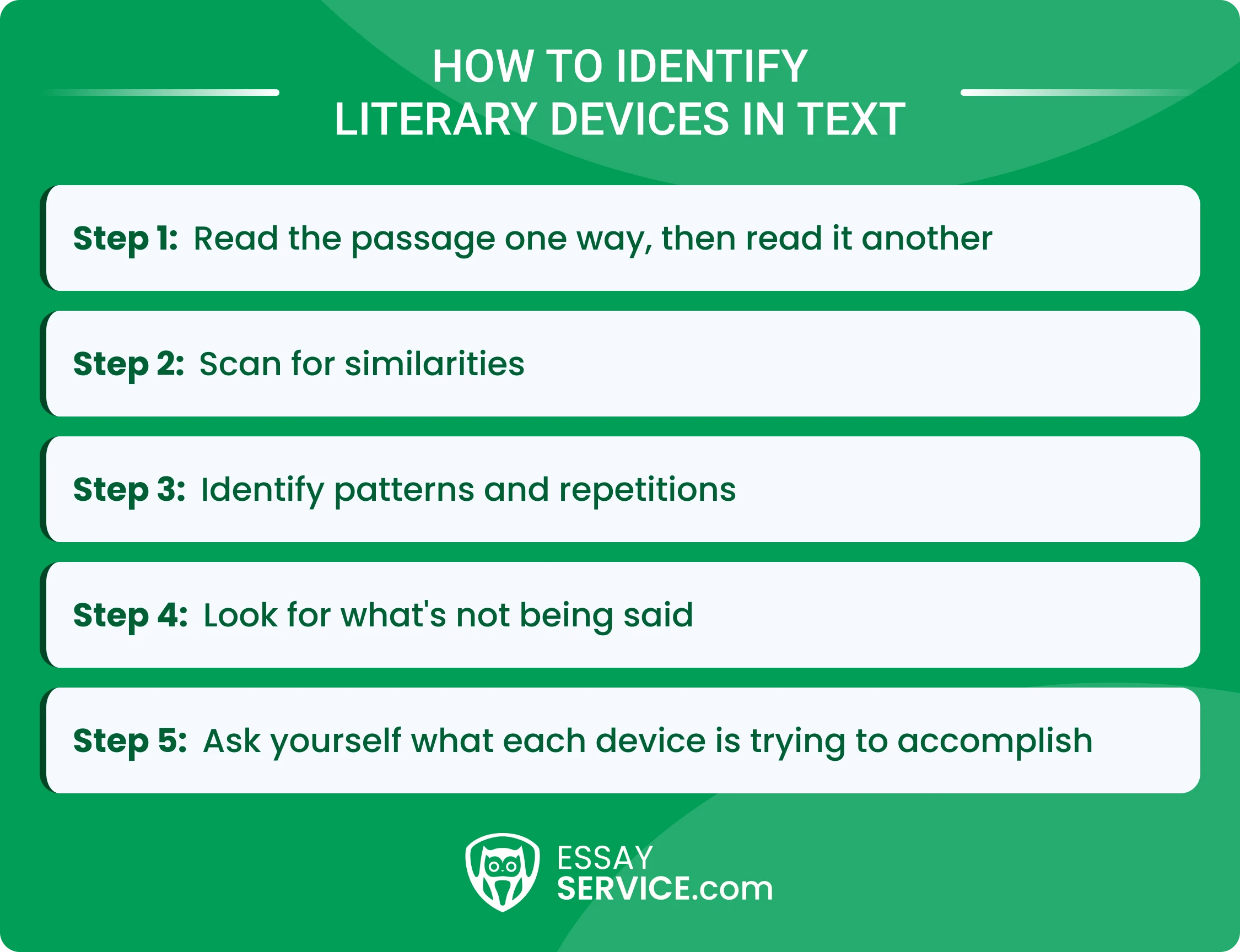
Step 1: Read the passage one way, then read it another
- Read once for comprehension. Who is speaking? What is happening? What is the mood?
- Read again more slowly, noting diction, syntax, and repeated sounds/imagery
- Highlight any fixture that stands out to you as intentional or embellished from straightforward, utilitarian language.
Step 2: Scan for similarities
- Are there words like “like” or “as?” You may have found a simile.
- Does one thing become another? You may have found a metaphor.
- Are verbs or descriptions meant for humans applied to inanimate objects? Look for personification or anthropomorphism.
Step 3: Identify patterns and repetitions
- Are the same words, phrases, or sentence structures used multiple times in the passage? You may have found repetition.
- Is a word or phrase repeated at the beginning of multiple clauses? You may have found anaphora.
- Does the same image or idea repeat throughout a larger work? It may be a motif, rather than a literary device.
Step 4: Look for what's not being said
- Can an object, color, or place be interpreted to mean something larger than itself? It may be a symbol.
- Is there a discrepancy between what is said and what is meant? You may have found irony.
- Does any detail seem strangely placed or emphasized early in a passage? It may be foreshadowing.
Step 5: Ask yourself what each device is trying to accomplish
- What feeling, mood, or reaction is the passage trying to invoke?
- What literary device commonly creates that effect? (Suspense? Foreshadowing. Contrast? Irony or juxtaposition.)
- If a figure of speech doesn't appear to create mood or meaning, ensure that it isn't just phrasing.
7 Tips on How to use literary devices in your writing
Knowing what literary devices are called is only half the battle. Using them well in your own writing is another skill entirely. It takes practice to know when a literary device truly enhances your writing and when it’s just window dressing. Here are seven tips to help you decide.
- Start with what you want the reader to feel, then choose your device accordingly. Instead of forcing metaphors or alliteration into your writing because they sound cool, decide what you want a passage to do first. Then choose the device that’ll get you there.
- Use one potent literary device instead of five weak ones. A single strong metaphor will hit readers harder than a paragraph filled with every flashy literary device you can think of. Trust me, your readers will appreciate it when you let your wonderful imagery speak for itself.
- Match the literary device to your intended tone. You won’t use ineffective juxtaposition in a serious, somber story, just like hyperbole and satire don’t belong in your WWII memoir. Let the tone of your piece determine which devices make sense.
- Read lines with literary devices out loud. Alliteration, repetition, and anaphora all rely on sound, rhythm, and music to work. The best way to test whether you’ve used a literary device correctly is to read the line out loud. If it sounds forced or silly, you probably need to try something else.
- If you hit a stunning metaphor or simile, don’t explain what you just wrote. If it’s a good metaphor or truthful simile, your reader will understand what you mean without you having to explicitly point it out. If you feel the need to explain what you wrote right afterward, you most likely just wrote something ridiculous.
- Revisit foreshadowing and symbolism when editing. Chances are, your first draft won’t quite hit the sweet spot of planting now and payoff later. Don’t sweat it; just make a note to go back and add some foreshadowing once you know your ending.
- Delete anything that doesn’t serve your story. Chekhov might have said, “If in the first act you’ve hung a pistol on the wall, by the second act you’d better…” well, you know. If your symbolic camel’s nose under the tent doesn’t matter by the end, it’s likely better to delete than to leave in as unearned flair.
A literature review writing service can help you synthesize sources and present a well-organized academic review.
Final words
Literary devices are not something thrown on top of quality writing like decoration. They are the means by which meaning, feeling, and cadence actually enter the reader's mind. When you can identify a metaphor, notice foreshadowing, or see a motif developing over chapters, both reading and writing become much more thoughtful. Consider the 24 examples above as your foundation. Continue analyzing as you read, and the rest will come.
Frequently Asked Questions
What is a literary device?
What are some of the most common literary devices?
What is an example of a literary device in a sentence?
What is the difference between literary devices and figurative language?

Phil spends his working days teaching international trade. He contributes to our blog as a freelancer, leveraging his experience with MBA students to advise on academic writing, studying abroad, and securing funds.

New posts to your inbox
Your submission has been received!