Yes, “I” is acceptable in many essays, though the correct choice varies by assignment type. Reflective essays, personal statements, and narrative assignments expect the first person, and most methodology sections use it to show who made each research decision.
First person in academic writing becomes a problem mainly in argumentative, expository, and literary analysis essays, where the argument lands harder when evidence does the persuading. The assignment brief is the deciding authority. A stated requirement there answers the question before disciplinary habit applies.
Can you use “I” in an essay?
You can use “I” for reflective, personal, and application essays; usually not for argumentative, expository, and literary analysis. The first person also fits a personal narrative essay, response papers, and the methods section of a research report, where it names who ran the study.
The habit of using “I” in academic writing turns risky in formal argument and close reading, the formats where graders want the focus on evidence and the text. Discipline moves the line too. Psychology and sociology welcome “I”; history and literature stay stricter.
The instructions win over everything else. A rubric that bans first person means avoid it, even where the format would normally allow it.
When should you use first person in an essay?
Use first person in five situations: reflective or personal writing, descriptions of your own research choices, places where your reading and a source’s need separating, sentences a passive construction would muddle, and statements of your thesis. The last one, the “scholarly I,” is the most useful of the five in formal essays.
- Reflective and personal writing. Example: “I assumed the placement would bore me; week one proved me wrong.”
- Your own research decisions. Example: “I chose thematic analysis because the interview data resisted fixed categories.”
- A split between your reading and a source’s. Example: “Smith calls the ending hopeful; I read it as unresolved.”
- A passive sentence that hides the actor. The vague “The survey was piloted” becomes the direct “I piloted the survey.”
- The thesis, stated as the “scholarly I.” Example: “I argue that the novel treats memory as unreliable.”
Berkeley’s Reading and Composition teaching program recommends reusing the “[Scholar] argues that” construction for the writer’s own interpretation, which turns a timid summary into a claim


When should you avoid first person?
Avoid first person in formal argument when the pronoun adds nothing to the point. Three habits cause most of the damage: hedges like “I think” or “I believe,” throat-clearing openers like “In this essay I will,” and personal framing that buries the evidence. These limits answer the other side of the question, can you use first person in an essay: when to leave it out.
The first person in different citation styles
Citation styles split into two camps on the first person. APA, Chicago, AMA, and IEEE accept “I” or “we” for describing your own work; MLA accepts it in moderation and advises against self-announcements. None of the five bans the first person outright. Journal and instructor rules still override the manual.
Rules that hold across most styles:
- Use first person for your own actions and decisions, not as filler.
- Avoid the editorial “we” that means “people in general,” which APA flags as a vague usage to replace with a specific actor.
- Prefer writing in the active voice, since the first person often shortens the sentence.
- Reserve “we” for actual co-authors on a multi-author paper.
- Defer to the journal or instructor when the manual and the assignment disagree.
Which assignments allow first person?
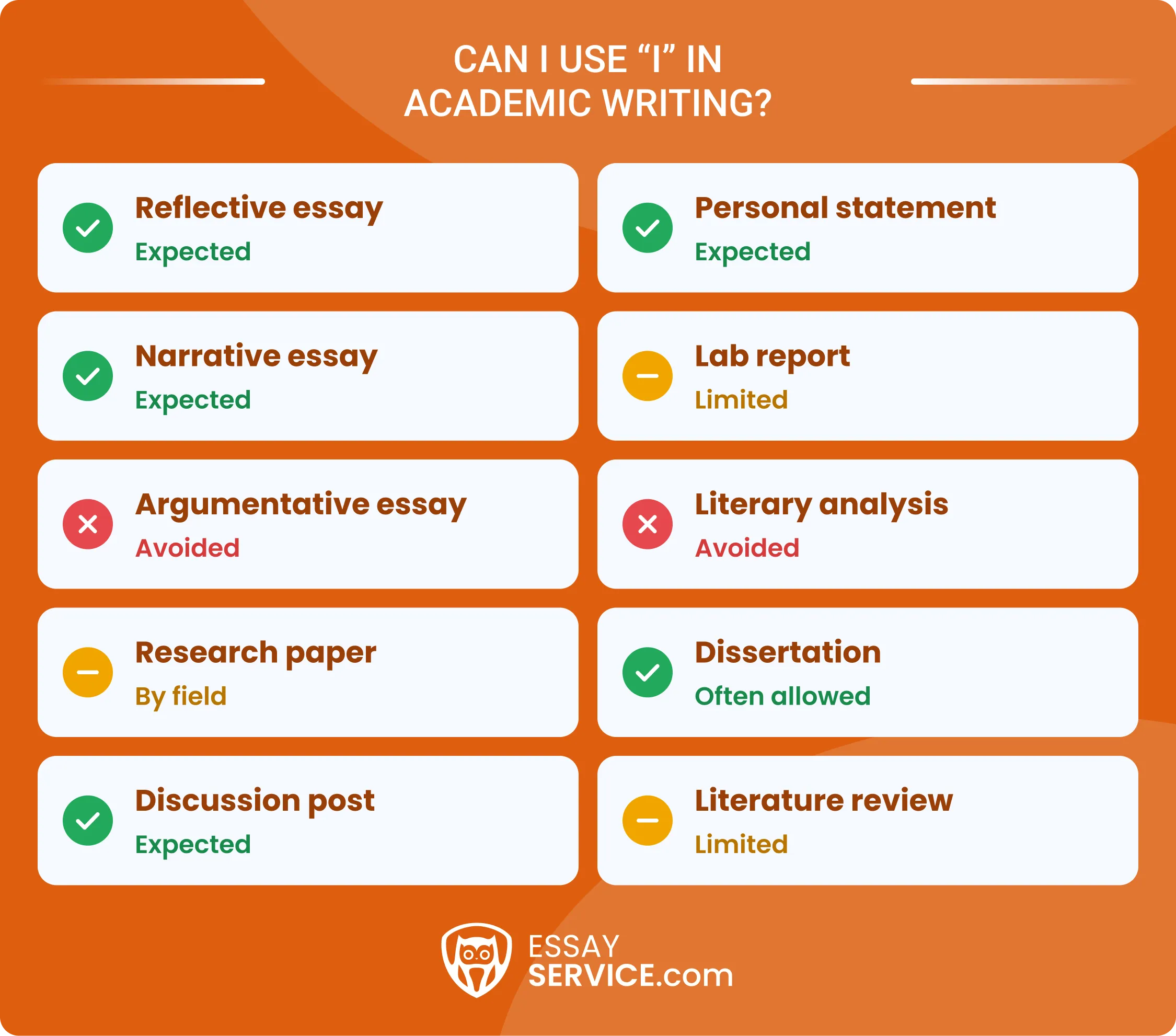
Assignment type is the fastest predictor of first person use in academic writing. Essays built on the writer’s own experience welcome “I.” Essays built on outside evidence keep it out. The grid below answers can you use I in an essay for ten common formats.
Is first person the same as using personal experience?
No. First person is a grammatical choice; personal experience is a kind of evidence. A sentence can use “I” with zero anecdote, and a sentence can report lived experience with no “I” at all. The confusion between the two is why first person in academic writing gets banned by mistake.
The distinction decides what a grader actually objects to. Most rubrics that forbid “I” are really objecting to unsupported personal opinion. The pronoun itself is seldom the issue.
Two examples make the gap clear.
First person without personal experience: “I analyze the 1965 census data in three stages.” That sentence is pure method. No story and no opinion appear, and it would pass in most APA papers.
Personal experience without first person: “A decade in retail management shows how fast morale collapses after layoffs.” The claim leans on lived experience, yet the pronoun stays absent.
The takeaway is practical. Fix the weak evidence first. The pronoun question tends to answer itself once the evidence holds.
Can you use “we” in an essay?
Use “we” only when the essay has more than one author. A solo writer who reaches for “we” to sound scholarly commits a common error, and APA directs a single author to write “I” instead.
Two uses of “we” cause the trouble.
The false plural puts “we found” on work that one person did. APA Style tells a sole author to switch to “I.”
The editorial “we,” as in “we live in a digital age,” means humanity in general and stays vague about who “we” is. Replace it with a named group, such as “US teenagers” or “first-year nurses.”
The same clarity rule governs using “I” in academic writing: name the actor, then choose the pronoun that matches.
What should you use instead of “I”?
Replace “I” with the subject it was hiding. The strongest fix names the real actor in the sentence, usually the essay, the evidence, or the data. This is the heart of the first person vs third person essay question: swap the pronoun for the thing doing the work.
Both the UNC Writing Center and Writing Commons note that “the present author” or “the researcher” reads more awkwardly than a plain “I” and sounds no more objective. A fake third-person self is not a repair. When the pronoun has no clean replacement, keep “I” and drop the invented stand-in.
How do you check if the first person is allowed?
Check four sources in order, and stop at the first one that gives an answer. The assignment brief outranks everything; disciplinary habit is the last resort. This precedent settles can you use I in an essay for any specific paper.
- The assignment brief or rubric. A written instruction here is final.
- The instructor’s stated preference. Syllabus or lecture comments override the general convention.
- The required style guide. APA, MLA, Chicago, AMA, or IEEE sets the default.
- The disciplinary norm. Apply this only when the first three are not present.
Our academic writing services can make the correct grammatical choices for you.
Final thoughts
First-person is allowed in more essays than tradition suggests. Reflective, personal, and narrative work expects “I,” and methods sections use it for clarity. Formal argument and literary analysis stay in the third person. The evidence question comes first, and the pronoun question follows. Above all, the assignment brief decides, so read it before drafting.
Frequently Asked Questions

Phil spends his working days teaching international trade. He contributes to our blog as a freelancer, leveraging his experience with MBA students to advise on academic writing, studying abroad, and securing funds.


New posts to your inbox
Your submission has been received!