A personal narrative essay is a true story from your own life. It’s written in the same detail and pace as a conventionally “good” fiction work, but the difference is that you write about something that truly happened to you. The usual stall spots are the same for most students learning how to write a personal narrative essay, such as difficulty deciding which events are worth writing about in the first place, or cramming in every detail, regardless of whether it belongs there or not, or naming the feelings and forgetting to show scenes.
This guide covers the whole process with clear steps and acclaimed examples, so you know exactly how to open and close your personal narrative essay, along with how to handle all the parts in between.
What Is a Personal Narrative Essay?
So, what is a personal narrative essay, after all? People define it in slightly different ways, although the core of the paper doesn’t change much. It’s your story, written in your own words, about a real moment that changed your perception. The event can be tiny or huge; that’s less important, but what counts is that you were there and it meant something to you. You’re the narrator and the main character at the same time. A strong personal narrative essay has the following characteristics:
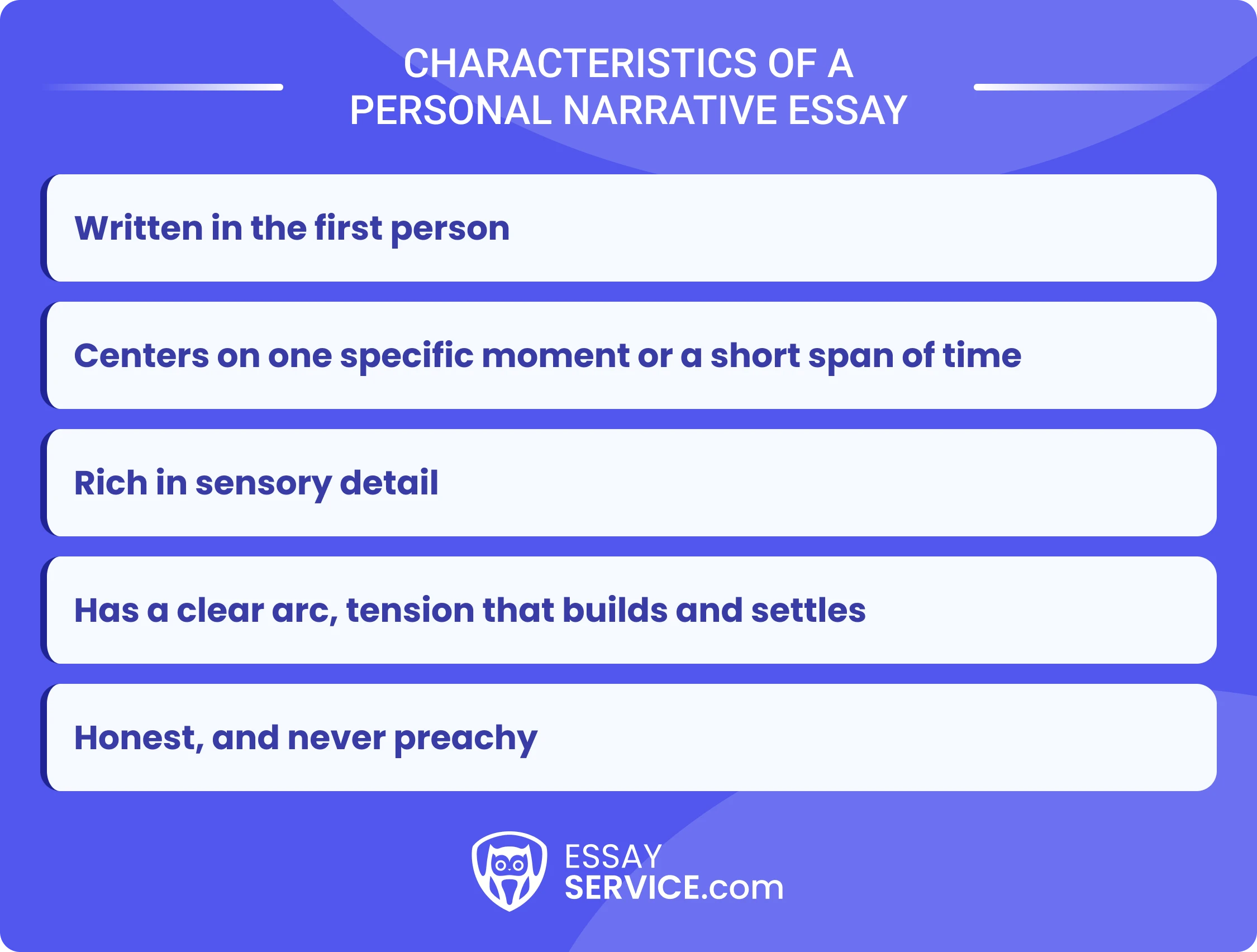
- It's written in the first person. You use "I" the whole way through.
- One specific event anchors the whole piece, or at most a short stretch of time.
- Sensory detail fills every scene, so the reader sees, hears, and feels what you did.
- There's a clear arc, where tension builds and then settles.
- Above all, it stays honest about what the moment meant to you, and it never preaches.


Beat the Deadline Today
Get a custom, plagiarism-free essay delivered fast by writers who deliver.
Personal Narrative vs. Other Essay Types
The word "narrative" shows up on a lot of assignment sheets, and the labels blur together fast. Here's how the personal narrative essay differs from the forms people confuse it with.
How to Choose What to Write About
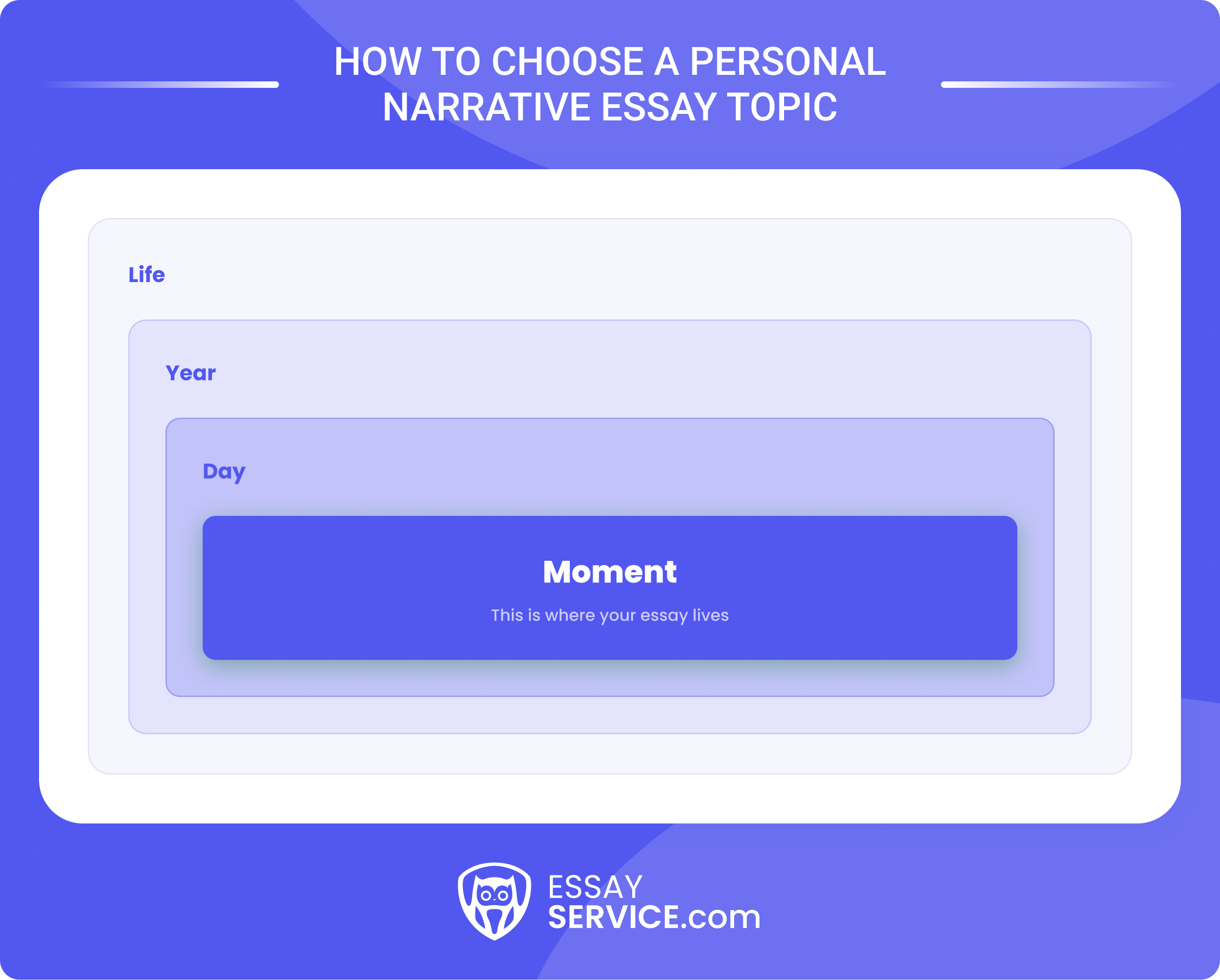
Most guides hand you a list of broad themes and wish you luck without giving you detailed advice on choosing the idea to write about. When you choose your personal narrative essay topics, small moments tend to give you the most to work with.
- Find a small moment. Even a single conversation can be called meaningful if it changed you. A tight window gives you room to show real detail.
- Find the change. Look for the point where you understood something you hadn't understood a minute before, or acted in a way that surprised you.
- Test the “this still bothers me.” If a memory still nags at you years later, there's usually a reason, and that reason is your essay.
- Don’t go overly dramatic. No car crash or grand tragedy required. A small embarrassment or an ordinary kindness can hold a whole essay.
Read these as doorways into a scene, not as themes to explain:
- The last time you lied to someone who believed you.
- An adult treated you as wrong when you knew, for certain, you were right.
- You stayed silent once and wished afterward that you hadn't.
- The day you realized a friend had changed, or you had.
- That exact second you knew you no longer wanted something you'd chased for years.
- Someone else took credit for your work, and you let them.
- Your last conversation with a person before everything changed between you.
- One afternoon your parent became a person to you, with their own fears.
- A small promise you broke, and what it cost you.
Personal Narrative Essay Structure
A personal narrative essay structure follows the same rough path most of the time, which helps to have before you start drafting. This personal narrative essay outline is a skeleton that your story can bend to fit itself:
- Opening. Drop the reader into a scene, close to the action, with a concrete image or a line of dialogue, not a wind-up.
- Rising action. The moment builds step by step. Let tension gather as the situation gets more complicated or the stakes climb.
- Turning point. Something changes on this beat. It's the heart of the whole piece.
- Reflection. Show what you made of it. Your understanding reaches the reader without any tidy lesson spelled out.
- Close. Land somewhere small and true. A final image often beats a grand statement.
How to Write a Personal Narrative Essay in 6 Steps
Here's the part where you actually build the thing, which I'll take you through in order. You find your moment and dig out why it matters, work out what changed in you, sketch a plan, draft without flinching, layer in detail, and thread your reflection through before you cut the obvious lesson.
Step 1: Dig Beneath the Surface
Start with the memory you keep coming back to, the one that won't quite leave you alone. At this stage, half the students pick something overdramatic, and the other half go for something they’re embarrassed by. It’s usually the second group, in my experience, that ends up with a better essay. Take that afternoon you got caught skipping practice. Fine. Now comes the harder question: what did it show you about yourself? The event is only the surface. Its meaning is a layer down. Write both out plainly:
- The moment: I lied to my coach about being sick.
- The meaning: I was more afraid of trying than of getting caught.
Pro tip: If the meaning won't come, leave it blank and start writing anyway. It tends to surface around the third paragraph, once your hands are already moving.
Step 2: Name What Changed
A personal narrative tracks a change in the narrator. And who is the narrator in this paper? It’s you. So, get clear on the two versions of yourself before you write a word - the first is who walks in, the second is who walks out. There is distance there and that distance is exactly the engine that keeps your paper moving. Most of learning how to write a personal narrative essay comes down to building everything around that gap and cutting whatever doesn't feed it. A quick table helps me every time:
Fill in those two boxes before anything else.
Pro tip: If both boxes say the same thing, you've got an anecdote, not a narrative. Go find a memory where the boxes disagree.
Step 3: Sketch Out an Outline
Your personal narrative essay outline shouldn't look like the rigid Roman-numeral thing you were taught in ninth grade. Five or six quick bullets will do, each one naming a scene in the order it happens. Keep them short, a few words apiece. For the skipped-practice example, mine might read:
- Locker room, the decision to lie
- The phone call to Coach
- The long walk home
- What I caught in the hallway mirror
- The text I never sent
That's a whole essay, and it took ninety seconds. A skeleton this loose keeps you oriented while it still leaves room to find things you didn't plan.
Pro tip: Write this outline by hand. Something about the screen tempts you to over-plan, and an over-planned narrative reads stiff.
Step 4: Write Fast and Ugly
Turn off the editor in your head because your first draft is supposed to be bad. In fact, its entire purpose is to be bad. Write the whole thing straight through and don't reread as you go. Momentum matters more than polish right now, because you can't fix a blank page and you won't find your voice by perfecting one paragraph for an hour. Set a timer for thirty minutes and race it. What you'll have at the end is a mess, and that mess holds every scrap of raw material you'll need later.
Pro tip: Open in the middle of the action, not before it. Skip the setup and begin where something's already happening, like a voice mid-sentence or a door already open.
Step 5: Earn Each Detail Its Place
Detail is what convinces a reader you were really there, so choose the details that pull double duty. The cold vinyl of that locker-room bench does more work once it also tells us how tense you were. When you learn how to write a personal narrative essay, you start treating each detail as evidence. Ask it a question: does it prove something about the moment? Then it stays. Does it only sound pretty? Then it's gone. Go through every scene and ask what a camera would actually catch, then ask which of those things the story needs.
Pro tip: Sound and smell lodge in a reader's memory longer than sight does.
Step 6: Thread the Reflection Through the Essay
You already know that the experience you’re writing about changed you, and through reflection, you let the reader know about that change, so it should thread all the way through your essay. Sprinkle small signals of your older, wiser self as you go, then write your ending. Once it's down, hunt for the line that states the lesson outright (the "and that's when I learned honesty matters"), and delete it. Readers can't stand being told what to feel. Trust your scenes to land the point for you.
Pro tip: If the meaning only becomes clear the second you spell it out, the scenes above it aren't pulling their weight yet, and the real fix belongs up there in the scenes.
Show, Don't Tell: Personal Narrative Essay Examples
This is the one skill that turns a flat essay into something a reader stays with. The trick is to build the scene that produces the feeling and let the reader arrive at it themselves. Here are three personal narrative essay examples. Each takes the same beat and writes it twice, once told and once shown.
Showing an Emotion
Don't say:
"I was furious at my brother."
Instead, say:
"I set my fork down very carefully, and when I asked where the forty dollars went, it wasn't a question."
The anger never gets named. You read it in the careful fork and the flat voice.
Showing a Relationship
Don't say:
"My dad and I were never close."
Instead, say:
"We ate at the same diner every Sunday, and when I got stuck on a crossword clue I'd slide the paper over, and he'd fill in the word and slide it back, and neither of us said anything."
Showing the Meaning
Don't say:
"That summer taught me some friendships aren't built to last."
Instead, say:
"I kept her seat open on the bus for a week, then let a freshman take it, and one morning I deleted the whole thread and watched her name drop off my screen.
Common Mistakes to Avoid
Even a good story trips over the same few things again and again. Here are the ones I see most often in student drafts, and what to do instead.
- Summarizing when you should be building a scene. "We fought all summer" skips the story. Pick one fight and put me in the room for it.
- Too much time on the page. A full year is a memoir's job. A personal narrative essay breathes best across an afternoon or a single conversation.
- Front-loaded backstory kills momentum. Three paragraphs of setup and the reader's already gone. Begin in motion and hand out context in small pieces as they're needed.
- Adjectives get stuffed in where detail should go. "A gorgeous, breathtaking, unforgettable view" says nothing. One exact detail beats a pileup of empty modifiers.
- The lesson gets saved for the last line. If your final sentence explains the point, cut it and trust the closing image to speak.
- Maybe you write the person you wish you'd been. Readers can smell a flattering self-edit. The awkward, real version of you is the one worth reading.
Personal Narrative Essays Worth Reading
You'll learn more from a handful of good papers than from any rulebook. All of the personal narrative essay examples here tell one true story well, which is exactly what you're being asked to do.
- "That Old House" by Lydia C. Buchanan. Takes one ordinary feeling, wanting a house you can't afford, and lets it open onto a whole generation's situation without ever raising its voice.
- "M.A.S.H." by Sarah Gerard. Watch how she uses a repeated phrase, "it was a different time," to carry the argument so she never has to state it outright.
- "The Bus Chasers" by Maggie Andersen. A father's mental map of a city becomes the whole essay, one specific detail doing the work a hundred vague ones couldn't.
- "Losing My Dad in Installments" by Mariana Serapicos. A model for writing about grief through small concrete things instead of big emotional claims.
- "Southings" by Thomas Dai. Notice how tightly he writes about place, letting images of the South carry meaning the reader assembles on their own.
Leave the Writing to Us
Our team delivers well-researched, custom essays on time, every single time.
Final Thoughts
A personal narrative essay lives or dies on a few habits. Pick one small moment, not a whole era. Track what changed in you. Show scenes instead of summarizing them. Feed in detail that earns its place, thread your reflection through, and cut the tidy lesson at the end. Then read it aloud.
Frequently Asked Questions
How Long Should a Personal Narrative Essay Be?
How Do You Start a Personal Narrative Essay?
Can a Personal Narrative Essay Have a Thesis?
Is a Personal Narrative Essay Written in First Person?
What's the Difference Between a Personal Narrative and a Memoir?
Can You Write About Something Sad or Traumatic?

Phil spends his working days teaching international trade. He contributes to our blog as a freelancer, leveraging his experience with MBA students to advise on academic writing, studying abroad, and securing funds.
New posts to your inbox
Your submission has been received!