A statement of purpose covers your academic preparation, research interests, and career goals. A personal statement covers your background, experiences, values, and character. Graduate and doctoral programs usually ask for the statement of purpose. Undergraduate admissions and professional schools lean on the personal statement, and some programs even want both.
This guide breaks down the personal statement vs statement of purpose with a side-by-side table, plain definitions, what each document should include, and real university length limits you can check for yourself.


Stuck on the hard part?
Writer’s block happens. We craft a polished, on-prompt essay that sounds like you.
Statement of purpose vs personal statement at a glance
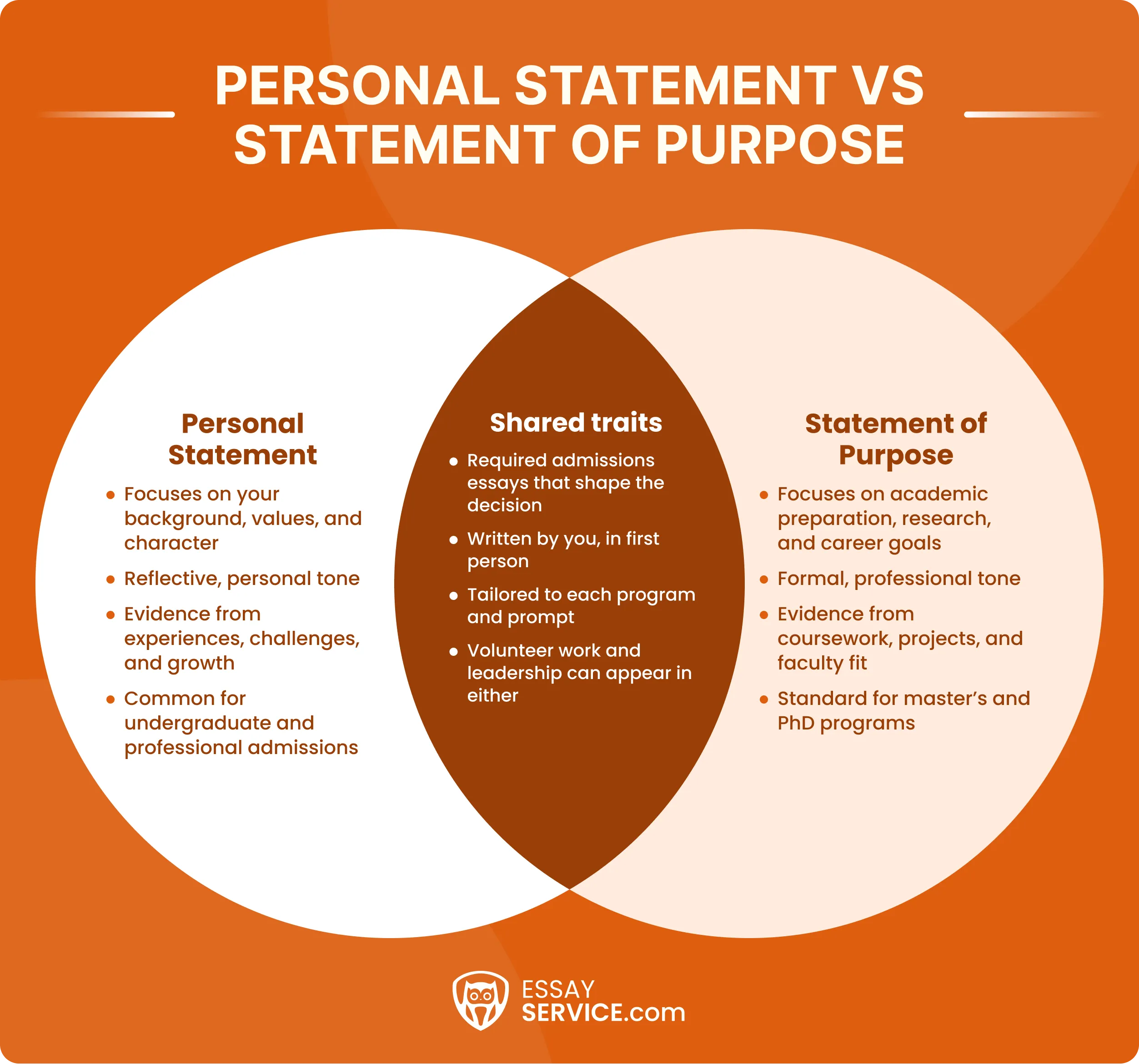
The difference between personal statement and statement of purpose comes down to focus. A statement of purpose documents your academic case. A personal statement documents your personal story. The table below lines up both essays across seven factors that decide how you write each one.
What is a statement of purpose?
A statement of purpose is a one-to-two-page essay that explains your academic background, research interests, and reasons for applying to a specific program. Admissions committees weigh it heavily and read it to judge academic fit, meaning how well your record matches what the faculty study and teach. The document should give reviewers evidence on three fronts:
- Preparation: coursework, training, and skills that ready you for the field.
- Research fit: questions and methods that line up with specific faculty.
- Direction: career goals that make the degree a logical next step.
Master’s and PhD programs request a statement of purpose most often, and many science and engineering departments treat it as the single most important piece of writing in the file. Most versions run 500 to 1,000 words, though each program sets its own limit. A strong statement of purpose reads like a focused research pitch with proof behind every claim.
If you buy personal statement from our service, a professional will handle all characteristics and the writing process.
What to include in a statement of purpose
A statement of purpose works best when it moves through six building blocks, and each one should tie to evidence an admissions reader can verify.
- Academic background: your degree, major coursework, and the training that prepared you for this field.
- Research or projects: specific work you have done, with methods, results, and what you learned.
- Relevant work experience: jobs, internships, or lab roles that sharpened skills the program values.
- Research interests: the exact questions you want to study, precise enough to match a faculty member’s work.
- Career goals: the role or research path you are aiming for after the degree.
- Why this program and faculty: specific professors, labs, or resources that make this the right fit.
Reviewers can tell within a paragraph whether you researched the program or recycled a template.
What is a personal statement?
A personal statement is an essay about your background, experiences, and character, and it shows the person behind the transcript. Readers use it to understand your motivations and the path that led you toward this field. The document gives context that grades and test scores leave out, like obstacles you worked through or moments that set your direction. Admissions readers want the human context that a transcript cannot provide. A personal statement shows up in three kinds of applications:
- Undergraduate admissions: the main college essay nearly every applicant submits.
- Professional schools: medicine, law, and similar programs use it to see who you are.
- Some graduate programs: many pair it with the statement of purpose.
The strongest personal statements pick one or two defining experiences and dig deep into them.
What to include in a personal statement
A personal statement earns its strength through reflection, so each element below should connect an experience to what it taught you.
- Formative experiences: the moments or people that pointed you toward this field.
- Challenges and growth: obstacles you faced and the concrete ways you changed because of them.
- Values and motivations: what drives you, and why this work matters to you personally.
- Leadership or service: roles where you took responsibility or supported a community.
- Perspectives you bring: the background, culture, or viewpoint that gives you a distinct angle.
- How you’ll contribute to the community: the specific ways you plan to add to the program and campus.
Key differences between a statement of purpose and a personal statement
Purpose, tone, evidence, length, and the programs that require them differ between the two essays. Each one below explains what admissions readers expect and how the two documents diverge.
Purpose and focus
A statement of purpose argues that you are academically ready for a specific program. It centers on academic preparation, research interests, and the fit between your goals and the faculty’s work. A personal statement answers a different question about you as a person: what drives you, what you have lived through, and what perspective you add. The two overlap at the edges, yet each leads with its own job.
Tone and style
A statement of purpose keeps a professional, measured tone, closer to an academic cover letter. A personal statement allows warmth, voice, and narrative. Match the register to the document:
- SOP: precise, evidence-first, focused on scholarship.
- Personal statement: reflective, specific, written in your natural voice.
Content and evidence
A statement of purpose builds its case from academic evidence. A personal statement builds its case from lived experience. The raw material differs:
- SOP evidence: coursework, research, publications, technical skills, and named faculty whose work matches yours.
- Personal statement evidence: turning points, obstacles, values, and the people or moments that set your course.
Length and format
A statement of purpose usually runs 500 to 1,000 words, roughly one to two pages. A personal statement varies more by level: around 650 words for undergraduate applications and one to two pages for graduate and professional ones. Format expectations differ too:
Programs that require each
Statement-of-purpose requirements cluster around research-focused graduate study. Personal-statement requirements cluster around admissions that weigh the whole person. Most UC campuses ask for both. Typical patterns:
- Statement of purpose: master’s and PhD programs, especially in the sciences and engineering.
- Personal statement: undergraduate admissions, plus medical, law, and other professional schools.
- Both: many graduate programs, which split academic content and personal content across two essays.
Same applicant, two essays: example openings
A pair of statement of purpose vs personal statement examples from one applicant makes the contrast concrete. Below, a hypothetical applicant to a public-health master’s program opens each essay. Same person, same goal, two different jobs.
Statement of purpose opening:
My interest in maternal health policy grew during two years as a data analyst at a county health department, where I tracked prenatal-care gaps across 14 clinics. I want to build the statistical and policy training to turn findings like those into programs that reach underserved mothers. The MPH program’s work on perinatal outcomes, and Professor Lin’s research on Medicaid coverage effects, line up directly with the questions I plan to pursue. My goal is a career in applied health policy, where I can design interventions that close the gaps I measured firsthand.
Personal statement opening:
The first budget my mother balanced out loud at the kitchen table was for prenatal vitamins she almost skipped. I was nine, and I did not understand the math, only the worry in her voice. Years later, that memory stayed with me as I read maternal-mortality data at work and recognized the women in the numbers. I have learned to hold both the statistic and the person, and that is the lens I bring to public health: rigor that never forgets whose life each figure represents.
What makes each opening fit its type:
- The SOP leads with competence. It names a role, a measurable project, and a faculty match within four sentences.
- The personal statement leads with character. It opens on a scene and a value, then connects that value to the work.
- Both point at the same career, yet the SOP proves readiness through evidence and the personal statement earns trust through reflection.
Read grad school personal statement examples and learn its specifics as well.
Which one should you write?
The SOP vs personal statement choice is usually settled by the prompt, not by preference. Read the application’s exact wording and the word limit before you draft anything. Work through these steps:
- Name the document the program actually asks for. Use the label and prompt on the application, not a generic template.
- Read the prompt for content clues. A prompt that asks about research interests, preparation, and goals wants SOP-style content, even when the label says “personal statement.”
- Match length to the instruction. A 500-word limit signals a focused academic essay; two pages leaves room for story.
Many US graduate programs use the term “personal statement” loosely. The prompt often asks why you are prepared for the field and what you want to study, which is the work of a statement of purpose. When that happens, write to the prompt and lead with academic substance.
When a program asks for only one essay, cover your academic case first, then add a short, genuine note of personal context if there is room. When a program asks for both, keep them distinct: academic argument in the statement of purpose, personal story in the personal statement, with little overlap between them.
A quick rule of thumb:
- Research or PhD focus points toward a statement of purpose.
- Whole-person admissions point toward a personal statement.
- Two separate prompts mean write both, each in its own lane.
What goes where: SOP vs. personal statement content
A quick sort of your material before you draft keeps each essay in its lane. The table below maps ten common content types to the essay where each one belongs, with two items that work in either place.
Volunteer work and leadership fit either essay, depending on the angle. For the statement of purpose, tie them to skills, outcomes, and research relevance. For the personal statement, tie them to values, motivation, and personal growth. The same experience can appear in both essays, as long as each version makes a different point and avoids repeating the other word for word.
Examples of MBA personal statements deserve a separate article, too, since the committee expects different traits from this one.
Common mistakes to avoid
More or less, it’s the same errors that derail both of these essays. Here are five to avoid, each with a few words on how to fix them.
- A personal story in place of an SOP. Fix: open with academic evidence, research interests, and faculty fit, not a childhood scene.
- A résumé in prose in place of a personal statement. Fix: choose one or two experiences and reflect on them; a long list of achievements does little here.
- One essay sent to every program. Fix: rewrite the program-specific and faculty-specific lines for each application.
- A draft that ignores the prompt. Fix: answer the exact question the application asks, point by point.
- An essay over the word limit. Fix: cut to the stated count, since many systems reject anything past the maximum.
A request as simple as ‘Write my personal statement for me’ is all it stands between your papers and professional help.
Overwhelmed by application essays?
We write your papers while you handle the admissions headaches.
Final thoughts
A statement of purpose makes your academic case: preparation, research interests, faculty fit, and goals. A personal statement shows who you are: background, values, and growth. Graduate research programs usually want the statement of purpose, undergraduate and professional admissions lean on the personal statement, and some ask for both. Read the prompt, match the length, and keep each essay in its lane.
Frequently Asked Questions
Is statement of purpose and personal statement the same?
Can I use my statement of purpose as a personal statement?
What is the difference between a statement of purpose and a personal statement?

Essie isn’t just an educator with a Bachelor’s in English: she’s passionate about writing. She uses her experience in grading papers to write comprehensive guides for our blog.


New posts to your inbox
Your submission has been received!