
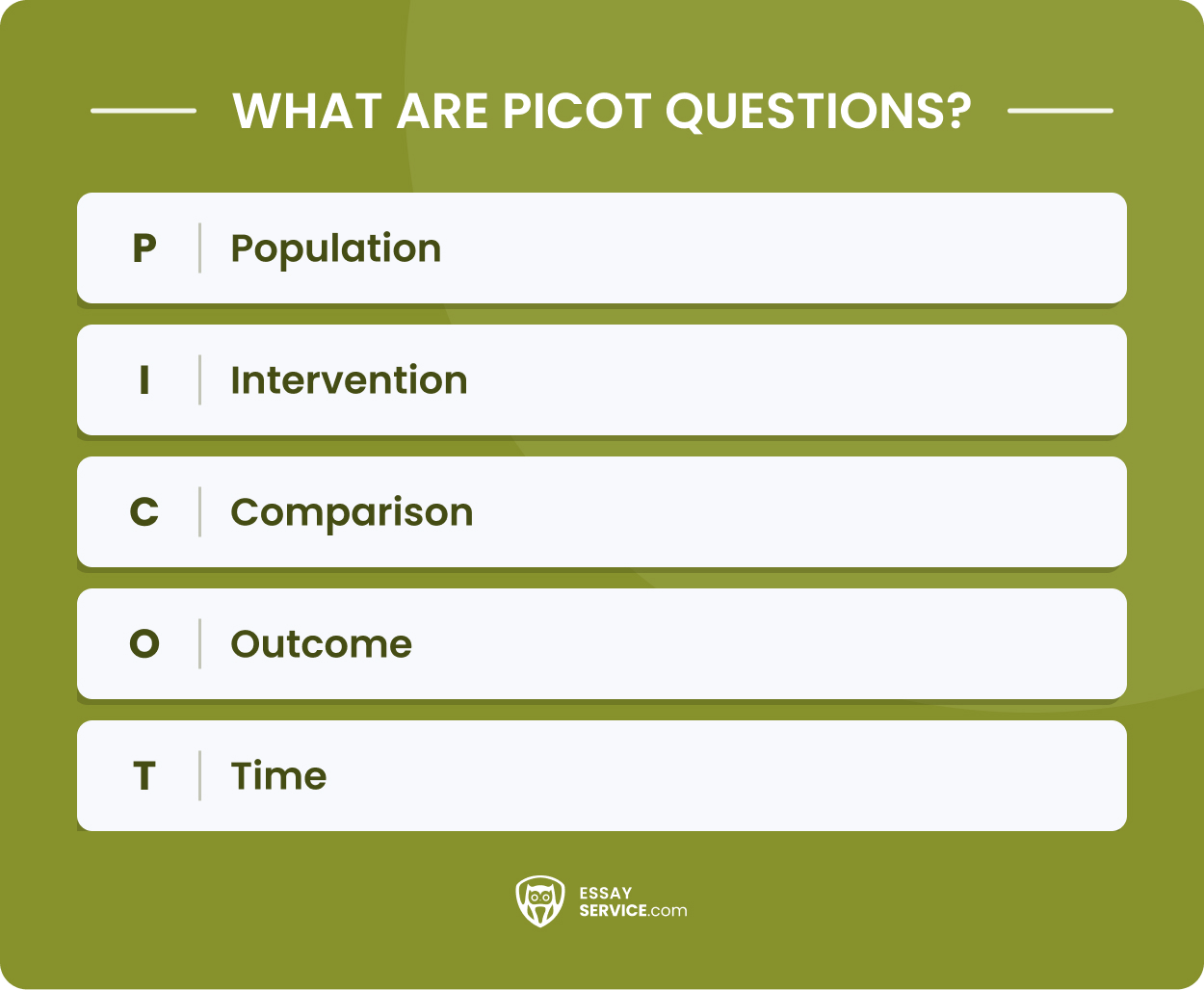
A PICOT question is a structured clinical question that names five parts: Population, Intervention, Comparison, Outcome, and Time. One worked example: in adults with type 2 diabetes (P), does a low-carbohydrate diet (I) compared with a standard diet (C) lower HbA1c (O) over six months (T)?
This guide gathers more than 130 PICOT question examples, sorted in 3 ways: by question type, by nursing specialty, and by clinical topic.


Short on time?
Send us your PICOT question and a nursing expert will help you write the full paper.
PICOT question examples with breakdowns
Three complete PICOT questions below appear as tables that separate each part, so the build of every question is clear before it becomes a sentence. Each table lists the Population, Intervention, Comparison, Outcome, and Time, then shows the finished question. These examples of PICOT questions for nursing cover a medication decision, a screening protocol, and a patient-education session.
Example 1. In adult inpatients with community-acquired pneumonia (P), does an early switch to oral antibiotics (I) compared with a full intravenous course (C) affect length of hospital stay (O) within seven days (T)?
The Comparison here names a specific alternative, which gives the literature search a clean contrast to look for.
Example 2. In adults on medical-surgical units (P), does a standardized sepsis screening tool at triage (I) compared with clinician judgment alone (C) increase early sepsis identification (O) over a three-month rollout (T)?
Time anchors the question to a measurable window, so results can be compared against a baseline period.
Example 3. In adults with a new heart failure diagnosis (P), does a nurse-led teach-back discharge session (I) compared with a printed instruction sheet (C) lower 30-day readmission rates (O) within 30 days of discharge (T)?
PICOT question examples by type
Five question types cover nearly every clinical question a nursing paper will pose: intervention (therapy), etiology (risk factors), diagnosis, prognosis (prediction), and meaning (qualitative). The examples of PICOT questions grouped below label each type, so the right template is easy to copy.
Intervention (therapy) questions
Template: In [population], does [intervention] compared with [comparison] affect [outcome] within [time]? Intervention questions test an action a nurse can take, which makes them the most common type in coursework.
- In adults after total knee replacement (P), does continuous cold therapy (I) compared with intermittent ice packs (C) reduce reported pain scores (O) during the first 48 hours (T)?
- In children who receive an IV insertion (P), does a vibration-and-cold distraction device (I) compared with no distraction (C) lower procedural pain ratings (O) at the moment of insertion (T)?
- In adults on mechanical ventilation (P), does head-of-bed elevation to 30 degrees (I) compared with a flat position (C) reduce ventilator-associated pneumonia (O) across the ICU stay (T)?
Etiology (risk factor) questions
Template: In [population], does [exposure or risk factor] compared with [no exposure] increase the risk of [outcome] over [time]? Etiology questions place a risk factor in the I slot, since the aim is to study harm and causation.
- In postpartum women (P), does a history of gestational diabetes (I) compared with no such history (C) increase the risk of type 2 diabetes (O) within 10 years (T)?
- In hospital nurses (P), does rotating night-shift work (I) compared with fixed day shifts (C) raise the risk of medication errors (O) over a 12-month period (T)?
- In long-term care residents (P), does prolonged indwelling catheter use (I) compared with intermittent catheterization (C) increase catheter-associated urinary tract infections (O) within 30 days (T)?
Diagnosis questions
Template: In [population], is [test or tool] compared with [reference standard] more accurate for identifying [the condition] at [time]? Diagnosis questions measure a test against a reference standard, so the outcome is accuracy of detection.
- In adults with chest pain at the emergency department (P), is a high-sensitivity troponin assay (I) compared with standard troponin (C) more accurate for detecting myocardial infarction (O) at initial presentation (T)?
- In older adults at admission (P), is the 4AT screening tool (I) compared with routine nursing observation (C) better for identifying delirium (O) within the first 24 hours (T)?
- In patients at risk of pressure injury (P), does subepidermal moisture measurement (I) compared with visual skin assessment alone (C) improve early detection (O) at the bedside (T)?
Prognosis (prediction) questions
Template: In [population] with [condition], does [factor] compared with [other factor] predict [outcome] over [time]? Prognosis questions ask what a condition leads to over time, which is why the outcome is a future event.
- In adults after a heart failure hospitalization (P), does a high B-type natriuretic peptide level (I) compared with a normal level (C) predict hospital readmission (O) within 30 days (T)?
- In ICU patients on vasopressors (P), does early lactate clearance (I) compared with delayed clearance (C) predict 28-day mortality (O) within 28 days (T)?
- In stroke survivors (P), does mobilization within 24 hours (I) compared with later mobilization (C) predict functional independence (O) at 90 days (T)?
Meaning (qualitative) questions
Template: How do [population] experience [situation] during [time]? Meaning questions often omit the Comparison, and the I slot becomes an issue of interest instead of a treatment.
- How do parents of children in the NICU (P) experience nurse-led family presence during resuscitation (I) across the admission (T)?
- How do new-graduate nurses (P) perceive bedside preceptor support (I) during their first six months of practice (T)?
- How do adults with chronic pain (P) describe nurse-led self-management education (I) across a 12-week program (T)?
Check out our article and find the right nursing research topics for your projects.
PICOT question examples by nursing specialty
Each of these nursing picot question examples keeps the full Population, Intervention, Comparison, Outcome, and Time structure, so it can drop into a paper with light editing. Coverage runs across infection control, mental health, oncology, telehealth, and workforce wellbeing, as well as a set of pediatric pico question examples for younger patients.
Infection control and patient safety
- In adult ICU patients (P), does chlorhexidine bathing (I) compared with soap-and-water bathing (C) reduce central-line-associated bloodstream infections (O) over a 60-day period (T)?
- In hospital staff on inpatient units (P), does an electronic hand-hygiene reminder system (I) compared with poster reminders (C) improve hand-hygiene compliance (O) over three months (T)?
- In surgical patients (P), does a preoperative checklist (I) compared with no checklist (C) lower surgical-site infection rates (O) within 30 days (T)?
- In long-term care residents (P), does a daily oral care protocol (I) compared with usual oral care (C) reduce aspiration pneumonia (O) over six months (T)?
- In patients with urinary catheters (P), does a nurse-driven catheter removal protocol (I) compared with physician-order removal (C) decrease catheter days (O) during admission (T)?
- In medical-surgical nurses (P), does barcode medication administration (I) compared with manual verification (C) reduce medication errors (O) over 90 days (T)?
- In inpatients at fall risk (P), does hourly rounding (I) compared with standard checks (C) lower inpatient fall rates (O) over a 30-day period (T)?
- In neonates in the NICU (P), does a central-line maintenance bundle (I) compared with standard line care (C) reduce bloodstream infections (O) over 12 months (T)?
Pain management
- In adults after abdominal surgery (P), does multimodal analgesia (I) compared with opioid-only analgesia (C) reduce reported pain scores (O) during the first 72 hours (T)?
- In patients with chronic low back pain (P), does guided imagery (I) compared with usual care (C) lower pain intensity (O) over eight weeks (T)?
- In labor patients (P), does nitrous oxide (I) compared with epidural analgesia (C) affect pain satisfaction scores (O) during active labor (T)?
- In children after tonsillectomy (P), does scheduled acetaminophen (I) compared with as-needed dosing (C) reduce pain ratings (O) over 48 hours (T)?
- In oncology patients with bone pain (P), does music therapy (I) compared with standard care (C) lower self-reported pain (O) over a two-week admission (T)?
- In older adults with osteoarthritis (P), does topical NSAID gel (I) compared with oral NSAIDs (C) affect pain relief (O) over four weeks (T)?
- In burn patients during dressing changes (P), does virtual reality distraction (I) compared with standard analgesia alone (C) reduce procedural pain (O) at each change (T)?
- In ICU patients on ventilators (P), does a nurse-led pain assessment scale (I) compared with no formal scale (C) improve pain control (O) over the ICU stay (T)?
Mental health
- In adults with major depression (P), does cognitive behavioral therapy (I) compared with medication alone (C) reduce depressive symptom scores (O) over 12 weeks (T)?
- In inpatients on psychiatric units (P), does structured group therapy (I) compared with unstructured milieu time (C) lower aggression incidents (O) over 30 days (T)?
- In veterans with PTSD (P), does prolonged exposure therapy (I) compared with supportive counseling (C) reduce symptom severity (O) over 10 sessions (T)?
- In college students with anxiety (P), does a mindfulness app (I) compared with no intervention (C) lower anxiety scores (O) over six weeks (T)?
- In adults with schizophrenia (P), does a medication adherence program (I) compared with standard follow-up (C) reduce relapse rates (O) over 12 months (T)?
- In patients at suicide risk on acute units (P), does structured safety planning (I) compared with routine discharge teaching (C) affect readmission rates (O) within 90 days (T)?
- In adolescents with depression (P), does school-based counseling (I) compared with primary-care referral (C) improve symptom remission (O) over one semester (T)?
- In adults with insomnia and anxiety (P), does sleep hygiene education (I) compared with usual advice (C) improve sleep quality scores (O) over four weeks (T)?
Maternal and women’s health
- In pregnant women with gestational diabetes (P), does nurse-led dietary counseling (I) compared with standard prenatal care (C) improve glycemic control (O) over the third trimester (T)?
- In postpartum women (P), does early skin-to-skin contact (I) compared with routine newborn care (C) increase breastfeeding initiation (O) within the first hour (T)?
- In women after cesarean delivery (P), does early ambulation (I) compared with delayed ambulation (C) reduce venous thromboembolism (O) within seven days (T)?
- In first-time mothers (P), does prenatal breastfeeding education (I) compared with no formal education (C) increase exclusive breastfeeding (O) at six weeks (T)?
- In women with postpartum depression risk (P), does a nurse home-visit program (I) compared with clinic follow-up (C) lower depression scores (O) over three months (T)?
- In women in active labor (P), does continuous labor support (I) compared with intermittent support (C) reduce cesarean rates (O) during delivery (T)?
- In perimenopausal women with hot flashes (P), does paced breathing (I) compared with usual care (C) reduce symptom frequency (O) over eight weeks (T)?
- In adolescents at a contraception clinic visit (P), does a shared decision-making tool (I) compared with standard counseling (C) improve method satisfaction (O) at three months (T)?
Pediatrics
- In children with asthma (P), does a written asthma action plan (I) compared with verbal instructions (C) reduce emergency visits (O) over six months (T)?
- In infants with bronchiolitis (P), does high-flow nasal cannula (I) compared with standard oxygen (C) reduce ICU transfers (O) during admission (T)?
- In children before immunization (P), does a cold-vibration device (I) compared with standard technique (C) lower injection pain (O) at the time of the shot (T)?
- In pediatric patients with type 1 diabetes (P), does an insulin pump (I) compared with multiple daily injections (C) improve HbA1c (O) over 12 months (T)?
- In children on an inpatient unit (P), does child-life play therapy (I) compared with standard care (C) reduce procedural anxiety (O) during the stay (T)?
- In preterm infants (P), does kangaroo care (I) compared with incubator care (C) improve weight gain (O) over two weeks (T)?
- In children with eczema (P), does nurse-led caregiver education (I) compared with a pamphlet (C) improve symptom control (O) over eight weeks (T)?
- In school-age children with obesity (P), does a family-based activity program (I) compared with usual counseling (C) reduce BMI percentile (O) over six months (T)?
Gerontology
- In nursing home residents (P), does a structured exercise program (I) compared with usual activity (C) reduce fall rates (O) over six months (T)?
- In older adults with dementia (P), does music therapy (I) compared with standard care (C) lower agitation episodes (O) over 30 days (T)?
- In community-dwelling seniors (P), does a nurse medication review (I) compared with no review (C) reduce polypharmacy (O) over three months (T)?
- In older adults after hip fracture (P), does early mobilization (I) compared with delayed mobilization (C) improve functional recovery (O) at 90 days (T)?
- In residents with pressure injury risk (P), does repositioning every two hours (I) compared with every four hours (C) reduce pressure injuries (O) over 30 days (T)?
- In older adults with delirium (P), does a nonpharmacologic sleep protocol (I) compared with sedatives (C) shorten delirium duration (O) during admission (T)?
- In frail elders at home (P), does a telehealth check-in program (I) compared with routine clinic visits (C) reduce hospital admissions (O) over 12 months (T)?
- In older adults with urinary incontinence (P), does pelvic floor training (I) compared with usual care (C) reduce incontinence episodes (O) over eight weeks (T)?
Chronic disease management
- In adults with type 2 diabetes (P), does a mobile glucose-tracking app (I) compared with paper logs (C) improve HbA1c (O) over six months (T)?
- In patients with hypertension (P), does home blood-pressure monitoring (I) compared with clinic-only monitoring (C) improve blood-pressure control (O) over three months (T)?
- In adults with COPD (P), does a nurse-led pulmonary rehab program (I) compared with usual care (C) reduce exacerbations (O) over 12 months (T)?
- In patients with heart failure (P), does daily weight monitoring with nurse follow-up (I) compared with standard self-care (C) lower readmissions (O) within 90 days (T)?
- In adults with chronic kidney disease (P), does dietitian-nurse co-management (I) compared with physician care alone (C) slow eGFR decline (O) over 12 months (T)?
- In patients on long-term anticoagulation (P), does a pharmacist-nurse clinic (I) compared with usual care (C) improve time in therapeutic range (O) over six months (T)?
- In adults with obesity (P), does motivational interviewing (I) compared with standard advice (C) increase weight loss (O) over six months (T)?
- In patients with chronic pain and depression (P), does integrated care management (I) compared with separate referrals (C) improve function scores (O) over six months (T)?
Emergency nursing
- In adults with suspected sepsis in the ED (P), does a one-hour sepsis bundle (I) compared with standard care (C) reduce mortality (O) within 28 days (T)?
- In ED patients with chest pain (P), does an accelerated diagnostic protocol (I) compared with standard workup (C) shorten length of stay (O) during the visit (T)?
- In trauma patients at triage (P), does a nurse-initiated imaging protocol (I) compared with physician-order imaging (C) reduce time to CT (O) at arrival (T)?
- In ED patients with acute stroke signs (P), does a dedicated stroke nurse (I) compared with usual triage (C) shorten door-to-needle time (O) during the visit (T)?
- In pediatric ED patients with fever (P), does nurse-initiated antipyretics at triage (I) compared with physician-ordered dosing (C) reduce time to treatment (O) at arrival (T)?
- In ED patients with opioid overdose (P), does take-home naloxone with teaching (I) compared with standard discharge (C) reduce repeat overdoses (O) over 90 days (T)?
- In adults with acute agitation in the ED (P), does verbal de-escalation (I) compared with immediate chemical restraint (C) reduce restraint use (O) during the visit (T)?
- In frequent ED users (P), does a case-management referral (I) compared with usual care (C) reduce return visits (O) over six months (T)?
Cardiac nursing
- In patients after myocardial infarction (P), does a cardiac rehab referral (I) compared with no referral (C) reduce rehospitalization (O) within one year (T)?
- In adults with atrial fibrillation (P), does nurse-led anticoagulation education (I) compared with standard teaching (C) improve adherence (O) over six months (T)?
- In heart failure patients at discharge (P), does teach-back education (I) compared with routine instructions (C) lower 30-day readmissions (O) within 30 days (T)?
- In patients after cardiac surgery (P), does early chest physiotherapy (I) compared with standard care (C) reduce pulmonary complications (O) within seven days (T)?
- In adults with hypertension and cardiac risk (P), does a nurse-led lifestyle program (I) compared with usual care (C) lower 10-year risk scores (O) over 12 months (T)?
- In patients on telemetry units (P), does a structured alarm-management protocol (I) compared with default settings (C) reduce alarm fatigue (O) over 60 days (T)?
- In cardiac catheterization patients (P), does early ambulation (I) compared with prolonged bed rest (C) reduce access-site complications (O) within 24 hours (T)?
- In patients with an implantable defibrillator (P), does remote monitoring (I) compared with in-clinic checks (C) reduce clinic visits (O) over 12 months (T)?
Oncology and palliative care
- In adults on chemotherapy (P), does scalp cooling (I) compared with no intervention (C) reduce hair loss (O) over four cycles (T)?
- In cancer patients with nausea (P), does acupressure wristbands (I) compared with antiemetics alone (C) reduce chemotherapy-induced nausea (O) over a cycle (T)?
- In patients with advanced cancer (P), does early palliative care (I) compared with standard oncology care (C) improve quality-of-life scores (O) over 12 weeks (T)?
- In terminally ill patients at home (P), does a hospice nurse program (I) compared with usual care (C) reduce hospital deaths (O) over the final 30 days (T)?
- In oncology patients with fatigue (P), does a walking program (I) compared with rest advice (C) reduce fatigue scores (O) over eight weeks (T)?
- In patients on opioids for cancer pain (P), does a bowel regimen protocol (I) compared with as-needed laxatives (C) reduce constipation (O) over two weeks (T)?
- In families of palliative patients (P), does structured bereavement support (I) compared with no formal support (C) lower complicated grief (O) over six months (T)?
- In adults with a new cancer diagnosis (P), does a nurse navigator (I) compared with standard referral (C) reduce time to treatment (O) within 30 days (T)?
Perioperative and critical care
- In surgical patients (P), does preoperative warming (I) compared with standard care (C) reduce postoperative hypothermia (O) during recovery (T)?
- In ICU patients on ventilators (P), does daily sedation interruption (I) compared with continuous sedation (C) shorten ventilator days (O) during the ICU stay (T)?
- In adults before surgery (P), does carbohydrate loading (I) compared with overnight fasting (C) improve recovery scores (O) within 48 hours (T)?
- In critically ill patients (P), does early enteral feeding (I) compared with delayed feeding (C) reduce infection rates (O) over the ICU stay (T)?
- In postoperative patients (P), does a nurse-led ERAS protocol (I) compared with traditional care (C) shorten length of stay (O) within seven days (T)?
- In ICU patients at delirium risk (P), does the ABCDEF bundle (I) compared with usual care (C) reduce delirium days (O) during admission (T)?
- In patients after major surgery (P), does goal-directed fluid therapy (I) compared with standard fluids (C) reduce complications (O) within 30 days (T)?
- In mechanically ventilated adults (P), does subglottic suctioning (I) compared with standard suctioning (C) reduce ventilator-associated pneumonia (O) over the ICU stay (T)?
Telehealth and AI in nursing
- In patients with chronic disease (P), does telehealth monitoring (I) compared with in-person visits (C) reduce hospital admissions (O) over 12 months (T)?
- In adults with hypertension (P), does an AI-driven blood-pressure app (I) compared with standard self-monitoring (C) improve control rates (O) over six months (T)?
- In nurses on inpatient units (P), does an AI early-warning score (I) compared with manual vital-sign review (C) improve detection of deterioration (O) over 90 days (T)?
- In rural patients with diabetes (P), does video-based nurse coaching (I) compared with clinic visits (C) improve HbA1c (O) over six months (T)?
- In postpartum women at home (P), does a remote monitoring program (I) compared with routine follow-up (C) improve early complication detection (O) over six weeks (T)?
- In older adults with heart failure (P), does an AI symptom-triage chatbot (I) compared with a nurse phone line (C) affect readmission rates (O) within 90 days (T)?
- In ICU teams (P), does AI-assisted sepsis prediction (I) compared with standard screening (C) reduce time to antibiotics (O) over six months (T)?
- In home-care patients (P), does wearable fall-detection technology (I) compared with usual monitoring (C) reduce injury from falls (O) over 12 months (T)?
Nurse burnout and workforce
- In hospital nurses (P), does a mindfulness program (I) compared with no program (C) reduce burnout scores (O) over 12 weeks (T)?
- In new-graduate nurses (P), does a 12-month residency program (I) compared with standard orientation (C) improve retention (O) at one year (T)?
- In ICU nurses (P), does scheduled debriefing after critical events (I) compared with no debriefing (C) lower secondary traumatic stress (O) over six months (T)?
- In night-shift nurses (P), does a scheduled nap policy (I) compared with no nap (C) reduce reported fatigue (O) over three months (T)?
- In med-surg nurses (P), does self-scheduling (I) compared with fixed scheduling (C) improve job satisfaction (O) over six months (T)?
- In charge nurses (P), does leadership training (I) compared with no training (C) improve team engagement scores (O) over 12 months (T)?
- In nurses on high-acuity units (P), does a four-patient assignment (I) compared with a six-patient assignment (C) reduce missed care (O) over 90 days (T)?
- In bedside nurses (P), does a peer-support program (I) compared with usual resources (C) lower turnover intention (O) over 12 months (T)?
Community and global health
- In rural communities (P), does a community health worker program (I) compared with standard outreach (C) improve vaccination rates (O) over 12 months (T)?
- In low-income families (P), does a home-visiting nurse program (I) compared with clinic-based care (C) improve child immunization completion (O) by age two (T)?
- In adults in underserved areas (P), does mobile clinic screening (I) compared with referral alone (C) increase hypertension detection (O) over six months (T)?
- In pregnant women in low-resource settings (P), does group prenatal care (I) compared with individual visits (C) improve attendance (O) over the pregnancy (T)?
- In school-age children (P), does a handwashing education program (I) compared with no program (C) reduce diarrheal illness (O) over one school year (T)?
- In people with HIV in rural areas (P), does nurse-led treatment support (I) compared with standard care (C) improve viral suppression (O) over 12 months (T)?
- In older adults in the community (P), does a volunteer check-in program (I) compared with no program (C) reduce social isolation scores (O) over six months (T)?
- In refugees at resettlement clinics (P), does a trauma-informed screening protocol (I) compared with routine intake (C) improve mental health referrals (O) within 90 days (T)?
Learn the entire process of how to write a research question while you’re at it.
PICOT question examples for capstone and DNP projects
Six quality-improvement PICOT questions below fit the capstone and DNP work, where the goal is a measurable change in one unit or in one population over a defined period. Each of these PICOT questions examples pairs a nurse-led intervention with a trackable outcome, so a student can collect baseline data, run the change, and report results.
- In medical-surgical nurses (P), does a standardized fall-risk handoff tool (I) compared with the current verbal handoff (C) reduce inpatient falls (O) over a six-month implementation (T)? This works for a capstone because fall data already exists, which makes a before-and-after comparison straightforward.
- In adults discharged with heart failure (P), does a nurse-led teach-back protocol (I) compared with standard discharge teaching (C) lower 30-day readmissions (O) over nine months (T)? Readmission rates are tracked at the unit level, so the outcome is easy to measure against a baseline.
- In ICU patients on ventilators (P), does an oral care bundle (I) compared with current practice (C) reduce ventilator-associated pneumonia (O) over 12 months (T)? The bundle is low-cost and nurse-owned, which keeps the project within a student’s scope.
- In outpatient clinic staff (P), does a diabetes self-management education workflow (I) compared with usual visits (C) improve average HbA1c (O) over eight months (T)? Lab values give a clean quantitative outcome that fits a DNP data analysis.
- In same-day surgery patients (P), does a preoperative warming protocol (I) compared with standard care (C) reduce postoperative hypothermia (O) over six months (T)? The intervention changes one step in an existing process, which makes staff adoption realistic.
- In acute-care nurses (P), does a structured sepsis screening checklist (I) compared with clinician judgment alone (C) improve time to antibiotics (O) over nine months (T)? Time-to-treatment is a recognized quality metric, which strengthens the project’s relevance for review boards.
How do you use a PICOT question in your paper?
A PICOT question within a paper states the research question in the introduction, supplies the keywords for the literature search, sets the order of the main sections, and gives the discussion a reference point.
It supplies the search terms:
It sets where each section begins:
- Introduction: The question appears at the end, right after the problem statement, so the reader knows exactly what the project asks.
- Literature review: sources are grouped by the evidence they offer on the Intervention and Outcome.
- Methods: Describes how the Intervention and Comparison were applied to the Population over the stated Time.
- Results: the Outcome is reported here.
- Discussion: findings tie back to the original question.
These sample PICOT questions keep all five sections aligned with one clear focus.
And if all this sounds too challenging or time-consuming for you, you can always pay for essays on our platform.
Can’t pin down PICOT question?
Our nursing writers can help you narrow it down and build your paper around it.
Final thoughts
A PICOT question names five parts: Population, Intervention, Comparison, Outcome, and Time. The five question types cover intervention, etiology, diagnosis, prognosis, and meaning. The 130-plus examples above span specialties, topics, and capstone projects, so any nursing paper has a working template to adapt.
Frequently Asked Questions
What is an example of a PICOT question?
Can a PICOT question have no comparison?
How long should a PICOT question be?

John spends his days studying the impact of language. He uses his deep understanding of linguistics and research experience to help students communicate more effectively and craft immaculate research-intensive papers.


New posts to your inbox
Your submission has been received!