Key Takeaways
- Mission-fit is what separates a scholarship essay from a regular personal statement. Committees fund a specific kind of person for a specific reason, so tie your story directly to what the award exists to support.
- Specific, verifiable detail does the persuading. Real people and honest moments of failure beat polished generalities every time, and reviewers spot manufactured polish.
- Answer the actual prompt in full, hit every sub-question in order, and respect the word count. Then hand your draft to one honest reader who will tell you which sentence made them skim.
A scholarship essay is the short piece of writing you submit with a scholarship application to argue, in your own words, why this particular award should go to you. Easy enough, as it sounds. The trouble starts with the fear most people feel when they open the empty document, that their life will look painfully average next to everyone else’s. Read enough scholarship essay examples, and you will see that it won’t, not if you do it right.
Each scholarship essay sample in this article has all the characteristics to win. We’ll also go through the handful of qualities a strong scholarship essay sample tends to share, along with professional tips for writing yours.
What Makes a Scholarship Essay Win
A winning scholarship essay always does one particular thing, which is proving you fit the mission of whoever funds the award. If you confuse it with a personal statement, what helps most is naming the distinction between the two early on. A personal statement is written for an admissions office that's deciding if you belong on their campus. A scholarship essay answers to the funder, and that group has a mission behind the money, which is usually a memory they're honoring, a field they want more people in, a kind of student they built the fund for. Mission-fit is the requirement that sets the two apart. Miss it, and the polish won't save you.
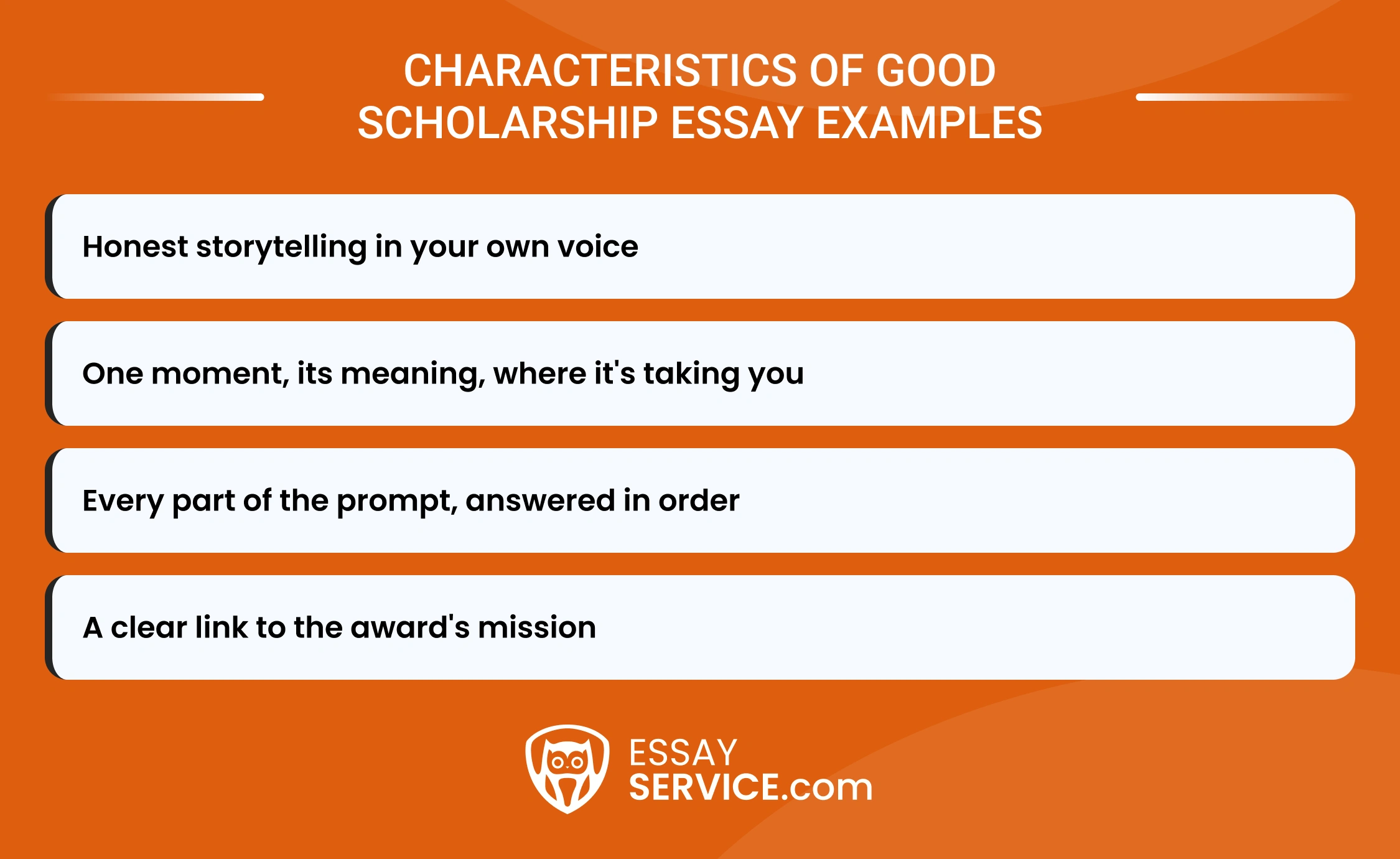
Beyond that, four qualities turn up again and again:
- Honest storytelling in a voice that sounds like you, full of details nobody could have invented.
- A three-part movement through the essay: one concrete moment that changed something, the meaning you drew out of it, and the direction it's pushing you now.
- A visible answer to the exact prompt, including every sub-question the funder asks, in the order they ask it.
- A clear line connecting your story to what the scholarship exists to fund, so the reader sees why their money belongs with you specifically.
What Scholarship Committees Actually Look For
Before you plan how to write a scholarship essay, know who's on the other end. Your application often lands in front of two or three reviewers, and some of them score you against a rubric you'll never get to see. These are people who read essays by the hundred, so the tired moves register instantly.
The move they resent most is manufactured polish. Johanna Donovan, who has reviewed scholarship essays at NC State for over thirty years, says that she can spot an essay a student didn't write. That squares with what I've seen. Committees reward exact detail, a visible link to their mission, and evidence that you actually finished the things you started. My advice? Give one reader who doesn't love you a draft, and ask if it sounds like you. If they hesitate, rewrite it.


Your Words, Perfectly Polished
Hand us the draft and we'll turn it into writing that actually gets read.
Scholarship Essay Examples That Actually Won
The seven scholarship essay examples below share exactly one trait: each one won its writer real money. I chose them to cover the prompts you'll bump into most often. Read for the decisions each writer made, the exact detail they picked, the moment they chose to open on. These are scholarship essay examples that won money, and no two of them pulled it off the same way.
Scholarship Essay Example #1
Prompt: “It is very important to know who you are. To make decisions. To show who you are.” – Malala Yousafzai. Tell us three things that are important to you. How did you arrive at this list? Will these things be important to you in ten years? Why? * (No more than 400 words)
The three things that are important to me are my family, being successful, and leaving a legacy. As a result of my past, I keep these three crucial things at the forefront of my mind every day to help myself be successful.
Above all, my family is the most important thing in my life. The meaning of family may differ for everyone, but for me, my family is life. I almost died in the 2010 Haitian earthquake, as Jacmel was one of the worst damaged areas, had it not been for my grandmother and my mom. Later, if it was not for my uncle, my mom would not have been able to come to America to give me a better life. Without my family, I wouldn’t be here. I am forever indebted to their sacrifices, and I am so grateful that I have their eternal love and support.
Success is also very important to me. I hope to accomplish many things in my life, but most importantly, I would like to make my family proud so that they know that all of their sacrifices were worth it. Success to me is having a career that I love and allows me to help my family members financially. I hope to no longer experience hardships such as homelessness, poverty, and economic difficulties, as I had in my young life.
Ultimately, however, I would like to grow into someone who is loved and remembered by people who aren’t my immediate family members and my friends. I do not wish to be glorified, but I want to be more than a nonentity in this big, vast world. I hope that if I can inspire the change that I want to make, I can leave a legacy that continues to influence and shape the landscape that follows me. After coming to the epiphany that if I died today, nothing would change except for the lives of those extremely close to me, I find myself unwilling to be just another Jane Doe. I want to leave a part of myself behind, whether it is a building or a popular hashtag, that is meaningful and permanent once I die.
Why It Works:
- The opening. Sentence one hands the reader a map: family, success, legacy. A tired reviewer instantly knows where this is headed. It runs abstract, and a concrete scene might have hit harder, but a clean roadmap is a fair move for a prompt with three parts to cover.
- Family. The strongest section by far. A flat line, "my family is life," gets grounded in something no one could invent: nearly dying in the 2010 Haitian earthquake, with Jacmel named outright. Every relative attaches to a specific action.
- Success. Ties straight back to family, so the essay stays coherent instead of splitting into three. Naming real hardship raises the stakes.
- Legacy. The boldest swing. The "Jane Doe" fear is honest and sticks. The hashtag line undercuts the gravity a little.
Scholarship Essay Example #2
Prompt: “The secret of our success is that we never, never give up.” - Wilma Mankiller. Tell us about a time when you failed at something. What were the circumstances? How did you respond to failure? What lessons did you learn? * (No more than 400 words)
“I’ve danced ballet since I was seven-years-old. But, even after almost eight years, I could still barely extend my legs as high as my peers nor could do as many pirouettes as them. My flexibility was incredibly subpar and I easily wore out my Pointe shoes, making them unwearable after a couple of months. Where the average lifespans of my peers’ pointe shoes extended into months, mine could barely last ten classes. I was the weakling of my class at Ballet Etudes, and I was too absorbed in my insecurities to do anything to better myself to become the dancer I aspired to be.
After a humiliating recital, wherein my pointe shoe ribbons untied in the middle of our group performance, I all but gave up on dance. I was in the middle of doing a Changement de Pieds (Change of feet jumping step) when I glanced down in horror to see my beautiful ribbons untied as I forgot to tape them with clear tape as I usually did before my performances. Glancing to my right, I saw that my ballet teacher backstage had also taken note and was rushing me to get off the stage, her hands beckoning me in a frantic manner. After berating me for not having properly tied my laces, I was not allowed to finish my part. Later, I could barely get back on stage that evening for our final performance as I didn’t want to fail myself and my team again. But, because of my move to Port Saint Lucie in the summer before sophomore year, I was able to rekindle my passion for ballet and pointe at South Florida Dance Company. South Florida Dance Company was my saving grace, a place where I was able to restart my experiences in dance and renew the joy I once felt in my art. It was an incredible feeling regaining my confidence and surety in my abilities, as a result of the additional help that I received from my dance teacher, Ms. Amanda.
Presently, I always remind myself to be the best that I can be and to positively use my dance role models, like Misty Copeland, as encouragement to be a better dancer. From this experience, I learned that to overcome personal failures, I needed to move forward and think positively because change doesn’t happen when you sit still.”
Why it works: This one's uneven. The opening works because it's specific with pointe shoes that die after ten classes when everyone else's last months, the writer calling herself "the weakling" of Ballet Etudes, and admitting she did nothing to fix it. That honesty about her own role is what the prompt wants.
The recital scene is the best part. She stops summarizing and shows one moment where the ribbon untying mid-jump, the teacher waving her off the stage. You can picture it.
The recovery is where it thins out. The move to Port Saint Lucie fixes everything in a couple of rushed sentences, and the closing lesson about not sitting still is the kind of line a reader forgets immediately.
Scholarship Essay Example #3
Prompt: Please explain how your experience volunteering and participating in community service has shaped your perspective on humanity. Elaborate on how these experiences have influenced your future ambitions and career choices.
I didn’t really understand my community until I was forced to see it from the outside; sort of like when you see a picture of yourself someone else took that you weren’t aware of. It took a 3,000 mile flight for me to gain a different perspective of the world, of my world. When I landed in Maine it was nothing like the place I called home. There was no traffic, there were lots of trees, and absolutely no spanish to be heard anywhere. I missed my people, my home, and my community the most as I saw the ways in which other communities fostered creativity, advocacy, and community involvement.
I talked about my community every chance I got, writing a public backlash to Donald Trump and reading out to the group of parents to show them my unique struggle. The election of Donald Trump has forced me to come to terms with the harsh realities of this world. The lack of respect he has for women, minority groups, and factual evidence are alarming. This presidency makes me want to prove wrong all of his perceptions of people like me, the poor, the immigrant, the woman. I left people in awe, leaving me empowered. I had people come up to me and explain that they can relate to my poem about not fitting in, being Mexican American and not feeling like you can consider yourself American or Mexican because you’re both. I emphasized that I, like many others, am in between and we have the same platform that anyone else does to succeed. I explained that many of us, hold this pressure of first generation children of immigrants to prove that we are the proof that our parents sacrifices of restarting in a new country was worth it. I was the visible representation of a first generation child of immigrants, branching out into a new environment despite where I had come from and shocking everyone with my prosperity.
If I was the only visible representation available, I was going to use my voice to echo the feelings of my entire community and make it known that we are all here– all of our struggles, our efforts, and our passions, are not absent from places where we are not seen.
Maine helped me branch out in my own community now as a Student Ambassador. From this experience, I’ve learned that I can represent my high school and have the responsibility to assist staff at events for prospective students and organize presentations for parents. I spend a lot of time interpreting for parents at meetings and explaining the current events that are ongoing and new educational opportunities that students should take advantage of. I have had the privilege to work alongside office staff and the Principal, where I get to positively dedicate my time to parents who have general questions regarding the schools upcoming events. By dedicating my time as a Student Ambassador, I have allowed myself to excel at communicating with others and improving my customer service skills. I want my education to change the negative stigmas surrounding my community, by showing that it’s possible to expand your access to the world and allow you to leave, by choice, through receiving a post-secondary education. I am someone who has grown up in an area with limited resources fostering limited mindsets. My neighborhood has 4 elementary schools, 2 high schools, and a strip club feet away from a library. What message does that send to children? It’s normal in my community to have pregnant classmates in high school. People aren’t aware of the world outside, they aren’t encouraged to ever leave.
Through my experience as a volunteer that communicates a lot with parents, I have learned that the American Dream does not simply belong to first generation students like myself. I have found that our accomplishments are stacked upon the sacrifices of our parents. I used to think that growing up was like the passing of a baton where you’re the next runner and it’s your turn to run your best race, but I now see that this is a team effort, as you expand your horizons your family also gets to experience the benefits. I want to demonstrate to my community that there can be a female, bilingual, Latina doctor. I want to showcase that one’s zip code, doesn’t determines one’s success. One of the most common questions I get at these parent meetings is “what’s better college or university”? This question didn’t make sense to me at first then I realized that parents wanted to know the difference between community college and a four year. Concepts like financial aid, grants, loans, are all foreign concepts as most of our parents never went to college. They want to be able to help but do not know where to begin. As a student ambassador I helped bridge that gap. We often held meetings where we explained to parents within our community what resources were out there and available and what the difference were among the different options for each student. Being the student face for Animo, I’ve learned that I as a student and daughter, can provide assistance to my own community through the knowledge that I have gained. I am the communication that is needed in my community that’s necessary for further successes by using my personal knowledge and experience to help uplift and educate others in similar situations.
Why it Works: A 3,000-mile flight to Maine, a place with no traffic, lots of trees, and no Spanish anywhere. That absence is a concrete detail, and it explains why the writer suddenly saw her own community clearly. Good use of a specific place to trigger reflection.
The Trump paragraph is the riskiest choice here. Political content can alienate a reader, and this section runs long and a little scattered. What saves it is the poem about being Mexican American, feeling like neither, and other people coming up to say they related. She turns a political moment into a story about identity and representation, which is stronger ground.
The Student Ambassador material is the most convincing part. Interpreting for parents at meetings, explaining the difference between community college and a four-year, walking families through financial aid they'd never encountered. These are real, verifiable actions, and they prove the community claim instead of just asserting it. The library-next-to-a-strip-club line and the pregnant-classmates detail hit hard because they're specific and unflinching.
Scholarship Essay Example #4
Prompt: Describe a challenge you have overcome. What did you learn during the ordeal? How did it change or shape you? Does it impact your future plans?
The winter my father slipped on the loading dock, our family restaurant lost its only cook, who also happened to be its dishwasher, its owner, and my dad. He couldn't stand for more than ten minutes. I was sixteen.
No one asked me first. It just became obvious that someone had to open Golden Bowl at 4 p.m. on weekdays, and I was the someone. My mother ran the register and answered the phone in the little English she had. I learned to fry orange chicken in a wok taller than my forearm, to plate lo mein without scalding my wrists, to tell a regular that their usual would be twelve minutes because the fryer needed a second.
For a while I believed I could do all of it. My chemistry grade said otherwise. I got a 51 on the unit test about stoichiometry, a word I could barely pronounce that semester because I was too wiped to open the chapter. That 51 rattled me for weeks. I went to Mr. Alvarez during his lunch and told him the truth about my nights. He didn't excuse me from anything. He handed me a study schedule and the name of a classmate, Priya, who tutored on Saturday mornings before her shift at the mall.
The real lesson had nothing to do with grit: asking for help is a skill, and I had none of it. I'd assumed that handling everything alone was the same as being responsible. It isn't. The people who rescued that semester were the ones I finally let in on how bad things had gotten.
My father walks fine now, and Golden Bowl still opens at four. I don't work the fryer anymore, because I'm applying to nursing programs. That choice traces straight back to those months. I watched my mother navigate a hospital in a language that wasn't hers, and I decided I want to be the person who slows down and explains the discharge papers a second time, in plain words. This scholarship would let me cut my work hours and give clinical rotations the attention they deserve.
Why it Works:
- The opening is the best in the batch. That first sentence delays the reveal until the last three words, "and my dad," so the loss of a cook and dishwasher suddenly becomes personal. "He couldn't stand for more than ten minutes. I was sixteen." Two short sentences after a long one, and the whole situation is clear. No wind-up, no throat-clearing.
- The second paragraph proves the work with sensory specifics: the wok taller than a forearm, plating lo mein without burning her wrists, quoting a regular twelve minutes because the fryer needed a second. These aren't decorations. They're evidence that she actually did the thing.
- The chemistry paragraph is where the essay grows up. The 51 on the stoichiometry test admits failure, which most applicants avoid, and then names real people who helped: Mr. Alvarez and Priya, down to Priya's mall shift. Specificity again does the persuading.
- The lesson paragraph states its point plainly, that asking for help is a skill, and it's earned by everything before it, so it doesn't feel tacked on.
- The close nails mission-fit. The nursing goal connects to watching her mother struggle through a hospital in another language, and the scholarship gets a concrete use: fewer work hours, better clinical rotations. Full marks.
Scholarship Essay Example #5
Prompt: What person do you most admire? Why? What qualities do they have? How do you hope to emulate them? What specific thing did they do that inspired you?
The person I admire most kept her vocabulary flashcards banded together in the cupholder of a 2004 Corolla with 190,000 miles on it. That's my mother. At forty-four she decided to finish the high school diploma she had abandoned at seventeen, and she did it while working as a home health aide six days a week.
I want to be precise about why, because "my mom is inspiring" is the kind of sentence a committee has read four hundred times. Here is the specific thing. One Tuesday in October, she got home at 9 p.m. She smelled of the antiseptic soap her agency issues. She ate half a bowl of rice at the counter, then opened her algebra workbook. I asked if she was too tired. She said tired was a luxury she would deal with in June. She had an equations quiz Thursday and a client with dementia who had wandered off that afternoon, and both of those facts lived in the same evening for her without any drama.
Three qualities stand out when I think about her. The first is a stubbornness that never curdles into self-pity. The second is humility. She asked me, her own kid, to check her essays, and she took the red marks without flinching. The third is a private accounting she does, where she measures a day by what she moved forward rather than by what went wrong.
The thing that actually changed me was small. On the morning of her final exam, she left a sticky note on my bathroom mirror. It said, "Hard is not the same as impossible. Love, Mom." I was failing pre-calc at the time and had been telling myself the class was simply beyond me. That note dismantled the excuse. I stopped saying I couldn't and started asking my teacher what I was missing. My grade climbed to a B minus by finals, which I am not ashamed of.
I hope to emulate her in the least glamorous way possible: by doing the boring, repeated work when no one is watching. She never posted about her diploma. She framed it and hung it in the hallway where only we would see it. When I train to become a physical therapist, there will be years of anatomy drills and clinical hours that nobody claps for. I already know how to put my head down through that, because I watched her do it at a kitchen table, one flashcard at a time.
She passed, by the way. 3.4 GPA. The Corolla still runs.
Why It Works: What sets this essay apart is restraint. It never once tells you to be impressed. The Corolla with 190,000 miles, the flashcards in the cupholder, a mother finishing at forty-four what she quit at seventeen: the facts do the arguing, and the writer trusts them to.
The move I'd point students to is the line "my mom is inspiring is the kind of sentence a committee has read four hundred times." She calls out the cliché, then refuses to write it. That single act of self-awareness tells a reviewer this applicant knows what a weak essay looks like and chose not to hand one in.
Then there's the control of information. Look at how much she withholds. We don't learn the mother passed until the final three lines, and the GPA and the still-running Corolla arrive as a payoff, not a plea. Most applicants would have opened with "my mother overcame everything." This writer makes you wait, and the waiting is what makes it land.
Scholarship Essay Example #6
Prompt: Describe a topic, idea, or concept you find so engaging that it makes you lose all track of time. Why does it captivate you? What or who do you turn to when you want to learn more?
I once spent an entire Saturday afternoon following the word "salary" backward until it landed on Roman soldiers and salt. That is the kind of thing that eats my hours without asking permission. Etymology, the history of where words come from, is the subject I fall into and forget to eat lunch over.
It began with a dull vocabulary assignment freshman year. We had to define "companion." I looked it up out of pure obligation and found that it breaks into "com" and "panis," which means "with bread." A companion is, at root, the person you break bread with. I read that line and something clicked that has not un-clicked since. Every ordinary word suddenly had a basement I wanted to climb down into.
Let me be specific about the pull, because "I love learning" tells you nothing. Old ideas hide in plain words, and most people walk right past them. "Muscle" comes from the Latin for little mouse, because a flexing bicep looked, to somebody, once, like a small mouse that moves under the skin. That person made the comparison two thousand years ago, and the rest of us have repeated it every day since without noticing. When I chase a word, I get a small record of how people understood the world before anyone explained it to me directly.
When I want to dig further, I have a short list of places I trust. The Online Etymology Dictionary, etymonline, lives in a permanent tab on my laptop. I read Mark Forsyth's book "The Etymologicon" twice and then irritated my whole family by reciting bits of it at dinner. And there is Ms. Kettler, my English teacher, who studied Latin in college and lets me come by after seventh period to argue about what a root really means when the internet and the textbooks disagree.
The habit has changed how I handle every other subject. Biology terms stopped being random noise the day I could split "photosynthesis" into light and putting-together. Legal vocabulary in my government class does the same trick. I am leaning toward linguistics in college, though law tempts me too, since both come down to reading exactly what a word is doing and refusing to guess. Whatever I pick, I am fairly sure I will never open a dictionary and simply close it again ten seconds later.
Why It Works: The engine of this essay is the writer never stating the interest, always enacting it. You could delete the sentence "Etymology is the subject I fall into" and lose nothing, because the salary trail already told you. Three times she picks a word, cracks it open, and lets the reader watch it come apart. Salary and salt. Companion and bread. Muscle and mouse. By the third, you're not reading about a fascination anymore, you're inside the same loop she is.
The essay is also making an argument that the writer thinks well, not just that she likes words. The muscle-mouse passage is the tell. Some anonymous person, two millennia back, saw a bicep twitch and reached for a rodent, and we've all said it since without noticing. That's an observation about how metaphor gets buried in language over time, and a fifteen-year-old noticed it. That's the real flex, and it's smart to let the example carry it rather than announcing "I am analytical."
Credit too for treating the prompt's second question as a chance rather than a chore. Etymonline, the Forsyth book she reread, Ms. Kettler after seventh period. These specifics double as proof the habit is ongoing.
Scholarship Essay Example #7
Prompt: Some students have a background, identity, interest, or talent that is so meaningful they believe their application would be incomplete without it. If this sounds like you, then please share your story.
I can tune a piano by ear, and I learned how because ours went out of tune and we could not afford the sixty dollars to fix it.
The piano came from a church that was throwing it out. My grandmother took it home in a borrowed truck when I was nine, and for two years it sounded fine. Then a humid summer warped something, and middle C started to fight with the C an octave up. A technician quoted us a price my mother said "we'll see about," which in our house meant no. So I opened the lid, looked at the tuning pins, and got the wrong idea that I could handle it myself.
The first attempt was a disaster. I over-tightened a string until it snapped with a sound like a gunshot and left a red welt on the back of my hand. My grandmother did not yell. She said, "Okay, now you know what too far feels like." That sentence turned out to be the entire lesson.
I taught myself slowly, using a cheap tuning lever, a set of rubber mutes I made from an old flip-flop, and a free pitch app when my ear could not be trusted. It took me nearly a year to tune the whole instrument without breaking anything. I learned to hear "beats," the wobble two slightly-off notes make when they ring together, and to chase that wobble until it flattens into one clean tone. It is a physical, patient skill that lives in the ear and the hands at the same time.
Here is why my application would feel hollow without this. The piano taught me a specific way of solving problems that I now bring to everything. I do not panic at a task I have never done. I break it into the smallest honest unit, in this case one string, and I accept that the first tries will be ugly. My chemistry lab partner thinks I am unusually calm when an experiment fails. I am not calm. I just remember the welt on my hand and adjust.
I plan to study mechanical engineering. People assume that is a leap from music. It is the same instinct: a system is out of tune, you find the one part that is fighting the others, and you turn it, gently, until the whole thing agrees. I have been doing that since I was eleven, on a free piano, with a flip-flop.
Why It Works: The reason this essay works is that a small, odd skill becomes a window into how the writer's mind operates, and it never oversells the skill itself.
Money runs underneath the whole thing without a single line of self-pity. The sixty dollars they couldn't spare, the church piano hauled off in a borrowed truck, the mother's "we'll see about" that everyone in the house knew meant no. The writer trusts the reader to register the economic reality on their own, which is far more dignified than spelling it out.
The snapped string is the emotional center, and the grandmother's response is what makes it stick: "Okay, now you know what too far feels like." One line of real dialogue does more than a paragraph of reflection could, and the writer is wise enough to step back and let it sit rather than explaining it to death.
The technical paragraph earns trust through precision. Rubber mutes cut from a flip-flop, a year of slow practice, the description of "beats" as the wobble between two off notes. This is someone who genuinely did the thing, and specificity is the proof.
Then comes the turn most talent essays miss. The skill is reframed as a method, breaking a problem into its smallest honest unit, and tied forward to mechanical engineering. The flip-flop callback in the final line ties it shut without a bow. My one note: the "same instinct" explanation of engineering slightly over-clarifies a connection the reader had already made.
Deadlines Don't Scare Us
Send the brief tonight, get clean, ready-to-use writing back before you need it.
Tips for Writing a Scholarship Essay
You've seen the standard scholarship essay tips a hundred times: proofread, start early, be yourself. All fine, all useless the second time you hear them. Here are the ones that actually move a decision once you get to the real work of writing a scholarship essay.
- Read the funder before you write a single sentence. Find out who created the award, who won it last year, and what the organization says it cares about. Then aim one paragraph straight at that.
- Answer every sub-question in the prompt, and do it in the order they ask. Reviewers often score against a checklist that mirrors those exact bullets, so a skipped question is a lost point on a sheet you'll never see.
- Cut your first paragraph. First drafts almost always open with throat-clearing: a dictionary definition, a borrowed quote, a slow windup. Delete it and begin on paragraph two, where your actual scene starts.
- Trade adjectives for numbers and names. "I worked hard at my job" is empty. "I closed the register at 11 p.m. four nights a week at the Shell on Route 9" tells a reviewer exactly what your effort looked like.
- Respect the word count precisely. Some application portals cut you off mid-sentence at the limit, and a reader can dock you for coming in far under it.
- Hand the draft to one honest person. Not a parent who will love anything you produce. Someone who'll tell you which sentence made them skim.
If you have an important paper to write that will determine the future of your education, just use essay writing services, and our experts will get on it right away.
Final Thoughts
A winning scholarship essay tends to come down to four things. You tell the truth in a voice that's unmistakably yours. You move through one real moment, the meaning you took from it, and where it's pushing you now. You answer the actual prompt, every sub-question included, in the order they asked. And you draw a straight line from your story to what the funder cares about.
That last part is the one people forget, so let it be the thing you remember. Mission-fit is what separates a nice personal essay from a scholarship essay that wins. A committee isn't handing out money for good writing alone. They're funding a specific kind of person for a specific reason.
So write yours honestly, answer what they asked, and show them why their money belongs with you. Then send it.
Frequently Asked Questions
How Long Should a Scholarship Essay Be?
How Do You Start a Scholarship Essay?
What Should You Not Write in a Scholarship Essay?
Can You Reuse the Same Scholarship Essay?
Do Scholarship Committees Check for Plagiarism Or AI?
What Do Scholarship Committees Look for in an Essay?

Anna has been helping students become more productive learners for 20+ years now. Her experience, combined with a Master’s degree in psychology, ensures her blog posts contain only valuable insights.


New posts to your inbox
Your submission has been received!