
A research question defines the exact problem a study investigates. It sets the focus for research, analysis, and writing. This guide explains how to write a research question that leads to meaningful answers. You will see clear examples, common mistakes, and practical steps that help turn a broad topic into a focused research question suitable for academic work.
What Is a Research Question?
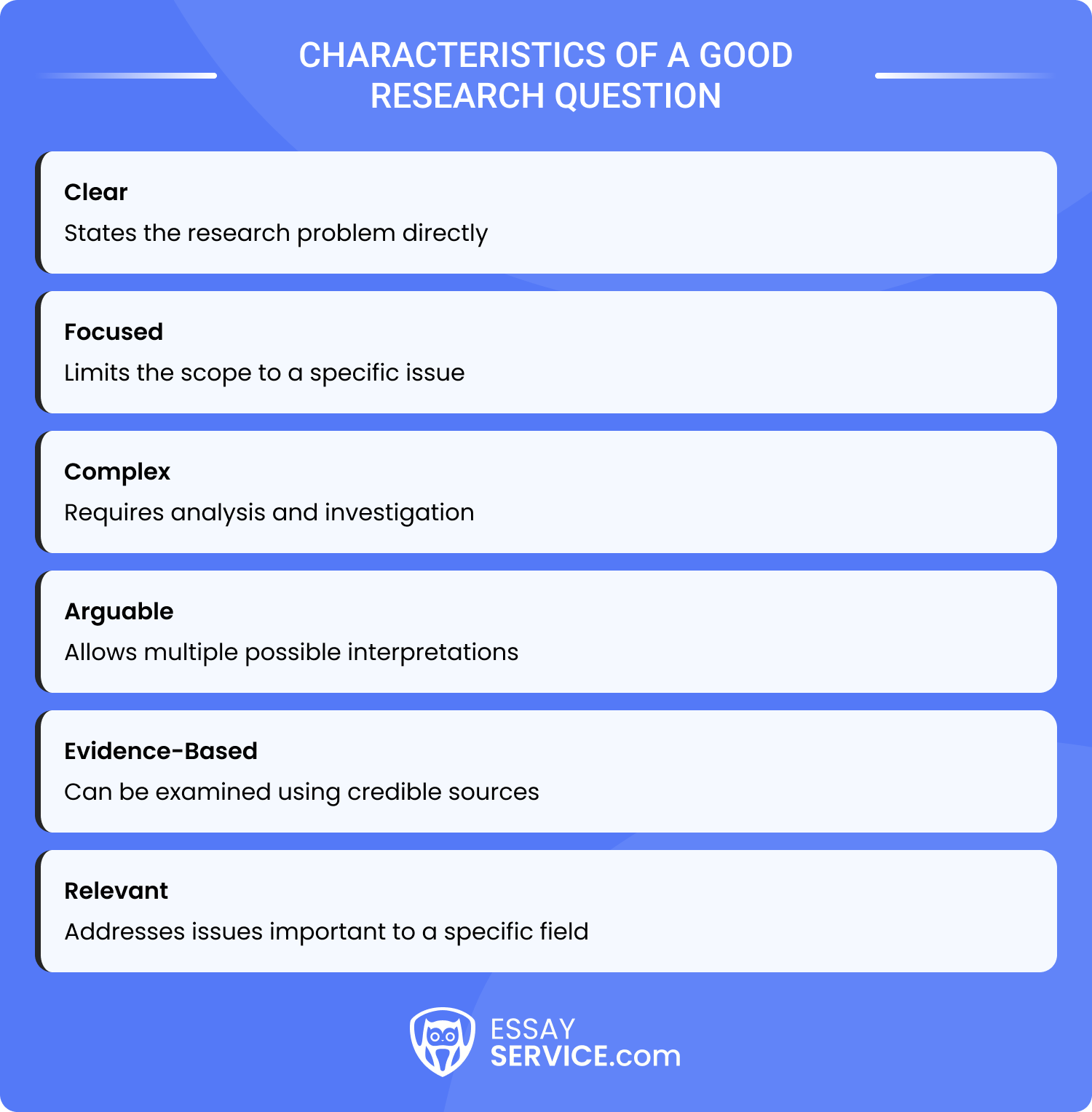
A research question is a clear, open-ended statement that defines the exact issue of the study and determines every stage of the writing process. Researchers rely on this question to decide which sources belong in the paper and which ideas require deeper analysis. Drafts can quickly fail if the process of developing research questions doesn't receive enough attention. Good research questions are:
- Clear - Communicates the research problem directly and uses the fewest possible words.
- Focused - Limits the scope of the study and prevents an unfocused research question.
- Complex - Requires analysis and significant investigation rather than a few factual sentences.
- Arguable - Supports multiple potential answers and encourages an arguable thesis.
- Evidence-Based - Allows evaluation through credible sources and existing knowledge related to the topic.
- Relevant - Addresses ideas that matter to a particular audience or field of study.
Since it's so crucial to correctly shape a question early in the study, students often reach out to research paper writing services for professional help.
Why Is a Research Question Important?
A research question defines the exact problem a study investigates and sets the focus of the research. Researchers use the question to select sources, guide analysis, and decide which evidence belongs in the paper. A weak or unfocused research question usually produces scattered research and irrelevant information. A clear question limits the scope of a broad topic and directs the research process toward a specific answer. Each section of the paper must contribute evidence or analysis that helps answer the research question. A well written question keeps the research organized and supports a clear academic argument.
How to Develop a Research Question
Writing research questions requires a structured process. Researchers start with a broad topic, review existing information, and refine the focus into a clear research problem. Skipping steps often leads to weak questions. If you'd rather have the professionals handle the writing process, you can always pay for a research paper.
1. Understand the Instructions
Begin with the assignment prompt. Read it slowly and identify the exact task. It might be a prompt that requests a deeper analysis, or something that simply asks for an explanation or an evaluation. The wording in the instructions will signal the type of answer expected. Write down requirements such as length, topic boundaries, and required sources. These limits shape the research problem before the research even begins. A research question that ignores the instructions usually produces irrelevant analysis. Clear instructions narrow the field and guide the early direction of the research.
2. Choose the Right Topic
Start with a general subject that allows investigation. A topic such as global warming, urban transportation, or digital privacy gives space for deeper inquiry. The next step involves forming a research questions draft that targets a specific issue within that subject. Researchers rarely settle on the first idea that appears. They test several possible angles and look for one that supports meaningful analysis. A useful topic encourages curiosity and offers enough credible sources to support the research.
3. Conduct Preliminary Research
Before committing to a question, review existing studies. Gather information from academic articles, reports, and current periodicals that reveal how researchers discuss the topic. Patterns begin to appear after several sources. Researchers use this stage to conduct preliminary research and examine existing knowledge. A quick google search often reveals useful starting points. Notes gathered here help shape the direction of the research question and expose gaps that invite further investigation.
Pro Tip: Search Google Scholar or your library database for your topic. If you cannot find at least three relevant academic sources, the question likely lacks a workable evidence base.
4. Keep the Research Question Focused
A broad topic creates confusion during research. A clear question requires limits. Researchers reduce the scope by specifying a location, a group of people, or a defined time period. This stage often involves making a research questions more precise. Each revision removes unnecessary complexity and sharpens the focus. The research question becomes easier to answer through analysis rather than scattered facts. A narrow scope keeps the research organized and prevents the project from drifting into unrelated ideas.
5. Formulate the Question
The final step turns the research problem into a direct question. The wording must invite analysis and support more than one possible answer. Questions that produce a few factual sentences rarely lead to meaningful research. Students learning how to formulate a research question often rewrite the question several times. Each revision improves clarity and focus. A strong question guides the entire study. It determines which sources matter and shapes the direction of the research paper.
Pro Tip: Write three versions of the question: one broad, one narrow, and one balanced. Compare them against available sources and choose the version that supports meaningful analysis without overwhelming the research.


Research Question Examples
The following research questions examples for students show how a broad question becomes a focused research problem that supports analysis and meaningful answers.
What Kind of Research Questions Are There?
Different research goals demand different question structures. Questions about income trends, climate data, or voting patterns rely on measurable variables and numerical evidence. Questions about patient experiences, workplace culture, or community responses require interpretation and contextual analysis. When you understand how to create a research question early, you define the direction of the research before sources and analysis begin to accumulate. This section explains the main types of research questions and how each structure shapes the study.
Quantitative Research Questions
Quantitative research questions investigate measurable patterns. Researchers rely on numerical data, statistical analysis, and defined variables. These questions appear in studies that measure outcomes, test relationships, or compare groups. Surveys, experiments, and large datasets often supply the data. The structure of the question identifies what researchers will measure and which variables they will analyze. Clear variables make the analysis possible. Quantitative question types are:
- Descriptive: Descriptive questions measure characteristics within a group or situation. Researchers identify frequencies, percentages, or averages. The goal involves documenting patterns in measurable terms.
- Comparative: Comparative questions investigate differences between groups or conditions. Researchers measure outcomes across two or more populations.
- Relationship: Relationship questions examine statistical connections between variables. Researchers evaluate how one factor relates to another measurable factor.
- Inferential - Inferential questions test whether patterns observed in sample data apply to a larger population using statistical analysis and probability.
Qualitative Research Questions
Qualitative research questions examine human experience, interpretation, and social context. Researchers use them when numerical measurement cannot explain the issue completely. Interviews, field observations, and textual analysis often provide the evidence. Students who aim to make a good research question in qualitative studies focus on understanding meaning rather than measuring frequency. The wording usually encourages explanation and interpretation. Common qualitative question types include:
- Contextual: Contextual questions investigate how environments or social settings influence behavior, beliefs, or decisions.
- Descriptive: Descriptive questions document how people experience a phenomenon in real situations. Researchers record observations and participant perspectives.
- Evaluative: Evaluative questions investigate how individuals judge the effectiveness or impact of programs, policies, or services.
- Explanatory: Explanatory questions investigate reasons behind actions, decisions, or attitudes observed within a group.
- Exploratory: Exploratory questions investigate topics with limited existing research. Researchers gather insight before deeper analysis becomes possible.
- Interpretive: Interpretive questions examine how individuals construct meaning around experiences, events, or social practices.
Mixed-Methods Studies
Mixed-methods research combines quantitative measurement with qualitative study. Researchers analyze numerical data and also collect explanations that clarify those results. Surveys may reveal patterns, while interviews explain why those patterns appear. This approach connects statistical analysis with lived experience. Mixed-methods studies allow researchers to investigate a problem through multiple forms of evidence.
Research Question Developing Frameworks
Researchers rarely invent research questions in a vacuum. Structured frameworks help translate a broad idea into a precise investigation. Common frameworks are:
- FINER - This framework checks whether a question is Feasible, Interesting, Novel, Ethical, and Relevant. Researchers use it early to judge if a project deserves investigation.
- PICOT - Frequently used in clinical research. The structure identifies Population, Intervention, Comparison, Outcome, and Timeframe, so the research problem becomes measurable.
- PEO - Useful for qualitative investigations. The framework focuses on Population, Exposure, and Outcome when researchers examine lived experience or environmental influence.
- SPIDER - Designed for qualitative and mixed studies. It defines Sample, Phenomenon of Interest, Design, Evaluation, and Research type. This is one of the most popular frameworks for research methods in psychology.
- CLIP - Often used in social policy research. The framework clarifies the Client group, Location, Issue, and Purpose before research begins.
Mistakes to Avoid Formulating Research Questions
Weak research questions usually appear early in the project. The problem often lies in scope, wording, or practical feasibility. Writing a good research question requires deliberate refinement before research begins. The following mistakes frequently undermine otherwise promising research topics.
- Overly Broad Scope - Extremely broad questions scatter the research effort across too many issues. Researchers struggle to collect relevant evidence and analysis loses depth.
- Unrealistic Data Requirements - A question may require data that cannot realistically be collected. Limited access to participants, restricted archives, or missing datasets often make the investigation impossible.
- Unclear or Vague Wording - Terms such as “impact,” “change,” or “improvement” fail to define the research problem clearly. Ambiguous wording produces inconsistent analysis.
- Ethical Issues Overlooked - Research that involves vulnerable populations or sensitive medical data must meet ethical standards. Poorly designed questions may create serious ethical concerns.
- Fact-Only Questions - Questions that lead to easily found facts produce shallow research. Strong investigations require interpretation, evaluation, and analysis.
- Multiple Problems in One Question - A single sentence sometimes contains several different problems. Researchers then attempt to answer unrelated issues in one study. Clear research design requires one focused research question.
Pro Tip: Replace Vague Words with Measurable Terms. Avoid words like impact or role. Use concrete indicators such as exam scores, response time, or participation rates.
Final Thoughts
The article explains how to write a research question by defining its role in guiding the research process and writing. It outlines key characteristics of strong questions, steps for developing them, common frameworks, typical mistakes, and examples. There are several types of research questions: quantitative, qualitative, and mixed-methods, each of which shows how clear scope and wording support meaningful analysis and credible research.
Frequently Asked Questions
How to Write a Strong Research Question?
How to Write a Qualitative Research Question?
How to Write a Quantitative Research Question?
How to Write a Mixed Methods Research Question?
What Are the 5 Steps of Writing a Research Question?

Essie isn’t just an educator with a Bachelor’s in English: she’s passionate about writing. She uses her experience in grading papers to write comprehensive guides for our blog.
- LibGuides: Research Project: Develop a Research Question. (2026). https://libguides.lorainccc.edu/research-process/question
- LibGuides: Psychology : 2. Formulate a Research Question. (2025). https://xula.libguides.com/psychology/research_question
- Mattick, K., Johnston, J., & de la Croix, A. (2018). How to…write a good research question. The Clinical Teacher, 15(2), 104–108. https://asmepublications.onlinelibrary.wiley.com/doi/10.1111/tct.12776



New posts to your inbox
Your submission has been received!