
A concert review explains and critiques a live music performance. It tells readers who performed, what music was played, how the performance was delivered, and gives your opinion on the overall experience. While slight variations occur in concert review guidelines, the formula remains consistent from assignment to assignment: artist/background, music description, performance critique, your reaction, and conclusion/recommendation.
This article discusses how to write a concert review with the aspects that your instructor will be grading you on. Then we'll break down 8 concert review examples to show how it all comes together.
What instructors look for in a concert review essay?
First, read your assignment rubric. Professors have specific (and sometimes overlapping) requirements for grading concert reviews. While they vary, the majority of rubrics will give you credit for:
- Named repertoire. (Write down what pieces/music were performed instead of vaguely stating "the music.")
- Using correct musical vocabulary. (Terms like tempo, dynamics, texture, and genre should all be used correctly.)
- Providing evidence for your opinions. (If you didn't like how a singer performed a passage, explain why musically instead of saying "it was nice.")
- Relating the piece to a genre studied. (Connections to styles or periods of music covered in class.)
- Including verification of attendance. (Provide a copy of the program, ticket stub, or a URL of the concert.)
One rubric that does a great job of this is Saint Leo University's Concert Critique rubric. As you can see in the screenshot, they grade the Background of the performer, Description of the music, Depth of critique, Opinion, and Conclusion as individual categories. Keep in mind that every teacher and course will have its own rubric. Your course's rubric should be considered authoritative and trump any advice or suggested structure you read in this article or elsewhere.


Need Help With Your Music Assignment?
Get expert support with concert reviews, essays, and research papers from professional academic writers.
Concert review structure
The process of writing a concert review essay follows the same basic skeleton, even when individual instructors ask for slightly different details. According to the University of Nevada, Reno's Writing & Speaking Center, a strong review breaks into four parts.
- Your introduction names the concert title, gives your overall impression up front, briefly outlines the concert's structure, and mentions the featured conductors or performers.
- The concert's hard facts section covers instrumentation, tone, tempo, and any notable anomalies, like a broken string or a special announcement. Some guidelines push this further into specific musical vocabulary: Tennessee State University's Fundamentals of Music concert review guidelines ask students to note harmony (dissonant or consonant), texture (homophonic or polyphonic), melody, dynamics, and rhythm for each piece discussed.
- Your experience review is where subjective reaction comes in: how the concert made you feel, what emotions or images it evoked, and what stood out. Both sources warn against two pitfalls here: writing too generally ("the music made me feel...") without supporting evidence, or simply narrating the performance moment by moment rather than analyzing it.
- Finally, the conclusion ties together your overall opinion, whether you'd recommend the performance, and any lingering thoughts.
Concert review template
Once you know the structure, filling in a template makes the writing process much faster. Use this as a starting skeleton, then adjust it to match your own instructor's rubric.
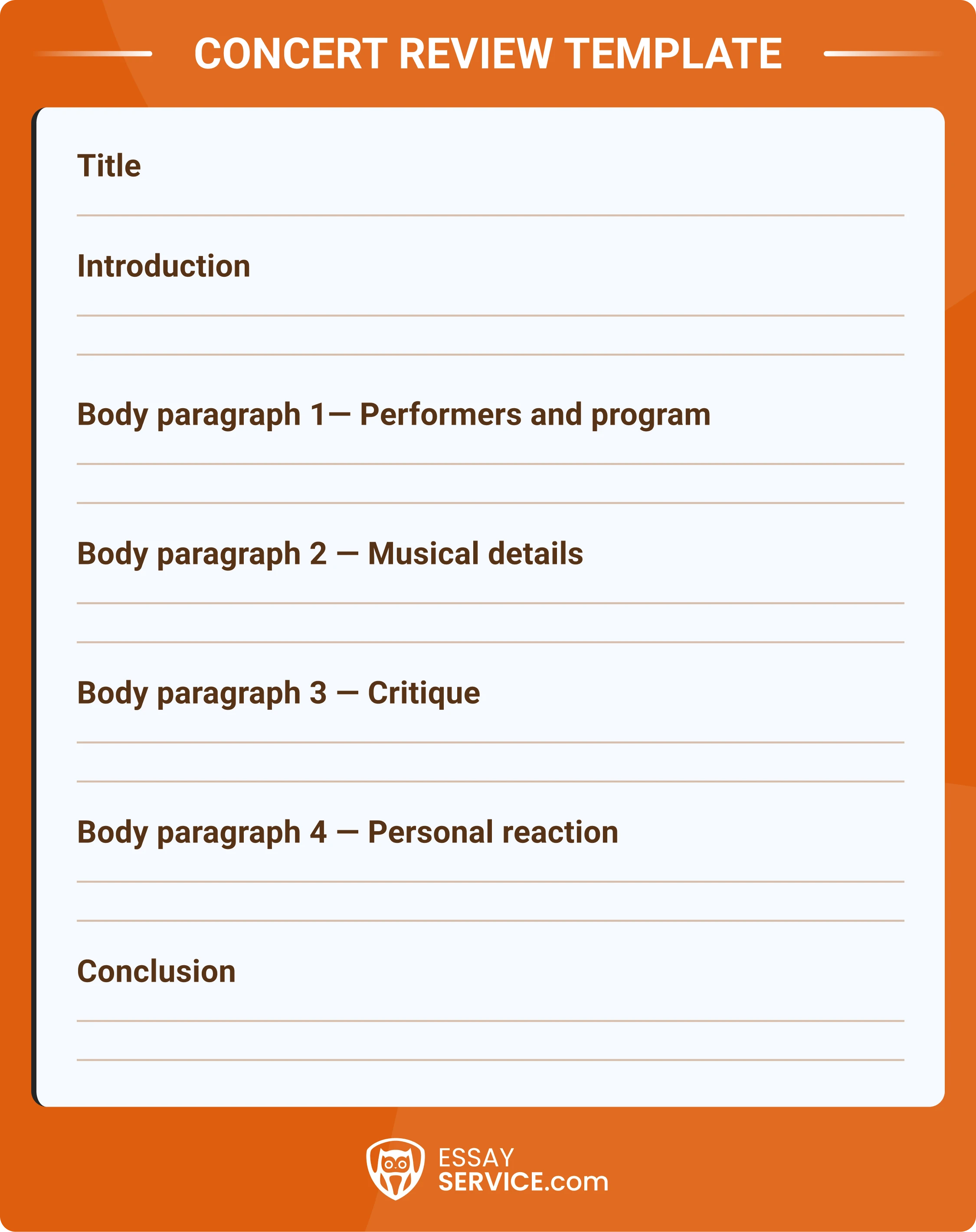
Title: [Concert name, in quotation marks or italicized per your citation style]
Introduction: Name the event, performers, and venue. State your overall impression in one or two sentences. Briefly preview what the concert included.
Body paragraph 1 — Performers and program: Who performed, and what was their background? What pieces or songs were on the program?
Body paragraph 2 — Musical details: Describe tempo, dynamics, texture, harmony, and instrumentation for at least one or two specific pieces.
Body paragraph 3 — Critique: Evaluate how well the performers interpreted the music. Was it in tune, rhythmically solid, emotionally convincing?
Body paragraph 4 — Personal reaction: What moment stood out most, and why? Use specific musical reasons, not vague praise.
Conclusion: Sum up your overall experience and say whether you'd recommend the performance to others.
How to write a concert review?
Any good concert review relies on preparation before the concert, focus during the concert, and careful writing afterward. Let’s take you through writing a concert review from start to finish.
- Take notes at the concert: Instead of trusting your memory to recall specifics of what happened the night of the concert, write down interesting things you notice. From audience reactions to musical details.
- Take a picture of the program or keep the program: This will help you remember the order of songs once you get home and try to write about your favorite part of the concert.
- Notice your surroundings: Who’s in the audience? How do the musicians interact with the audience? What does the performance space look like? How does the space enhance or limit the performance?
- Pick out musical details while you listen: Harmony? Texture? Tempo? Dynamics? Instrumentation? Focus on at least a few songs and take notes on musical vocabulary.
- Write down your thoughts: What was your favorite part of the concert? Your least favorite? How did you feel? Any questions that came to mind? You’ll notice that writing after some time has passed results in vague descriptions.
- Write your review: You have your notes, now write your review. Ideally, do this shortly after the concert while you still remember details. A good place to start organizing your draft is to divide it into these sections: performers, musical details, what you liked and didn’t like, and your personal reaction.
- Back up your assertions: Instead of saying something was moving, say what specifically about the music made you feel that way. Help your readers hear what you heard.
- Edit your work: Read over your paper. Did you switch between the past and present tense? Do you start too many sentences with “The”? Is there a section of your argument you forgot to prove to your readers? Edit edit edit.
- Proofread: Double-check with your professor for any length requirements, citation style, concert program/ticket requirements, etc. Then make sure to give your writing one last proofread before hitting that submit button.
Concert review examples
A concert report example does more than describe what happened onstage. It names specific pieces, uses accurate musical terminology, backs up personal reactions with clear reasoning, and follows a logical structure from introduction to conclusion. Below are 8 example reviews covering different concert types and writing styles, so you can see how the format shifts depending on the genre and setting.
Concert review example 1 - Classical orchestra performance
The Riverside Symphony Orchestra's performance of Dvořák's Symphony No. 9 opened their fall season with striking clarity. The brass section handled the famous largo theme with restraint, letting the English horn solo breathe without rushing. Tempo choices throughout the first movement felt slightly brisk compared to typical recordings, which gave the piece an urgency I hadn't expected. The string section's dynamics shifted convincingly between the quiet, contemplative passages and the sweeping fortissimo sections. My only critique is that the acoustics in the hall's upper balcony muddied some of the lower brass tones during the final movement. Overall, the interpretation felt fresh without straying from the score's emotional core, and I'd recommend the ensemble to anyone new to classical programming.
Concert review example 2 - Jazz ensemble
The Blue Note Quartet's late-night set leaned heavily into improvisation, opening with a loose, syncopated rendition of a standard tune before drifting into original compositions. The bassist's walking lines anchored the group while the saxophonist took extended solos that pushed well past the original melody, sometimes for four or five minutes at a stretch. The interplay between drummer and pianist during the trading fours section was the highlight of the night, each responding to the other's rhythmic ideas in real time. The venue's intimate setting suited the genre well, though the mix occasionally buried the piano under the horn. This was a strong example of jazz performance built on spontaneity rather than tight arrangement.
Concert review example 3 - Pop/rock concert
The venue's sound system struggled early in the set, with vocals sitting too low in the mix during the opening three songs before a mid-show adjustment fixed the balance. Once corrected, the band's energy carried the rest of the night, particularly during an extended bridge section where the lead guitarist improvised over a repeating bassline. The crowd's engagement noticeably shifted the performance itself; call-and-response moments during the chorus sections felt genuinely spontaneous rather than rehearsed. Lighting design matched the tonal shifts well, dimming for slower songs and flashing hard during upbeat transitions. Despite the rocky start, the overall performance built momentum steadily and ended on a high note.
Concert review example 4 - Choir performance
The university choir's program balanced sacred and secular pieces, moving from a somber Renaissance motet to a lively contemporary arrangement within the same set. The blend between vocal sections was tightest during the a cappella pieces, where pitch stayed remarkably stable without instrumental support. Dynamics were the standout element of the night: the choir's controlled crescendo during the closing piece built tension effectively before resolving into a quiet final chord. A few tempo inconsistencies appeared in the more rhythmically complex contemporary piece, likely due to its irregular meter. Still, the group's diction and phrasing throughout showed clear preparation, and the overall program felt thoughtfully sequenced.
Concert review example 5 - Solo piano recital
The pianist's program moved chronologically from Baroque to modern repertoire, giving the audience a clear sense of stylistic evolution across each piece. Articulation in the Bach prelude was crisp and even, while the Chopin nocturne that followed leaned into rubato more heavily than I expected, stretching certain phrases almost to the point of losing the underlying pulse. The final piece, a contemporary minimalist work, relied on repetitive patterns that built hypnotic intensity rather than melodic development. Pacing between pieces felt slightly rushed, with minimal pause for the audience to reset emotionally between contrasting works. Technically, the performance was precise, though a bit more room to breathe between sections would have strengthened the overall arc.
Concert review example 6 - Musical theater production
The touring production's live orchestra elevated several numbers beyond what a recorded soundtrack could offer, particularly during the act one finale, where the brass swelled beneath the ensemble vocals. Lead performers handled the score's demanding vocal runs cleanly, though the sound mixing occasionally favored the orchestra over dialogue during quieter scenes. Staging choices, like using minimal set pieces during transitions, kept the pacing tight between musical numbers. The choreography during the larger ensemble numbers showed strong synchronization, especially given the limited stage space. While a few technical hiccups with the microphones affected two songs in the second act, the overall production effectively balanced music, performance, and staging.
Concert review example 7 - Opera performance
The soprano's interpretation of the lead role brought unexpected vulnerability to a part often performed with more bravado, particularly during the second-act aria, where her dynamic control shifted from near-whisper to full voice within a single phrase. The orchestra, under the conductor's direction, stayed tightly in sync with the singers throughout, even during the more rhythmically complex ensemble scenes. Costume and set design leaned traditional, which suited the piece's period setting without distracting from the vocal performances. My main critique concerns pacing in the third act, where a lengthy scene change noticeably broke the emotional momentum built up beforehand. Even so, the vocal performances alone justified the evening.
Concert review example 8 - Electronic/DJ set
The DJ's set built gradually rather than opening at full intensity, layering ambient textures for the first twenty minutes before introducing a steady four-on-the-floor beat. Transitions between tracks were seamless, often blending two songs' basslines together for thirty seconds or more before fully committing to the next track. The visual production, synced lighting that pulsed with the beat drops, added a layer that a purely audio recording wouldn't capture. Crowd energy peaked around the midpoint of the set during an extended breakdown that built tension for nearly two minutes before releasing into a bass-heavy drop. The overall pacing showed a clear understanding of how to sustain a live audience's attention over an extended set.
Musical terms worth knowing for a concert review essay
Employing correct musical terminology is one of the quickest ways to improve a concert review, provided those terms are used properly. Teachers love to give points for specific, correct language rather than generalized language, so it can help to know some terminology, sorted by category, beforehand.
Safety note: an incorrect word will typically lose you more marks than an unabashedly descriptive sentence. Describe what you heard using plain English if you're not 100% sure what word to use.
Mistakes to avoid while writing a concert review
Yes, even good writers make these mistakes when composing a concert review. Here are a few pitfalls to avoid according to our essay writing service online:
- Being too vague about emotion: Sentences that start "The music made me feel..." or "It was like..." should be backed up by specific musical details, rather than just an emotion.
- Doing a play-by-play: Telling about the concert as it happened ("First the trombone player played, then the trumpets entered.") is telling about your observation, not giving your analysis.
- Including irrelevant information: There's no need to list every instrument you saw, or every person's name that performed, if they're printed on the program.
- Switching tenses: Choose to write in either the past tense or present tense and use that throughout your essay.
- Beginning too many sentences the same way: Your essay will sound like it was written by a computer if you start too many sentences with "This song..." or "The music sounded like..."
- Forgetting to proofread: Computer programs can catch spelling and grammar mistakes, but not all. You should always read over your paper once you're done writing.
Wrapping up
There are three ingredients for a successful concert review: preparation, specific observation, and truthful analysis supported by musical examples. Learn from the samples above, follow the outline, and remember your teacher's rubric. It will become second nature to connect hearing to writing with practice.
Frequently Asked Questions
What does a good concert review look like?
How long should a concert review be?
Can you write a concert review in the first person?

John spends his days studying the impact of language. He uses his deep understanding of linguistics and research experience to help students communicate more effectively and craft immaculate research-intensive papers.



New posts to your inbox
Your submission has been received!