
A clinical case study is a detailed account of one patient’s presentation, assessment, and care that explains the reasoning behind every clinical decision. Medical and nursing programs assign it to test how a student works through a real diagnosis. The format follows a fixed set of sections, each with its own job. This guide breaks down that format, walks through clinical case study examples section by section, and maps every part to the CARE checklist. A free clinical case study template in PDF waits at the end, ready to download and fill in.
What is a clinical case study?
A clinical case study is one of the types of nursing papers, a structured account of a single patient case that documents the full arc of care and justifies each clinical judgment. A student picks one patient, de-identifies the details, and walks a reader through assessment, diagnosis, treatment, and outcome. The goal is demonstrated reasoning. An instructor grades it on the quality of that reasoning.
The nearest lookalike is the clinical case report, the kind that medical journals publish. Both describe one patient in depth. The difference is audience and aim. A case report exists to tell other clinicians about something unusual or instructive, and it follows the CARE checklist for publication. A clinical case study stays an academic exercise that a student writes for a grade under a program’s own template.


Save the All-Nighter for Clinicals
Patients need you more. A specialist drafts your nursing paper by morning instead.
What is the difference between a clinical case study, a case report, and a SOAP note?
A clinical case study, a case report, and a SOAP note differ mainly in purpose, audience, and length. A case study demonstrates a student’s reasoning for an instructor. A case report publishes an instructive case for other clinicians. A SOAP note records one encounter for the care team. The table below lays out each contrast.
What is the format of a clinical case study?
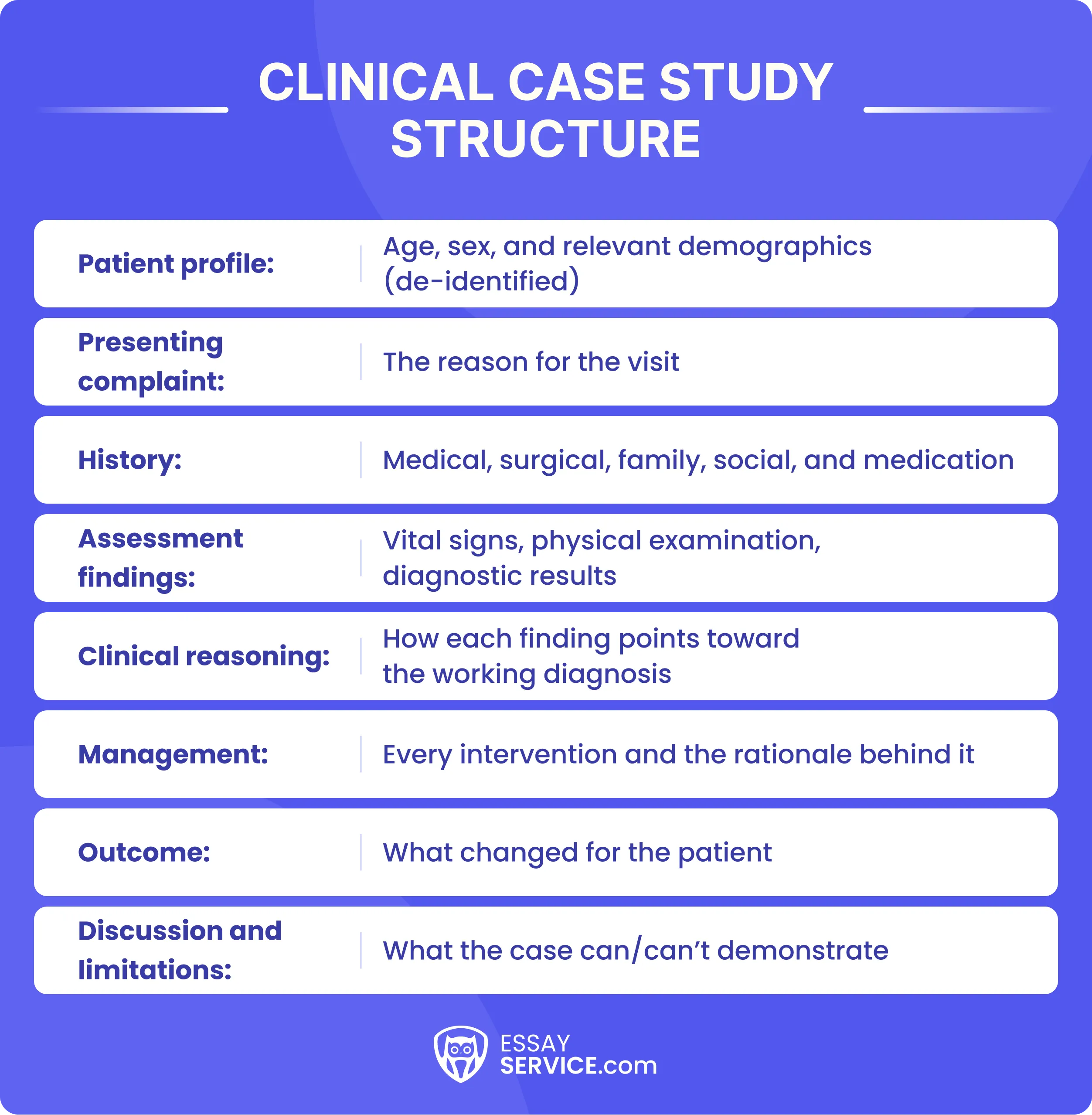
A clinical case study format runs through eight sections in a fixed order: patient profile, presenting complaint, history, assessment findings, clinical reasoning, management, outcome, and discussion. Clinical reasoning and management take the most space, at about 20% each. The table below shows the word-count share that works for a 2,000-word paper.
What is the CARE checklist for clinical case reports?
The CARE checklist is a 13-item reporting standard for clinical case reports The 13 items cover the title, keywords, abstract, introduction, patient information, clinical findings, timeline, diagnostic assessment, therapeutic intervention, follow-up and outcomes, discussion, patient perspective, and informed consent. Most medical journals now ask authors to submit a completed CARE checklist with any case report.
What are examples of clinical case studies?
All clinical case study examples below follow the same eight-section structure and annotate the reasoning behind the diagnosis. Every patient is fictional and included for teaching only. These case study examples in healthcare model what graders look for.
Disclosure: all six patients are composites for teaching and do not represent real individuals.
Medicine: acute chest pain in the emergency department
- Discipline and setting: Emergency medicine, in a hospital emergency department.
- Patient profile: A 58-year-old man, has hypertension and a 30-pack-year smoking history.
- Presenting complaint: Central chest pressure for 45 minutes. The pain spread to the left arm and came with sweating and nausea.
- Assessment findings: Blood pressure 158/94, heart rate 98, oxygen saturation 97% on room air. The ECG showed ST depression in the lateral leads. The first troponin came back elevated at 85 ng/L and rose on the three-hour repeat.
- Clinical reasoning (annotated): The working diagnosis is a non-ST-elevation myocardial infarction (NSTEMI). A HEART score of 7 placed him in the high-risk group, and the rising troponin confirmed myocardial injury. STEMI was ruled out because the ECG showed no ST elevation. Aortic dissection was excluded because blood pressure matched in both arms and the pain never moved to the back. Pulmonary embolism was set aside because oxygen saturation stayed normal and the patient had no leg swelling or recent immobilisation. Musculoskeletal and reflux causes fell away once troponin returned positive.
- Management and outcome: The team gave aspirin 300 mg, a second antiplatelet agent, and therapeutic anticoagulation, then referred the man to cardiology for coronary angiography. Angiography found a 90% blockage in the left circumflex artery, and a stent restored flow. He left the hospital on day three with secondary-prevention medicines and a cardiac-rehabilitation referral.
What this example shows: Fast reasoning under time pressure is the core skill an emergency case study tests. The grader looks for a ranked differential, a named risk tool, and a clear line that connects each finding to the diagnosis. Strong answers state what was excluded and the evidence behind each exclusion, since three life-threatening causes of chest pain share overlapping signs. The management section earns marks when every drug and referral has a stated reason that a guideline supports.
Nursing: post-operative wound infection
- Discipline and setting: Surgical nursing, on a post-operative ward.
- Patient profile: A 67-year-old woman, is five days out from an open hemicolectomy.
- Presenting complaint: Pain at the surgical wound climbed over 24 hours. A dressing change revealed fever and cloudy discharge.
- Assessment findings: Temperature 38.6°C, heart rate 104, and wound edges red and warm. White cell count 15.2. A wound swab went to the lab for culture.
- Clinical reasoning (annotated): The working nursing problem is a surgical site infection. Local redness, heat, purulent discharge, and fever together point to a wound source as the most likely of the common post-operative fevers. A chest source was ruled out because the lungs were clear on auscultation. A urinary source was excluded because the patient had no urinary symptoms and a clear urinalysis. A deep vein thrombosis was set aside because the calves were soft and non-tender.
- Management and outcome: The nurse escalated to the surgical team, started the prescribed empirical antibiotics, and set up a wound-care plan with daily review and fluid-balance monitoring. Culture-guided antibiotics followed. The wound improved over six days, and she went home with community-nurse follow-up.
What this example shows: Assessment, escalation, and a structured care plan are what a nursing case study rewards. The grader checks that the nursing problem is named in nursing terms, that the escalation is timely, and that monitoring is specific. A strong answer rules out the other post-operative fever sources and gives a reason for each.
Physiotherapy: post-ACL reconstruction rehabilitation
- Discipline and setting: Physiotherapy, in an outpatient musculoskeletal clinic.
- Patient profile: A fictional 24-year-old recreational footballer, is six weeks out from a hamstring-graft ACL reconstruction.
- Presenting complaint: A review appointment for rehabilitation progress. He reports knee stiffness and trouble straightening the leg fully.
- Assessment findings: Knee flexion reached 110 degrees, and extension lacked 5 degrees of full. A quadriceps lag appeared on a straight-leg raise. Mild effusion remained. Single-leg strength measured 60% of the uninjured side.
- Clinical reasoning (annotated): The working judgment is normal week-six recovery. Quadriceps inhibition and a small extension deficit are the two limits. Progress follows the criterion-based ACL rehabilitation progression in JOSPT, which gates each phase on clinical milestones. Graft failure was ruled out because the knee stayed stable on Lachman testing. Infection was excluded because there was no heat, spreading redness, or fever. A locked meniscus was set aside because the knee reached full passive extension on the table.
- Management and outcome: The plan prioritized full extension, quadriceps activation drills, and progressive closed-chain loading, and added hop tests once strength passed 80%. He regained full extension by week ten and cleared return-to-sport criteria at month nine.
What this example shows: Criterion-based progression is the backbone of a rehabilitation case study. The grader expects objective measures at each visit, a named guideline, and milestones that gate the next phase. Top marks go to answers that tie every exercise to a specific impairment, such as an extension deficit or a strength gap. The reasoning section should explain what each test rules out, since graft, joint, and meniscal problems can all stall recovery. Outcomes read best as measured percentages and dates.
Pharmacy: polypharmacy review in an older adult
- Discipline and setting: Clinical pharmacy, in an ambulatory-care medication review.
- Patient profile (fictional): A fictional 82-year-old woman, takes 11 regular medicines for hypertension, type 2 diabetes, insomnia, and low mood.
- Presenting complaint: The GP requested a medication review after two falls in one month. She also reports daytime drowsiness and light-headedness on standing.
- Assessment findings: The standing blood pressure measured 24 mmHg below the seated reading. The medication list included long-term diazepam, amitriptyline, and two antihypertensives. Renal function showed an eGFR of 42. The anticholinergic burden score came to 3.
- Clinical reasoning (annotated): The working conclusion is medication-related falls. Orthostatic hypotension and central sedation are the drivers. The 2023 AGS Beers Criteria flag diazepam and amitriptyline as potentially inappropriate for adults over 65, and the evidence links both to falls and confusion. A primary cardiac cause was ruled out because the ECG was normal and symptoms tracked posture. A neurological cause was excluded because the cranial-nerve and gait screens were unremarkable apart from unsteadiness after standing. An infection was set aside because inflammatory markers and urinalysis were clear.
- Management and outcome: The pharmacist recommended a slow diazepam taper, a switch off amitriptyline, and a reduced antihypertensive dose, with a four-week review. Over eight weeks, the orthostatic drop narrowed to 10 mmHg, and she reported no further falls.
What this example shows: Structured deprescribing is the heart of a pharmacy case study. The marker wants a named screening tool, a problem list that names specific drugs, and a taper plan with review dates. A good answer justifies each change against evidence and flags interactions the prescriber may have missed. The reasoning should show what non-drug causes were excluded, since falls in older adults often have more than one cause. Measured outcomes, such as a smaller postural drop, confirm the result.
Clinical psychology: generalised anxiety presentation
- Discipline and setting: Clinical psychology, in an outpatient mental-health clinic.
- Patient profile (fictional): A fictional 29-year-old graduate student, has no earlier psychiatric history.
- Presenting complaint: Eight months of persistent worry across work, health, and finances, with trouble sleeping and constant restlessness.
- Assessment findings: A GAD-7 score of 16 indicated severe anxiety. The clinical interview confirmed excessive worry on most days for more than six months. Thyroid function and a basic metabolic panel were normal. Caffeine and substance use were minimal.
- Clinical reasoning (annotated): The working diagnosis is generalized anxiety disorder under DSM-5 criteria. Chronic uncontrollable worry, restlessness, and sleep disturbance beyond six months support it. Panic disorder was ruled out because there were no discrete panic attacks. Social anxiety disorder was excluded because the worry reached beyond social scrutiny. A primary depressive disorder was set aside because low mood was secondary and the mood screen fell below threshold. Hyperthyroidism was ruled out by the normal TSH.
- Management and outcome: The psychologist started cognitive behavioral therapy that targeted worry exposure and cognitive restructuring, added sleep-hygiene work, and discussed an SSRI referral as an option. After 12 weekly sessions the GAD-7 fell to 6, within the mild range.
What this example shows: Diagnosis against explicit criteria is the standard a psychology case study is graded on. The grader looks for a validated measure, a DSM-5 match, and a differential that clears nearby disorders. The best answers explain each exclusion with the sign that settled it, since anxiety, panic, and mood disorders overlap. The management plan should name the therapy model and the target symptoms. A repeated score, such as a falling GAD-7, turns the outcome section into measured evidence.
Occupational therapy: return to work after stroke
- Discipline and setting: Occupational therapy, in a community stroke rehabilitation service.
- Patient profile (fictional): Mr. F, a fictional 54-year-old office administrator, is three months after a left middle cerebral artery stroke with right-sided weakness and mild word-finding difficulty.
- Presenting complaint: A goal-setting session about returning to a desk-based admin role. Mr. F wants a plan for a phased return.
- Assessment findings: A MoCA score of 24 showed mild cognitive impairment, mainly in attention. Right-hand grip measured 60% of the left. Typing speed dropped to 22 words per minute. A workplace demands analysis flagged screen work, multitasking, and a 40-minute commute.
- Clinical reasoning (annotated): The working formulation is a capable return to work. Reduced hand function, attention fatigue, and mild expressive difficulty are the limits. The plan matches each work demand to a current ability and a needed adaptation. A full-time immediate return was ruled out because attention faded after 40 minutes on testing. An unsupported return was excluded because the commute and multitasking exceeded present tolerance. A building-access barrier was set aside after a site visit found step-free entry.
- Management and outcome: The therapist built a graded return-to-work plan: half-days for the first month, task batching to protect attention, voice-to-text software for longer documents, and a liaison call with the employer. Mr. F returned to four full days by month six with the adaptations still in place.
What this example shows: Function-focused reasoning drives an occupational therapy case study, and this plan puts it to work. The marker wants standardized assessments, a clear link to real-world tasks, and a graded plan with employer input. Strong answers match each barrier to a specific adaptation and justify the pacing. The reasoning should state what was excluded, since cognitive, physical, and environmental factors each affect a return to work. A measured endpoint, such as days worked per week, shows the plan delivered a usable result.
Where can you read real published clinical case reports?
Four authoritative sources host real published clinical case study examples: BMJ Case Reports, the Journal of Medical Case Reports, Clinical Case Reports from Wiley, and the Open Textbook Library’s Health Case Studies. Three are fully open access and peer-reviewed. The fourth is a free teaching collection of eight worked cases.
- BMJ Case Reports: a peer-reviewed journal with more than 26,000 cases across every specialty. Most content needs a subscription or an institutional fellowship, so check library access first.
- Journal of Medical Case Reports: a fully open-access journal from BioMed Central that has published since 2007. Every case is free to read, and reports run to about 2,000 words, a close match to a student assignment.
- Clinical Case Reports: a gold open-access Wiley journal covering medicine, nursing, dentistry, psychology, and veterinary science. Each case aims at a clear best-practice teaching message, which models the tone a grader wants.
- Health Case Studies (Open Textbook Library): a free CC BY-SA collection of eight full cases, and several run day by day across the emergency room, ward, and operating room. The set covers COPD, pneumonia, unstable angina, heart failure, a motor-vehicle collision, sepsis, colon cancer, and deep vein thrombosis.
Do you need patient consent for a clinical case study?
Written informed consent is required for any clinical case study that uses a real patient, even after de-identification. Consent must be specific to the write-up, and for publication it must appear on a signed form. A fully fictional or composite case needs no consent. This section gives general guidance and does not replace legal advice.
What counts as identifying?
A name is the obvious identifier. Several other details can expose a patient alone or in combination: an uncommon diagnosis, a specific job, a town or hospital, family structure, exact dates, and any photographs. Remove or blur each one before the case leaves the clinical setting, and reread the draft as a stranger would.
When a case needs ethics approval
A coursework case study for an instructor usually needs de-identification and local program sign-off. A full ethics review is uncommon at that stage. A case that will be published, or that reports an experimental treatment or more than three patients, often needs institutional review board or research ethics committee approval. Check the target journal’s policy early, since approval can take weeks.
Coursework de-identification and publication consent
De-identification protects privacy by stripping identifiers from the text. Publication consent is a separate step: the patient agrees, in writing, that the de-identified case can appear in public. Coursework often stops at de-identification. Publication always needs both.
Can consent be withdrawn?
A patient can withdraw consent at any point before publication, and the case must then be pulled or rewritten as fiction. Keep the signed form on file and record the consent date. Journals have withdrawn published case reports after finding that consent was not properly obtained or that a patient stayed identifiable.
How do you write a clinical case study step by step?
A clinical case study comes together in six steps: pick a case with a clear question, get consent and de-identify, build the timeline, record the assessment findings, make the reasoning explicit, and report outcomes against the original goals. Each step below links to one of the worked examples above.
Step 1: Select a case with a clear clinical question
Pick a case that raises one clear clinical question, because a focused question keeps the whole write-up tight. The chest pain example above works for exactly this reason: it asks a single thing, does this presentation represent acute coronary syndrome? Avoid a case where the diagnosis was obvious within a minute, since it leaves almost no reasoning to show.
Run a candidate case through three checks before committing:
- The question fits in one sentence without extra clauses.
- The answer was genuinely in doubt at first contact.
- The reasoning, not the diagnosis, is the part worth reading.
Step 2: Obtain consent and de-identify
Get written consent before anything else if the patient is real, then strip the identifiers. Every example above shows the safe version of this: initials only, an age band, and no hospital name or exact date. The handling is predictable for each type of identifier:
For the post-operative nursing case, the wound photos would need that separate consent before they go near a submission. Save the signed form, and note the date you took consent.
Step 3: Build the timeline from the record
Pull the dates and times straight from the clinical record, then lay them out as a simple timeline before writing prose. The chest pain case shows why this matters: the 45-minute onset and the three-hour troponin rise are the backbone of the reasoning. A clean timeline also exposes gaps in the record early, while there is still time to fill them.
Here is the chest pain case mapped to that structure:
Include the same five anchors in any timeline: the presentation, each key test, each intervention, the response to each, and the follow-up points, such as the eight-week review in the pharmacy case.
Step 4: Write the assessment findings before the interpretation
Record what was found before writing a word about what it means, so the evidence stands on its own. The clearest way to do that is to swap every adjective for a measurement:
Keep interpretation out of this section entirely. The physiotherapy case models this, with plain measurements first and the meaning held back. A reader should be able to reach the diagnosis from the findings before the reasoning section spells it out.
Step 5: Make the clinical reasoning explicit
Spell out the link between each finding and the conclusion, because the reasoning section is where most marks live. The chest pain case rules out dissection, pulmonary embolism, and reflux one by one, each with a stated sign, and the pharmacy case ties its conclusion to the 2023 AGS Beers Criteria by name.
Work through four moves in order:
- Name the working diagnosis.
- List each alternative that was considered.
- Give the specific sign that ruled each alternative out.
- Cite the guideline or tool behind every judgment.
Step 6: Report outcomes against stated goals
Measure the result against the goal set at the start, so the outcome section proves something concrete. Use the same unit for the goal and the result, and state what did not improve alongside what did. These three cases show the pattern:
Learn the specifics of nursing essay writing as well, as this skill will prove very beneficial in medical school.
What mistakes should you avoid in a clinical case study?
Six mistakes sink most clinical case studies:
- Description without reasoning. A case study that lists what happened without explaining why collapses into a report. The grader wants the thinking: why this test, why this diagnosis, why this drug. Add a reason to every clinical move, or the highest-weighted section scores nothing.
- Identifying details left in. A single uncommon detail can unmask a de-identified patient. An unusual diagnosis, a named employer, a small town, or an exact admission date each adds a risk. Check the draft against a privacy checklist, and ask a second reader to flag anything that narrows the field.
- A diagnosis with no evidence trail. A diagnosis that arrives without the findings to support it leaves the reader unconvinced. Every working diagnosis needs a visible line back to the vitals, tests, and history. Name the differential too, and show what each piece of evidence ruled out.
- No timeline. Loose dates in the prose hide the sequence of care. A short timeline, a table or a dated list, fixes the order and reveals gaps. Build it first, then write around it. The eight Health Case Studies model a clean day-by-day structure.
- Claiming generalisability from one case. One case shows what happened once. A single case does not show what usually happens. Avoid words like “proves” or “always.” A single case generates a hypothesis for larger studies to test. State that limit plainly in the discussion.
- Omitting limitations. A case study with no limitations section reads as overconfident. State what the single case cannot establish, what data was missing, and where bias could enter. Two or three honest sentences raise the credibility of everything above them.
Get professional help from our medical essay writing service at any time you’d like.
From Ward Notes to Finished Paper
A writer can turn your clinical mess into a clean, graded nursing paper.
Final thoughts
A clinical case study documents one patient’s care and proves the reasoning behind every decision. The format runs through eight sections, with clinical reasoning and management weighted heaviest. Consent and de-identification protect the patient. The CARE checklist keeps it complete. Strong examples, real and published, are the fastest way to learn.
Frequently Asked Questions
What is a clinical case study?
How long should a clinical case study be?
What is the format of a clinical case study?
What’s the difference between a case study and a case report?
Do you need patient consent for a clinical case study?
What is the CARE checklist?
Where can you find real clinical case study examples?
How do you de-identify a patient in a case study?

John spends his days studying the impact of language. He uses his deep understanding of linguistics and research experience to help students communicate more effectively and craft immaculate research-intensive papers.



New posts to your inbox
Your submission has been received!