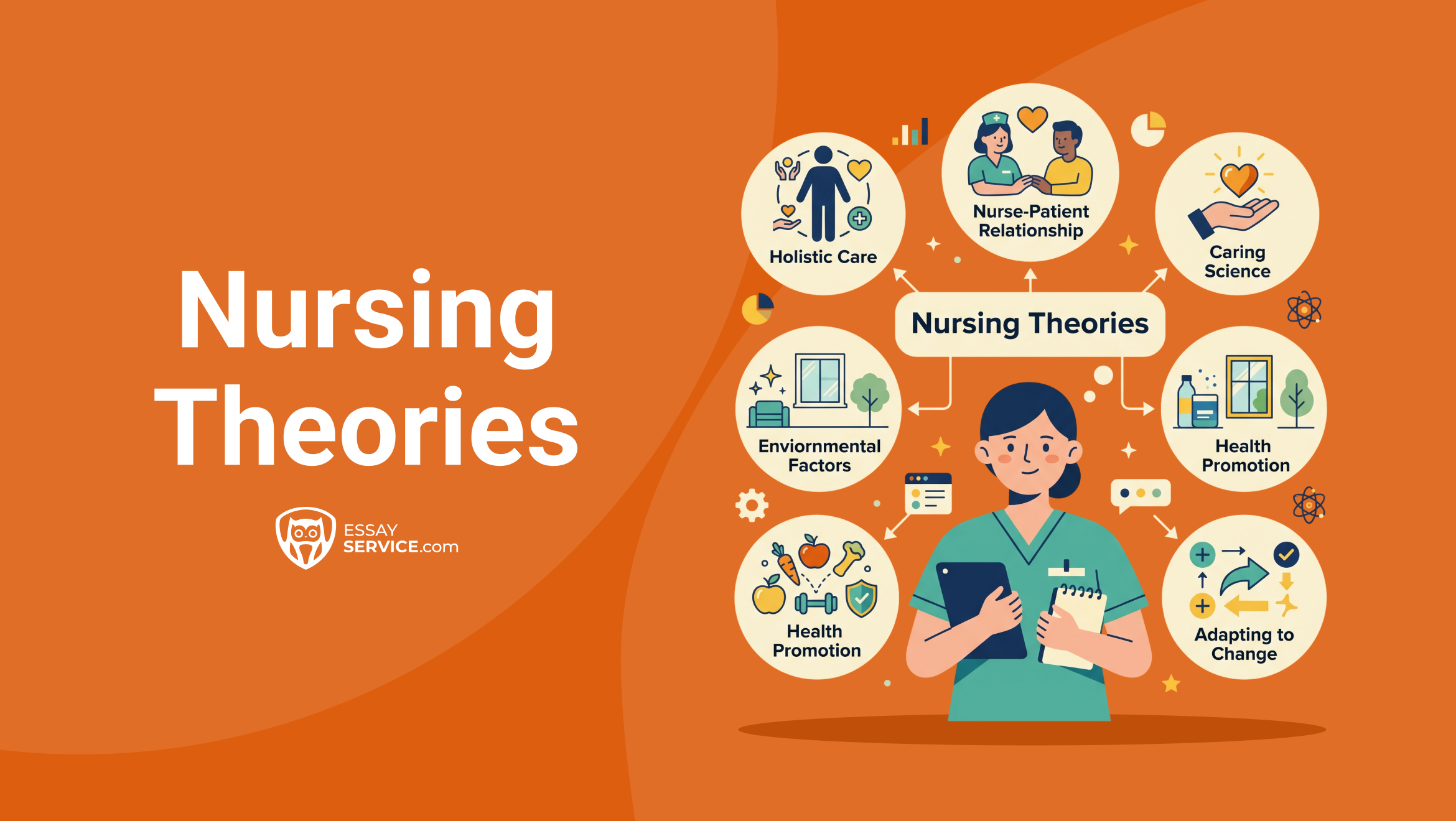
Nursing theory gives a name to the reasoning behind care: what a nurse notices, why that detail matters, and which response makes clinical sense. In nursing theory examples, the same major names often appear because their ideas still sit under modern coursework:
- Nightingale’s Environmental Theory
- Orem’s Self-Care Deficit Theory
- Roy’s Adaptation Model
- Watson’s Human Caring Theory
- Peplau’s Interpersonal Relations Theory
- Henderson’s Need Theory
- Neuman’s Systems Model
This article traces nursing theories and nursing theorists through their basic history, components, levels, and practical use in student writing.
What Is Nursing Theory?
Nursing theory is a structured explanation precisely naming the thought process behind every decision. What should you assess first? Is there a certain patient who deserves attention immediately? What is the reasoning behind this or that care decision? These few cornerstones sit within that framework:
- Assessment
- Communication
- Comfort
- Safety
- Independence
- Ethics
In nursing practice, theory helps students and nurses explain care with more than “the patient needed it.” It asks a harder question: what makes this action clinically appropriate for this patient, in this condition, at this moment?


Clinicals Steal Time
Let us help turn your nursing prompt into a clear paper while your schedule is already overloaded.
Why Are Nursing Theories Important?
A patient’s chart may say post-op pain, but the nurse still has to notice the fear, low mobility, poor sleep, family tension, confusion about medication, maybe embarrassment about needing help. It’s exactly nursing theory that helps make sense of this mess and gives each detail a designated place in the decision. Afterward, the nurse has information about whatever needs assessment, or teaching, or protection, and what can temporarily be set aside altogether.
In plain words, the importance of nursing theory is to keep the care decisions completely tied to judgment. Otherwise, it becomes a dry list of tasks, and real people with real struggles deserve better than that. The nursing profession in its entirety has a knowledge base, one built around response, safety, and dignity, and the theory shows just that. If we switch a little to the academic side of all this, theory also improves the writing because a care plan follows actual clinical reasoning.
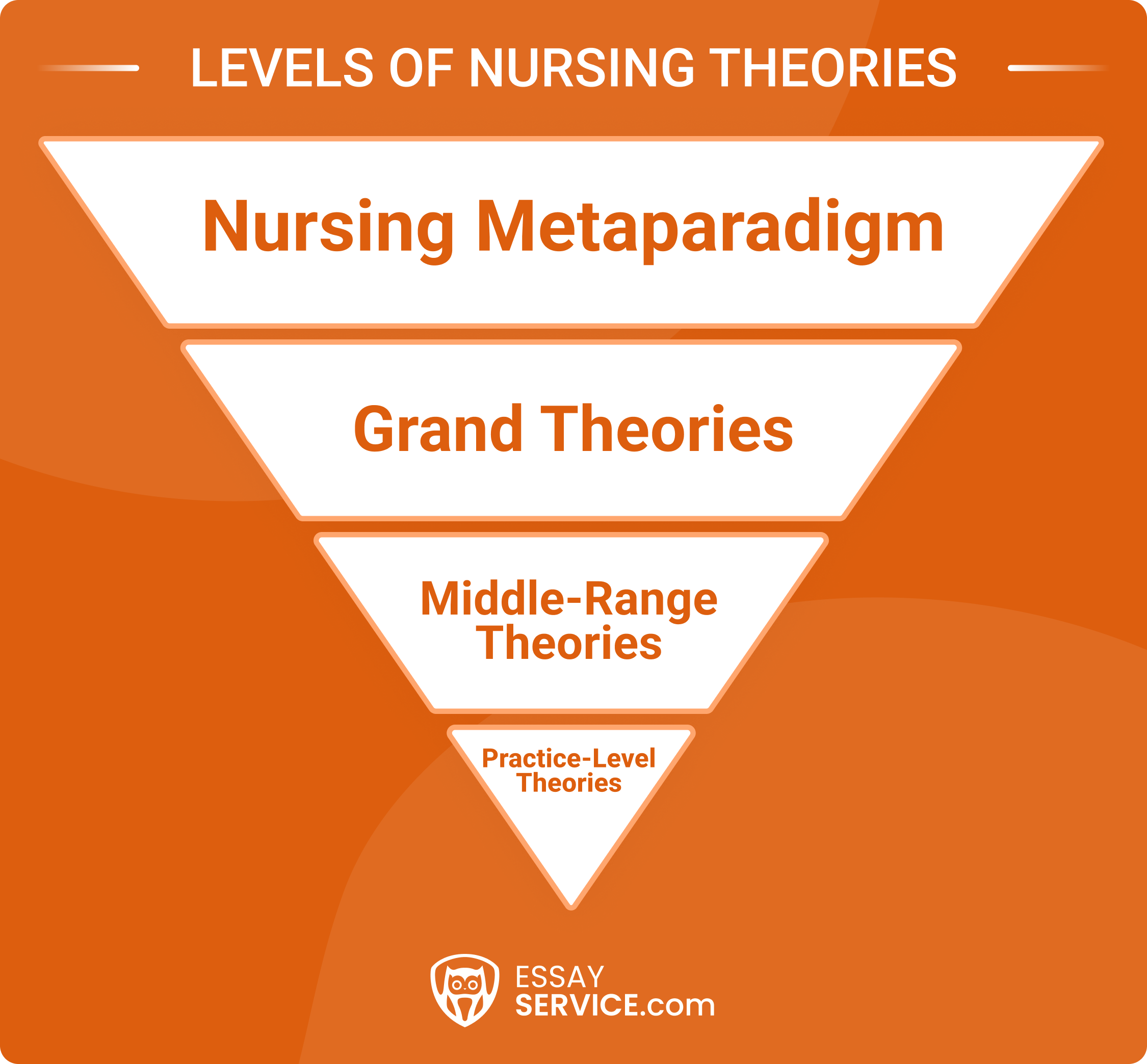
Levels of Nursing Theories
The main types of nursing theories are grouped by scope. Some explain nursing as a discipline. Some deal with patient problems that researchers can study more closely. Some stay near the bedside, where the nurse has to make a decision and explain it clearly. This is where nursing theories and nursing practice start to make practical sense.
Nursing Metaparadigm
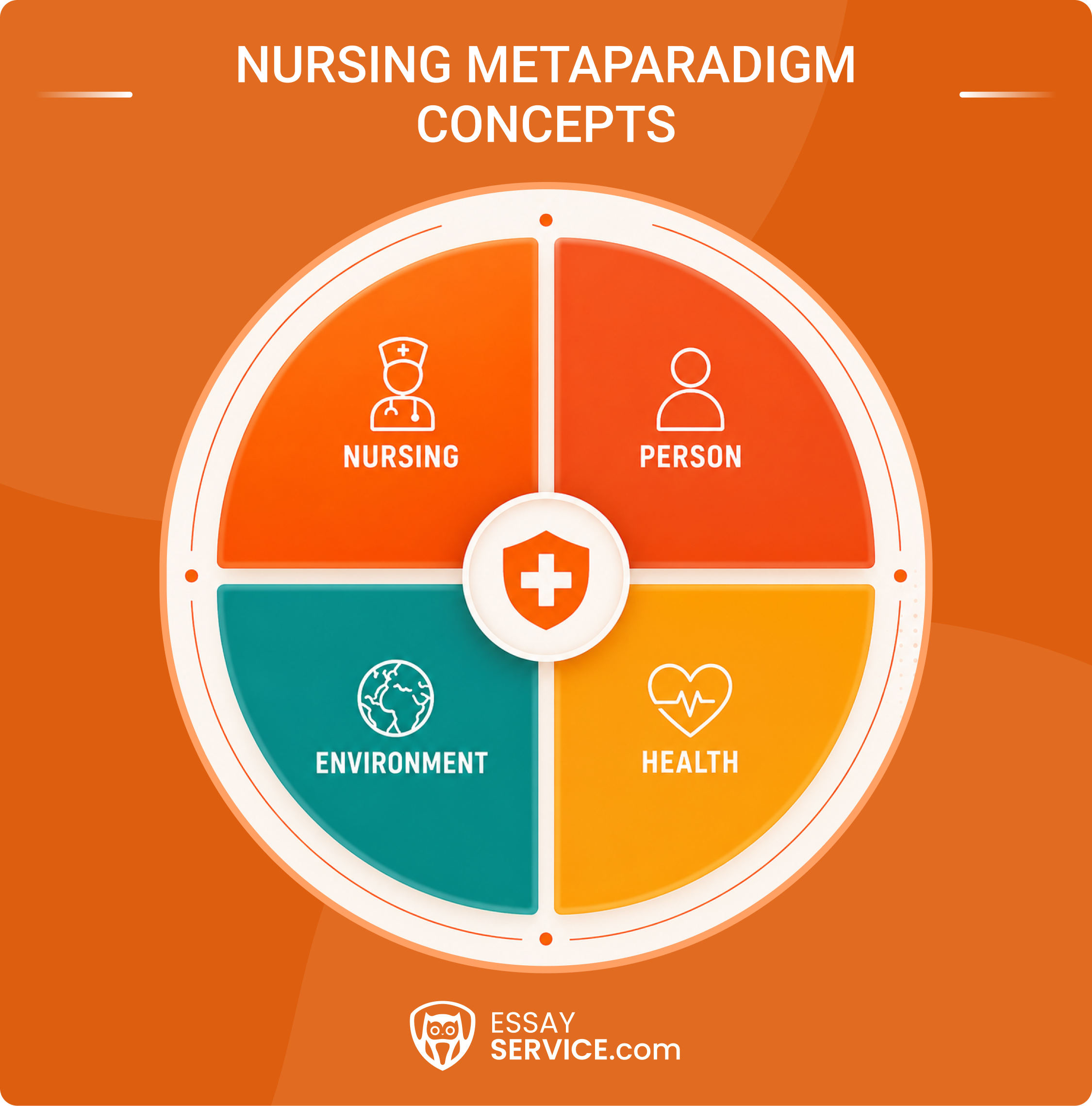
The nursing metaparadigm is the broadest frame in nursing theory. Almost every major theory returns to these four ideas, even when the wording changes.
- Person: Not always one patient. A family may be the focus, or a group, or a community, along with any beliefs and fears and general cultural background.
- Health: This covers illness, comfort, stability, function, risk, recovery, and the patient’s own understanding of being well.
- Environment: The room, home, income, family pressure, culture, safety, and access to care can change recovery.
- Nursing: Assessment, judgment, teaching, advocacy, skill, and trust are within this concept.
Grand Theories
Grand theories take the widest view of nursing. They can feel abstract at first, and honestly, that is why students sometimes struggle with them.
- Big concepts are self-care, adaptation, caring, environment, human need, and nurse-patient relationships.
- Orem, Roy, Watson, Henderson, Neuman, and Peplau are common names in this group.
- A grand theory can frame an entire paper when the topic needs a broad nursing lens.
- Real patient examples usually make these theories easier to understand.
Middle-Range Theories
Middle-range theories have a narrower focus, so they often work well in research papers and clinical assignments.
- Common topics include pain, comfort, uncertainty, coping, chronic illness, family stress, and health promotion.
- The concepts are usually specific enough to observe, test, and explain.
- Nursing research often uses this level because the scope stays manageable.
- A middle-range theory can connect patient behavior, nursing action, and expected outcomes.
Practice-Level Theories
Practice-level theories deal with specific care situations. Students usually grasp this level quickly because it feels close to actual clinical work.
- Fall prevention, wound care teaching, discharge planning, post-operative anxiety, medication education, and infection control fit here.
- The focus stays on a defined patient group, setting, problem, and goal.
- Care plans become clearer when the theory points toward concrete interventions.
- The nurse assesses the problem, chooses an action, checks the patient’s response, and adjusts care with a reason.
Nursing Theory History Over the Years
I would start the long history (longer than you would expect, in fact) of the nursing theory with a practical problem. Yes, the sick people were being cared for, but what was the optimum? The nurses needed their own language for determining what exactly counted as “good” care. Those ideas eventually became formal nursing theory models. Let’s go back in time a little and look through it step by step:
- Florence Nightingale made the environment part of care. In 1859, Nightingale published Notes on Nursing, a text built around how conditions like ventilation, cleanliness, light, noise, food, bedding, and observation affected the patient. This was the first time nursing was given the argument that surroundings affect recovery and that the nurses are responsible for those surroundings.
- Nursing education started asking for clearer knowledge. The hospital school training through service, routine, supervision, and repetition surely produced skilled nurses; no one can deny that. But the knowledge gap was just as obvious. Nursing needed concepts that could be taught, questioned, studied, and carried beyond one clinical ward and used in student papers.
- Mid-century theorists gave nursing a personal voice. Peplau’s interpersonal relations theory appeared in 1952 and placed the nurse-patient relationship at the center of care. Henderson later defined nursing through the patient’s need for strength, will, or knowledge, especially when independence was limited. The adjustment was larger than it looks. They changed what nurses could say about their work.
- The 1970s brought larger models. Orem’s Nursing: Concepts of Practice was published in 1971, with self-care deficit theory as its central contribution. Roy, Watson, Neuman, and other theorists also pushed nursing toward broad explanations of adaptation, caring, systems, and human response. Some language gets dense here. That is true. Still, the profession needed serious theory if research and graduate education were going to grow.
- Recent decades have moved theory closer to use. Middle-range and practice-level theories became especially useful because they could deal with pain, uncertainty, comfort, chronic illness, safety, and patient education. The history of theories in nursing practice ends, at least for now, with a practical demand: theory has to help nurses explain decisions, not decorate them.
Main Components of Nursing Theories
Once you identify the phenomenon, concepts, definitions, relational statements, and assumptions (the main components), the nursing theories become easier to explain.
Phenomenon
The phenomenon is the issue the theory studies: pain, comfort, self-care, adaptation, uncertainty, or communication. It gives the theory its subject, so start here, before definitions.
Check: This theory mainly explains _____.
Concepts
Concepts are the theory’s main ideas. Some stay broad; others can be observed.
Definitions
Definitions set limits around each concept. “Health” may mean independence in one theory and adaptation in another, so never assume the word means the same thing everywhere.
Relational Statements
Relational statements show how ideas connect:
- Patient teaching → better understanding → stronger self-care
- Anxiety → weaker communication → missed or unclear information
- Environment → privacy, noise, safety, comfort → patient comfort changes
Use this test: Can you turn the theory into an if/then sentence?
Assumptions
Assumptions are the ideas a theory treats as already true. For example, a nursing theory may assume that the care environment affects recovery. These assumptions guide the theory’s logic before any intervention is even discussed.
Nursing Metaparadigm
The metaparadigm of nursing gives the theory its broadest frame. It organizes care around four ideas: person, environment, health, and nursing. The nursing metaparadigm concepts we describe below keep the discussion focused on the patient situation, not on loose theory language alone in assignments.
Person
At the center of the mataparadigm of nursing is the person. Person means whoever receives care, be it one patient, a family, a group, or a community. Look at needs, beliefs, fears, culture, knowledge, limits, and goals.
Prompt: What does this person need help with or understanding?
Environment
The environment includes everything around the person affecting care.
Health
Health can mean illness, recovery, comfort, function, risk, stability, independence, or quality of life. The theory decides the emphasis, so define it before applying it.
Nursing
Nursing is the professional response: assessment, teaching, advocacy, judgment, technical care, communication, and evaluation. This is where theory turns into action.
Quick test: What does the nurse do, why does it fit, and how will the result be judged?
Important Nursing Theories and Models
Some theories show up again and again because they give students a workable way to explain care. These nursing theory examples cover environment, independence, communication, culture, adaptation, stress, goals, and clinical judgment. Once you fully understand these theories, you will understand care better, in general, and as for the academic side, you will also avoid many nursing essay mistakes.
Florence Nightingale’s Environmental Theory
Florence Nightingale was the first theorist to develop nursing theories, which is why her work still anchors nearly every modern nursing curriculum. Nightingale’s theory centers on the environment in which the patient resides. Factors such as air, light, cleanliness, warmth, noise level, bedding, food, and observation all play a role and can either aid in recovery or worsen the illness. Simple yet important.
Use this theory when the case includes:
- Poor hygiene or infection risk
- Sleep disruption
- Weak nutrition
- Unsafe room conditions
- Limited ventilation
- Discomfort caused by noise, heat, cold, or clutter
Virginia Henderson’s Need Theory
Henderson’s definition of nursing involves assisting a patient who lacks the strength, will, or knowledge to perform daily tasks. Therefore, it is applicable to all forms of care, including basic care, mobility, hygiene, breathing, rest, food, communication, learning, and discharge planning.
Best use: Choose one need and show how nursing support helps the patient regain as much independence as possible.
Hildegard Peplau’s Interpersonal Relations Theory
Peplau’s theory acknowledges that the nurse-patient relationship is part of the nursing process. Anxiety, fear, distrust, confusion, and lack of communication can hinder the intended results of clinical care, even if a patient has been given appropriate instructions.
Writing tip: Use Peplau when the conversation changes the care outcome.
Dorothea Orem’s Self-Care Deficit Theory
Orem asks a question that demonstrates the essential nature of the theory: what can the patient do, and where is nursing help needed? This theory is useful for patients with chronic illnesses, those who need post-surgical care, as well as medication, wound care, and discharge instructions.
Quick check for a paper:
- What self-care task is the patient struggling with?
- Is the problem knowledge, strength, motivation, pain, or access?
- What can the nurse teach, support, or temporarily do?
- What should the patient manage later?
This is where nursing knowledge becomes a plan for independence, not just a paragraph about care.
Sister Callista Roy’s Adaptation Model
Roy’s theory explains how people deal with changes in their lives. Patients can change when they are diagnosed with a new disease, have surgery, become disabled, experience pain, lose someone in their family... The nurse should assess how the patient has responded to the change, then identify what aids or blocks adjustment.
Use Roy when the case involves:
- Lifestyle changes
- Chronic illness
- Body image concerns
- Role changes at home or work
- Emotional stress after diagnosis
- Family adjustment
Core question: What is the patient trying to adapt to, and what makes that adaptation harder?
Jean Watson’s Theory of Human Caring
Watson’s theory emphasizes caring, dignity, trust, presence, and the way the patient experiences illness. If written poorly, Watson’s theory can sound "soft," therefore, be specific. Caring isn’t a state of mind; it is expressed in words, actions, protection, explanation, and respect shown by the nurse.
Use carefully: Connect every “caring” point to an action.
Betty Neuman’s Systems Model
Neuman’s theory considers the patient a system impacted by different types of stressors (physical, emotional, social/cultural, environmental, or financial). Neuman's theory is valuable to clinicians when a patient has multiple overlapping problems.
Stressors to name:
- Pain
- Infection risk
- Anxiety
- Family conflict
- Poor sleep
- Limited money
- Weak support
- Unsafe housing
Practical move: Identify the stressor, explain how it affects the patient, then connect the nursing intervention to prevention or stabilization.
Imogene King’s Theory of Goal Attainment
King’s theory emphasizes the importance of communication, understanding, and shared goals. A nurse who has given the patient a care plan without their understanding does not provide effective treatment.
Best use: Choose King when cooperation and patient participation matter.
Madeleine Leininger’s Transcultural Nursing Theory
Leininger’s theory focuses on the role of culture in care. Be careful not to make lazy generalizations about a patient’s diet, family roles, modesty, or religious beliefs, and how they express pain. A patient's culture should never be viewed as an added decoration because it could possibly impact what is safe and what is respectful for them.
Ask before applying it:
- What belief or practice affects care?
- What should the nurse respect or clarify?
- Could language create misunderstanding?
- Does the plan need a culturally safe adjustment?
This is one of the clearest places to discuss nursing theorists and their theories in patient-centered work.
Ida Jean Orlando’s Nursing Process Theory
Orlando’s theory is based on the patient's immediate needs and the nurse's responsiveness. The critical component of this theory is validation. The nurse observes a patient’s behavior, speculates about its meaning, verifies the speculation through communication, and responds accordingly.
Use the theory like this:
Patient behavior → nurse’s interpretation → patient confirmation → nursing action
Example: A patient refuses to walk after surgery. The nurse should not jump straight to “noncompliant.” Pain, dizziness, fear, confusion, or embarrassment may be involved. Orlando’s theory pushes the nurse to confirm first, and then choose the right response.
Nursing writing services on our platform can help you connect with a professional who can take over your tasks while you have long hours.
Nursing School Is Relentless
Writing does not have to be. We help with essays when the workload stops being reasonable.
Final Thoughts
Nursing theory matters because it gives care a reasoned structure. It explains what nurses notice, how they interpret patient needs, and why one response fits better than another. The metaparadigm keeps attention on person, environment, health, and nursing, while major theories give students practical ways to discuss independence, adaptation, communication, culture, comfort, and clinical judgment in both papers and care plans.
Frequently Asked Questions
What Is Nursing Theory and Why Is It Important?
What Is the Nursing Metaparadigm?
How to Choose a Nursing Theory?

- Pagnucci, N., Tolotti, A., Valcarenghi, D., Carnevale, F., Sasso, L., & Bagnasco, A. (2024). Conceptualising nursing theory and practice within a local cultural and professional context: A methodological example to inform theory development. Journal of Research in Nursing, 30(1). https://journals.sagepub.com/doi/10.1177/17449871241268493
- Hurd, B. (2024, July 29). Insights Into Nursing Theories: Key Concepts to Understand - Nevada State University. Nevada State University. https://nevadastate.edu/son/rn-bsn/insights-into-nursing-theories-key-concepts/
- Gebre Yitayih Abyu. (2019, September 24). Nursing Theories Author from 1 to 20 theories. https://www.researchgate.net/publication/335999036_Nursing_Theories_Author_from_1_to_20_theories



New posts to your inbox
Your submission has been received!