You make a solid point, you back it up. Then, you move on to writing the next paragraph, and once you reread, you notice that something feels off. You can make the connections between the paragraphs yourself, but you can also tell the reader will have to look deeper for that same link. Sounds familiar? If so, you can probably benefit from a better understanding of transition words for body paragraphs. When your essays start to feel disjointed, they make certain relationships between sentences instantly visible.
In this article, you’ll see how to move between points without sounding forced, how to guide a reader through your logic step by step, and how to avoid those subtle breaks that quietly weaken your writing.
What Are Transition Words for Body Paragraphs
To define them simply, essay transition words for body paragraphs are signals. They tell the reader how one idea connects to another. You might be adding a point or taking the essay in a different direction, even making a cause-and-effect link between two events. Without transition words, a paragraph still makes sense on its own, yet when you look at the bigger picture, the entire paper is scattered.
Transition words have different purposes depending on where they are located in the essay. In an introduction, they move the reader's attention from a general context toward the thesis statement. In a body paragraph, they take you from one idea to the next and link the topic sentence to supporting details. Transitions for a conclusion signal the end of the paper. Although the roles change slightly, the goal doesn't: these words are needed to maintain the flow.


Stuck Mid-Essay?
Get expert writing help that actually makes your ideas connect.
The List of Transition Words for Body Paragraphs
As we've established, different essay parts ask for different transition words. But the same truth goes for the distinct body paragraphs, as well. You wouldn't use the same words in the third paragraph that you used in the first because the reader expects a different signal.
Below, you’ll see how transition words change depending on position and purpose, along with examples you can place into your own writing. And if you're not sure how many paragraphs your paper should contain, take a look at our guide on how many body paragraphs should be in an essay.
Transition Words for Beginning of Body Paragraphs
At the beginning of a body paragraph, transition words connect the previous statement to a new idea without breaking the flow. They act as a bridge. The reader should feel a clear continuation, even when the topic shifts slightly. These transitions often refer back to the earlier paragraph and introduce the next point.
- Firstly
- To begin with
- In the first place
- To start with
- At the outset
- Moving forward
- Following this
- Building on this
Transition Words for First Body Paragraphs
The first body paragraph follows the introduction, so the transition needs to pick up the thesis statement and move into the first main point. The reader expects a clear starting step in the argument, so the wording should feel direct and tied to the central idea of the essay.
- Firstly
- To begin with
- In the first place
- The first key point is
- One important aspect is
- To start with
- At the outset
Transition Words for Second Body Paragraphs
The second body paragraph continues the argument. It adds a new idea or develops the previous one further. The transition words here signal progression. The reader should feel the discussion moving forward, not circling back.
- Secondly
- Next
- In the second place
- Another point is
- Additionally
- Furthermore
- Moreover
- Following this
Transition Words for Third Body Paragraphs
By the third body paragraph, the argument is already in motion. This section often deepens the discussion or introduces a slight shift before the conclusion. The transition words reflect that later stage and signal that the essay is approaching its final points.
- Thirdly
- Finally
- In the third place
- Lastly
- At this point
- At this stage
- Ultimately
- Subsequently
Common Transition Words Categorized by Function
Besides the distinctions between transition word placements, they also differ in their function. This section breaks them down based on what they actually do within a paragraph, so your writing stays clear and controlled.
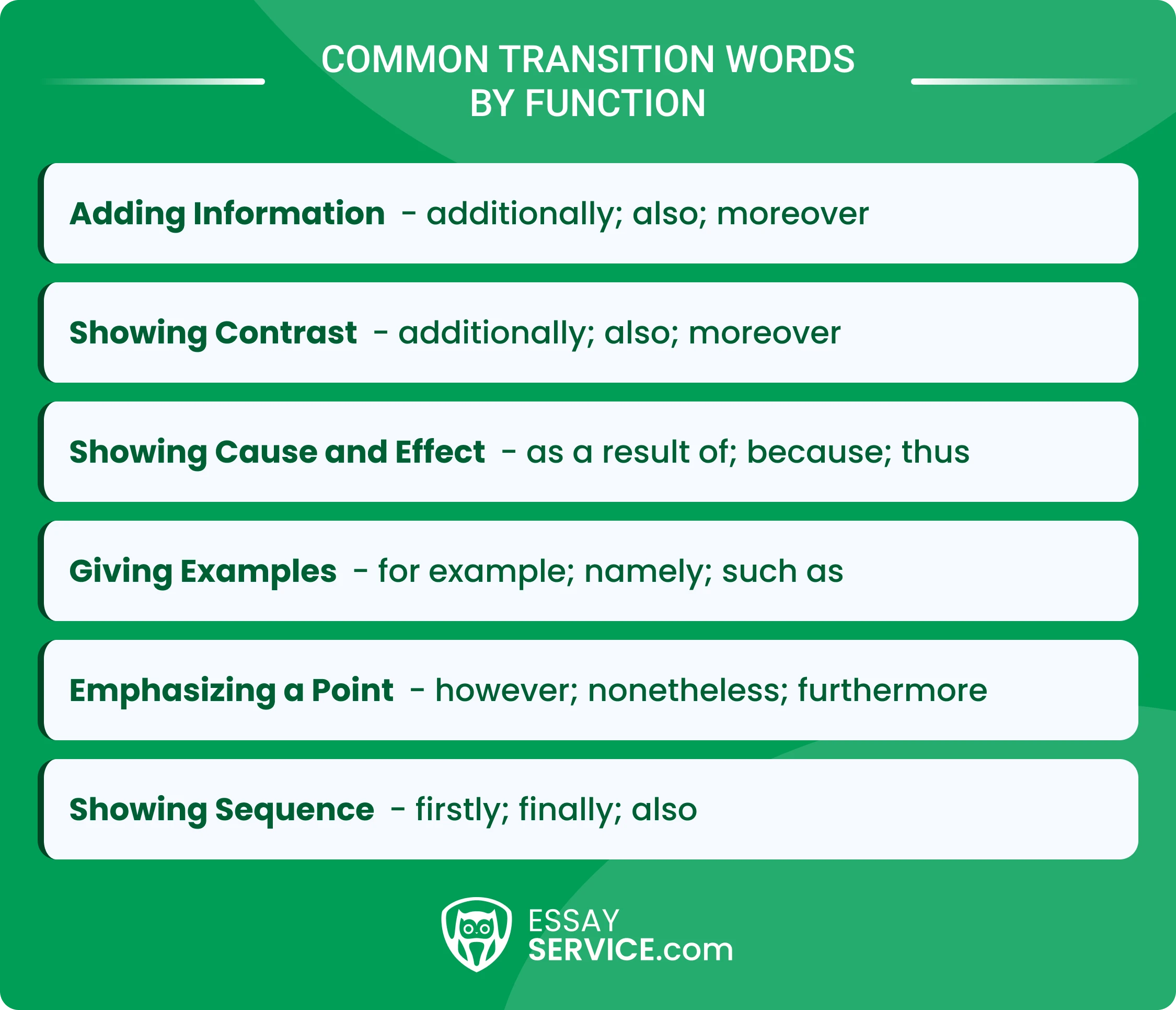
Adding Information
This group of transitions keeps the discussion moving in the same direction. The main point stays intact while extra support, detail, or clarification is layered in. The reader should feel continuity, not a shift. These words work best when your paragraph builds on a single idea instead of introducing a new one.
- Additionally
- Also
- Moreover
- Furthermore
- Again
- Further
- Then
- Besides
- Too
- Similarly
- Correspondingly
- Indeed
- Regarding
Showing Contrast
A change in direction happens when these words are used. One idea is set against another, which creates tension inside the paragraph. The reader is guided to notice differences, limitations, or opposing views without losing track of the main point.
- By contrast
- Although
- Compared with
- Conversely
- Despite
- However
- Nevertheless
- Yet
- Whereas
- Conversely
- In comparison
Showing Cause and Effect
These transition words switch the focus to relationships between ideas. The statement leads to another in a logical way, so the reader can clearly see what caused a result or what follows from a specific condition. This type strengthens the argument by making reasoning visible.
- As a result of
- Because
- Therefore
- Thus
Giving Examples
When transition words are used before examples, they make abstract ideas concrete. Specific cases are introduced to support a point and make it easier to understand. The reader moves from general thinking to something concrete that can be visualized or tested.
- For example
- For instance
- Namely
- Such as
- As follows
- As exemplified by
- Such as
- Including
- Especially
- Particularly
- In particular
- Notably
- Mainly
If you struggle to develop enough supporting detail, EssayService's paragraph expander can help you come up with examples you can then connect with proper transitions.
Emphasizing a Point
These transitions narrow down the attention and show us what the most important point is. The wording highlights importance, signals weight, and pushes the reader to focus on a key idea. This category often reinforces something that has already been introduced rather than adding new information.
- However
- Nonetheless
- Furthermore
- Despite X
- Notwithstanding X
- In spite of X
- While X may be true
Showing Sequence
Order becomes the priority. Ideas are arranged step by step or placed along a timeline, so the structure of the paragraph feels organized and easy to follow. The reader understands what comes first, what follows, and how the progression unfolds.
- First(ly)
- Second(ly)
- Third(ly)
- Another
- Additionally
- Finally
- Moreover
- Also
- Subsequently
- Eventually
- Next
- Then
Got The Idea Already?
We can help you turn it into a clean, readable, high-quality paper.
Tips on How to Use Transition Words in Essays
You can drop in good transition words for body paragraphs and still end up with stitched-together writing. Memorizing the list doesn't necessarily mean you can utilize it. The issue usually comes down to placement and intent. A transition should reflect the logic already present in your sentence. If the connection itself isn’t real, the word won’t save it. Take a look at the following tips:
- Match the function to the sentence. If the idea adds, use an additive word. If it shifts direction, signal contrast.
- Pay attention to position. Place transitions at the start of the sentence when linking paragraphs, or mid-sentence when refining a point.
- Don't overuse. Avoid stacking multiple transitions in one sentence. One clear signal is enough.
- Build a clear topic sentence first, then place the transition so it leads into that main point without delay.
- Avoid repetition across paragraphs. Rotate naturally to maintain flow.
- Test the sentence without the transition. If the connection disappears, you placed it correctly.
- Use stronger transitions between paragraphs than within them. The reader needs clearer guidance at those breaks.
- Stay aligned with your argument. Every transition should reflect the structure, not fight against it.
If you struggle with understanding transition words or using the right ones in your essay, ask us, 'Write a paragraph for me.'
Conclusion
Transition words for body paragraphs reveal the logical sequence of your arguments. Each one shows how your ideas connect, how your points build, and how the essay moves forward. When they’re used with purpose, the writing feels controlled and easy to follow. Without them, even strong ideas start to drift. Clear connections keep everything in place.
Frequently Asked Questions
What Is a Transition Word for a Body Paragraph
How to Transition Into a Body Paragraph
What Is a Good Starter for a Body Paragraph

Phil spends his working days teaching international trade. He contributes to our blog as a freelancer, leveraging his experience with MBA students to advise on academic writing, studying abroad, and securing funds.
- Monroe University LibGuides: Essay Writing: Paragraphs and Transitions. (2024). https://monroeuniversity.libguides.com/c.php?g=589208&p=4072926
- Library: Academic writing: Linking/transition words. (2015). https://www.staffs.ac.uk/. https://libguides.staffs.ac.uk/academic_writing/linking
- 33 Transition Words and Phrases. (n.d.). https://www.merriam-webster.com/. https://www.merriam-webster.com/grammar/transition-words-list



New posts to your inbox
Your submission has been received!