
A novel outline is a working plan that organizes the main character, central conflict, major plot points, key scenes, and ending. Writers use novel outlines to test the story’s logic before committing to full chapters. A clear outline shows what happens, why each event matters, and how pressure builds across the novel.
This article will help you understand how to write a novel outline, which techniques to use for different types of stories, and how to develop a map that supports your writing, but does not tie you down to every scene.
Common Novel Outlining Methods
The best way to outline a novel is the one that helps you solve your specific story problems. For instance, if you have a story with a very tangled plotline, you would probably use a different outlining method than if you had a story that contains a very flat character arc. Here are a few of the most common techniques of writing a novel outline:
- Snowflake Method: A single-sentence summary becomes a paragraph, and then a full page. After that, you will create character sheets and short summaries for every scene. This method works best if you haven't decided what happens in the middle.
- Hero’s Journey: You will create a map of the main character’s ordinary world, the call to adventure, tests, crises, rewards, etc. This will work very well for you if the characters undergo inner change.
- 3-Act Structure: Divide the story into the first (setup), the second (confrontation), and the third act (resolution). Once you have created the outlines for each, identify the inciting incident, midpoint, low point, climax, and final choice.
- Save the Cat! Beats: You will use a specific set of beat points (opening image, statement of theme, catalyst, midpoint, dark night of the soul, and finale) to create your outline. This method works when you have difficulty determining the proper pacing for the story.
- The Series Grid: Create tables for each book of the series, character arc, timeline, main conflict, subplot, and loose ends. This helps you keep a series alive until the end rather than killing it off by the third book.
- The Bookend Method: Create an opening promise and final image at the beginning. Align the middle with the emotion represented in the difference between them. This helps maintain tension throughout, since each scene should lead toward the story's conclusion.
If you don't have time for creative writing because of your academic assignments, learn how to write an essay outline first.


Write Without Spiraling
Get professional support with structure, clarity, and polishing when your assignment gets too much.
How to Write a Novel Outline?
A strong novel outline grows step by step. First, you define the main character, then create the central problem, add the catalyst, build obstacles, plan the lowest point, shape the resolution, track the character arc, connect the opening to the ending, and turn everything into a usable story structure. Let's look at each step of how to outline a novel in clearer detail in the following section.
Define the Main Character
Identify your main character first, then outline the traits they've developed based on the past circumstances. These traits determine their character choices, no matter what happens in the rest of your story. Just like real people, characters rely on their pre-determined emotional reaction to anything else that occurs.
Remember to limit backstory in this step, as it won’t be seen in the finished book. Use mainly the information that affects the character’s choice/action (for example, if the character has experienced abandonment, they may lie to keep a relationship; if the character has a need for control, they may cause issues when under pressure).
Pro Tip: When naming your characters, say the names out loud. Some of them are harder to read than others because the word sounds don’t match. Consider what genre you are writing to find the right rhythm or flow between the names you choose (i.e., contemporary thrillers vs historical fantasy).
Create the Main Problem
When outlining a novel, create conflicts or disruptions that create a reason for the character to take action. This action will change the main character's normal way of life, and if the main character doesn’t act to resolve them, they will continue to escalate and further complicate all future decisions and actions. If the conflict you create is weak, then the main character will be given too much room to delay decisions, which will affect the pacing of your novel until you reach the first act.
Pair the created conflict with a clearly defined goal, so you know how the character should complete each scene. The reader must be able to follow the character’s ultimate goal in order to follow the action of the plot:
- Problem: A journalist discovers that her late father fabricated evidence in a famous criminal case.
- Goal: She must uncover the truth before a documentary series turns him into a national hero again.
Introduce the Catalyst
The catalyst creates a situation that interferes with the main character’s routine and that pushes them into the main plot. Readers need to experience motion quickly through the introduction of the catalyst. If you introduce it too slowly, then the catalyst will provide no pressure behind the scenes. A useful catalyst creates a dramatic change in the main character’s surrounding world that cannot be comfortably avoided.
For example, in Gone Girl, Nick’s lifestyle changes with Amy’s disappearance. Nick now lives a completely different life from what he would have if Amy had not disappeared. The introduction of Amy’s disappearance creates immediate urgency for Nick, and creates a structure for the entire story by altering others’ perceptions of him.
Build Obstacles
Obstacles throughout the outline provide tension in your novel. Each obstacle should be increasingly more difficult than the previous one, and should help build up to the story’s climactic conclusion. Randomly occurring obstacles (for example, the ones occurring outside of any of the character’s actions) will come across as artificial and boring because they don't follow the character’s prior actions.
To create a proper structure for the obstacles, use escalation through consequence. The first obstacle should be an inconvenience; the second should destroy the character’s trust or resources; and the third should threaten his/her main goal. Each time a new obstacle is created, you add to the intensity of the character.
For instance, if the character investigates hospital corruption, the first obstacle would be obtaining copies of hospital operational records. The second would be a refusal of cooperation by the witnesses, and the third would result in either the character losing their job or being investigated.
This progression keeps the plot moving forward because each scene changes the conditions of the next one. Readers stay engaged when consequences keep evolving instead of repeating.
Come Up With the Lowest Point
The lowest point is the scene where the story proves the old plan cannot work anymore. The character may lose access, trust, evidence, safety, money, love, or belief in their own judgment. Its job is to break the strategy the character has relied on since the beginning, so the ending can grow out of a sharper choice.
This moment usually appears near the end of the second act. By then, the character has tried several solutions and paid for several mistakes. The strongest version connects directly to those earlier choices. If the protagonist hid information, the lowest point may arrive when nobody trusts them. If they tried to control every outcome, they may lose influence exactly when they need help most.
Pro Tip: Write the “all is lost” moment as a cause-and-effect note: “Because the character chose X, they lose Y.” This keeps the scene tied to the plot instead of turning it into random misery.
Plan the Resolution
The resolution shows what changes after the main conflict reaches its final pressure point. Start by deciding what the main character wins, loses, accepts, or understands. Then separate the climax from the resolution. The climax answers the main conflict. The resolution shows the result of that answer. Keep it practical: who is still present, what relationship has shifted, what promise gets fulfilled, and what final choice proves the character has changed?
Pro Tip: Map the resolution backward. Write the last scene first in one clear sentence. Then list the proof needed before that scene can feel earned. If the ending requires trust, show where trust broke earlier. If the ending requires courage, show the exact scene where fear is used to control the choice.
Develop the Hero's Journey (Arc)
The character’s arc tracks how the main character changes under pressure. Start with their false belief, coping habit, or emotional blind spot. Then connect each major plot point to a small change in behavior. The arc should move through visible choices, not private thoughts alone. A character who becomes braver must take harder risks on the page. A character who learns honesty must tell the truth when lying would be easier.
To do: Write four checkpoints: who the character is at the opening, what the catalyst forces them to face, what the lowest point teaches them, and what final action proves the change. Add one scene under each checkpoint. This gives character development a track inside the plot instead of leaving it vague.
Connect the Beginning to the End
The beginning should plant the question that the ending answers. Look at the opening scene, the main character’s first choice, and the first visible problem. Then compare them with the last scene. The end should show what changed in the character, the goal, and the world around them. This does not mean the final scene has to mirror the first one exactly. It means the story should feel designed, with the last page paying off what the first pages introduced.
Pro Tip: Use a mind map for this connection, where the opening is in one circle and the ending in another. Between them, add every plot point: the catalyst, obstacles, lowest point, resolution. Draw arrows only where cause and effect are clear.
Build the Outline
Now turn the separate pieces into a working outline for a novel. Keep each plot point short enough to revise. One or two sentences per section is enough at this stage. The goal is to see the whole story structure without drowning in scene-level detail. Use the character, problem, catalyst, obstacles, lowest point, arc, and resolution you already planned.
- Opening: show the main character’s normal life and the first visible problem.
- Catalyst: use the event that breaks that routine.
- Action: show the first serious attempt to solve the problem.
- Rocks 1 through 3: build obstacles that grow worse each time.
- The Big Rock: place the lowest point here.
- Resolution: answer the central conflict.
- Last scene: prove the character’s arc through one final choice.
Pages Need Some Help?
Send the messy draft or the blank document and get academic support that makes sense.
Tips for Writing a Novel Outline
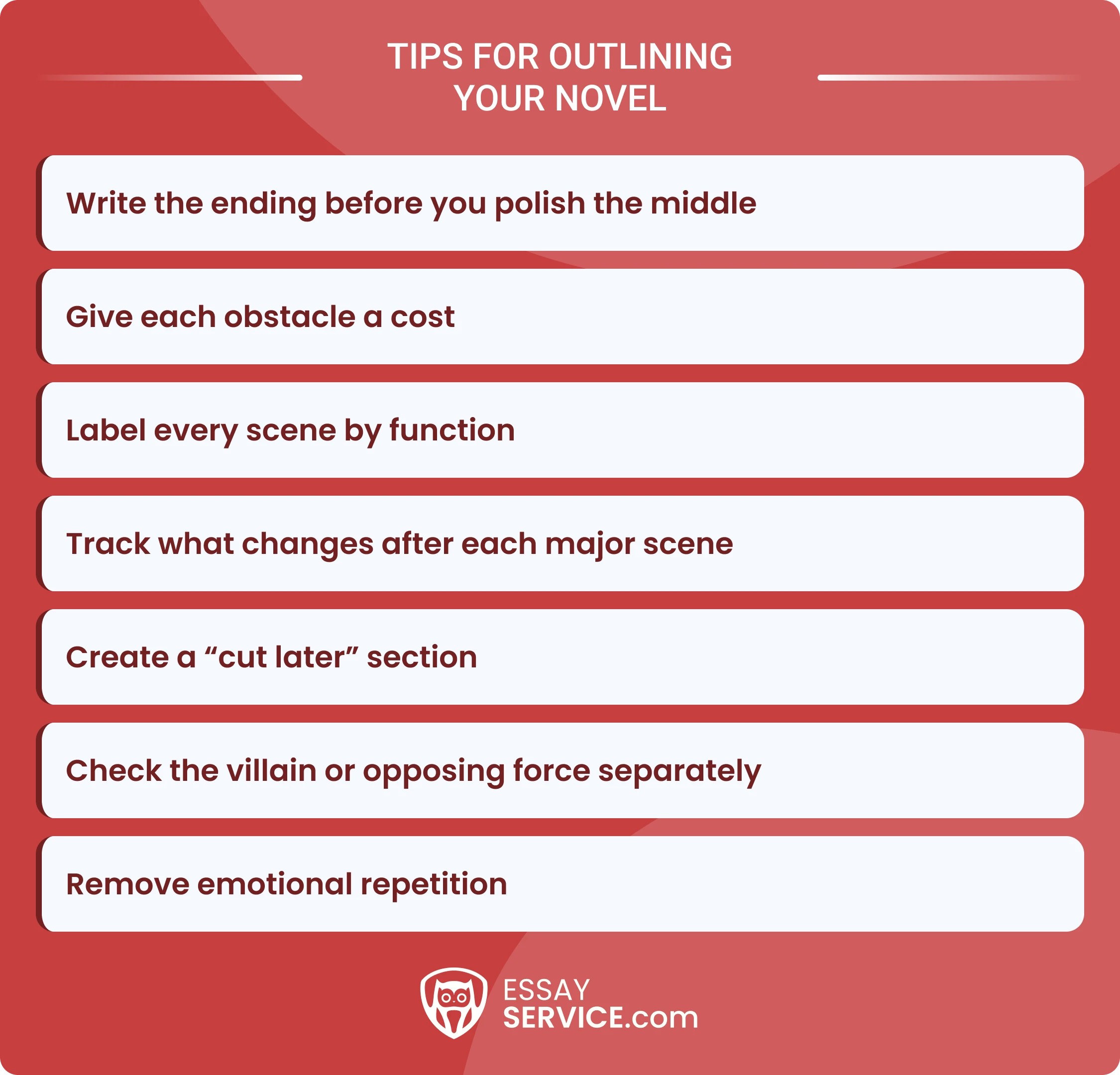
Good tips should make the outline easier to use, not restate basic rules. When you outline your novel, use small checks that reveal weak spots early and make revision less painful.
- Write the ending before you polish the middle. You do not need every detail, but you need to know what final choice the story is moving toward.
- Give each obstacle a cost. A blocked door is boring unless the character loses time, trust, evidence, money, or safety.
- Label every scene by function. Use tags like clue, setback, reveal, reversal, pressure, or repair.
- Track what changes after each major scene. If nothing changes, combine it with another scene.
- Create a “cut later” section. Put uncertain scenes there instead of deleting them while the idea is still forming.
- Check the villain or opposing force separately. Their actions should progress even when the main character is reacting.
- Mark emotional repetition. If three scenes prove the same fear, keep the strongest one.
You can always take time to pay someone to write your essay if you're short on time or energy.
The Last Word
Novel outlining gives the story structure before the drafting pressure starts. A clear outline helps you track the character, conflict, obstacles, pacing, and ending without losing direction halfway through the book. Once the major plot points connect logically, the writing process becomes faster, cleaner, and much easier to revise without untangling the entire novel later.
Frequently Asked Questions
What Is a Novel Outline?
What Does a Novel Outline Look Like?
How Long Should a Novel Outline Be?
How to Structure a Novel Outline?
How to Make a Novel Outline?

John spends his days studying the impact of language. He uses his deep understanding of linguistics and research experience to help students communicate more effectively and craft immaculate research-intensive papers.
CF Library: Creative Writing: Outline, World-Build, Chapter Summary. (2025). https://library.cf.edu/. https://library.cf.edu/creativewriting/outlining



New posts to your inbox
Your submission has been received!