
You need to turn a question into a statement when the sentence has to present a clear answer instead of asking a question. At the planning stage, a question can be useful to give you direction, but clear academic writing needs a concrete, unambiguous statement. The change from the question can seem small, but it changes the way your idea is understood completely.
The transformation can be done through word order, verb adjustment, added context, or reported phrasing. The strategies need a little bit of practice to perfect, so in this article, I will teach you 10 methods with examples - this way, the final sentence will sound natural and correct.
Why to Turn a Question into a Statement?
Turning a question into a statement is useful when a sentence needs to present an idea directly. In most student writing, the reader expects a claim, focus, or explanation, not a question left hanging there.
- A thesis becomes easier to defend.
- A research question can be developed into a claim.
- A topic sentence gives the paragraph a clear direction.
- Interview material sounds more formal.
- Essay sections connect better.
- Repeated questions make academic writing unfinished.
Are you planning to apply to med school? You will definitely need a medical school personal statement writing service to back you up in the application process.
When Should You Not Turn A Question into a Statement?
Changing questions into statements does not work in every situation. Some questions have a job that a statement cannot really do, especially when the original wording matters.
- Research questions should stay as questions when the assignment requires them.
- Quoted dialogue needs the speaker’s exact wording.
- Interview transcripts should preserve the original exchange.
- Direct questions work well when the writer is addressing the reader.
- Discussion prompts lose their purpose when rewritten as claims.
- Questions used for analysis should remain visible so the reader can examine them.


Rewrite With Purpose
Our writers help reshape confusing questions, weak claims, and rough drafts.
Start with the Type of Question
Before you rewrite the sentence, check what kind of question you have. This sounds basic, I know, but it prevents a lot of awkward revisions later on. A yes/no question usually needs a simple word-order change. A WH-question may need extra information because the answer must be built into the statement. Choice questions need even more care, since the final sentence should not erase the options too quickly.
How to Turn a Question into a Statement?
The main strategies for turning questions into statements are grammar-based. So, they’re not creative. First, you need to identify the question type, always, like we learned in the last section. Then, you can start checking which method to use, be it changing the word order, the verb form, etc. Not every question can be remade into a statement by a small change only.
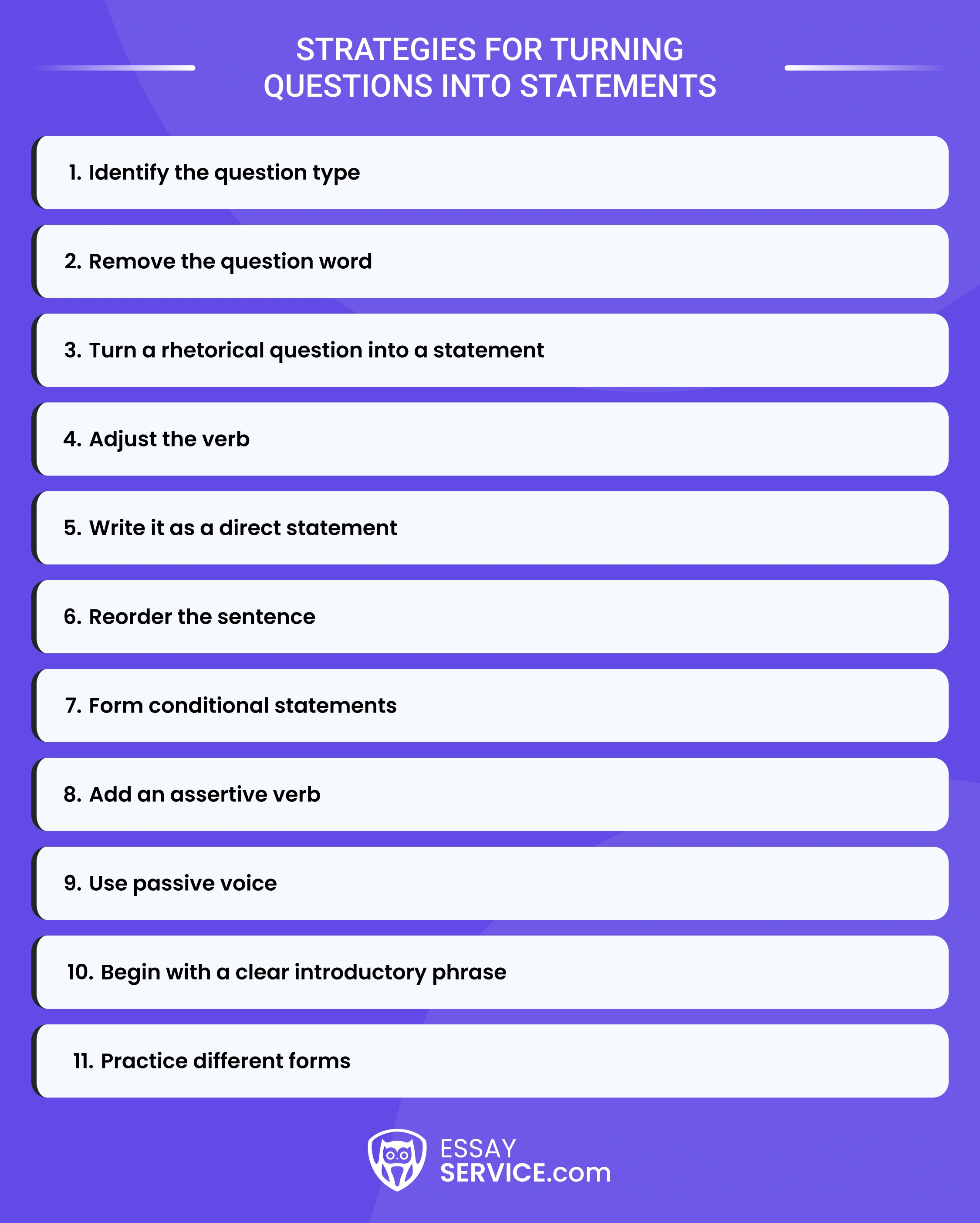
Remove Question Words
Question words such as what, why, when, where, who, and how usually signal that information is missing. That missing information has to be in the statement. If the question asks “why,” give the reason in the statement. If it asks “how,” explain the action, process, or result. The revised sentence should feel complete on its own without the original question
Convert Rhetorical Questions
A rhetorical question already has an implied conclusion. In cases like this, your task is to write that implied meaning directly. What is the question actually asking? Figure this out first, then turn that idea into a declarative sentence. This works especially well in formal writing because rhetorical questions sound overly dramatic. A sentence that states the point plainly usually sounds more mature, and, honestly, it is easier to support with evidence.
Revise the Verb
Many questions use helping verbs before the subject: do, does, did, can, should, is, or are. A statement usually puts the subject first and places the verb after it.
If the question uses did, the main verb often returns to the past tense. If the question uses does, the statement may need an s ending.
Write a Direct Statement
Any time a question has a known answer, that answer can simply be rewritten as a direct claim.
Just take the question and remove the question structure, then state what the answer is clearly. “Water conservation is very important” is grammatically correct, but it is not a good one to develop. A strong direct statement should be very specific so it can be supported with proof.
Reorder the Sentence
The verb in a question is before the subject, while the main verb in a statement comes after the subject. Identify the subject first and place the main verb after it. Remove the question mark and change the verb tense if needed. I would still read the new sentence once, because extra phrases can make the order clumsy.
Learn how to write a mission statement while you’re at it if you need to sum up the purpose of your project.
Form Conditional Statements
Questions that ask about conditional results can become conditional statements (with words such as if, when, unless, etc.). The revised sentence should show both the condition and the result. Pay attention to certainty, though. A question about a possible result may need may or can. A question about a regular pattern can use the present tense. The grammar should match the strength of the idea, since accuracy matters here.
Add Assertive Verbs
Assertive verbs make rewritten sentences more confident. Words such as shows, suggests, explains, reveals, confirms, and indicates tell the reader what kind of claim the sentence is making. Choose the verb carefully because it should match the evidence - one careless word can make the claim sound exaggerated.
Use Passive Voice
You can use passive voice when the action or result needs more attention than the person who performed it. Object first, then a form of be, then the past participle. This strategy works in reports, instructions, process descriptions, and formal summaries. Still, the sentence needs enough information to stay clear. If the actor is important, include a short by phrase. If the actor is unknown or obvious, the passive version may sound cleaner. Use it for clarity, not for hiding responsibility.
Add an Introductory Phrase
An introductory phrase can turn a question into a reported statement. Phrases such as the report explains, the article examines, the guide describes, and the writer asks place the original question inside a larger sentence. After the phrase, the word order should follow statement grammar. The question mark disappears, and the sentence becomes smoother. Keep the opening short, though. A long introductory phrase can make the main idea arrive too late.
Practice Several Forms
One question can often become several different statements, depending on the purpose of the sentence. You might write a direct statement, a conditional statement, a reported statement, or a claim with an assertive verb. This is why practice helps more than memorizing one pattern. Try two or three versions, then choose the one that fits the paragraph. Read the sentence aloud if it feels stiff. Also check that the meaning stayed accurate. A rewrite is successful only when the grammar improves and the original idea remains intact.
A simple guide on how to begin a statement of purpose will help you make the entire drafting process a whole lot easier.
What Not to Do When Turning Questions into Statements
A question can be rewritten correctly in grammar and still come out wrong in meaning. That is where students usually lose control of the sentence. The new statement should keep the same tense, purpose, and level of certainty, with only the structure changed.
- Do not delete a question word and leave the sentence without the information it was asking for.
- Do not keep question word order, such as “can the device,” inside the statement.
- Do not change the tense just because the sentence sounds smoother that way.
- Do not turn a neutral question into a confident claim without evidence.
- Do not remove one option from an either/or question unless the answer clearly supports it.
- Do not leave a question mark after the sentence has become a statement.
- Do not forget to fix auxiliary verbs, especially do, does, and did.
- Do not rewrite quoted speech when the exact wording needs to stay in place.
- Do not use passive voice if the person or thing doing the action is important.
- Do not make the statement broader than the original question allows.
Claim It Clearly
Get support with sentences that need sharper wording, better logic, and a point worth developing.
The Last Thought
Turning questions into statements works best when you start with the question type. Yes/no questions usually need reordered words. WH-questions need the missing answer added. Choice questions need their options handled carefully. Then check tense, verb form, and certainty so the final statement keeps the original meaning.
Frequently Asked Questions
How Do I Restate an "Either/Or" Question?
How to Change a Question into a Statement When There Are Negative Auxiliary Verbs?
How Do You Change a Question into a Statement Without Changing the Meaning?

Phil spends his working days teaching international trade. He contributes to our blog as a freelancer, leveraging his experience with MBA students to advise on academic writing, studying abroad, and securing funds.



New posts to your inbox
Your submission has been received!