A three-paragraph essay is the compact version of the standard five-paragraph format, and it works on a simple principle. The first paragraph presents an argument, the second paragraph supports it and proves it, and the last one wraps up the overall idea being discussed. If you’ve been assigned this paper, chances are your teacher wants to strip away any padding so you’re “forced” to say what you actually believe.
The most difficult aspect is selecting the single best argument to use as a foundation. Based on my personal experience after years of reading such essays, more of them are derailed by the wrong argument than a misplaced comma. Therefore, in this article, I will explain how to write all three sections correctly, how long each part should be, and how to select the best argument that will hold the entire essay together.


Essay Due Tomorrow?
Get it professionally written handled by a writer who knows the format inside and out.
What Is a 3 Paragraph Essay?
A 3 paragraph essay is built from three parts:
- Introduction
- One body paragraph
- Conclusion
Nothing gets added beyond that. You state a claim, you back it with one clear reason and a piece of evidence, and then you wrap the thought up before it wanders anywhere else. It exists simply because not every idea needs five paragraphs to prove itself, and every student needs to know how to defend their position in a very limited space.
Be it a book report, a quick response, or simply a prompt you’re answering in fifteen minutes during class, all of them fit one claim and one supporting point far better than a longer essay would. Once you see that, you also quickly see that this format is not a limitation but rather the right tool for its specific purpose.
How Long Is a 3 Paragraph Essay?
The 3 paragraph essay format usually lands somewhere between 150 and 300 words, though that range shifts with grade level. Younger students typically stay near the lower end of that range. High schoolers, in my experience, push closer to 300, sometimes past it. If you want a more specific count for each section, the estimates can look like this:
- Introduction: Three to five sentences. A hook, a little background info, and a thesis that precisely states your claim.
- Body Paragraph: About five to seven sentences that lay out your point, evidence, and what connects those two.
- Conclusion: Three to four sentences that restate the claim and end the point cleanly.
3 Paragraph Essay Outline
Here's the 3 paragraph essay outline I hand students when they're unsure of where to start and what each section should include:
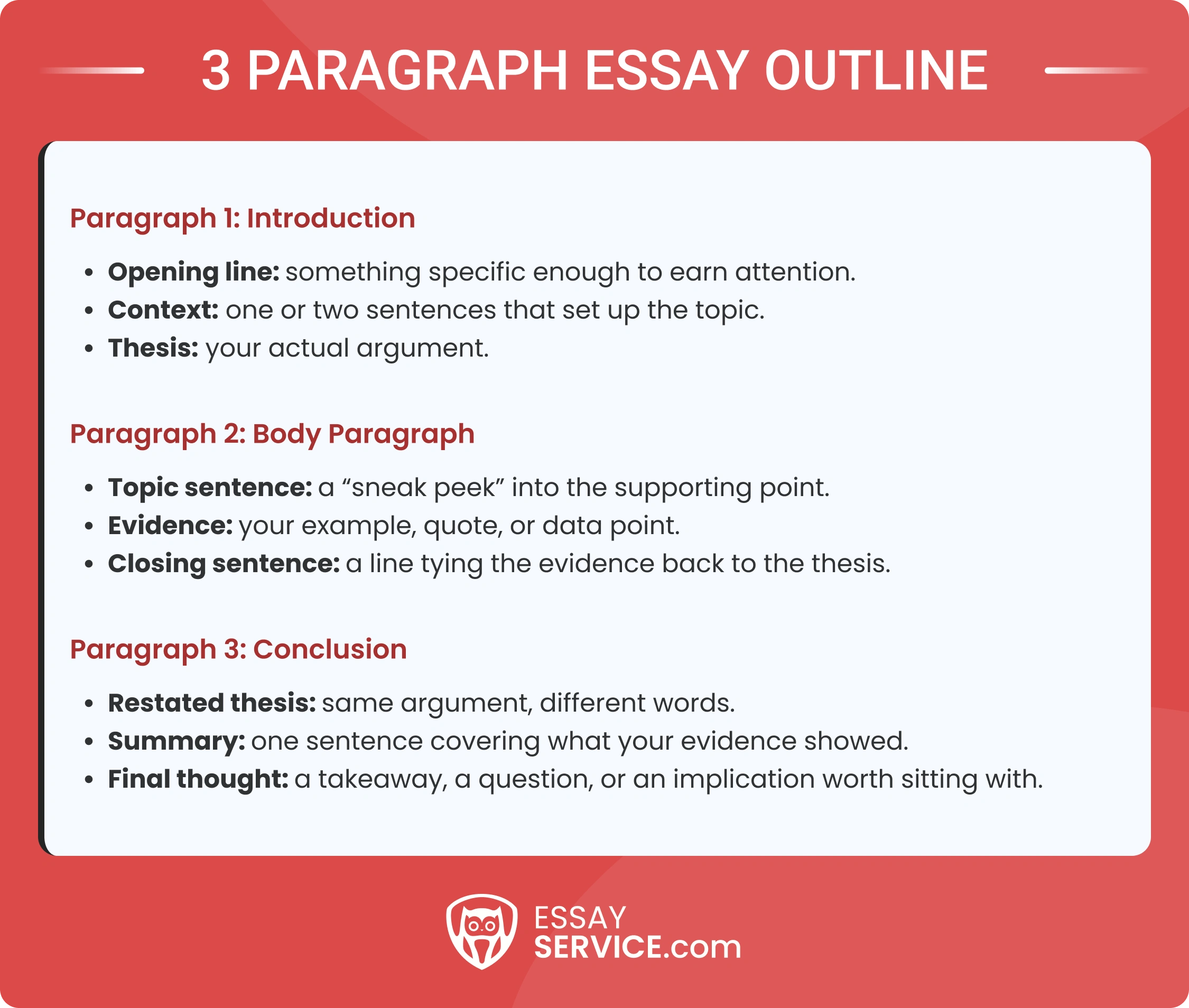
Paragraph 1: Introduction
- Opening line: something specific enough to earn attention, not a generic statement about "society today."
- Context: one or two sentences that set up the topic without repeating the thesis.
- Thesis: your actual argument, stated plainly.
Paragraph 2: Body Paragraph
- Topic sentence: a “sneak peek” into the supporting point covered in the paragraph.
- Evidence: your example, quote, or data point, explained rather than dropped in and left open for interpretation.
- Closing sentence: ties the evidence back to the thesis and sets up the conclusion.
Paragraph 3: Conclusion
- Restated thesis: same argument, different words.
- Summary: one sentence covering what your evidence showed.
- Final thought: a takeaway, a question, or an implication worth sitting with. I tell students this line often ends up being the one a reader remembers.
3 Paragraph Essay Template
Reading an outline is one thing. Filling in an actual template with your own words is another, and that's usually where students get stuck. Below is a free PDF template you can copy or print for offline use:
How to Write a 3 Paragraph Essay?
Writing a 3 paragraph essay includes three steps, one per paragraph, and I'll walk through each using a single running example so you can see how the pieces actually connect rather than just how they're described on their own. The topic: whether cities should subsidize urban beekeeping programs.
Introduction
Draft the hook and the background first, then your thesis afterward. Students tend to write the thesis before anything else, and they end up with a background sentence or two that doesn't actually lead into it. I've seen this happen more times than I can count, usually because the background was written to justify a claim already fixed in the student's head. Start with a concrete hook like a specific number, a real scene, a single documented fact. Skip broad claims like "nature in cities matters now more than ever." Save the direct, plain wording for the thesis instead; the hook can afford a little more flair.
Example: [Hook] Manhattan rooftops now host over 300 registered beehives, and honey yields there rival rural farms. [Background] Urban beekeeping has grown across major U.S. cities over the past decade, and hobbyists and small nonprofits have driven most of that growth, not city budgets. [Thesis] Cities should fund small-scale beekeeping programs because they improve local plant pollination and give residents a low-cost way to engage with urban ecology.
Body Paragraph
I’ve seen many students drop a statistic in their 3 paragraph essays and move on, as if the number speaks for itself. It doesn’t. But before you include a statistic or an example, you have to choose first, and that’s the part that is even more unforgiving.
If you have multiple supporting points, ask which option directly proves your thesis, not just relates to your topic. A statistic about how many people support a policy isn't the same as a statistic proving that policy works, and I've read plenty of essays that mix the two up. Favor specifics, also. Vague evidence, something like "many experts agree," gives a grader nothing to check and nothing to trust. If two pieces of evidence seem equally strong, pick the one you can explain in fewer sentences.
Once chosen, spend two sentences unpacking what the evidence shows before tying it back to your thesis, and name what a study actually measured, not just its conclusion.
Example: [Topic sentence] Pollination data backs up the case for city-funded hives. [Evidence] A 2019 study in Berlin found community gardens within half a mile of managed hives saw a 45 percent increase in fruit set on pollinator-dependent plants. [Analysis] That increase translates into real yield gains for city gardeners, who currently depend on wind and wild pollinators alone; a system that, frankly, produces inconsistent results at best. [Transition] Better pollination benefits more than gardens, though, and that's really where the argument for public investment gets stronger.
If you’re short on time (or energy), a simple request, such as ‘Write my paragraph for me,’ followed up by short instructions, will be enough for the professionals from our platform to get right on it and finish your paper.
Conclusion
Don't summarize for the sake of summarizing. A conclusion that just repeats paragraph two in slightly different words wastes the one spot in the essay where you have room left to add something new. Give the reader a fresh angle instead, a question worth sitting with, an implication your evidence raises, or a next step it points toward. Try drafting two or three options for that final line before picking one. That last sentence is usually what people remember after they've forgotten the statistic in your body paragraph, so don't spend it restating something they read thirty seconds earlier.
Example: [Restated thesis] Municipal support for beekeeping pays off through healthier gardens and stronger public engagement with urban wildlife. [Summary] Berlin's pollination data shows what happens when hives get real institutional backing instead of scattered volunteer effort. [Final thought] Every city block with an empty rooftop is a missed opportunity sitting in plain sight, and most residents walking past it have no idea.
If you’re writing a 5 paragraph essay instead of its shorter counterpart and need to come up with a way to introduce your final point, you will probably need some help with the transition words for third body paragraph.
3 Paragraph Essay Examples
You've seen the format broken into parts. Here's how it reads as a whole. Below are three complete 3 paragraph essay examples, each on a different topic and written at a different grade level, so you can see the structure hold up in practice, not just on paper.
3 Paragraph Essay Example #1
Energy drinks have become a fixture in school hallways, tucked into backpacks alongside textbooks and lunch money. Sales of caffeinated beverages marketed to teens have climbed steadily over the past several years, and schools have largely stayed quiet on the issue. That silence should end. Schools should ban energy drink sales on campus because the caffeine and sugar content in these products disrupts sleep and concentration during school hours.
The evidence here is hard to ignore. A 2021 pediatric health survey found that teens who consumed energy drinks regularly reported nearly double the rate of sleep disturbances compared to peers who didn't. Poor sleep doesn't stay contained to nighttime; it follows students into first period, where attention spans and memory retention both take a hit. Banning sales on campus won't stop a student from buying a can at a gas station, but it removes the easiest access point and sends a clear signal about what the school considers acceptable during instructional hours.
3 Paragraph Essay Example #2
Killer whales in the wild can travel over 100 miles in a single day. In captivity, most spend their lives in tanks that offer a fraction of that space. That gap between natural behavior and captive conditions sits at the center of a debate that shows no sign of resolving quietly. Marine parks should stop breeding and acquiring large marine mammals because captivity causes measurable physical and psychological harm that no facility has managed to eliminate.
Dorsal fin collapse offers one of the clearest signals of this harm. Nearly all captive male orcas develop a bent or fully collapsed dorsal fin, a condition seen in less than 1 percent of wild populations. Researchers link this largely to the limited swimming space and altered muscle use that captivity forces on these animals. Beyond the physical toll, documented cases of aggression between tank mates, rare in the wild, point to psychological stress that confined spaces seem to produce reliably. Facilities have improved tank size over the decades, but improvement isn't the same as adequacy.

3 Paragraph Essay Example #3
Lab-grown meat has moved from science journals to actual grocery shelves faster than most people expected. A handful of countries have already approved it for sale, and more are reviewing applications now. That speed has outpaced public understanding of what the product actually is. Any packaging containing lab-grown meat should carry clear labeling because consumers currently have no reliable way to distinguish it from conventionally farmed meat at the point of sale.
Singapore, the first country to approve lab-grown meat for commercial sale, requires labeling that specifies the product's cultivation method directly on the package. Surveys conducted there after the rollout showed that most shoppers wanted this information available, regardless of whether they intended to buy the product or avoid it. That distinction matters. Labeling isn't about steering consumers toward or away from lab-grown meat; it's about giving them the information to make that call themselves, the same way calorie counts or allergen warnings function on any other label.
If you’re ready to take a break and trust a professional with any of your academic assignments, just ask us, ‘Write my essay.’
Stuck On Your Thesis?
Let an experienced writer build your essay from scratch, so you submit something sharp instead of rushed.
Do's and Don'ts of Writing 3 Paragraph Essays

A few habits separate a solid 3 paragraph essay from one that reads like it was assembled in a hurry. Here's what I tell students, based on the mistakes I see most often.
Final Thoughts
A three paragraph essay runs on three parts: an introduction that hooks, gives context, and states a thesis; a body paragraph that offers one point, one piece of evidence, and analysis connecting it back; and a conclusion that restates the thesis and closes with a final thought. The whole essay typically lands between 150 and 300 words, with the introduction and conclusion running shorter than the body paragraph. Picking the single strongest example is usually the hardest part of the process, and it's worth spending real time on that choice before drafting.
Frequently Asked Questions
What Does a 3 Paragraph Essay Look Like?
How Many Sentences Are in a 3 Paragraph Essay?
How to Start a 3 Paragraph Essay?
.png)
Jaroslav specializes in helping students unlock their creative side and let it shine. Armed with his Bachelor’s degree in creative writing, he imparts his advice on making communication effective and engaging.
- Monroe University LibGuides: Essay Writing: Paragraphs and Transitions. (2024). https://monroeuniversity.libguides.com/c.php?g=589208&p=4072926
- Naydan, L. (2019). How Do I Write an Intro, Conclusion, & Body Paragraph? | U-M LSA Sweetland Center for Writing. https://lsa.umich.edu/sweetland/undergraduates/writing-guides/how-do-i-write-an-intro--conclusion----body-paragraph.html
- Judi. (2017, August 23). Learning to Write a 3 Paragraph Essay. Bdaily Business News; https://bdaily.co.uk/articles/2017/08/23/learning-to-write-a-3-paragraph-essay



New posts to your inbox
Your submission has been received!