Description words are words that provide details about different qualities, such as shape, color, texture, size, sound, emotion, or other attributes, and are used to describe things, people, places, or actions. The most common types are adjectives and adverbs: adjectives modify nouns, and adverbs add meaning to verbs. This article will help you understand what descriptive words are and how they work in a sentence to make communication clearer.
If you’re not sure how to use descriptive words in the right context, or just feel overwhelmed with assignments, our essay writing service offers help with any academic task, whether you need guidance or a fully structured draft.


Write Smarter With EssayService
Turn rough drafts into clear, well-structured writing with expert help.
What Are Descriptive Words?
A descriptive word gives more information about a noun or a verb, so the reader understands exactly what something looks like, feels like, or sounds like. They help you describe things with clarity by adding qualities and details that make your writing easier to imagine. A sentence like 'The food tasted good' tells the reader something, but it doesn’t create a clear picture. You could make it stronger with descriptive words such as savory, buttery, crisp, or smoky.
In the sentence 'The sharp, cold wind scraped across my face,' the words sharp and cold describe the wind, while scraped gives the action a stronger texture.
For a broader explanation of how vivid language builds an entire scene, read the descriptive essay guide.
Types of Descriptive Words
Descriptive words come in a few main forms, and each one helps you add detail in a different way. The main types include:
- Adjectives
- Adverbs
- Participles
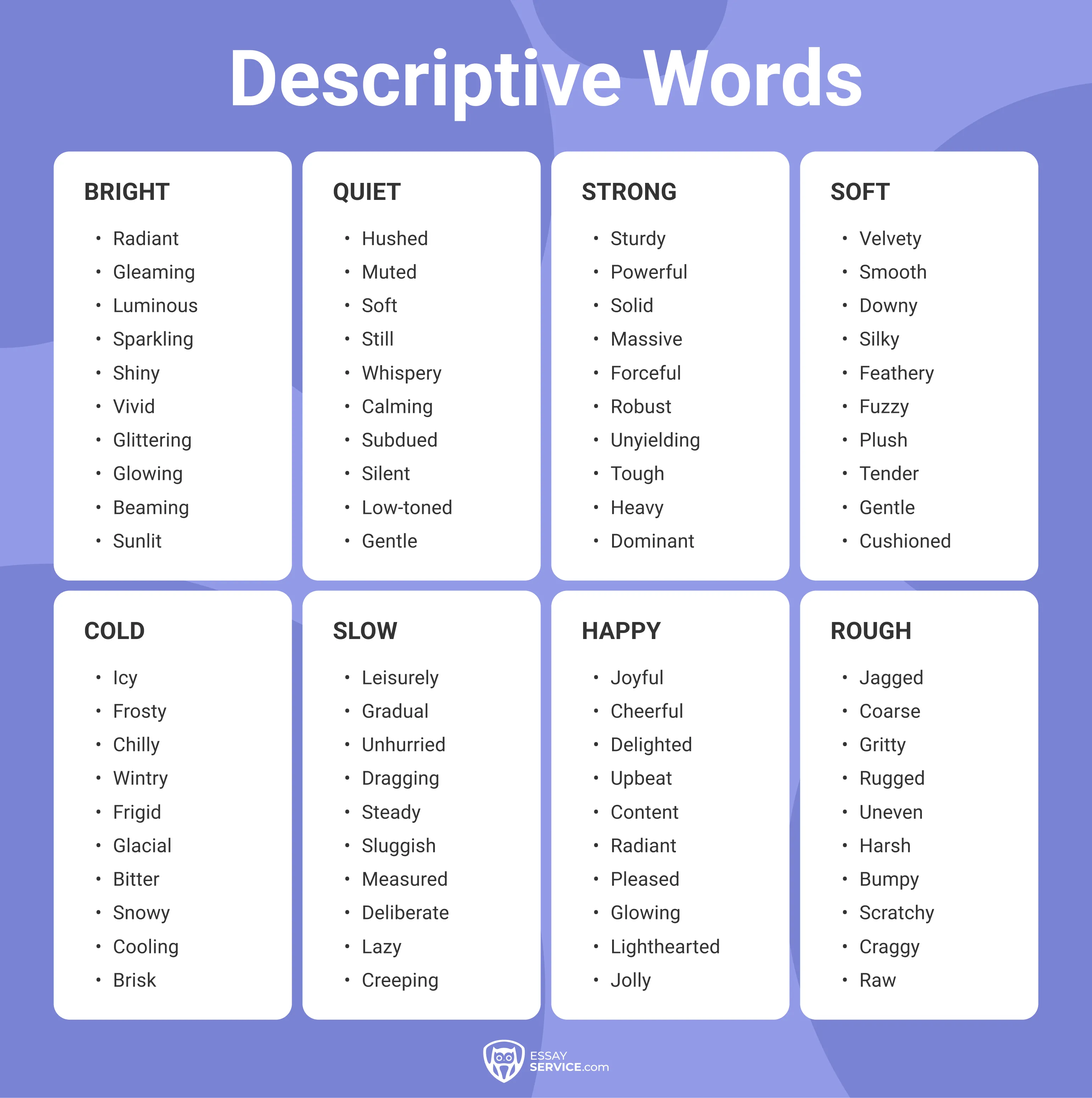
Adjectives
Descriptive adjectives modify nouns and give you details about appearance, size, shape, personality, or condition. Adjective examples of descriptive words help you describe people, objects, and scenes in a clear way.
Adverbs
Adverbs modify verbs, adjectives, or other adverbs. They explain how something happens and add clarity to the action or tone of your sentence.
Participles
Participles come from verbs but act like descriptive words.
- Present participles end in -ing.
- Past participles often end in -ed or -en.
- They add movement, emotion, or condition to a noun.
Categorized List of Descriptive Words
Each category below helps you focus on one specific aspect, such as personality, texture, senses, appearance, size, or time, so you can match the word to the context and keep your writing precise and vivid.
Descriptive Words for Personality
Personality words help you show what a person is like through clear traits instead of vague descriptions. Use them when you want a real-life character to feel more specific in a sentence or story. The table below shows both negative descriptive words and positive descriptive words.
Texture & Condition Descriptive Words
These are the types of words that describe things by showing how an object feels, looks, or behaves on the surface. Use them when you want to give the reader a clearer picture of an item’s physical qualities, such as whether it’s smooth, worn, soft, or damaged. These descriptive words make scenes, objects, and settings easier to visualize.
Sensory Descriptive Words
Sensory words help you describe things through the five senses: sound, smell, taste, touch, and sight. Use the descriptive words for writing below so that the reader’s mind can experience the scene the same way a person in it would.
Emotions
Emotional words help you show how a person feels in a clear way. You give the reader a stronger picture when you choose words that match the feeling. Writing becomes easier to follow because these words add clues about the mood. Even a short scene can feel more real when the emotions are specific. Each choice helps the meaning come through without extra explanation.
Appearance
Appearance words help you explain how something looks in a way that feels direct and easy to picture. They can show size, shape, color, or the overall condition of a person, object, or scene. Readers understand your meaning faster when these details are specific instead of vague. You can use appearance words to highlight an important feature or to make a setting feel more real. Great descriptive words add a small detail that builds a fuller image without confusion.
Size
Size words help you describe how big or small a person, object, or place is. They make writing clearer because the reader can understand scale without extra explanation. You can use these words to describe height, width, amount, or overall proportions. Each choice gives the reader a more accurate picture of what you’re describing.
Age & Time
Age and time words help you show when something happened or how old a person, object, or place is. They give writing a clear sense of timing so the reader understands whether something is new, old, recent, or long-lasting. You can use these words to show stages, history, or duration without adding long explanations.
How to Use Descriptive Words
Using descriptive words can make your writing clearer and easier for readers to imagine. These small choices add detail without needing long explanations.
- Replace long explanations with one precise descriptive word.
- Look at the object again and write the first two traits you actually notice.
- While choosing adjectives, test two different ones in the same sentence.
- Read the line aloud to hear if the description sounds natural.
- Pick words that match the mood of the scene, not just the meaning.
- Remove any adjective that the reader can easily guess without you saying it.
- Limit yourself to one descriptive upgrade per sentence to keep things clean.
If you’re practicing descriptive language for a future assignment, browse descriptive essay ideas by EssayService.
Level Up Your Writing With EssayService
Take the next step toward stronger, more polished academic work.
The Bottom Line
We’ve covered the main types of descriptive words, including adjectives, adverbs, and participles, and shown how each one works in a sentence. Each section of our article includes tables of words so that you have quick examples to use.
If using these words in your own writing feels confusing, you can use EssayService’s descriptive writing generator and get the job done within minutes.
Frequently Asked Questions
What Are Some Descriptive Words?
What Are Good Descriptive Words?
How To Use Descriptive Words In Writing?
How Do Descriptive Words Help You?
When To Use Descriptive Words?

Essie isn’t just an educator with a Bachelor’s in English: she’s passionate about writing. She uses her experience in grading papers to write comprehensive guides for our blog.
- University of Nevada, Reno Writing & Speaking Center. (n.d.). Descriptive writing. https://www.unr.edu/writing-speaking-center/writing-speaking-resources/descriptive-writing
- Butte College. (n.d.). Parts of speech: adjectives, adverbs, and participles. https://www.butte.edu/departments/cas/tipsheets/grammar/parts_of_speech.html
- Indiana University of Pennsylvania Writing Center. (n.d.). Descriptive writing. https://www.iup.edu/writingcenter/writing-resources/organization-and-structure/descriptive-writing.html



New posts to your inbox
Your submission has been received!