.webp)
Key Takeaways
- A thesis outline helps you organize chapters and keep the project focused.
- Roman numerals, capital letters, and numbered points make the structure easy to follow.
- Clear sections for the introduction, literature review, methodology, results, analysis, and conclusion guide the writing process.
- A well-planned outline saves time by showing where each idea and piece of evidence belongs.
A thesis outline begins with defining the research question, forming a clear thesis statement, breaking the project into major points, and arranging each chapter’s supporting ideas in a logical order using Roman numerals and capital letters. A complete outline also shows how the introduction, methodology, analysis, and conclusion link together so the writing process stays focused and fully developed.
In this article, we’ll give you a practical thesis outline example and a PDF resource you can follow during the writing process, with EssayService available for students who want more personalized guidance on shaping chapters, refining arguments, or organizing research more effectively.


Start Your Thesis the Right Way
EssayService writers create thesis outlines by hand, focusing on clarity and research flow.
What Is a Thesis Outline?
A thesis outline is a structured plan that maps out the entire thesis before you begin writing. It lists the major points of each chapter, defines the thesis statement, and organizes supporting ideas in a logical order so the project has a clear direction. The outline also shows how the introduction, literature review, methodology, analysis, and conclusion connect, making it easier to manage the writing process and keep the paper fully developed from beginning to end.
Components of a Thesis Outline
A thesis outline starts with the required front sections, like the title page and abstract, and then moves into the main chapters: Introduction, Literature Review, Methodology, Results, Discussion, and Conclusion.
Title Page
A good title page signals the project’s direction long before the introduction does. A precise title helps you set boundaries for the research and prevents the scope from drifting halfway through the writing. Students who choose vague titles usually struggle later because the project expands beyond what they can reasonably support. A refined title page forces early clarity.
Abstract
The abstract becomes a tool for decision-making, even though it appears at the front. A brief, focused summary helps you see whether the research question, methods, and main findings align. If the abstract is unfocused, the thesis structure usually needs revision before you begin the full draft.
Introduction
An introduction works best when it explains why the study is necessary. Instead of repeating the general background, this section should identify the exact problem your thesis addresses. A strong introduction also prepares the reader for the organizational structure and sets expectations for the claim you intend to prove.
Literature Review
A literature review shows the existing research on your topic and explains how different studies relate to one another. This is where you identify the gap that shapes the entire thesis. Students who skip this step end up repeating existing work instead of contributing something new.
Methodology
A methodology chapter explains why certain methods were chosen, not just what they are. It should show that the tools match the research question and produce data that can actually answer it. If your chosen methods cannot support your claims, the thesis weakens regardless of the quality of the writing.
Results
The results section presents data without interpretation, which helps you see patterns before making claims about them. Good thesis writers use this chapter to check whether their evidence is sufficient and whether further data collection is necessary.
Analysis or Discussion
This chapter connects results to the thesis statement and explains what the findings mean in real academic terms. A strong discussion also shows limits, because overstated claims usually collapse in the conclusion or during defense.
Conclusion
A conclusion answers the research question clearly, identifies what the thesis contributes, and shows where future research should go next. This is the place to demonstrate that the project has intellectual value beyond a single assignment.
How to Write a Thesis Outline
Writing a thesis outline begins with identifying the main sections you expect the thesis to contain. As you place the supporting ideas beneath each section, the structure becomes clearer, even if it shifts once or twice during the process. Certain parts settle quickly while others need adjustment, and that adjustment is part of shaping a workable plan. The outline functions as a practical guide for drafting, giving the project direction without locking you into every detail too early.
- Define the Research Question: State the exact question the thesis will answer, which will help you set the direction for the rest of the outline.
- Create a Clear Thesis Statement: Your statement helps you decide what belongs in the project and keeps each chapter focused.
- Arrange the Points: Set the sequence so ideas build on each other. Some outlines need reshuffling at this stage, which is normal.
- Identify the Evidence for Each Part: Mark the data, studies, or arguments you intend to use. This keeps the outline fully developed instead of broad and vague.
- Add Notes on Methods and Planned Analysis: State which methods you will use and how the analysis will be handled. These notes give the outline enough depth to guide the writing.
- Check the Movement From Start to Finish: Look at the outline as a whole. The flow should move from context to claims to implications without leaving logical gaps.
- Prepare the Final Outline for Drafting: This last version becomes the reference you keep beside you. Students often revise it as they write, which is part of the process.
Need a Solid Thesis Foundation?
EssayService’s writers turn complex ideas into structured, AI-free outlines.
Thesis Outline Template
This outline is arranged in six major chapters that reflect the core structure of a standard thesis. Each section is labeled with Roman numerals, and every part includes capital-letter subpoints that break the chapter into specific tasks.
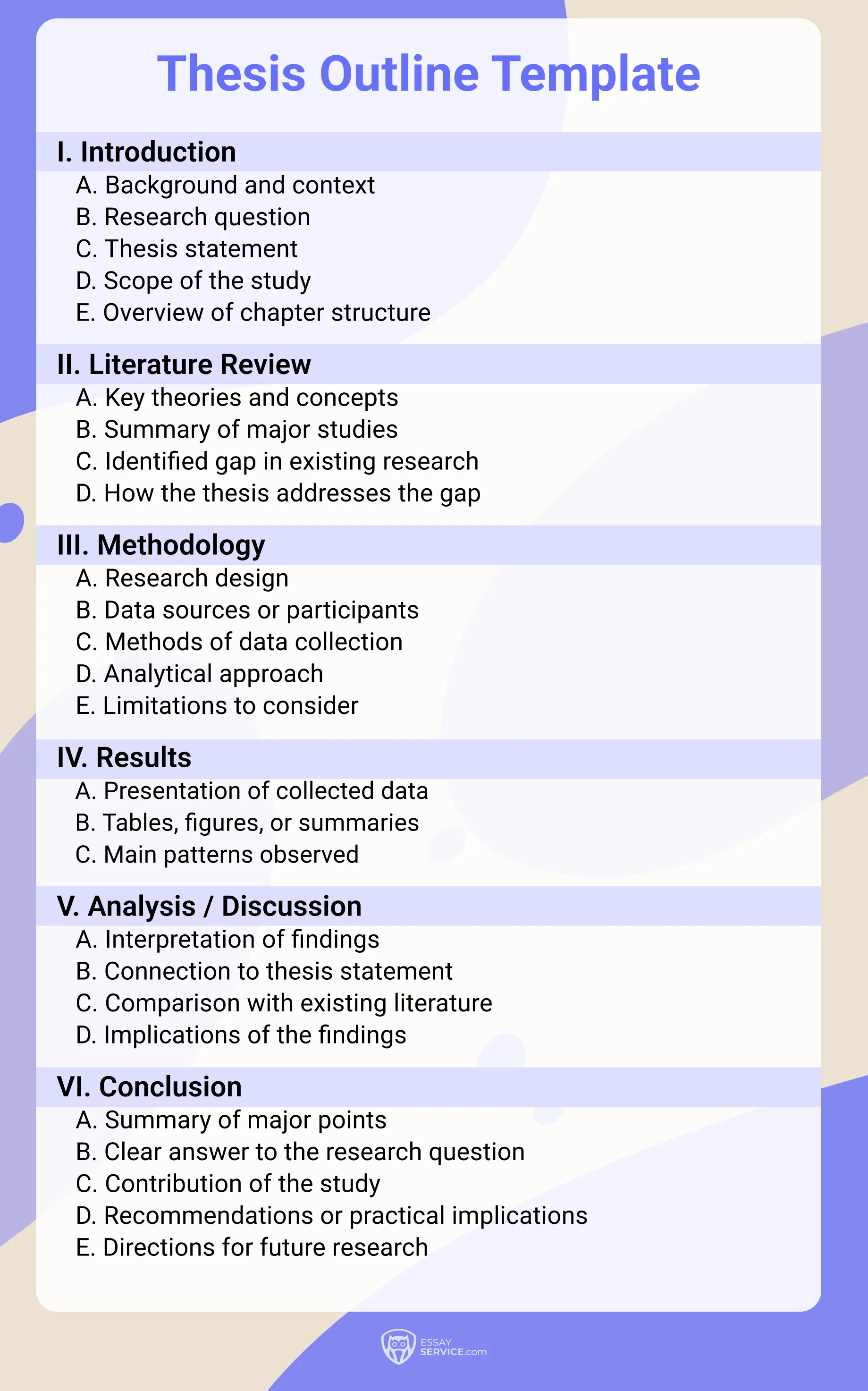
Thesis Outline Examples
A thesis outline example typically begins with a clear thesis statement, followed by major points organized with Roman numerals. Each major point includes capital-letter subpoints and numbered details that show how the argument will develop across the chapters. This structure makes the outline easy to convert into a chapter draft, and students often keep a thesis outline sample PDF nearby to check whether their sections follow a logical order.
Thesis Outline Example 1
Topic: The Impact of School Start Times on High School Students’ Academic Performance
I. Introduction
A. Background: Growing debate about early school schedules in secondary education
B. Research question: How do later school start times affect academic performance among high school students?
C. Thesis statement: Delayed start times improve academic outcomes by increasing sleep duration, improving cognitive function, and reducing absenteeism.
D. Scope: Public high schools in urban districts, grades 9–12
E. Overview: Literature review, methods, results, analysis, and conclusion
II. Literature Review
A. Theories of adolescent sleep cycles and cognitive functioning
B. Previous findings on sleep deprivation and academic outcomes
C. Research gap: Limited studies focused on diverse student populations in large urban districts
D. Contribution: This thesis evaluates performance indicators across multiple schools with varying schedules
III. Methodology
A. Research design: Comparative, mixed-methods approach
B. Participants: Three urban high schools with different start times
C. Data collection: Standardized test scores, GPA data, attendance logs, student surveys
D. Analytical approach: Regression models and thematic coding of survey responses
E. Limitations: Restricted access to long-term data; variability in teacher grading practices
IV. Results
A. Quantitative findings: Higher GPAs and improved test scores in later-start schools
B. Key figures and tables: Performance comparison charts, attendance trend graphs
C. Patterns: Strongest improvements seen in first-period classes
V. Analysis / Discussion
A. Interpretation: Increased sleep strongly correlates with performance gains
B. Link to thesis statement: Findings support the claim that delayed schedules benefit learning
C. Comparison with literature: Aligns with previous medical and educational research
D. Implications: Policy changes could address chronic absenteeism and underperformance
VI. Conclusion
A. Summary: Later start times improve outcomes across key academic indicators
B. Answer to research question: Evidence shows measurable performance gains
C. Contribution: Provides new data from urban districts with diverse student populations
D. Recommendations: Districts should conduct pilot programs before full adoption
E. Future research: Longitudinal studies on mental health and college readiness
The example below demonstrates how a complete outline looks for a research topic in education, and you can download a PDF version if you want to use it as a template for your own thesis.

Thesis Outline Example 2
Topic: The Role of Social Media Algorithms in Shaping Political Polarization
I. Introduction
A. Background: Rapid growth of algorithm-driven news feeds across major social platforms
B. Research question: How do social media algorithms influence political polarization among young adults?
C. Thesis statement: Algorithmic curation intensifies political polarization by reinforcing selective exposure, amplifying emotionally charged content, and reducing cross-ideological visibility.
D. Scope: Users aged 18–29 in the United States
E. Overview: Review of prior research, explanation of methods, analysis of collected data, and final conclusions
II. Literature Review
A. Core concepts: selective exposure, algorithmic filtering, confirmation bias
B. Findings from political communication studies
C. Gap: Limited empirical evidence linking user behavior to algorithmic design features
D. Contribution: This thesis connects behavioral patterns with platform-level mechanisms
III. Methodology
A. Research design: Mixed-method approach combining survey data and platform interaction logs
B. Participants: 400 young adult users across three platforms
C. Data collection: Self-reported political engagement, content exposure records, frequency of cross-ideological interactions
D. Analytical approach: Correlation analysis, sentiment coding, and algorithmic audit techniques
E. Limitations: Self-report bias and platform restrictions on data access
IV. Results
A. Exposure patterns: Increased frequency of ideologically similar content
B. Emotional amplification: Higher engagement with negative or provocative posts
C. Reduced cross-views: Meaningful decline in interactions with opposing viewpoints
V. Analysis / Discussion
A. Interpretation: Algorithms shape political information flow in measurable ways
B. Link to thesis statement: Evidence supports the argument that design choices influence polarization
C. Comparison: Results align with communication theories but challenge earlier assumptions about user autonomy
D. Implications: Platforms may need transparent settings or exposure-balancing tools
VI. Conclusion
A. Summary: Algorithms reinforce polarization patterns among young adults
B. Answer: They influence political attitudes through selective exposure and emotional amplification
C. Contribution: Adds empirical data to an expanding area of digital politics research
D. Recommendations: Encourage platform-level interventions and media literacy programs
E. Future research: Long-term studies tracking shifts across election cycles
This outline focuses on digital media and political behavior, showing how to structure a research project with concepts, data sources, and clear analytical steps. You can also download a PDF version if you want to use the outline as a starting point for your own thesis work.
Thesis Outline Example 3
Topic: Evaluating the Efficiency of Solar-Powered Desalination Systems in Coastal Regions
I. Introduction
A. Background: Rising water scarcity and growing interest in renewable desalination technologies
B. Research question: How efficient are small-scale solar-powered desalination units in meeting household water needs in coastal regions?
C. Thesis statement: Solar desalination systems can supply reliable household water when optimized for thermal retention, membrane stability, and consistent solar exposure.
D. Scope: Low-cost, small-scale units designed for households in warm coastal climates
E. Overview: Technical background, experimental setup, performance evaluation, analysis, and final conclusions
II. Literature Review
A. Overview of desalination methods: thermal, membrane-based, hybrid
B. Existing research on solar desalination efficiency and system designs
C. Gap: Limited field-tested data on small-scale units intended for households rather than industrial plants
D. Contribution: This thesis offers real-world performance measurements under variable climate conditions
III. Methodology
A. Research design: Experimental evaluation of three prototype units
B. Data sources: Hourly solar intensity readings, water output logs, membrane condition reports
C. Procedures: Controlled testing over a 30-day period, including thermal storage experiments
D. Analytical approach: Efficiency calculations, comparative performance analysis, durability assessment
E. Limitations: Weather fluctuations and prototype constraints
IV. Results
A. Output levels: Daily water production across prototypes
B. Efficiency factors: Influence of heat retention, panel angle, and membrane type
C. Durability data: Wear, fouling, and maintenance intervals
V. Analysis / Discussion
A. Interpretation: Heat retention and membrane material have the strongest impact on performance
B. Link to thesis statement: Findings validate the potential of optimized small-scale units
C. Comparison: Prototype results exceed performance reported in earlier low-budget models
D. Implications: Affordable solar desalination could assist households in water-scarce coastal zones
VI. Conclusion
A. Summary: Optimized solar-powered units can meet part of a household’s daily water demand
B. Answer to research question: Efficiency depends heavily on design and environmental conditions
C. Contribution: Provides prototype-level evidence for practical system improvements
D. Recommendations: Refine membrane durability, increase thermal storage, adjust panel alignment
E. Future research: Field testing over longer periods and in additional climate zones
This example shows how a thesis in engineering or environmental science can be organized around experimental testing, performance data, and system optimization. You can download a PDF version if you want to use this outline as a template for your own research.
The Bottom Line
A clear thesis outline gives the entire project a stable direction. Students who work with structured outlines usually draft faster and revise more effectively because every section already has a defined role.
Anyone who needs extra support during this stage can turn to EssayService. We offer reliable assistance with writing, researching, outlining, and more. If the project requires deeper help, our thesis writing services provide expert direction from the earliest outline to the final submission.
Frequently Asked Questions
What Does a Thesis Outline Look Like?
How Much Detail Should a Thesis Outline Include?
How Should I Format a Thesis Outline?
How to Make a Thesis Outline?
Why Is an Outline Important in Thesis Writing?

John spends his days studying the impact of language. He uses his deep understanding of linguistics and research experience to help students communicate more effectively and craft immaculate research-intensive papers.
- University of Queensland. (n.d.). Structuring your thesis. https://my.uq.edu.au/information-and-services/higher-degree-research/hdr-candidature-support/how-write-thesis/structuring-your-thesis
- MIT Communication Lab. (n.d.). Creating an outline for your master’s thesis. https://mitcommlab.mit.edu/aeroastro/commkit/creating-an-outline-for-your-masters-thesis/
- University of Florida, Department of Anthropology. (n.d.). Senior thesis sample outline [PDF]. https://anthro.ufl.edu/wp-content/uploads/sites/55/Senior-Thesis-Sample-Outline.pdf



New posts to your inbox
Your submission has been received!