
Key Takeaways
- A rebuttal responds directly to an opposing view
- Strong rebuttals rely on logic and evidence
- The counterargument should be presented fairly
- Rebuttals strengthen credibility and clarity
- Placement affects how persuasive the response feels
A rebuttal in writing is a response that directly engages with an opposing viewpoint and explains why that position falls short. It shows the reader that you understand the counterargument, recognize reasonable concerns, and still stand by your position. Key elements include clear reasoning, relevant evidence, and careful explanation to demonstrate why your claim remains valid and persuasive within the overall argument.
For students who feel unsure about writing a rebuttal or want to see practical examples, EssayService helps strengthen logic and refine responses.


EssayService for Stronger Arguments
We help turn ideas into persuasive, well-structured essays that hold up under scrutiny.
What Is a Rebuttal in Writing?
A rebuttal is a reasoned response to an opposing viewpoint that explains why that position fails to weaken your claim. It identifies the counterargument, acknowledges valid points, and then uses logic, evidence, and clear explanation to show why your position remains stronger and more convincing within the essay or argument. By doing this, the writer demonstrates critical thinking, builds credibility with the reader, and strengthens the overall structure of the argument rather than ignoring disagreement.
Where Does the Rebuttal Go in an Essay?
A rebuttal goes in the body of an essay, usually right after the opposing view is explained. Below is an essay outline that shows a common placement for a rebuttal within an essay.
Introduction: The opening section where you present the topic, background context, and your main claim.
Main Argument: The body section where you develop your key points and support them with evidence and explanation.
Counterargument and Rebuttal: The part of the essay where opposing views are introduced and directly addressed with reasoning and evidence.
Conclusion: The closing section where you restate your main idea, summarize key points, and leave a final impression on the reader.
Key Elements of a Strong Rebuttal
When handled well, the rebuttal reads as part of the argument rather than an interruption. The key components of a persuasive rebuttal argument include the following:
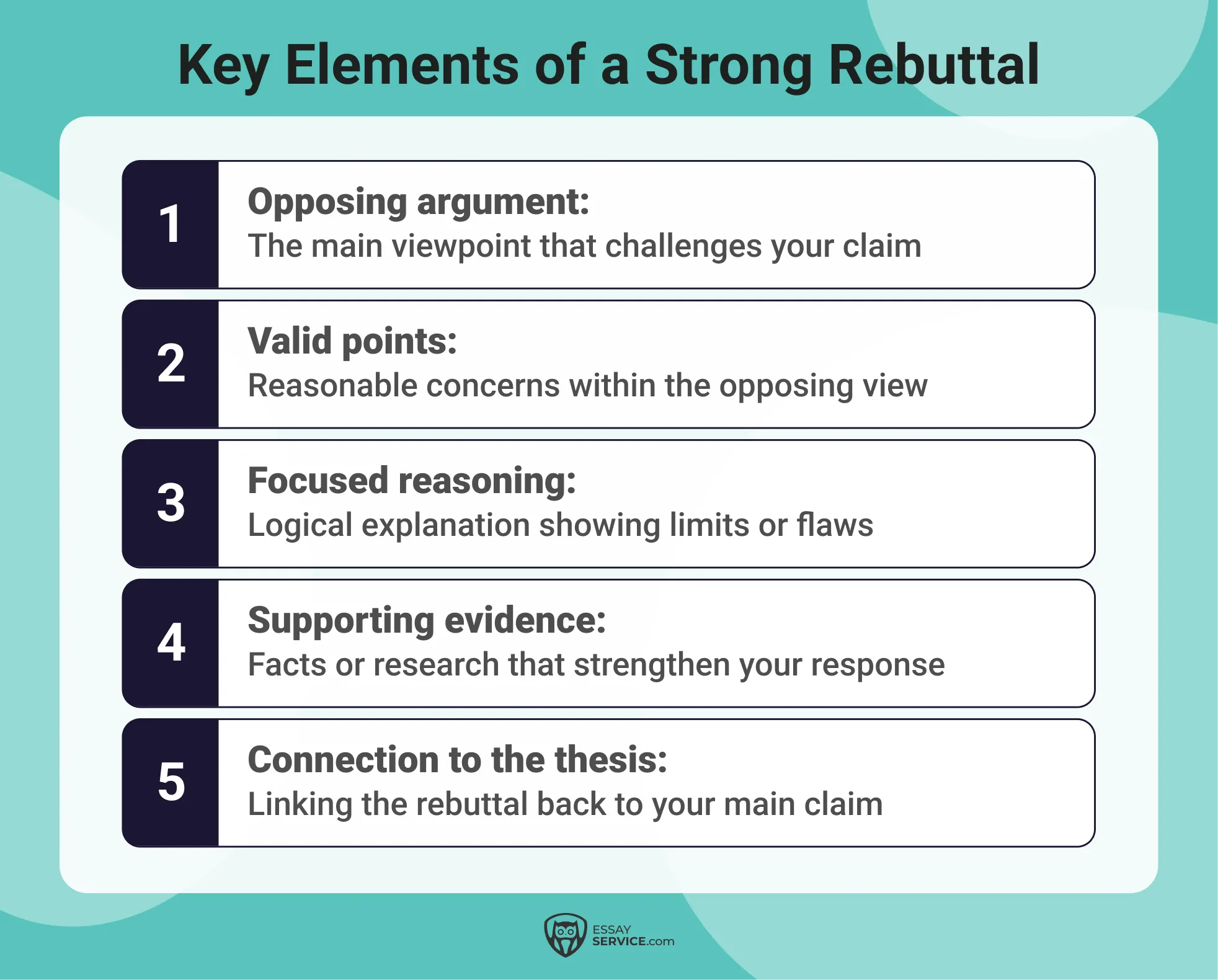
Identify the Opposing Argument
Start by stating the opposing argument clearly and without distortion. Credibility is often earned before any response is offered.
Acknowledge Valid Points
Some opposing views raise a good point that deserves recognition. By acknowledging reasonable concerns, the rebuttal avoids sounding rigid.
Respond With Focused Reasoning
Next, address the counterargument directly. Logic and explanation should drive this section. Weaknesses are clarified through reasoning instead of blunt dismissal.
Support the Response With Evidence
Evidence gives the rebuttal weight and direction. Facts, research, or concrete examples anchor the response. Claims feel stronger when support is visible on the page.
Reconnect to the Central Claim
Finally, link the rebuttal back to the thesis. This connection keeps the essay moving forward. The reader is guided smoothly into the next idea or the conclusion.
How to Write a Rebuttal?
Writing a rebuttal begins by identifying the strongest opposing idea. That idea is narrowed to the point that truly challenges your claim, and the response is checked for alignment with the thesis. Evidence is gathered next to support your reasoning, followed by deciding where the rebuttal fits in the essay. The process ends with a smooth transition that brings the reader back to your main argument and keeps the essay moving forward.
Identify the Main Counterargument
To write a rebuttal, start by figuring out the strongest objection someone could raise against your claim. For example, if your essay argues that online classes are effective, the main counterargument might claim that students learn less without in-person interaction. That idea directly threatens your position, so it needs attention.
Select the Strongest Opposing Point
Look at all possible objections and pick the most serious one. This is the point a careful reader would expect you to address.
Review Your Thesis and Main Points
Reviewing your thesis and main points means checking that the rebuttal still supports your central claim. Before responding, your thesis and main points should be reread to keep the focus intact. Doing this prevents the rebuttal from drifting off topic or weakening the argument you are building.
Gather Relevant Supporting Evidence
Gather research findings, data, or examples before writing. For example, if a counterargument claims that online classes reduce learning quality, studies comparing student outcomes in online and in-person courses can support the response.
Decide the Rebuttal’s Placement
In most cases, it is placed right after the counterargument. This order helps the reader follow the discussion without confusion. Sometimes, a short rebuttal is added near the conclusion to reinforce the thesis.
Prepare a Transition Back to Your Argument
End the rebuttal by guiding the reader back to your main argument. A smooth transition keeps the essay focused and maintains momentum.
Transition example: These findings support the original claim that course structure plays a larger role in learning outcomes than delivery format.
If you need help shaping rebuttals or refining argument flow, a professional graduate paper writing service can support the process by improving structure and clarity.
Better Argumentative Essays With EssayService
Clear structure, solid evidence, and strong rebuttals all in one place.
Rebuttal Examples in Writing
In this section, you will see rebuttal paragraph examples across different types of writing, including argumentative essays, research papers, persuasive speeches, literature analysis, and opinion articles.
Rebuttal Example in Argumentative Essay
Some critics argue that public libraries have lost their purpose because information now lives online. This view makes sense in a world where phones and laptops feel constant. What it misses, though, is how libraries still function as access points for people without reliable internet, paid databases, or quiet places to work. Free research help, community programs, and carefully reviewed sources are provided in these spaces every day. Because those services meet needs that search engines do not, the claim that libraries are obsolete does not hold up.
Rebuttal Example in Research
Some researchers suggest that increasing screen time directly causes lower academic performance among adolescents. It draws support from correlations that have been observed between device use and reduced attention spans. However, recent studies distinguish between passive screen use and structured educational engagement. When screen time is guided by instructional goals and monitored by educators, learning outcomes are often maintained or improved. These findings indicate that the effects linked to screen use depend more on context and design than on exposure alone.
Rebuttal Example in a Persuasive Speech
Many people claim that banning single-use plastics will hurt small businesses by raising costs. That concern sounds practical at first and deserves attention. Evidence from cities that adopted similar policies shows businesses adjusting through reusable alternatives and bulk purchasing. When transition periods are provided, costs are reduced, and customer support often increases. These outcomes suggest that environmental regulations can protect local economies while addressing long-term waste problems.
Rebuttal Example for a Literary Analysis
Some critics argue that an unreliable narrator weakens a novel’s message and leaves readers confused. Often, that claim assumes meaning depends on strict factual consistency. The technique is used deliberately to mirror the character’s fractured perception and inner conflict. By forcing uncertainty onto the reader, deeper attention is invited, and surface assumptions are challenged. Readers are left with a stronger understanding of the theme because form and meaning work together.
Rebuttal Example for an Opinion Article
Some readers believe that remote work weakens teamwork and erodes company culture. That concern usually comes from experiences with poorly managed virtual teams. In many organizations, however, collaboration has been strengthened through clear communication norms and intentional check-ins. When expectations are defined, and leadership adapts, strong professional relationships are still built. Workplace culture, in this context, depends more on management practices than on physical proximity.
The Bottom Line
Rebuttals strengthen writing by showing that opposing views have been considered and addressed. Across different formats, they improve clarity, reasoning, and credibility. When structure and evidence are used carefully, the argument feels more complete and persuasive.
For students who need extra support, EssayService provides guidance on refining rebuttals and strengthening overall essay structure.
Frequently Asked Questions
What Is the Purpose of a Rebuttal in Writing?
Where Does the Rebuttal Go?
How to Start a Rebuttal?
How to Make a Rebuttal?
What Is an Example of Rebuttal in a Sentence?

John spends his days studying the impact of language. He uses his deep understanding of linguistics and research experience to help students communicate more effectively and craft immaculate research-intensive papers.
- Pressbooks chapter on argument, counterargument, and refutation:
Howard Community College. (n.d.). Argument, counterarg, refutation. In ENGL087. https://pressbooks.howardcc.edu/engl087/chapter/argument-counterarg-refutation/ - Maryland Commission on Civil Rights. (n.d.). Helpful tips for writing your rebuttal (CP Resource). https://mccr.maryland.gov/Documents/Helpful%20Tips%20for%20Writing%20your%20Rebuttal%20-%20%28CP%20Resource%29.pdf
- Oklahoma City Community College. (n.d.). Building refutation. https://www.occc.edu/wp-content/legacy/writingcenter/pdf/Building-Refutation.pdf


New posts to your inbox
Your submission has been received!