
A critical response essay is a piece of writing where you read a text closely, form a judgment, and defend that judgment with evidence. Don’t think of it as if you’re writing a simple plot summary, nor treat it like a place for ranting about your opinions, because this paper needs to me much more structured and insightful than either of the two.
In this article, I'll show you how to write a critical response essay that earns its grade, and I'll do it with the structure I've seen work across hundreds of student drafts. We'll cover the format piece by piece, and I'll drop in examples so the ideas click. By the end, you'll know what your professor wants.
What Is a Critical Response Essay?
A critical response essay is a short piece of academic writing in which you evaluate a specific text and argue a judgment about it. The purpose of this judgement is to answer a concrete question of whether the text succeeds on its own terms. Throughout the essay, the writer assesses whether the claim of the original text’s author is properly supported, how strong the evidence and the reasoning built on it is, and if the piece achieves the purpose it has for its intended audience. Your opinion is only a conclusion based on those observations.
A critical response essay has two purposes, separate for the reader and the writer. The former gains a reasoned assessment of the text and its value. For the latter, it helps develop the core academic skill of analyzing an argument and defending a position against a source.


Quality You Trust
Work with skilled writers who research, draft, and refine every essay to your exact brief.
Critical Response Essay Structure
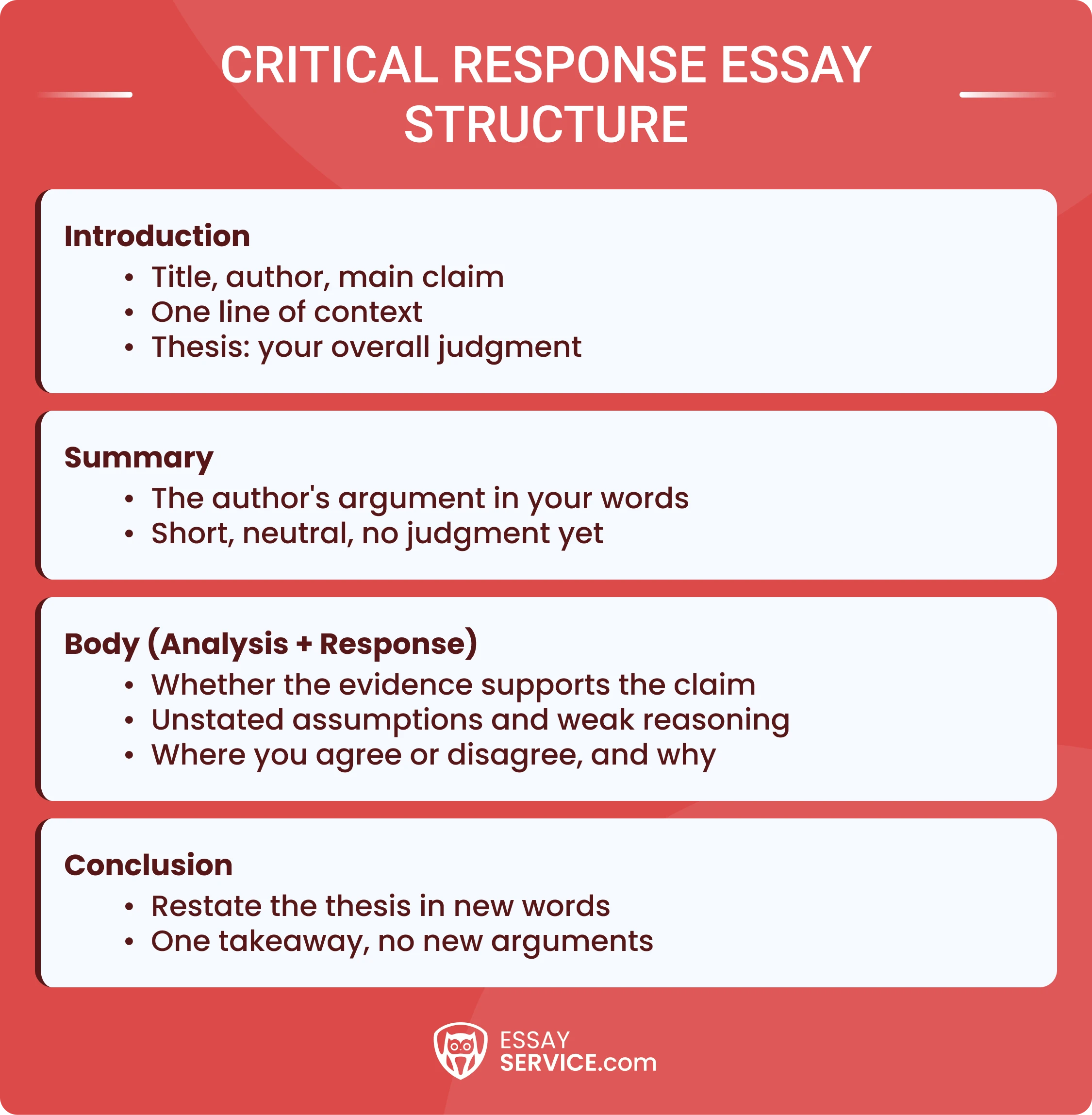
The critical response essay format has three parts: a short introduction and conclusion, with the body paragraphs covering summary, analysis, and the writer’s response between the two.
Introduction
In your opening paragraph, you should cover:
- The name of the text
- Author’s name
- A line of context
- Thesis statement with an evaluative angle
"The article is flawed" says nothing. "Its ethics hold, its cost figures don't" shows the reader, more or less, what's coming.
Body Paragraphs
The body paragraphs are, in turn, usually separated into three parts: summary, analysis, and the response. Let’s see what each one does.
Summary
Summary is written in present tense and is a neutral account of the author’s main claim and how they reach it, all expressed in your own words. This part runs for 2-4 sentences only, without going into too much detail, so you don’t drift into plot retelling.
Analysis
Now ask the concrete questions to determine how well the argument works (or doesn’t). Is the evidence solid or cherry-picked, causing the logic to jump? Are there any assumptions that stay unstated? What rhetorical moves does the author use to persuade the reader? At this stage, you’ll benefit from reading our guide on how to improve critical thinking.
Response
The response is sort of a conclusion for the previous two subsections. Say plainly where the text succeeds and where it fails against those standards, and calibrate your language to your confidence, "the author overlooks" for a firm point, "the author underplays" for a softer one. Grant the text its real strengths; a response that only attacks reads as biased, not rigorous.
Conclusion
Restate your thesis in fresh words, then widen out and talk a little about why your verdict should matter to a reader weighing the text. No new evidence here; that work belongs in the body.
How to Write a Critical Response Essay?
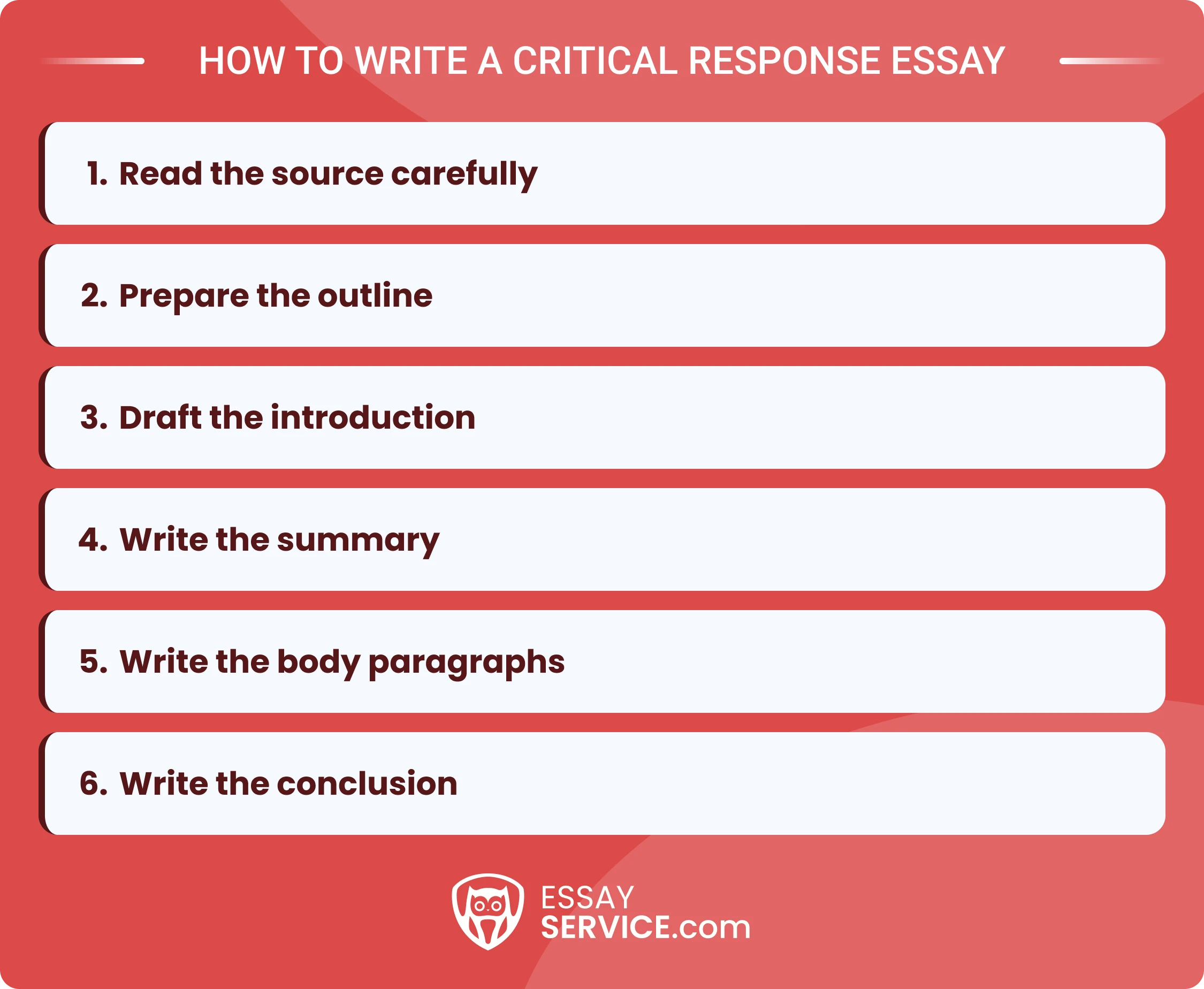
Writing a critical response essay breaks into six steps, and skipping any of them shows in the final draft. The reading and planning stages do the real work; if your notes are thin, no amount of polishing the prose will rescue the analysis. Here is the sequence.
Read the Source Carefully
Read the text at least twice, with a different goal each time. On the first pass, aim only to understand the argument, and hold off judging it. On the second, read with a pen and write the author's thesis in one sentence at the top of the page. Then work through the text tracking four things:
- The author's central claim
- Evidence assembled to support that claim
- Weak points where the reasoning loses force
- Any passage that surprises you or provokes disagreement
Prepare the Outline
Write your thesis at the top before anything else, since every section answers to it. Then map each part and how much space it gets. Keep the summary under a quarter of the essay and give analysis and response the majority.
Draft the Introduction
Open with the text's title and author, add one or two sentences of context (the debate it enters, the question it addresses), and place your thesis last so it launches the body. Keep it arguable and specific.
Weak: "This article is interesting."
Better: "The author convinces on ethics and dodges the question of cost."
Write the Summary
Summarize the source before you evaluate it, in present tense and your own words. A clean summary answers three questions:
- Who wrote this, and for whom?
- What is the core argument?
- Why does it matter, and what is at stake?
Write the Body Paragraphs
Give the body most of your word count, one point per paragraph, each built on the same pattern:
- Topic sentence: state the single claim the paragraph defends, before any evidence.
- Evidence: quote or cite a specific detail from the text. No floating assertions.
- Analysis: explain what the evidence shows and how it backs your claim. This sentence, not the quotation, earns the marks.
Write a Conclusion
Restate your thesis in new words, now backed by everything you have shown. Compress your findings into two or three sentences, then answer why your verdict matters to anyone reading the text. Add no new arguments, and do not apologize for your stance; a hedged ending undercuts the case you just built.
Now, let’s get to the practical side of the article and read the critical analysis examples essay.
Critical Response Essay Examples
Theory only takes you so far, so let's look at the real thing. Below are full sample essays that put every step into practice. Study how each example of a critical response essay handles summary, analysis, and judgment before you draft your own.
Critical Response Essay Example 1
Topic: Compression Without Loss? A Response to Ted Chiang's "ChatGPT Is a Blurry JPEG of the Web"
When a writer as careful as Ted Chiang reaches for a technical metaphor, it is worth asking whether the metaphor clarifies the thing or quietly reshapes it. In his 2023 New Yorker essay "ChatGPT Is a Blurry JPEG of the Web," Chiang argues that large language models are best understood as lossy compression of the text they were trained on: useful, often convincing, and fundamentally incapable of the understanding we tend to project onto them. His diagnosis is sharp, and much of it holds. Yet the essay's central analogy, powerful as it is, smuggles in an assumption about what human knowledge is that deserves more resistance than Chiang gives it.
Chiang, a science fiction writer known for stories that turn on precise thought experiments, wrote the piece for a general readership at the height of the first ChatGPT wave. His purpose is corrective. He wants to cool the hype by explaining, in plain terms, what these systems actually do. A lossy image format like JPEG discards data to save space and fills the gaps with approximations; Chiang contends that a language model does the same with the web, storing a compressed statistical impression and reconstructing plausible text when queried. The blurriness, in his account, explains both the fluency and the errors. What sounds like reasoning is interpolation.
The strongest part of the argument is its treatment of why model output feels authoritative. Chiang points out that a slightly blurred answer often reads as more polished than a jagged, correct quotation would, because the model smooths everything into the same confident register. This is a genuinely useful observation. Anyone who has watched a chatbot invent a citation in flawless academic prose has seen the phenomenon he describes. The uniformity of tone is doing persuasive work that has nothing to do with accuracy, and Chiang deserves credit for naming a mechanism that most critics only gesture at.
Where the essay strains is in the assumption underneath the metaphor: that the web represents a fixed body of knowledge which the model can only degrade. Compression, by definition, starts from an original and can never improve on it. But knowledge is not a JPEG. Much of what we value in human thinking comes precisely from recombination, from placing two unrelated ideas beside each other and noticing a pattern nobody recorded. Chiang half-acknowledges this when he concedes that models can produce novel-seeming combinations, yet he treats such output as a lucky artifact of blur rather than as something that might occasionally matter. The metaphor forecloses the question before it can be asked. If the original is sacred and the copy is always worse, then generation can only ever be a fancier form of loss.
This matters because the analogy shapes what readers conclude about use. Take Chiang's implied advice that we should return to the source rather than trust the compressed version. For factual retrieval, he is plainly right; asking a model for a quotation is asking for trouble. For a student stuck on how to frame an argument, though, a plausible reconstruction of many arguments at once can be a real starting point, even when no single sentence in it is quotable. The blur that ruins a citation can loosen a mental block. Chiang's frame cannot account for that, because within it a blurry copy has no function except to stand in poorly for something clearer.
None of this means the essay fails. Its core claim, that these systems model the statistical shape of language rather than the world behind it, remains one of the clearest explanations available, and I have handed it to students myself. The trouble is narrower. By choosing compression as his governing image, Chiang commits himself to a view of knowledge as something already complete, waiting only to be preserved or lost. That view undersells the messier truth that understanding often grows through exactly the kind of lossy, approximate recombination he describes with suspicion.
Chiang set out to puncture inflated claims about machine intelligence, and on that count he succeeds. The essay is a corrective the moment needed. What it cannot quite see is that a blurry copy of everything ever written is a strange and genuinely new object, and that its blur may turn out to be less a flaw than a feature we have not learned to use.
Critical Response Essay Example 2
Topic: The Class Beneath the Generation: A Response to Anne Helen Petersen's "How Millennials Became the Burnout Generation"
Petersen opens her 2019 BuzzFeed News essay with a confession that landed hard for a lot of readers. She could not bring herself to mail a package or fill out a simple form, not from laziness but from a paralysis she couldn't explain. She calls it errand paralysis, and the phrase went everywhere. What made it stick is that she ties it to something larger than one person's cluttered to-do list. Her claim is that burnout has stopped being an acute episode and hardened into the baseline condition of a whole generation. On the structural half of that argument she is persuasive. The generational half is where I want to push, because folding millions of very different lives into a single exhausted "we" hides the thing that actually predicts who burns out.
The essay is diagnostic and, in a quiet way, absolving. Petersen writes for millennial readers who have internalized their own failure to keep up, and she means to relocate the blame. She traces a childhood of relentless optimization, every hour scheduled and every activity a line on some future résumé, running straight into a labor market that promised security in exchange for all that effort and then withheld it. Student debt, the gig economy, the vanished stable career: these, she says, produced a cohort trained to work constantly and rewarded for it barely at all. Burnout becomes the predictable result of a broken bargain rather than a character flaw.
What she gets right is the mechanism linking the economy to the nervous system. Petersen is precise about how outside pressure turns into a private feeling. The low hum of tasks that never resolve, the guilt attached to rest, the suspicion that any downtime is time stolen from self-improvement: she names these accurately, and she is right that none of them were chosen. Her description of answering work email in bed and calling it relaxation captures a genuine distortion of what leisure has become. I have handed students that passage for exactly one reason. They see themselves in it immediately, which is its own kind of evidence for her case.
Then the word "generation" arrives, and the argument quietly loosens. The people she describes, over-scheduled children of invested parents, graduates buried in loans, knowledge workers who cannot log off, are a specific slice of the cohort, weighted heavily toward the professional middle class. Consider the millennial who left school at sixteen, who had no résumé-building childhood because there was no money for it, whose exhaustion comes from two hourly jobs and not from a salaried inbox. That person appears nowhere in the essay. Their burnout is real, arguably worse, and it fits none of the optimization-betrayed template. By calling the condition generational, Petersen ends up universalizing an experience that class explains far better.
That slippage costs more than precision. It shapes which solutions seem plausible. Treat burnout as something a whole age group shares, and the remedies drift toward the personal and cultural, things like firmer boundaries, a rejection of hustle, a change of collective attitude. Trace it to class instead, and the fixes turn material: wages, hours, debt relief, protections that reach some workers and not others because the problem was never evenly spread. Petersen nods at structural causes all the way through, yet her generational frame keeps tugging the analysis back toward a shared mindset that a bit of clarity might supposedly dissolve.
I don't think any of this sinks the essay. Petersen did something genuinely valuable. She took a feeling millions were treating as private failure and showed it had external causes, and for anyone drowning in self-blame that reframing does real work. Her instinct to look outward is sound. She simply stops at the generation when the harder, less flattering variable sits one level down.
Read that way, "How Millennials Became the Burnout Generation" works best as an unfinished argument. It correctly insists that burnout is manufactured, not deserved, and it correctly points to an economy that overworks and underpays. Its one real failure is mistaking a class experience for a generational one, a slip that leaves the essay more comforting, and less exact, than the situation actually calls for.
Critical Response Essay Example 3
Topic: The Question He Won't Answer: A Response to David Foster Wallace's "Consider the Lobster"
Gourmet magazine paid David Foster Wallace to attend the Maine Lobster Festival in 2004 and presumably expected a few thousand cheerful words about melted butter and coastal charm. He handed in something closer to a philosophy seminar. Most of "Consider the Lobster" circles a single uncomfortable question: does the animal suffer when it is dropped alive into boiling water, and if it does, what does that make everyone standing happily around the pot? The strength of the essay is that Wallace treats this as a live problem instead of a settled one. My reservation concerns how he leaves it. For all the honesty of his method, the closing pages perform a quiet trick that lets the reader keep everything and pay nothing.
The piece ran in a glossy food publication whose readers had signed up for pleasure, and Wallace understood exactly who they were. That audience is central to what he attempts. He first walks them through the festival's scale, the crowds and the industrial cookers, then turns to the biology: the lobster's nervous system, its documented struggle against the pot, the absence of any structure a scientist can point to and declare that pain does or does not register here. His stated goal is small. He wants readers to notice that a question exists where they had assumed there was none. Everything else in the essay grows out of that deliberate interruption.
What keeps the essay from hardening into a lecture is that Wallace indicts himself before anyone else. He confesses that he likes the meat, that he holds no worked-out position, that raising the subject at a festival makes him faintly absurd. Notice how he declines every stance that would let him off easy. He will not play the vegetarian who has risen above the problem, and he will not play the enthusiast who has decided the problem is nonsense. He stands inside the discomfort and reports it with unusual precision, down to the way a lobster hooks its claws over the rim of the kettle. This is the essay working at full strength, since a reader cannot fairly call him preachy when he has refused every superior position on offer.
And yet the more often I return to the piece, the more its final pages read less as humility and more as evasion. Wallace assembles enough troubling material that a reader who follows the logic could reasonably decide the animal belongs off the plate. Then, at the precise moment a conclusion becomes available, he pulls back and declares only that these are very hard questions he is not equipped to settle. The difficulty itself becomes the destination. He gathers evidence pointing toward a verdict and then refuses to name the verdict his own reporting has set up.
The cost of that retreat lands on the reader, though not in any way the reader will feel. Someone can finish the essay genuinely moved, sit with the unease for the length of a meal, order the lobster, and walk away convinced the moral work is done because the feeling was sincere. Wallace's open ending, which looks like the honest choice, quietly issues that permission. It turns being troubled into a replacement for deciding anything, and troubled people who decide nothing are the festival's most reliable customers. I doubt he intended this. It falls out of the shape he selected regardless, since sincere distress with nothing attached to it is the most comfortable resting place a person can find while planning to keep eating.
So what does a reader carry away from an essay this skilled and this slippery at once? Not that Wallace erred by leaving the question open, because some questions honestly resist being closed inside a magazine feature. The trouble sits lower than that. He built the whole piece on the idea that confronting a hard question honestly counts for something, and it does, yet honesty about a question and honesty about your own answer are separate duties, and he satisfies the first while sliding past the second. "Consider the Lobster" stands as a remarkable performance of moral attention. It simply halts one step short of where that attention was heading, and it presents the halt as wisdom.
Critical Response Essay Example 4
Topic: Blaming the Algorithm: A Response to Kyle Chayka's Filterworld
Walk into a renovated café in Lisbon, then one in Seoul, then one in Austin, and you meet the same room three times over. White subway tile, a hanging monstera, reclaimed wood, a short menu of oat-milk drinks. Kyle Chayka noticed this too, and his 2024 book Filterworld gives the feeling a name and hands it a culprit. The name is filterworld, his word for the flattened cultural landscape we now move through. The culprit is the recommendation algorithm, the ranking machinery behind Spotify, Instagram, and Netflix that, in his telling, quietly shrinks what culture can become. That the sameness is real, I won't dispute. What I question is the direction it runs. The same systems he blames for pressing culture into one shape are, at the same time, shattering it into thousands, and his book barely registers the second motion.
His argument is causal, not merely descriptive, which is what makes it provocative. Chayka, who covers technology and design for The New Yorker, insists that algorithmic curation does not simply mirror the taste we bring to it. It manufactures that taste, feeding us more of whatever we clicked before until a safe center is all any of us can see. The stakes he raises are close to civic. A world tuned for engagement, he warns, sheds the friction and regional oddness that once made encountering culture feel like meeting something from outside yourself.
His strongest chapter traces what he calls AirSpace, the interchangeable look of minimalist cafés from one continent to the next. He is exact about the loop that produces it. A photogenic room performs well as an image, the image spreads through the feed, and owners elsewhere copy whatever spreads. The section persuades because it stays close to a mechanism you can actually follow.
The dread gets harder to credit once you notice what these systems do in the other direction. Chayka's picture holds only if recommendation engines herd everyone toward one narrowing middle, and much of the evidence runs the opposite way. The feed splinters as readily as it flattens. Spotify's system has spawned microgenres too specific to have had names before the software coined them. TikTok sorts readers into BookTok subcultures that multiply faster than anyone can catalog. A machine that divides its audience into thousands of self-reinforcing niches is doing something stranger than homogenization, and Filterworld has almost nothing to say about it.
I suspect the blind spot comes from where Chayka looks. He studies the visible crest of the culture, the trending sounds and viral rooms, and reasonably concludes everything converges there. But virality was always going to look uniform, since it selects for whatever reads instantly to the largest crowd. Below it churns a long tail the same algorithms sustain, and that tail contradicts the thesis.
Chayka has caught one real motion and mistaken it for the only one. The more honest book would have held both at once, since the culture these systems hand us is not so much shrinking as coming apart into pieces too many to count.
Critical Response Essay Example 5
Topic: The Bridge She Doesn't Build: A Response to Rebecca Solnit's "Men Explain Things to Me"
By the time most people read "Men Explain Things to Me," they have already met it secondhand, through the word it sent into the culture. Rebecca Solnit's 2008 essay became shorthand for a whole species of male behavior, and the shorthand grew so familiar that the argument beneath it rarely gets a second look. Go back to the text and the striking thing is not the famous anecdote. It is the distance Solnit asks that anecdote to cover. She begins at a dinner party and arrives at rape and murder, presenting the two as points on one continuous line. That line powers the essay, and it is also the beam she never bolts down.
The opening scene is what everyone remembers. A man at a party lectures Solnit about a very important recent book on a topic she knows intimately, too pleased with his own authority to notice she is the author. She was writing for readers who would laugh in recognition, and that laugh is the hook. From there she widens the frame. The same reflex that lets a man explain a woman's own work back to her, she argues, is the reflex that lets men wave away women's testimony in far heavier settings, the courtroom and the crime scene among them. Her aim is to bind a small daily indignity to a pattern that costs women their safety.
Both ends of that line hold up on their own. The party bore needs no defending; every reader has met him. The graver end is documented too, and Solnit supplies enough to show that women get disbelieved precisely when belief matters most. My hesitation lives in the stretch between them, where the essay moves quickest and defends least. She treats the continuum as obvious, as if one root plainly feeds both the tiresome man at dinner and the juror who will not credit a woman's account. Plausible, certainly. It is also carrying most of the argument's weight, and she declares it rather than earning it. Why should a single mechanism reach across a gap that wide? The essay leaves that unanswered, trusting the reader to feel the connection in place of tracing it.
That missing span shaped how the essay was received. Because Solnit left the link between the trivial and the deadly implicit, skeptics had an easy way to dismiss her. Anyone unwilling to grant the continuum could seize the light end, insist that a smug dinner guest bears no resemblance to a rapist, and wave the whole piece off as overreach. A fair amount of the backlash did precisely that. Had she spelled out why the two ends share an axis, that objection would have collapsed; left unspoken, it gave critics room to work.
Read this way, the essay is a brilliant act of naming that stops just short of becoming an argument. Solnit spotted a pattern thousands of women knew on sight and had never seen labeled, and the labeling was itself worth doing. What she left for us to furnish is the connective tissue, the reason the man who talks over you at dinner and the man who will not believe you in court are running one program. Accept that link if you find it convincing. Just notice that Solnit asks you to carry it the last stretch yourself.
Critical Response Essay Example 6
Topic: What 2012 Can and Can't Prove: A Response to Jonathan Haidt's The Anxious Generation
Something did happen to teenagers around 2012. The lines measuring adolescent depression, self-harm, and anxiety bend upward at almost the same moment across several wealthy countries, and Jonathan Haidt has built a bestseller on explaining that bend. His 2024 book The Anxious Generation names a single cause: the smartphone, arriving in nearly every teenager's pocket right as those lines turned. The correlation is genuine and the timing is hard to shrug off. My objection is not that Haidt is obviously wrong. It is that he treats a striking coincidence as a closed case, and the certainty he projects runs well ahead of the evidence he actually holds.
Haidt, a social psychologist, argues that a "phone-based childhood" has displaced the "play-based childhood" that human development depends on. Constant notifications, curated feeds, and sleep lost to the screen, he claims, rewired a generation during the years their brains were most exposed. He wrote the book to move people rather than merely inform them, and it reads as an argument built to change behavior, aimed at parents, teachers, and legislators still in a position to act.
The book is difficult to wave away because of the sheer consistency of the pattern he assembles. The upward turn appears in the United States, in Britain, and beyond, roughly synchronized, concentrated among the young, and heavier for girls. Haidt marshals survey after survey until the shape feels undeniable, and a reader closes those chapters convinced that something real is being tracked.
The trouble is everything else that shares the same window. Around 2012 the world did not hand teenagers only a phone. The wreckage of the 2008 financial crisis was still settling into their households. Lockdown drills were becoming routine in American schools. Climate coverage grew steadily grimmer, and the way clinicians screened for and recorded adolescent distress kept shifting. Haidt lists several of these and sets them aside, yet correlational data of this kind cannot separate his story from theirs. A line that climbs when phones arrive also climbs alongside every other thing that arrived at once, and no amount of restating the timing settles which one is doing the work.
The overreach carries a practical cost, since Haidt wants the reader to act rather than nod. He calls for bans, delays, and firm age limits, and he wants them soon. If phones are the primary driver, that program is sensible. If they are one contributor among several, we could pull every device from every classroom and watch the lines barely move, having spent our attention and political capital on the most obvious candidate while the other causes keep working. Overstating a cause does more than bruise a theory. It points a real intervention at the wrong place.
I read The Anxious Generation as the strongest possible version of a claim that still needs testing, and there is genuine value in watching a hypothesis pushed to its limit. Haidt dragged a question parents were already whispering into full daylight, and the phones may yet prove to carry most of the blame. He simply has not shown it, only shown that they arrived at the same time as the harm. The honest reply is to take the alarm seriously and hold the verdict loosely, which is a harder posture than the book, in all its confidence, ever allows.
If you still need help after all the theory and practical examples, you can always reach out to our college essay writing services and have your papers done by professionals.
Deadlines, Handled
Our writers turn tight timelines into finished, high-quality papers you can actually rely on.
Dos and Don'ts of Writing a Critical Response Paper
The obvious advice won't help you here, so let me give you the failures I see over and over when students write a critical response essay. Here’s what you should and should not do in the process:
Do:
- Respond to the author's strongest point, not the one that's easiest to poke at. Taking on the weakest version of their case fools nobody.
- Let yourself change your mind mid-draft. Some of the best responses I've read started disagreeing and arrived somewhere more interesting.
- Name the author's assumptions, especially the ones they treat as too obvious to state. That's where real critique lives.
Don't:
- Confuse "critical" with "negative." Praising something and explaining why it works is fully valid analysis.
- Review the topic instead of the text. Your job is this author's handling of the subject, not the subject itself.
- Treat your first reaction as your final verdict. The gut response is a starting point, not the argument.
- Drop in quotations and assume they speak for themselves. The reader needs your reading of it, not the author's sentence sitting untouched.
Final Thoughts
A critical response essay asks you to understand a text, judge it, and defend that judgment with evidence. We covered the definition, the three-part structure, the six steps, and the traps worth sidestepping. Read closely, outline before you draft, and let the analysis do the heavy lifting. The grade tends to follow.
Frequently Asked Questions
What Is a Critical Response Essay?
How to Start a Critical Response Essay?
How to Write a Good Critical Response Essay?
How to Make a Critical Response Essay?

Susan shapes the new generation of nursing professionals as a professor. Her medical degree and teaching experience make for a wealth of advice on researching and writing complex papers.



New posts to your inbox
Your submission has been received!