Key Takeaways
- What you use as a starter will be your first sentence in your final paragraph. This can be "In the end", "All in all", or "As shown".
- The UNC Writing Center says not to use "in conclusion" or "in summary." They may come across as "wooden and trite" to the reader.
- If you have an argumentative essay, you should use starters that support your argument.
- Your starter is half of your last sentence. Make sure the sentence that comes next is a solid one.
A conclusion sentence starter is a short phrase that signals the final turn of a paragraph. The common ones include In conclusion, To summarize, Overall, Therefore, Thus. There are also concluding sentence starters that will help you end with more thought. Such as All things considered, As a result, Finally and In the final analysis.
Below is a list of conclusion sentence starters that let you conclude effectively. For assistance with bringing your essay to a close, our writing service is available to help you finalize your work.
What makes an effective conclusion starter
Conclusion starters are not all created equal. You should know if it will work for you. Here are some things that they have in common:
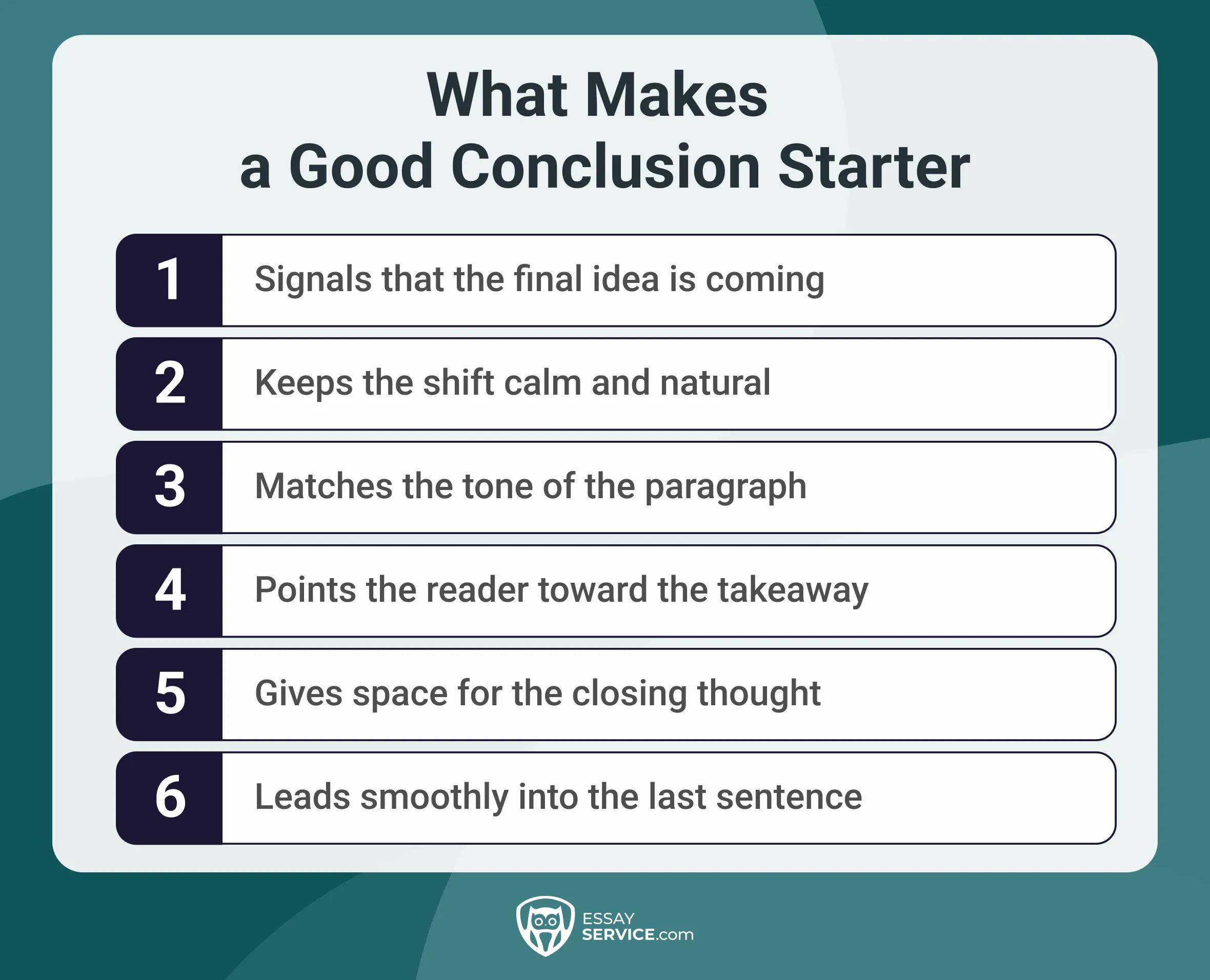
- A good starter signals that the final idea is coming.
- The wording feels calm, so the shift into the ending doesn't feel forced.
- The tone matches the rest of the paragraph.
- The phrase points the reader toward the main takeaway.
- The starter creates enough space for the final thought to land.
- The line guides the reader naturally into the last sentence.
If you’re writing a persuasive essay, learn how to write a conclusion for an argumentative essay that leaves the audience with a strong final impression.
List of effective conclusion starters
Here are some conclusion sentence starters for different types of writing. Find what best suits your paper, and try not to just use the first one that sounds smart.
Conclusion Sentence Starters for Essays
These work well for standard academic essays, striking a balance between formal and readable.
- Taking everything into account,
- Looking at the evidence as a whole,
- When these points are weighed together,
- Drawing this together,
- Considering the argument in full,
- Pulling these threads together,
- Reflecting on the discussion above,
- With all this in mind,
- Bringing these ideas to a close,
- Viewed together, these points suggest
- This analysis points to
- Considered together, the evidence indicates
- Stepping back from the details,
- What emerges from this discussion is
- This discussion makes clear that
Conclusion sentence starters for research papers
Research writing calls for phrases that emphasize findings and data-driven conclusions.
- The findings of this study indicate
- Based on the data presented,
- This research demonstrates
- The results collectively suggest
- This study's findings point toward
- The evidence gathered here supports
- These results contribute to understanding
- This investigation reveals
- The analysis conducted here shows
- Collectively, the data support
- This study's outcomes confirm
- The findings presented in this paper suggest
- This body of research indicates
- The results of this analysis point to
- This paper's findings underscore
Informal conclusion sentence starters
These suit blog posts, personal writing, or lower-stakes assignments where a conversational tone works.
- So, what does all this mean?
- Here's the bottom line:
- At the end of the day,
- Long story short,
- Put simply,
- The takeaway here is
- If there's one thing to remember,
- Bottom line:
- When it comes down to it,
- All things considered,
- Honestly, what matters most is
- The short version:
- In the end,
- Wrapping this up,
- If nothing else,
One-word conclusion starter ideas
Short, punchy transitions that work well mid-paragraph or in tighter writing.
- Ultimately,
- Overall,
- Therefore,
- Thus,
- Consequently,
- Accordingly,
- Finally,
- Hence,
- Clearly,
- Undoubtedly,
- Essentially,
- Fundamentally,
- Evidently,
- Notably,
- Altogether,
Longer concluding sentence starters
These give the ending more room to breathe, useful for complex arguments that need a fuller transition.
- Having examined the evidence from multiple angles,
- After weighing the strengths and limitations of each argument,
- Taking into account both the benefits and drawbacks discussed,
- Now that the key arguments have been laid out,
- Given the range of perspectives explored throughout this paper,
- Once all the supporting evidence is considered together,
- Having traced this argument through its various stages,
- When the full scope of this discussion is considered,
- After exploring the various dimensions of this issue,
- Taking a broader view of everything discussed so far,
- Now that the central claims have been thoroughly examined,
- Considering the full range of evidence presented in this paper,
- Having addressed the counterarguments raised earlier,
- After weighing each piece of evidence in turn,
- Once the implications of these findings are fully considered,
Evidence-based conclusion paragraph starters
These explicitly tie the ending back to data, research, or cited sources, which is useful for argumentative or research-heavy writing.
- The evidence consistently points to
- Supported by the data outlined above,
- As the cited research demonstrates,
- Based on the sources examined throughout this paper,
- The cumulative evidence suggests
- As multiple studies referenced here confirm,
- Given the weight of evidence presented,
- The data collected throughout this study supports
- As demonstrated by the sources cited,
- The research reviewed here consistently shows
- Grounded in the evidence discussed,
- As the statistics presented earlier indicate,
- Supported by the findings detailed above,
- The body of evidence reviewed points to
- As the case studies discussed illustrate,
Good conclusion sentence starters
A flexible, general-purpose set that works across most academic writing contexts.
- In light of the points discussed,
- As this paper has shown,
- Building on the ideas presented,
- Given the analysis above,
- This exploration has shown
- As outlined throughout this paper,
- The discussion above illustrates
- This paper has argued
- As this analysis reveals,
- Taken as a whole, this paper demonstrates
- This examination has revealed
- As the preceding sections have shown,
- This paper's central argument is that
- Synthesizing the points raised,
- As demonstrated throughout this discussion.
After choosing from research paper topics, use effective conclusions starters to end your paper with confidence.


Can’t Keep Up With Tasks?
Ask for support from one of EssayService’s professionals and hand them your papers.
Conclusion starter examples PDF
For a more detailed list, see our free printable conclusion sentence starters PDF:

Conclusion starter examples
It's always better to see a starter in sentence form so you can get a better idea if it's what you want to use in your essay. Here are 8 starters for each essay type. There are also 4 weak and strong starters.
Argumentative essay
- Taking everything into account, the evidence makes clear that a four-day school week improves student focus without sacrificing academic outcomes.
- Given the analysis above, stricter regulation of algorithmic content moderation is no longer optional if platforms want to curb the spread of misinformation.
Research paper
- The findings of this study indicate that sleep deprivation measurably impairs working memory in adolescents, even after accounting for caffeine intake.
- Based on the data presented, remote work arrangements are associated with higher reported job satisfaction, though the effect weakens significantly after 18 months.
Literary analysis
- As this analysis reveals, Gatsby's obsession with the past isn't nostalgia but a refusal to accept that certain versions of a person no longer exist.
- Taken together, the evidence indicates that Lady Macbeth's unraveling mirrors the play's broader argument that ambition consumes its own foundation.
Personal essay
- In the end, that summer taught me that asking for help isn't a failure of independence, it's a different kind of strength.
- If there's one thing to remember, it's that the risk I almost didn't take ended up defining the next four years of my life.
Weak vs. strong: the same conclusion, two ways
- Weak: As shown, social media plays a significant role in teenagers' lives. Whether it be their mental health or self-image, it is something we need to become more aware of.
- Strong: These results indicate that social media can negatively affect a teen’s mental health. More specifically, it can be attributed to certain aspects of social media that companies can change at any moment. Such as having the likes out in the open.
What changed: The weaker conclusion merely restated what your essay was about. By saying that it affects their mental health, it's just repeating what you already said in your thesis statement. The stronger conclusion tells the reader what your essay tried to prove and gives them an idea to take away from your essay.
How to use conclusion starters
These sentence starters let your reader know your paragraph is about to end. Here are some things that teach you how to start a conclusion effectively:
- Use your sentence starter at the beginning of your conclusion. This will allow the sentence to have your final thought and continue on.
- Have your last sentence relate to your thesis and what you talked about in your essay. Don't make your last sentence something brand new.
- Don't use the same sentence starter each time.
- Depending on your writing style, use these sentence starters. If your essay is formal, then you want your sentence starters to be more formal.
- Remember, your sentence starter is only part of the sentence; you still need to end your sentence with your final thought.
- If you can make your sentence without using one of these, don't use them.
- Do not give facts after using a conclusion sentence starter. You should be stating what you already wrote about in your essay.
Check out additional ways to end an essay with examples of different types of academic writing.
Mistakes to avoid
Even if you have a great starter, it can be ruined by the sentence that comes after it. Here are some examples.
- Restating your thesis statement: Using a starter and following it up with your thesis statement from your intro will not benefit you at all. Your conclusion should wrap up what you stated in your intro, but give it more meaning.
- Two starters: Using "In conclusion" and "To sum up" in your starter will seem redundant. Choose one starter and use that.
- Evidence starter without evidence: If you start off your last paragraph with "The data has proven that," and you didn't use any data in your paper, it will confuse your reader.
- Starter for formal writing in informal writing: If you were writing an informal blog post, starting your conclusion with "Based on the analysis above," would be inappropriate.
- Starter only: Just because you used a good starter doesn't mean that it ends your paper. Make sure your sentence that follows gives information.
Don’t Risk Your Academic Record
Skip the AI help and ask a human professional for authentic support.
Final Thoughts
Conclusion sentence starters make it easier to guide the reader into your last idea with clarity. The right phrase sets the rhythm, and the sentence that follows gives the thought its weight. Once you find a tone that fits your writing, the entire final paragraph becomes easier to shape.
Frequently Asked Questions
Should you use "In conclusion" in an essay?
How many sentences should a conclusion be?
What's the difference between a conclusion starter and a transition word?
What is a good conclusion starter sentence?
How to start a conclusion without saying "In conclusion"?
How to use conclusion sentence starters?
Why are conclusion sentence starters important?

Essie isn’t just an educator with a Bachelor’s in English: she’s passionate about writing. She uses her experience in grading papers to write comprehensive guides for our blog.
New posts to your inbox
Your submission has been received!