
An APA research paper outline lists the sections of your paper. You create it before writing full sentences. For APA 7, a research paper typically includes a title page, abstract, introduction, method, results, discussion, and references. If your paper is for school, you may not need an abstract, but always ask your teacher. This shows what an outline is used for and how to create one. We will provide an example you can modify that follows APA 7.
What is an APA research paper outline?
What your APA style paper outline should contain is what your paper will consist of. Each section will outline what it will cover. You will use APA 7 format, but instead of full paragraphs, you will provide brief information.
You want to know what your paper will cover before you write it. That's why you make an outline. Purdue OWL recommends deciding on your purpose, audience and thesis statement. Then you can list out what you want your paper to include. According to South Central College, your outline will help guide you through your paper. Have most of your research completed before making your outline.
When writing longer papers, you will need your outline more. Because you will have more information to work with, you may end up repeating yourself. An outline will help you see what you may be missing and whether your paper flows correctly. Your outline will not always be correct when writing your paper.


Need an APA outline built for you?
Our writers can plan your paper and follow APA 7 format from the title page to the references.
Why structure matters in APA papers
Headings allow your reader to navigate your paper with ease. If all papers were written in this format, your reader would know where to look if they wanted to read the method section. Mt. SAC’s Writing Center states that headings help organize your paper. Which they definitely are.
Another helpful tip about outlines is that you can see if you're missing anything. For example, you may have “Results: sleep data” and not know what to put under it. You can see this in a 10-line outline. It is harder when you are missing something from your paper that is 10 pages long. TMCC library also mentions that using an outline can help you avoid missing information in your paper.
Outline vs. table of contents
An outline plans what you will write, while a table of contents lists what you already wrote. The outline is a working tool for you, made before drafting. A table of contents is a finished page for the reader, with page numbers. Most course papers in APA 7 do not need one, so check your assignment.
APA paper outline format rules
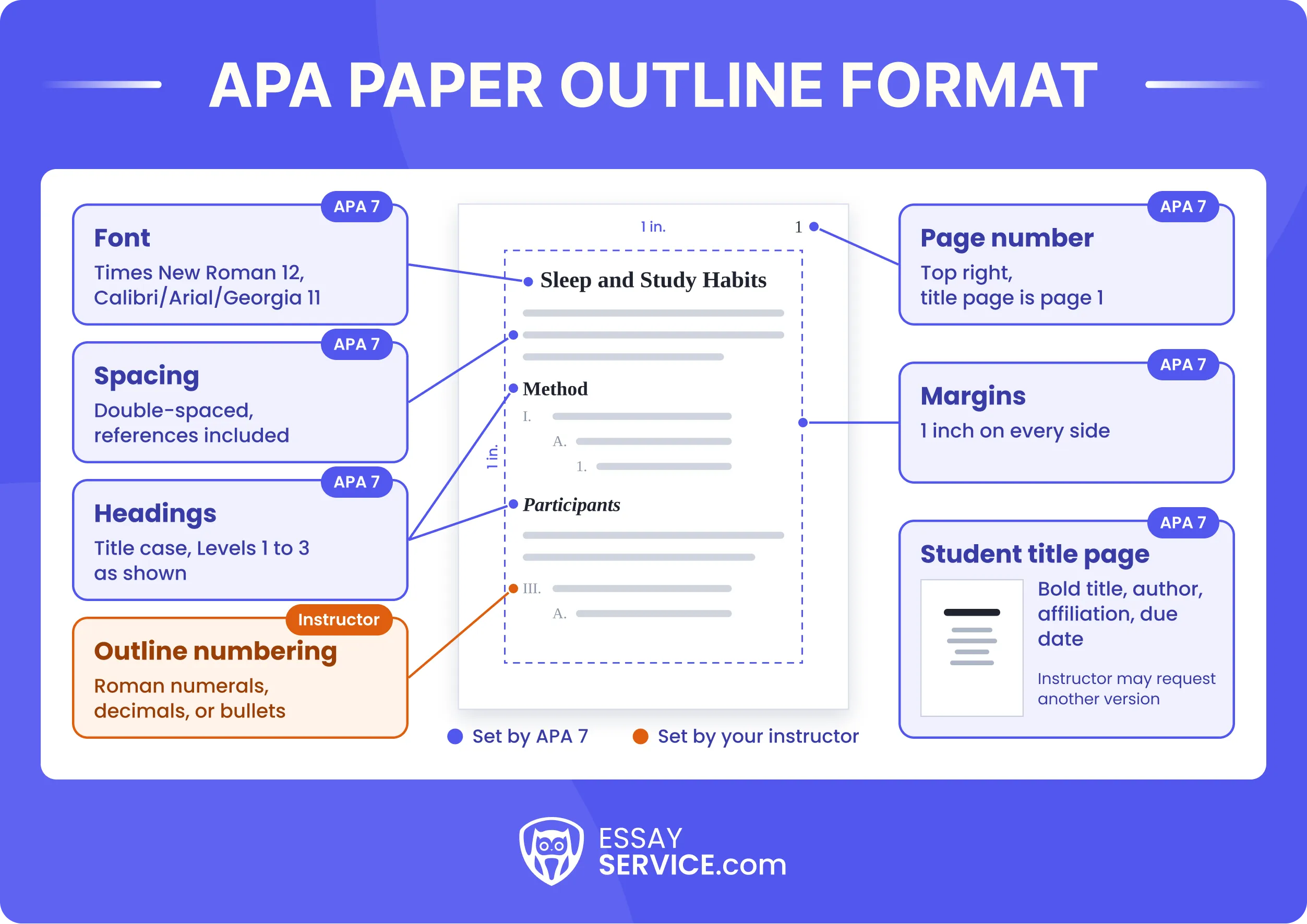
An APA outline format follows the same rules as an APA 7 paper, and your instructor can override most of them. APA 7 sets the basics for pages (font choices, spacing, margins, page numbers, headings). Your instructor usually decides the rest, such as whether to use Roman numerals or whether an outline is handed in at all. Always check the assignment brief first.
Outline levels and numbering
The proper way to go about this would be to follow the order of Roman numeral, uppercase letter, number, lowercase letter, and finally use parentheses around your number. (I, A, 1, a, (1)).
These levels are different from the 5 heading levels used in APA. The 5-level headings will appear in your final paper, using indentation and fonts instead of Roman numerals (Saint Mary's College). Some people may use Roman numerals for first-level headings and uppercase letters for second-level headings, but this isn't necessary.
This is not the same thing as APA headings. Those belong to the finished paper and work through alignment and font style, not numbers or letters.
Types of APA outline formats
APA will dictate how your paper will look, but there are different types of outlines. You can use one that your teacher tells you to or one you like. Here are three types of outlines that will work for your APA paper outline. Alphanumeric, Full sentence and Decimal. All of these outlines are for the same fictional research.
Alphanumeric outline
This method of outlining will use Roman numerals, uppercase letters, numbers and lowercase letters. Each one will have a short phrase. This is the most commonly used method. You can get this done quickly and can easily skim over your points. Great for when you are first brainstorming and want to rearrange things. Make sure to indent every time you go down a level, and keep all similar points together.
Phone Use and Study Focus in First-Year Students
I. Introduction
A. Phones during study sessions
B. Research question
II. Method
A. Participants
1. First-year students at one university
2. Recruited through course forums
B. Focus measure
III. Results
IV. Discussion
V. References
Full-Sentence outline
Like an alphanumeric outline except all your points will be full sentences. This is usually what people use when writing an essay. It will take more time but will include more information, so it's helpful to outline early. Purdue shows that if you have quotes in your full sentence outline, they must be cited using APA in-text citations, and you will have to put them on a separate reference page.
I. Phone checks during study time lower focus in first-year students.
A. Students look at their phones often while reading.
1. A one-week diary will count phone checks per hour.
B. Frequent checks may break up the work into short bursts.
II. A short survey will test whether more checks mean lower focus.
Decimal outline
Decimal Outline uses numbers instead of letters. You will have 1.0, 1.1 and 1.1.1, etc. Like the alphanumeric, just more numbers and decimals. It's good for long papers that may have many subpoints because you know where each line is on the paper.
1.0 Introduction
1.1 Phones during study sessions
1.2 Research question
2.0 Method
2.1 Participants
2.1.1 First-year students
2.1.2 Recruitment through course forums
2.2 Focus measure
3.0 Results
APA research paper outline template
Here is a template you can copy and fill in your own information in the [brackets]. Any information that your assignment may not require, feel free to remove. This will follow an APA-style paper outline for the 7th edition. Your paper should be formatted as follows. Title page, Abstract, Introduction (No heading needed since your title does this), Method, Results, Discussion and References.
Empirical research paper
I. Title page
A. Title: [bold, title case]
B. Author, affiliation, course, instructor, due date: [...]
II. Abstract (only if required)
A. Question: [one sentence]
B. Method and main result: [one or two sentences]
C. Meaning: [one sentence]
D. Keywords: [three to five]
III. Introduction (no heading in the paper)
A. Topic and why it matters: [...]
B. What earlier research found: [two or three sources]
C. Gap: [what is missing]
D. Research question and hypothesis: [...]
IV. Method
A. Participants: [who, how many, how recruited]
B. Measures: [...]
C. Procedure: [...]
D. Analysis: [...]
V. Results
A. [Finding 1]
B. [Finding 2]
VI. Discussion
A. Main findings: [plain words]
B. Link to earlier research: [...]
C. Limits: [...]
D. Next steps: [...]
VII. References
A. [Alphabetical, hanging indent]
Not sure what goes under “VI. Discussion”? Our guide to the discussion section of a research paper shows how to turn those notes into full paragraphs.
Literature-based student paper
Papers that don’t report original research can skip method, results, and discussion, so the outline gets shorter.
I. Title page: [...]
II. Introduction: [topic, why it matters, thesis]
III. Body
A. Theme 1: [point + sources]
B. Theme 2: [point + sources]
C. Theme 3: [point + sources]
IV. Conclusion: [thesis in new words, gap, what it means]
V. References: [alphabetical, hanging indent]
APA research paper outline example
A strong APA paper outline example maps each APA section to a Roman numeral and fills each with short, specific notes. The study below is hypothetical, with invented numbers, and uses the alphanumeric format.
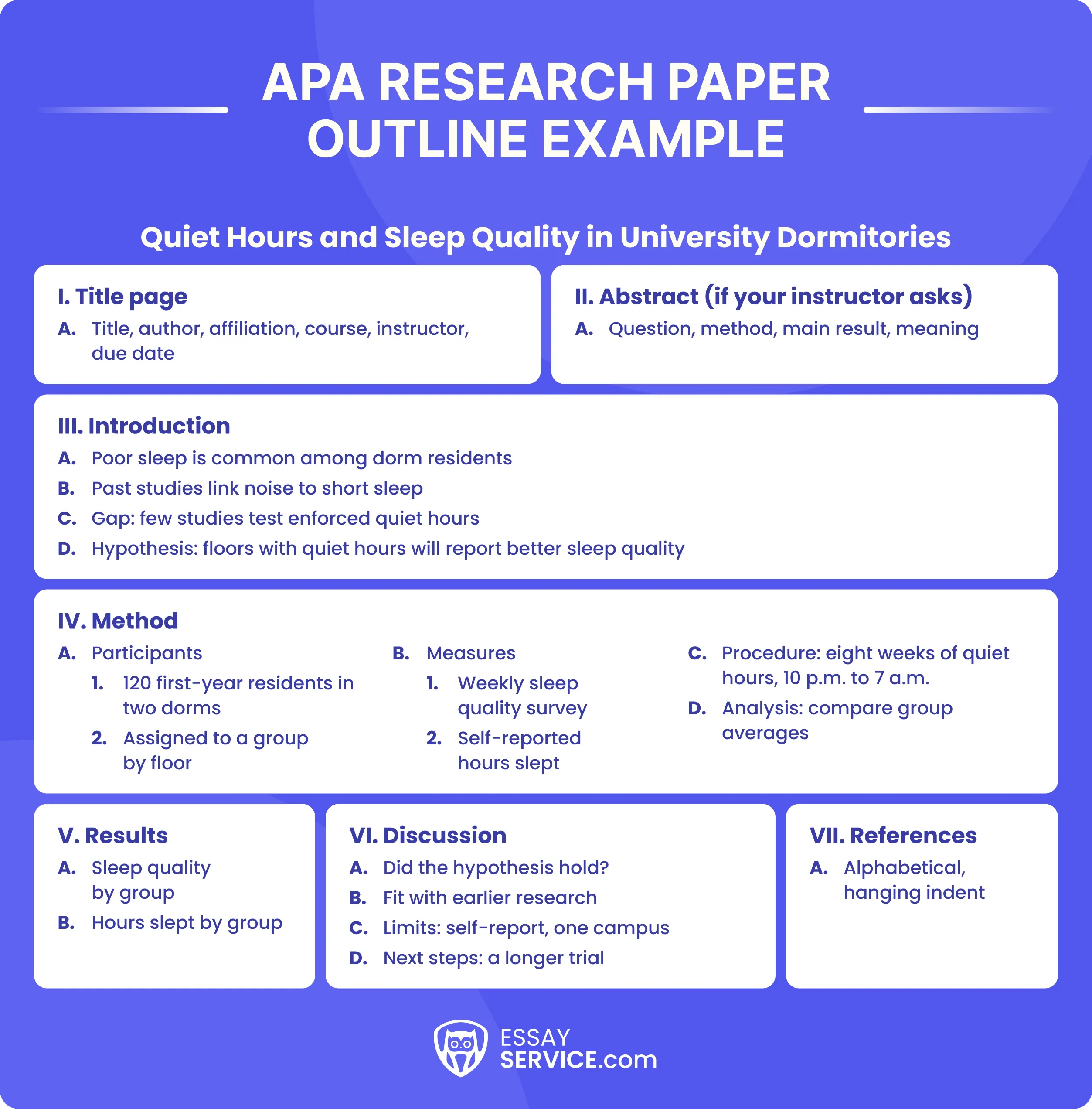
Quiet Hours and Sleep Quality in University Dormitories
I. Title page
A. Title, author, affiliation, course, instructor, due date
II. Abstract (if your instructor asks)
A. Question, method, main result, meaning
III. Introduction
A. Poor sleep is common among dorm residents
B. Past studies link noise to short sleep
C. Gap: few studies test enforced quiet hours
D. Hypothesis: floors with quiet hours will report better sleep quality
IV. Method
A. Participants
1. 120 first-year residents in two dorms
2. Assigned to a group by floor
B. Measures
1. Weekly sleep quality survey
2. Self-reported hours slept
C. Procedure: eight weeks of quiet hours, 10 p.m. to 7 a.m.
D. Analysis: compare group averages
V. Results
A. Sleep quality by group
B. Hours slept by group
VI. Discussion
A. Did the hypothesis hold?
B. Fit with earlier research
C. Limits: self-report, one campus
D. Next steps: a longer trial
VII. References
A. Alphabetical, hanging indent
Why it's helpful: Because each Roman numeral represents an APA section. So there is nothing to worry about missing. Your hypothesis will be your last sentence in your intro. Then, in your discussion, you answer that question so it all comes full circle. You can turn those points into a paragraph. Limitations can be thought of early on.
How to create an APA research paper outline in 7 steps
To create an APA research paper outline, check your assignment, set your thesis, pick a format, list the sections, add evidence, check the logic, and apply APA formatting. Here is the short version of how to write an APA outline:
- Review the assignment requirements.
- Write your research question and thesis.
- Choose an outline format.
- List the main sections of your paper.
- Add subpoints and evidence.
- Check hierarchy and logic.
- Apply APA formatting.
Step 1: Review the assignment requirements
First, read your instructions carefully. You should know if the outline needs to be turned in or just used by you. Do you need an abstract? How many words do you need? How many sources? Font size and any other specifications that your professor tells you to use. Follow your professor's guidelines and use APA for everything else. Normally, your paper will have a title page, then your abstract (if there is one), your paper and works cited. Write this information on your outline document so you can reference it when writing your paper.
Step 2: Write your research question and thesis
First, have a research question and a working thesis. Determine your purpose, audience and thesis before you begin. Keep both short. Such as: What will happen if we have enforced quiet hours on our floor? A working thesis would be. Those who live on a floor with enforced quiet hours will sleep better than those on a floor without them. This will also be your hypothesis if you are writing an empirical paper.
Step 3: Choose an outline format
Choose the format that best fits your needs. Most students will use alphanumeric because they can easily type keywords. If you want to go into more detail, use full sentences and if you have many details, use the decimal method. Use alphanumeric if your teacher does not specify. We have a section about the different types of APA outline formats. Make sure to use only one format throughout your outline.
Step 4: List the main sections of your paper
List all of your main sections that go in an APA paper in order. Each should have a Roman numeral. If your paper is an empirical paper, you will need a title page, abstract (if needed), introduction, method, results, discussion and references. If it's a paper about a topic, you would have a title page, introduction, theme(s) for your body, conclusion and references. Keep the points under them blank. South Central College calls it an outline. It's kind of like a roadmap for your paper. You want to complete this after you've researched most of your information.
Step 5: Add subpoints and evidence
Add at least 2-3 subpoints under each point. List what your evidence is under each subpoint. Have your claim, then where your information came from. It can be something like (Last name, year). Just how you would put it on your Works Cited page. You will have more time when writing because you will know where to get your info from. Try to keep your notes brief. If your subpoint is as long as a paragraph, break it up into two subpoints.
Step 6: Check hierarchy and logic
Read the outline from top to bottom and check that every point supports the one above it. Does each subpoint belong under its heading? Does the thesis from Step 2 appear in the introduction and get answered in the discussion? A lone “A” with no “B” under it usually means the point belongs to its parent. And relax a little. Plans change while you write, and that’s normal.
Step 7: Apply APA formatting
When you turn it in, format it as an APA paper. This will include setting your margins to 1 inch and double-spacing. Use an approved font such as 12-pt Times New Roman or 11-pt Calibri. And have your page number in the top-right corner (APA). You should ask your instructor if they want a title page. If it's only for you, then you can leave this step out; just keep it neat. See our chart above for more formatting.
If the deadline is close, you can also buy research paper help and share your outline with the writer.
Common APA outline mistakes
The five most common APA outline mistakes are mixing up levels, uneven sections, lone subpoints, non-parallel wording, and mixed formats. Each one is easy to fix.
Ready to hand off the full paper?
Share your outline and instructions, and our team will write the paper to match.
The bottom line
An APA research paper outline is a brief plan that follows the APA 7 section order and is structured in a few clear steps. Check the assignment, set your thesis, pick one format, list the sections, add evidence, test the logic, and format it if you hand it in. Use our templates and samples as a starting point, adjust them to your instructor’s rules, and the drafting will go more smoothly.
If you’d like expert help turning the outline into a finished paper, see our APA paper writing service.
Frequently Asked Questions
What sections go into an APA research paper outline?
Does APA have a required outline format?
Does an APA research paper outline need a title page?

Jennifer is a student currently pursuing a Journalism major. She oversees the EssayService blog team and uses her journalism skills to ensure all blog posts are accurate, trustworthy, and engaging.


New posts to your inbox
Your submission has been received!