Essay formatting is the system that decides how an essay is arranged and how the author should handle the sources. Besides the font and page numbers (which are also part of formatting, obviously), template type, cover page, spacing, headings, in-text citation, and the source list are subject to the formatting rules.
This article will highlight how to format an essay so you know how your paper should be laid out, and what rules you must follow when you adhere to different citation guides, as well as any common rules across all styles.
What Is an Essay Format?
An essay format is the set of rules that define the visible order and citation system for an academic paper. They determine the placement of each component, how to style the pages, and how to credit information taken from other sources.
The goal of essay formatting is not to make the essay visually attractive but to create an essay that is easy to read, one that provides a consistent flow of information throughout. This way, the reader can easily follow any argument without guessing how each section connects to the main point.
Core pillars of essay format include:
- Structure: How the essay organizes its components (introduction, body paragraphs, conclusion)
- Layout: margins, spacing, font, page numbers, and headings.
- Citation styles: APA, MLA, Chicago, Harvard, and other required systems.


Write With Confidence
Work with writers who can handle research, structure, citations, and editing.
How to Format an Essay: General Rules
A good format starts with the basic setup shared by most academic essays. Citation styles have their own details, of course, but many essay formatting requirements stay fairly consistent across subjects, classes, and assignment types.
- Check the instructions: Read the assignment requirements first, since your instructor’s requirements override any general rule.
- Choose the Font: Go for a readable academic font, usually 12-point Times New Roman, Arial, or another approved option.
- Set the Margins: Use one-inch margins, unless your assignment asks for a different page setup.
- Apply Spacing: Double spacing for the main text in most college and school essays.
- Add Page Numbers: Place page numbers in the position required by the citation style.
- Pick a Title: Give the essay a clear title that reflects the actual topic, not a broad label.
- Write an Introduction: The opening paragraph should lead into a focused thesis statement.
- Organize Body Paragraphs: Build each paragraph around a topic sentence, evidence, and your own explanation.
- Cite Borrowed Material: Give credit for every quote, paraphrase, borrowed fact, and outside idea.
- Finish with Sources: Add a reference page, Works Cited page, or bibliography according to the required style.
Standard Essay Format Structure
A standard essay format structure usually has three parts: introduction, body paragraphs, and conclusion. It should help the reader see what the paper argues, how each paragraph supports that argument, and why the final point follows logically. A useful essay format sample shows what each part should actually do. Here's the general essay layout:
- Introduction
- Give the reader enough context to understand the topic.
- Define key terms that may affect the argument.
- Add a clear thesis statement near the end of the paragraph.
- Mention the main direction of the paper without listing every detail.
- Body Paragraphs
- Start each paragraph with one clear topic sentence.
- Use one paragraph for one main point
- Add evidence after the topic sentence, then explain how it supports the thesis.
- Connect each paragraph to the previous one and the thesis
- Conclusion
- Refresh the thesis with new wording.
- Summarize the main line of reasoning in a few direct sentences.
- Show what the essay has explained.
- Avoid new evidence
- Do not end with a huge statement unless the essay already supports it.
- Close with a sentence that feels final and specific to the topic.
A few technical tricks can make the structure easier to build:
- Create a terminology list before drafting, especially if the essay uses field-specific words.
- Write a one-sentence job description for each paragraph before expanding it.
- Make a “claim-evidence-explanation” table to check paragraph balance.
- Highlight thesis keywords, then repeat those ideas across topic sentences in varied wording.
- Put all examples under the paragraph where they belong before drafting full sentences.
- Use bracket notes like [define term], [add source], or [explain link] during the first draft.
- Read only the topic sentences in order to test the argument’s flow.
- Move weak background details into the introduction or remove them completely.
- Cut any paragraph that explains the topic but does not support the thesis.
Other Essay Structures
Some essays need a tighter structure than the standard introduction, body, and conclusion pattern. Research papers may use IMRaD, argumentative essays may follow Toulmin or Rogerian logic, and compare and contrast essays may use block or point-by-point organization. These different essay formats help keep order, evidence, and explanation under control.
IMRaD Structure
IMRaD means Introduction, Methods, Results, and Discussion. This structure appears mostly in research-based essays, lab reports, and papers built around findings. It separates the research question, process, results, and interpretation, so the reader does not have to sort through mixed details.
Typical IMRaD layout:
- Introduction: presents the topic, background, research problem, and question.
- Methods: explains materials, participants, sources, procedure, or analysis steps.
- Results: reports findings directly, often with tables, figures, or grouped data.
- Discussion: explains what the findings mean and how they answer the question.
Argumentative Essay Structures
Argumentative essays need a reasoning system because a claim without proof will not carry the paper. Usually, this means choosing one of two models: Toulmin or Rogerian.
The Toulmin model breaks an argument into smaller parts, so the writer can test the claim, evidence, and logic separately. It works well for direct academic arguments where reasoning needs close attention.
- Claim: states the main position.
- Grounds: gives facts, examples, research, or expert views.
- Warrant: explains why the grounds support the claim.
- Backing: adds support for the warrant.
- Qualifier: limits the claim so it stays realistic.
- Rebuttal: answers a strong opposing point.
The Rogerian model fits sensitive topics because it starts with the opposing view before the writer’s position appears. The essay still argues a point, just with more careful framing.
- Shared problem: introduces the issue neutrally.
- Opposing view: explains the other side fairly.
- Valid concerns: notes points that deserve attention.
- Writer’s position: presents the main argument.
- Common ground: shows possible agreement.
- Solution: offers a practical final position.
Compare and Contrast Essay Structures
Compare and contrast essays need a set pattern because two subjects can become hard to track.
The block method discusses one subject fully, then the second subject.
- Introduction: names both subjects and comparison purpose.
- Subject A: covers all major points.
- Subject B: covers the same points.
- Conclusion: explains the comparison result.
The point-by-point method compares both subjects inside each category.
- Introduction: states the comparison claim.
- Point 1: compares both subjects through one feature.
- Point 2: repeats the pattern with another feature.
- Point 3: adds another shared category.
- Conclusion: sums up the main finding.
Essay Formats: APA, MLA, and Chicago
There are three major essay formatting styles: APA, MLA, Chicago. While the overall layout of each format controls the paper (how your page is set up, how to cite sources, how to put your list of sources at the end), what makes each style unique is that they are tied to very different fields of study and citation rules.
APA Format Essay
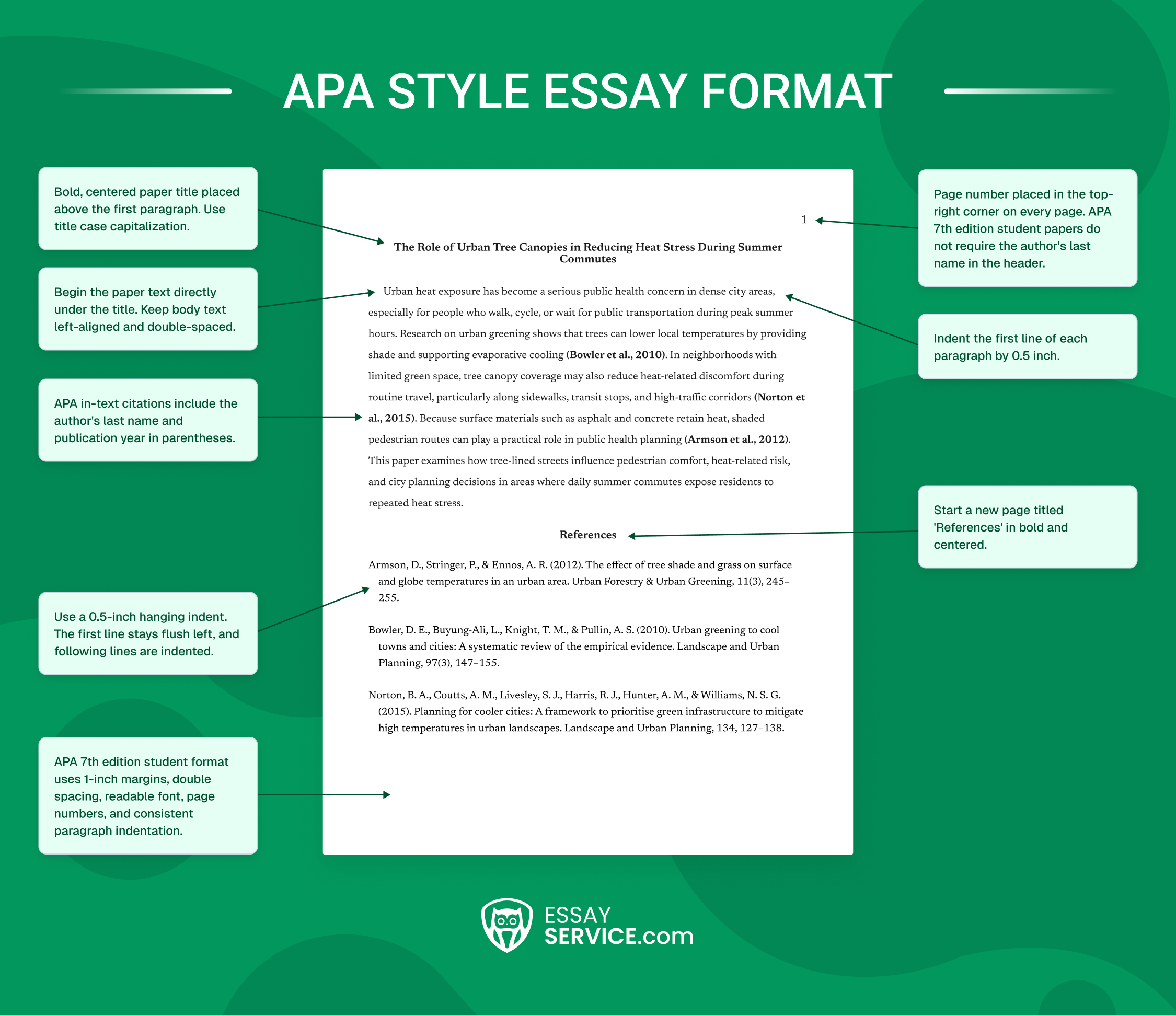
The APA format is used mostly for essays related to psychology, education, nursing, business, and social sciences. The 7th Edition guidelines use the author/date citation system; therefore, the publication date is an important detail for readers to determine how recent the research is. Here are some of the main characteristics of any APA essay format example:
- Use a readable font, such as 12-point Times New Roman, 11-point Arial, or 11-point Calibri.
- Keep one-inch margins on every side of the page.
- Double-space the full paper, including the title page and References page.
- Add the page number in the top-right corner.
- Include a title page with the essay title, student name, institution, course, instructor, and due date.
- Center and bold the title at the start of the main text.
- Use headings when the essay has clear sections, especially in longer papers.
- Cite sources with the author’s last name and year, such as (Miller, 2023).
- Add page numbers for direct quotations.
- Place the References page at the end.
- Alphabetize reference entries by the author’s last name.
- Use a hanging indent for every reference entry.
MLA Format Essay
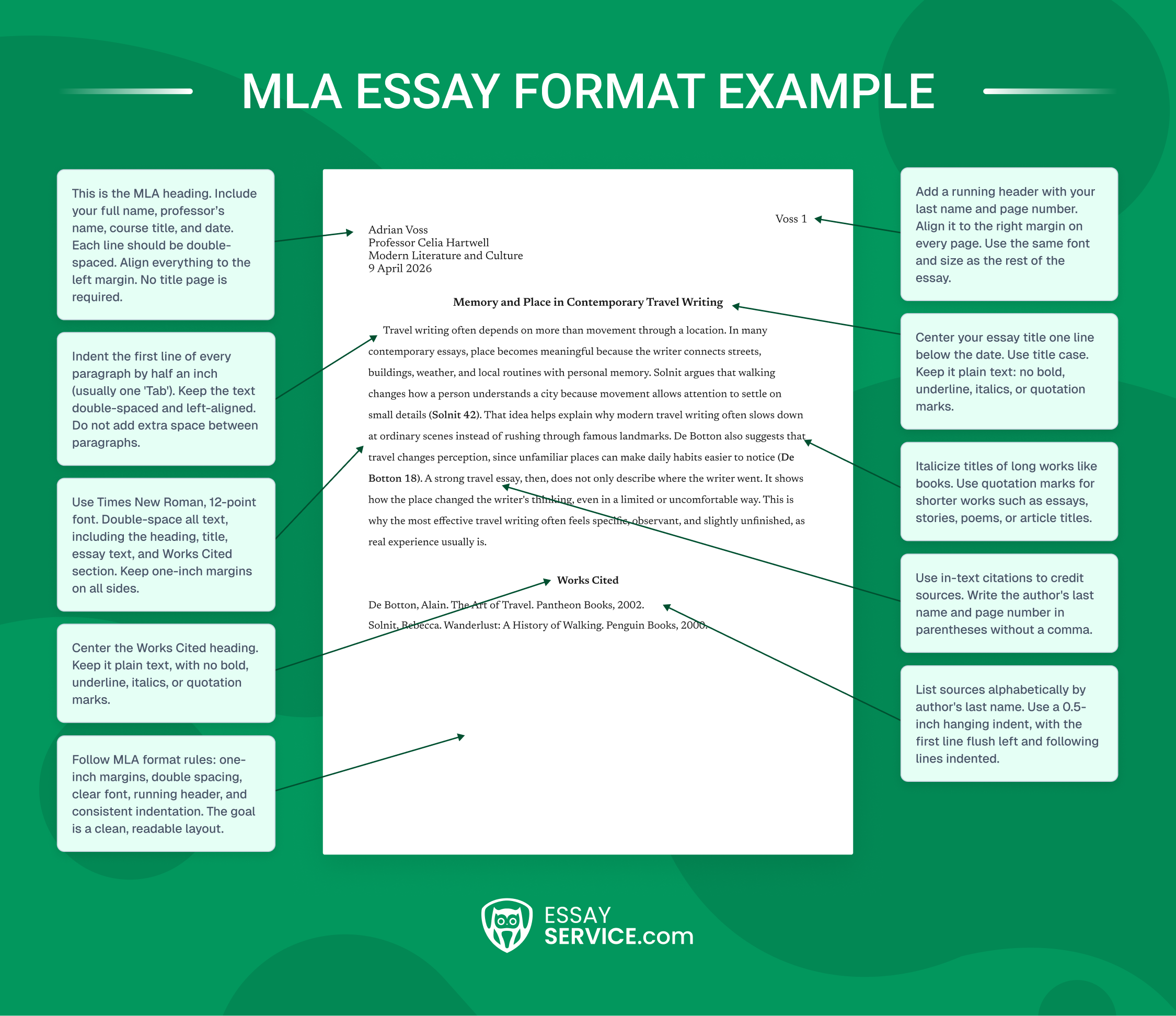
In literature, composition, language and cultural studies, and the humanities (and related courses, too), the 9th Edition of the MLA style is the most used guide. It lists authors and pagination as the most important details, because students often cite passages, poems, plays, speeches... MLA essay format example does not require a separate title page for a standard student essay. For example, a case study format in one of the abovementioned fields would follow these rules:
- Use a readable font, with 12-point Times New Roman as the usual choice.
- Set one-inch margins on all sides.
- Double-space the full essay, including the Works Cited page.
- Put your last name and page number in the top-right header.
- Do not add a title page unless the instructor requires one.
- Place your name, instructor’s name, course, and date on the first page, aligned left.
- Center the essay title above the opening paragraph.
- Avoid bold, underline, or italics in your own title unless a source title requires it.
- Indent the first line of each paragraph.
- Cite sources with the author’s last name and page number, such as (Miller 24).
- Use block quote formatting for long quotations.
- Add a Works Cited page at the end.
- Alphabetize entries by the author’s last name.
- Use hanging indents for source entries.
Chicago Format Essay
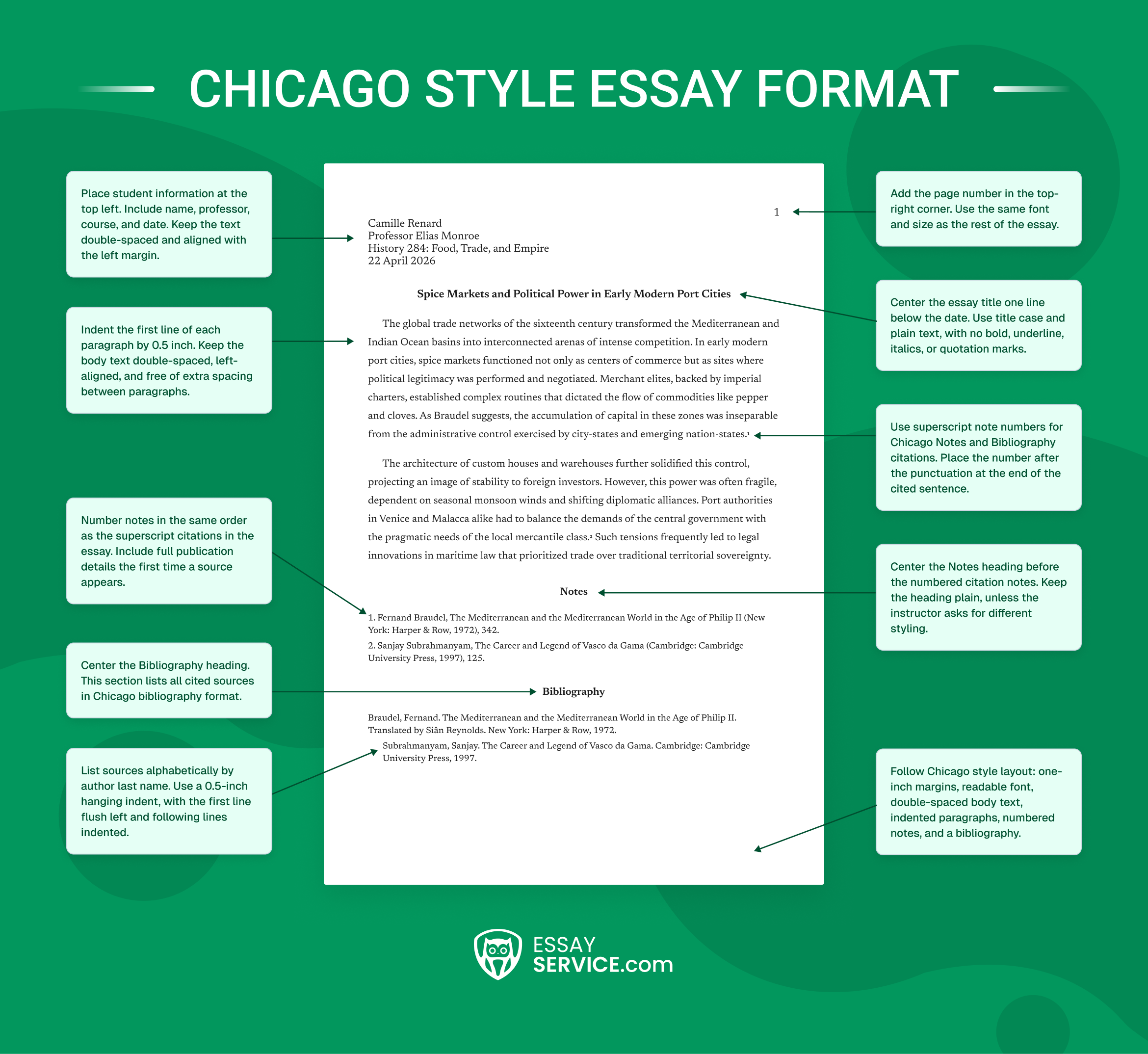
The Chicago Manual of Style is most commonly used in the fields of history, philosophy, religion, art history, and upper-level humanities classes. Instructors often assign the 17th Edition for papers that use the Notes and Bibliography citation format. Chicago is more formal-looking through its use of footnotes or endnotes. A properly formatted Chicago essay format example will allow readers to read the main text while pulling detailed citation information from the notes. Formatting rules include:
- Use a readable font, usually 12-point Times New Roman.
- Set one-inch margins unless the class instructions give another rule.
- Double-space the main text.
- Single-space footnotes, endnotes, and bibliography entries when required, with space between entries.
- Add page numbers in the header or footer according to the instructor’s preference.
- Use a title page for longer papers or when the assignment asks for one.
- Center the title and place student details lower on the title page.
- Indent the first line of each paragraph.
- Use footnotes or endnotes for citations in Notes and Bibliography style.
- Number notes consecutively across the paper.
- Place the superscript note number after the sentence or clause being cited.
- End with a Bibliography page.
- Alphabetize bibliography entries by the author’s last name.
- Use hanging indents for bibliography entries.
Other Essay Formats
APA, MLA, and Chicago handle a large part of academic writing, although they are not the only systems students may run into. Some courses, especially in technical, medical, and scientific fields, expect a more specialized essay writing format because the paper has to reflect how that discipline presents evidence, labels sources, and organizes research details.
Institute of Electrical and Electronics Engineers (IEEE)
IEEE format is used most often in engineering, computer science, information technology, electronics, robotics, and similar technical fields. Its most noticeable feature is the numbered citation system. Instead of using author-date or author-page citations, IEEE places source numbers in square brackets, such as [1], inside the text. The reference list then follows the same numbered order.
This format works well for technical writing because the citations stay short and do not interrupt formulas, figures, tables, or procedure-based explanations. IEEE papers also tend to rely on clear headings, numbered sections, labeled visuals, and consistent reference order, since the reader may need to move between data, diagrams, and source material without losing track of the point.
American Medical Association (AMA)
AMA format is common in medicine, public health, biomedical science, nursing research, and clinical writing. It also uses a numbered citation system, though citations usually appear as superscript numbers in the text. The reference list follows the order in which the sources first appear.
AMA can feel strict because medical writing depends heavily on precision. Source details need careful formatting, including author names, article titles, journal abbreviations, publication dates, volume numbers, issue numbers, and page ranges. In this style, small citation errors can make the paper look careless, especially when the topic involves recent studies, clinical evidence, or health-related recommendations.
Your Paper, Done Right
Get support with essays, research papers, and coursework when the deadline is approaching.
Which Essay Format Should I Use?
The right format usually comes from the course, the assignment type, and the field you are writing in. A college essay format for a literature paper will not usually match the format used for a lab report, medical review, or engineering analysis. The easiest way to choose is to connect the citation style to the subject area.
- APA: psychology, education, nursing, sociology, business, and social sciences.
- MLA: literature, composition, language, cultural studies, and general humanities.
- Chicago: history, philosophy, religion, art history, and advanced humanities.
- IEEE: engineering, computer science, electronics, technology, and data systems.
- AMA: medicine, public health, biomedical science, clinical research, and nursing research.
- Harvard: business, economics, social sciences, and some international university courses.
- Turabian: student research papers in history, theology, and humanities.
- Vancouver: medicine, health sciences, and scientific journal-style writing.
Remember, you can always pay to write essay on EssayService if formatting details become too much to handle.
Final Thoughts
Essay formatting is not only about margins and font size. It also controls structure, citations, headings, page numbers, and the final source section. APA, MLA, Chicago, IEEE, and AMA each serve different subjects, so the correct format depends on the assignment. Good formatting makes the paper easier to read, check, and grade without distracting from the argument.
Frequently Asked Questions
What Is the Format of an Essay?
How to Choose an Essay Format?
How to Do APA Format for Essay?
How to Do MLA Format for Essay?
How to Do Chicago Format for Essay?

- American Psychological Association. (2019, August). Paper Format. https://apastyle.apa.org/style-grammar-guidelines/paper-format
- Writing an Essay in MLA Format. (n.d.). Microsoft 365. https://www.microsoft.com/en-us/microsoft-365-life-hacks/writing/writing-an-essay-in-mla-format
- Purdue Writing Lab. (2019). APA General Format. Purdue Writing Lab; Purdue University. https://owl.purdue.edu/owl/research_and_citation/apa_style/apa_formatting_and_style_guide/general_format.html



New posts to your inbox
Your submission has been received!