
Key takeaways
- Test the missing step. Complete this sentence: “The cause produced the effect by ___.” If the blank stays empty, you have a claim to investigate, not an explanation.
- Test the order. Did the proposed cause occur before the outcome? Something that happened afterward cannot explain what started it.
- Test the alternative. In the missed-deadline example, would scheduling conflicts explain the delay better than unclear instructions? Compare explanations rather than choosing the most convenient one.
- Test the paragraph. Remove its “therefore.” If the connection disappears with the word, the paragraph needs reasoning, not another transition.
A cause and effect essay explains why something happened, what it led to, or both. It does more than say that one event came before another. It shows how the first one produced the second, step by step.
Take a student who hands in an assignment late. Blaming confusing instructions sounds like an answer, but it skips the hard part: how did confusion turn into a missed deadline? The essay lives in that gap. Below, you’ll see how to find the link, build the essay around it, and test it before you submit.
What is a cause and effect essay?
Imagine that the student misunderstood the requirements, began the wrong task, and had to redo the work. Now “unclear instructions caused a delay” has a process behind it. An essay could investigate that explanation by examining the instructions, the work completed, and the sequence of clarification and revision.
A cause and effect essay is an analytical essay that examines the reasons behind an outcome, the consequences of a cause, or a sequence connecting both. Its purpose is to explain a causal relationship through evidence and reasoning.
The essential elements are:
- Cause: An event, action, or condition that produces or contributes to a result; here, unclear instructions.
- Effect: The outcome being explained; here, the missed deadline.
- Mechanism: The connecting process, such as misunderstanding the task and redoing work.
- Evidence: Research, data, observations, or documented examples supporting that explanation.
- Transitions: Words and phrases that identify how the steps relate.
Distinguish causation from correlation. If students who attend more classes also earn higher grades, that association alone does not establish that attendance caused the difference. Examine instruction and feedback alongside study habits and prior preparation. A contributing cause need not explain everything, but it must explain something specific.
Cause and effect essay structure
Choose the body structure by asking what needs explaining: an outcome, a set of consequences, or a sequence. The same topic can support different essays, but your thesis must tell readers which one they are getting.
Introduction
Give readers enough background to understand the problem, then state the relationship your essay will explain. A clear opening is more useful than a dramatic hook that sends the discussion elsewhere.
Example thesis:
A prolonged closure of the town’s main bridge increases commuter travel time by diverting traffic onto longer routes and concentrating vehicles at fewer crossings.
This sample thesis names the cause, the outcome, and the mechanisms: detours and congestion. “The bridge closure has many effects” names only a topic. The stronger version also limits the paper; access to local businesses would require a different or broader thesis.
Rule of thumb: name the relationship, not just the subject.
Body paragraphs: start with causes or effects
Start where the assignment places the question.
- For a causes-focused essay, give each contributing factor its own paragraph: unclear instructions, scheduling conflicts, or technical problems.
- For an effects-focused essay, separate consequences: a road closure’s effects on travel time, bus routes, and access to businesses.
- For a chain essay, preserve the sequence: water leak, damaged flooring, repairs, classroom closure.
Build each paragraph around a causal point:
- Topic sentence: Identify the factor or consequence being examined.
- Evidence: Give readers something they can check.
- Explanation: Trace the process connecting that evidence to the outcome.
- Connection: Show how this point advances the thesis or leads to the next step.
In the leak example, skipping from water to classroom closure hides the reason the room becomes unavailable. The damaged flooring and repairs belong in the explanation, not merely in a list.
Rule of thumb: give each paragraph one connection to prove.
Body paragraphs: address the other side
An essay covering both causes and effects needs a recognizable turning point. In a light-pollution essay, the first part would explain why urban light pollution occurs; the second would examine its effects on nocturnal wildlife. Announce that shift rather than mixing origins and consequences in every paragraph.
A sample transition could read:
Having established the sources of artificial nighttime lighting, the essay now follows its consequences for wildlife movement and feeding.
Not every assignment requires both sides. A paper explaining missed deadlines can keep its attention on contributing factors. An effects-focused paper can establish the cause in the introduction without devoting half its body to origins.
Rule of thumb: follow the thesis’s question, not an automatic causes-then-effects formula.
Conclusion
Return to the relationship you have demonstrated and explain why it matters. For the hypothetical classroom closure, the conclusion could emphasize that the leak initiates a chain, while the repair work explains the room’s temporary unavailability. That distinction makes the sequence more useful than “the leak closed the classroom.”
Leave out new evidence and additional causes. If a new explanation seems essential here, it needs development in the body first.
Rule of thumb: finish the explanation you started.


Stuck on the missing step?
Our writers can help you trace how one cause leads to an effect and turn it into a clear essay.
Cause and effect essay outline
Here is a filled outline for a hypothetical missed-deadline essay. Its causes lead into intermediate consequences and then the final outcome, so the body does not repeat the same explanation under different labels.
Cause and Effect Essay Outline
- Introduction
- Introduce the missed assignment deadline.
- Establish the task and the time available to complete it.
- State a sample thesis: unclear instructions and scheduling conflicts contributed to the missed deadline by creating rework and reducing the time available for it.
- Body Paragraph: Cause 1
- Identify the unclear requirement the student misunderstood.
- Compare the assignment instructions with the initial work.
- Explain why the misunderstanding required revision rather than a minor correction.
- Connect that extra work to the deadline problem.
- Body Paragraph: Cause 2
- Identify a scheduling conflict in this imagined case.
- Compare the planned work period with the time actually available.
- Explain how the conflict limited the opportunity to redo the assignment.
- Body Paragraph: Effect 1
- Trace the time spent seeking clarification and redoing work.
- Show how that process follows from the misunderstood requirement.
- Use the sequence of drafts and clarification to support the explanation.
- Body Paragraph: Effect 2
- Explain how the revision work and reduced work time converged at the deadline.
- Distinguish their combined contribution from a claim that either factor alone explains everything.
- Support the final connection with the assignment timeline.
- Conclusion
- Restate the combined explanation without copying the thesis.
- Summarize how rework met limited time.
- Explain why identifying the process is more useful than simply blaming lateness on confusion.
Before drafting, reduce the argument to a diagram:
Cause → intermediate step → effect
For this outline: unclear instructions → rework within limited available time → missed deadline. Investigate any step you cannot yet explain.

Cause and effect essay examples
Real examples clearly show how to build links between reasons and consequences. Take a look at a real cause and effect essay sample below to see the different ways the parts can play out.
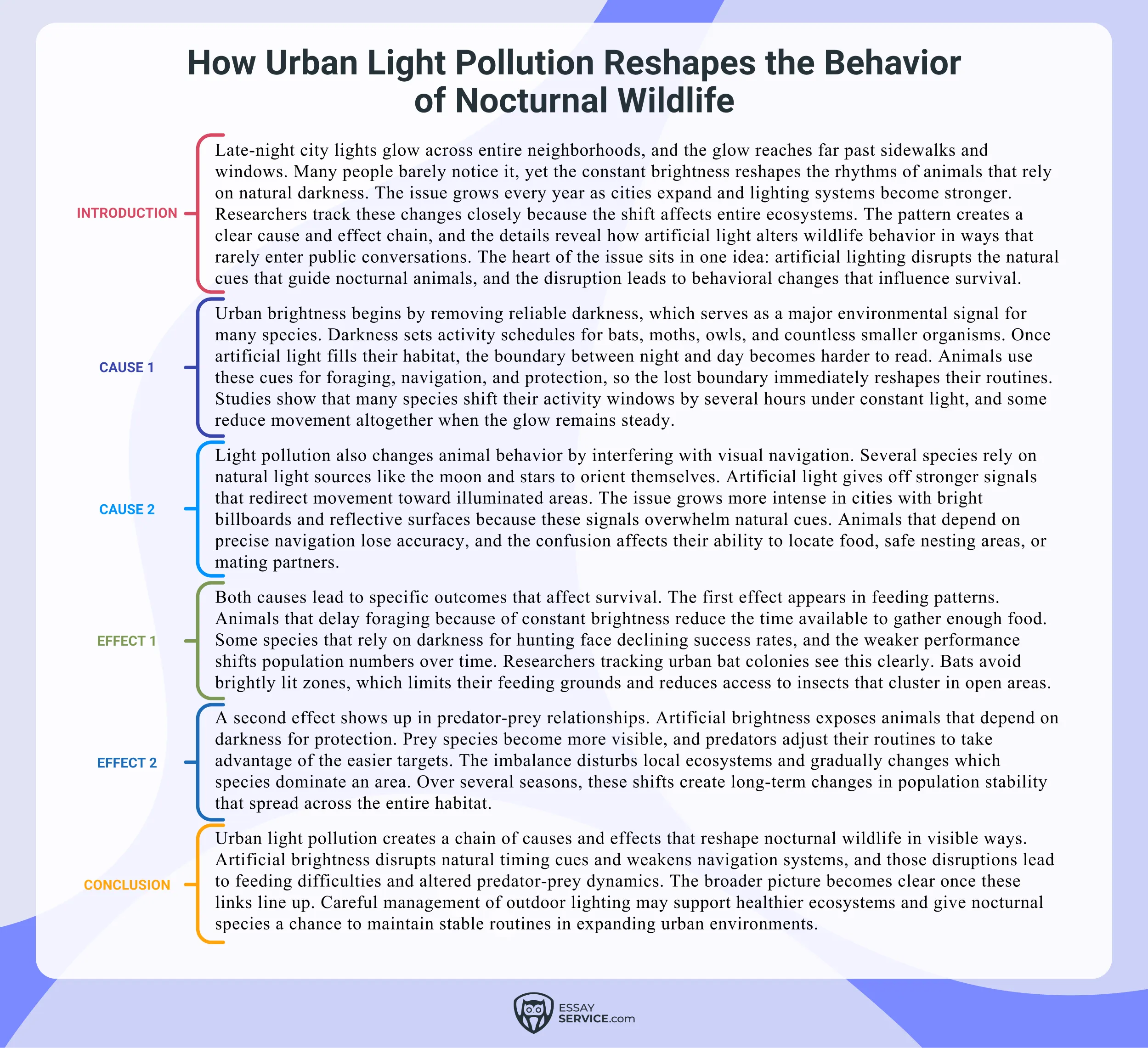
In this section, we've gathered several Cause and effect essay PDF samples for free, so you can download and use them for structural reference.
Tips for writing a cause and effect essay
Use revision to challenge the explanation, not just polish its wording.
- Check the timeline. “After” establishes order, not causation. Identify what changed between the proposed cause and effect.
- Check for a shared explanation. In the attendance-and-grades example, examine study habits and prior preparation before assigning the difference to attendance.
- Choose a focused causal question. Our list of cause and effect essay topics can help you identify an issue with specific causes or consequences to analyze.
- Replace labels with processes. “Confusion caused lateness” needs the clarification or rework that consumed time.
- Match evidence to the link. Instructions may demonstrate ambiguity; they do not, by themselves, establish when the student finished.
- Keep contradictory evidence. If part of the assignment was completed on time, examine which part your explanation actually accounts for.
- Avoid circular explanations. “The student was late because the work was delayed” restates the outcome. Find the event that produced the delay.
- Separate direct and indirect effects. In the wildlife model, insect concentration sits between lighting and predators’ encounters with prey.
- Qualify the claim when needed. “Contributed to” fits an argument involving several causes better than an unsupported claim of sole responsibility.
Useful transitions depend on the relationship:
Compare two sample sentences: “The student sought clarification; subsequently, the deadline passed” establishes sequence. “Because clarification required redoing the work, the student needed additional time” supplies a mechanism. Neither “because” nor “therefore” can replace the evidence needed to support it.
Check logic before you submit
Send us your draft and we’ll review the reasoning, evidence, and structure.
Wrapping it all up
A convincing explanation survives an attempt to find its weak point. Look for the unexplained jump, the competing cause, or the evidence that fits only part of the claim. Revise there first.
If you need help developing that structure, our writers at our essay writing service can organize your causes, effects, and supporting evidence into a coherent paper.
Finish by asking three questions: What caused the outcome? How did that cause operate? What evidence supports the connection?
Frequently Asked Questions
What is the purpose of a cause and effect essay?
What is an example of a cause and effect essay?
What is the outline of a cause and effect essay?
How many paragraphs is a cause and effect essay?

Jennifer is a student currently pursuing a Journalism major. She oversees the EssayService blog team and uses her journalism skills to ensure all blog posts are accurate, trustworthy, and engaging.



New posts to your inbox
Your submission has been received!