
Study Fatigue Statistics for 2026
The student fatigue trends have been pointing in the same direction for a while now. Post-pandemic recovery has been slower than expected, and for students especially, the data tells a fairly uncomfortable story:
- 55% of college students experience academic burnout
- 75% report feeling overwhelmed by their workload
- 27% of teenagers already show burnout symptoms
- Over 75% of students sleep under 8 hours regularly
- Globally, burnout prevalence ranges from 12% to over 70% depending on the population
Over 70% of college students report experiencing burnout at some point during their academic career. That number alone should give anyone pause, but what it does not capture is what study fatigue actually is beyond just feeling worn out after a long week.
Study fatigue is not the same as being tired. It is a state of cognitive and emotional depletion where the capacity to concentrate and make decisions starts to break down in ways that rest alone does not fully fix. Students in this state are not being lazy or dramatic. Something measurable is happening, and the research backs that up.
In this guide we pull together the latest study fatigue statistics on academic burnout, digital eye strain, and what sustained fatigue actually does to performance. If you are trying to understand the scale of the problem in 2026, this is a good place to start.
General Statistics on Study Fatigue
The data for learning fatigue below covers three areas that come up most often in the research: how regularly students feel overwhelmed, how burnout breaks down across gender groups, and what severe fatigue looks like across different countries. The overall picture is fairly consistent wherever researchers look.
Student Academic Exhaustion Rates
Around 73.4% of students report moderate to high stress levels, and 40% experience stress symptoms frequently rather than occasionally. About 75% feel overwhelmed by their workload, and for a significant portion that is not tied to a specific deadline. It is closer to a baseline.
Stress still spikes around exams and submission periods, but near-daily pressure is showing up outside of those windows too. That shift from occasional to persistent is what separates ordinary academic pressure from something more depleting.
Academic Burnout Statistics
Globally, burnout affects around 31.4% of students across 50 studies. In the US that figure rises to 52% at moderate to severe levels. Europe sits around 35% and Australia at 41%.
The gender breakdown is fairly consistent across studies:
- Female students report a 62% burnout rate versus 48% for male students
- 72% of female students report high stress compared to 56% of males
- Females consistently report higher emotional exhaustion across most datasets
Reliable data for non-binary students remains limited, which is itself worth noting.
Study Fatigue by Country
The numbers shift by region but the direction is the same everywhere.
- US: 52% of students report moderate to severe burnout, with 44% above average on burnout measures
- UK: burnout sat around 28% pre-pandemic and climbed to 45% during and after peak stress periods
- China: 40% report frequent stress symptoms, with 37.5% burnout among medical students specifically
- India: 38% moderate burnout among engineering students
No region comes out of this data looking fine. The context differs but the scale of the problem does not.
When fatigue builds up during heavy workloads, turn to our online essay writing service and manage deadlines more effectively.


Manage Your Workload Before It Builds Up
Avoid last-minute pressure by getting structured support when you need it.
Study Fatigue by Education Level
Fatigue does not start at university. For a lot of students it is already well established by the time they finish high school, and it tends to compound rather than ease as the academic stakes get higher. Here is what the data shows at each level.
High School Student Fatigue
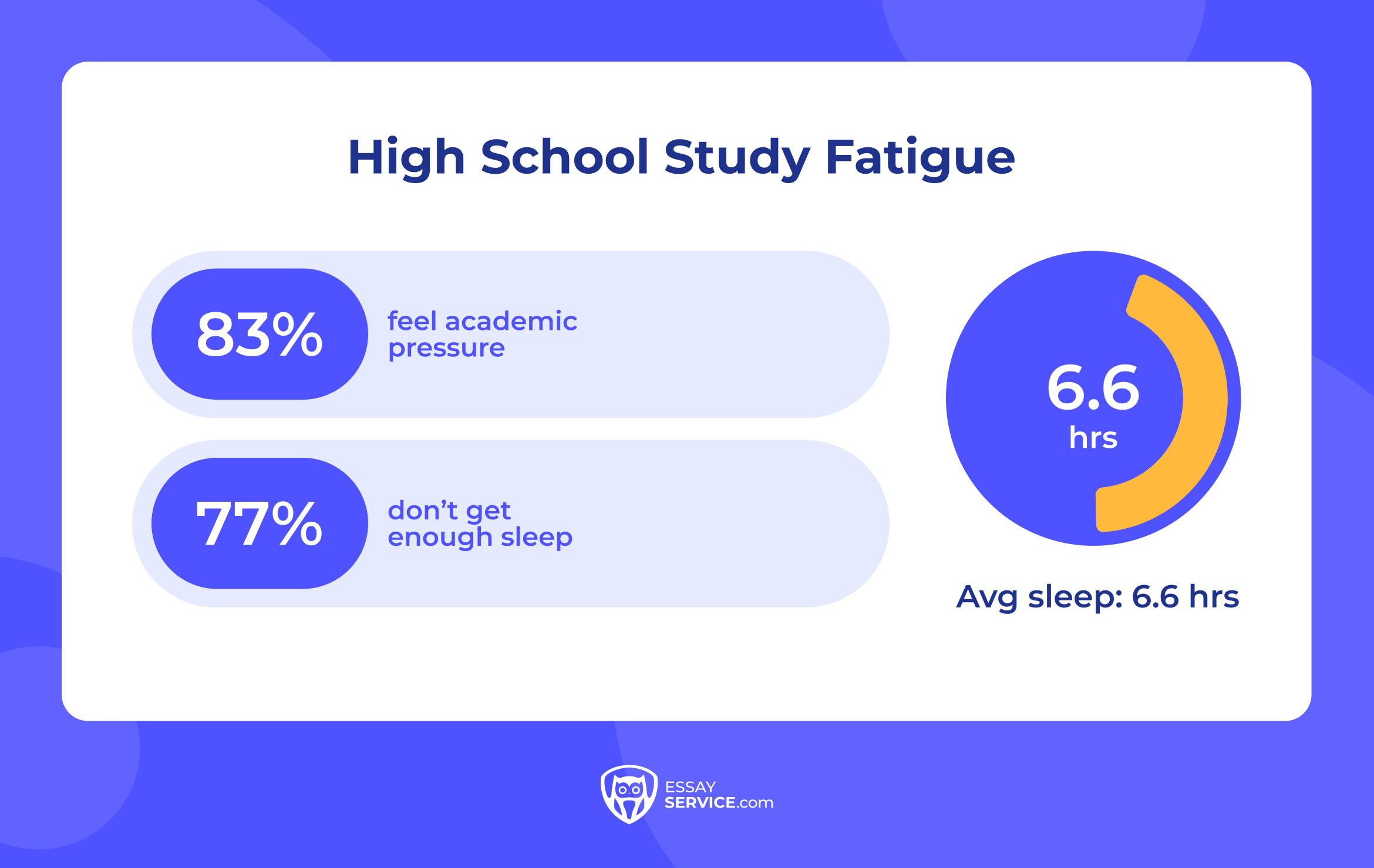
The pressure hitting high school students right now is coming from several directions at once. Around 83% cite academic pressure as a major source of stress, 68% feel pressure around grades specifically, and a third feel they have to stay involved in extracurriculars on top of everything else.
Sleep is where it shows up most clearly. The recommended amount for teenagers is 8 to 10 hours. The average high schooler is getting around 6.6. About 77% are not sleeping enough, and roughly 10% are getting under 5 hours regularly. Students are spending around 3 hours a night on homework and over 7 hours a week on extracurriculars. Something has to give, and it is usually sleep.
Undergraduate Student Statistics
The move to university brings a different kind of pressure. Academic workload sits alongside financial stress and the general adjustment of managing everything independently for the first time, often without much of a support structure in place.
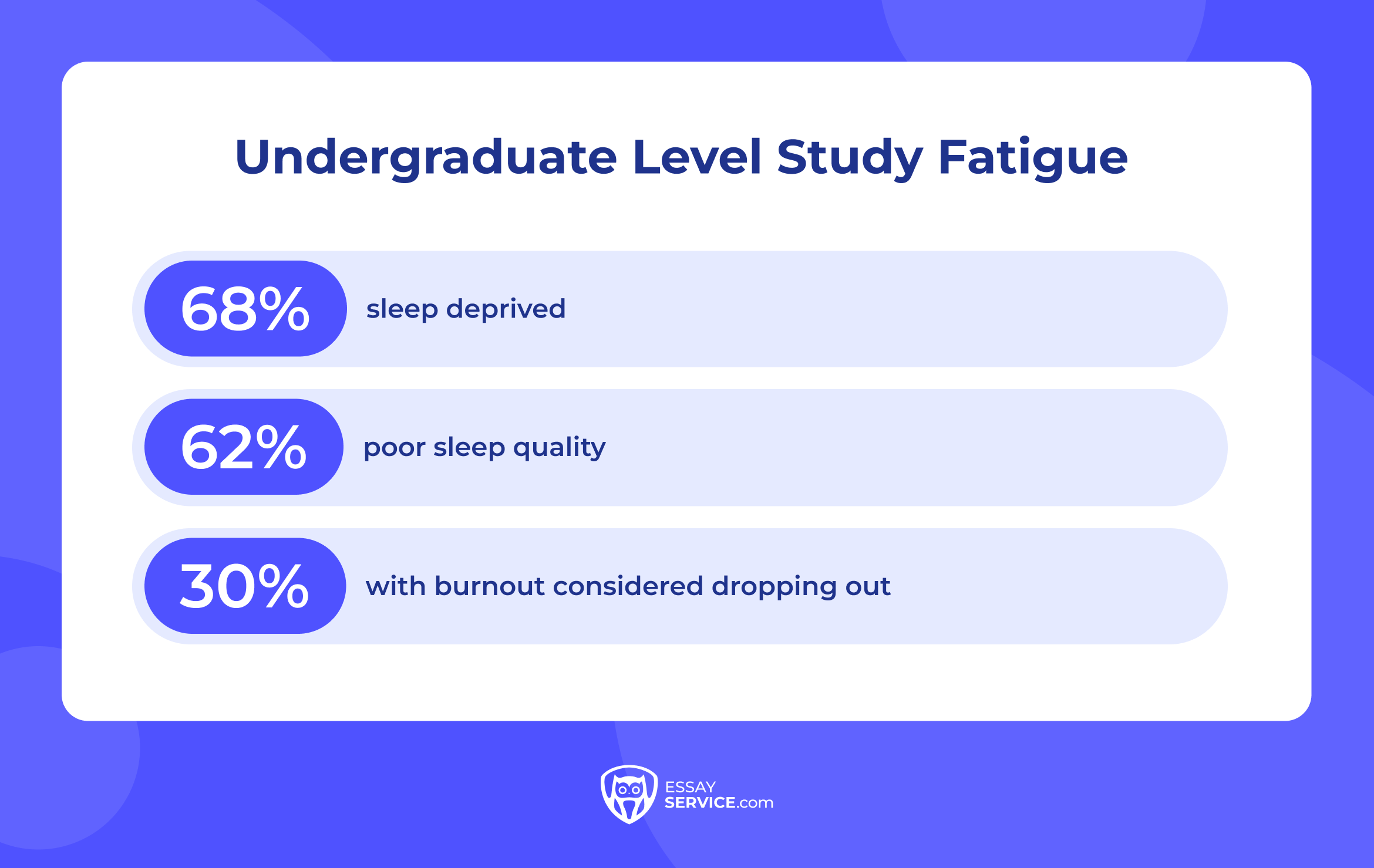
The sleep picture does not improve much either. Around 68% of college students are not sleeping enough, with 62% meeting the criteria for poor sleep quality. About 37% have been diagnosed or treated for stress and 31% for anxiety. What we find most concerning in the data is this: 30% of students experiencing burnout have seriously considered dropping out. That is not a small number, and it points to something beyond ordinary academic pressure.
Fatigue is often linked with stress during peak academic periods. Our guide on exam anxiety statistics breaks down how pressure affects student performance.
Digital Fatigue: Screen Time and Zoom Exhaustion
Screen time among students has reached a level that the research is starting to take seriously. The average student is spending around 5.9 hours a day on screens, and in some university cohorts that number climbs to 7.6 hours when study time alone is measured. Anything above 5 hours daily is associated with noticeably worse wellbeing outcomes. Here is what student exhaustion actually looks like:
.webp)
- 27% of high screen-use students report dry eye, 10% report regular headaches, with neck pain and sleep disruption also common
- Screen time shows a measurable positive correlation with both mental fatigue and brain fog
- AI tool use among teens doubled between 2023 and 2025, now sitting at 26%
- Educational screen use does not carry the same cognitive cost as passive or unstructured use
- The bigger risk factor is not time spent on screens but constant task-switching between multiple sources simultaneously
That last point is worth sitting with. It is not simply about how long students are online. How that time is structured matters considerably more than most people assume.
Study Fatigue Symptoms
Fatigue does not always announce itself clearly. A lot of students push through for weeks without recognising what is actually happening because the symptoms build gradually rather than appearing all at once. These are the signs we would point to:
- Difficulty concentrating even on familiar material
- Reading the same paragraph multiple times without retaining it
- Persistent tiredness that sleep does not seem to fix
- Irritability or emotional flatness that feels out of proportion
- Avoiding study tasks that would normally feel manageable
- Physical symptoms like headaches, eye strain, or tension in the neck and shoulders
- A growing sense of detachment from coursework or academic goals
- Declining output despite putting in the same or more hours
- Trouble making straightforward decisions or prioritising tasks
Key Causes of Study Fatigue
Study fatigue rarely comes from one source. What we tend to see in the research is several factors running at the same time, each one making the others harder to manage.
Academic Workload
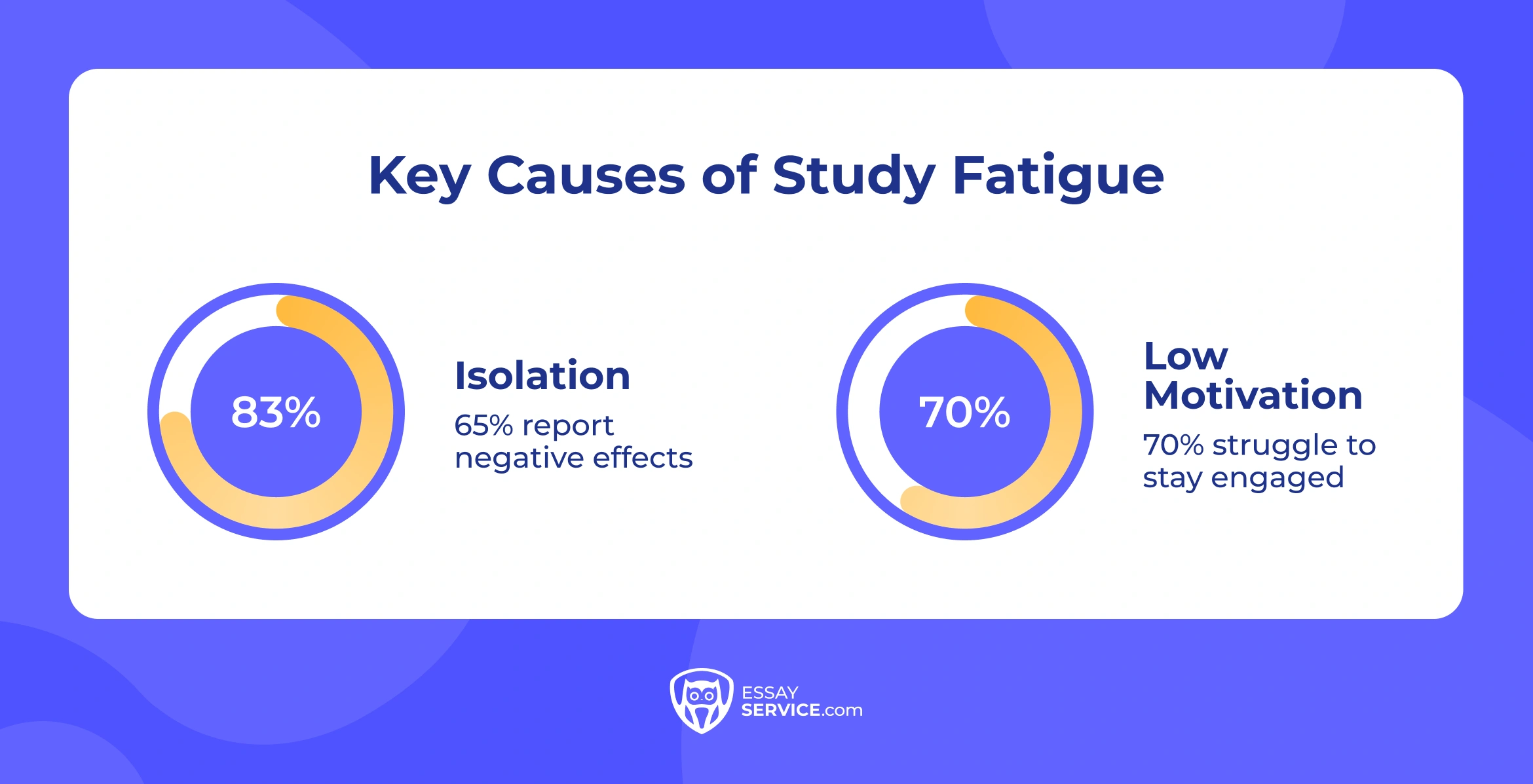
This is the most commonly reported driver. Around 75% of students feel overwhelmed by their workload, and 44.5% report that overload and procrastination are actively affecting their performance. During online learning periods, 70% struggled to stay motivated.
Sleep Deprivation
Only 30% of students get the recommended 7 to 9 hours of sleep. Around 60% report poor sleep quality, and students sleeping under the recommended amount are 40% more likely to experience burnout. Among high school students specifically, that figure rises to 70%.
Financial Stress
Around 15.8% of students report financial pressure directly harming their academic performance. Longer working hours, less recovery time, and disrupted sleep tend to follow, all of which push burnout risk higher.
Social Isolation
65% of students reported social isolation affecting their performance. Lower social support is one of the more consistent predictors of burnout across studies.
Motivation Decline
70% of students report difficulty maintaining motivation. Once engagement drops, academic performance tends to follow, and the two reinforce each other in ways that are difficult to reverse without outside support.
Keep Your Academic Work on Track
Reduce overload by getting expert help with demanding assignments.
Impact on Grades and Student Retention
Fatigue does not stay contained to how a student feels. It shows up in their work, their attendance, and eventually in whether they stay enrolled at all.
On grades, the data is fairly direct. Students with high burnout show around 25% lower GPA compared to peers with low burnout levels. That is not a marginal difference. Burnout has a consistently negative relationship with academic achievement across both school and university settings, with meta-analysis research putting the effect size at around −0.23.
Participation drops alongside grades. Around 44.5% of burned-out students report increased procrastination and delayed work completion. Enthusiasm for good academic performance falls, deadlines get missed, and engagement with coursework becomes harder to sustain.
The retention picture is where it gets more serious. Burnout prevalence ranging from 38% to over 60% correlates directly with higher dropout intentions. Emotional exhaustion predicts disengagement over time, and 30% of burned-out students have seriously considered leaving their programme altogether.
Final Words
The numbers in this article aim to highlight an issue that’s often seen as a personal weakness instead of a larger problem. Study fatigue is real and affects many people, but it can improve with the right kind of support. If you see yourself in any of this data, that can be a helpful first step. Understanding what’s going on and why usually makes it easier to take action.
Frequently Asked Questions
What Is Study Fatigue?
How Common Is Study Fatigue?
What Are the Usual Symptoms of Study Fatigue?
What Causes Study Fatigue?
Can Online Learning Cause Study Fatigue?

Phil spends his working days teaching international trade. He contributes to our blog as a freelancer, leveraging his experience with MBA students to advise on academic writing, studying abroad, and securing funds.
- Jacobs-Pinson, E. (2024, September 18). 30+ Eye-Opening Student Burnout Statistics That Demand Attention in 2024 - Brooklyn, NY. Crown Counseling. https://crowncounseling.com/statistics/student-burnout/
- HIGH5. (2026, January 5). Student Burnout Statistics (U.S., 2024–2025) — Curated Primary-Source Dataset. HIGH5 Strengths Test; HIGH5. https://high5test.com/student-burnout-statistics/
- Chong, L. Z., Foo, L. K., & Chua, S.-L. (2025). Student Burnout: A Review on Factors Contributing to Burnout Across Different Student Populations. Behavioral Sciences, 15(2), 170. https://www.mdpi.com/2076-328X/15/2/170
- Olson, N., Oberhoffer, R., Reiner, B., & Schulz, T. (2025). Health Behaviors Among Students and Their Association with Stress, Student Burnout and Study Engagement. Societies, 15(6), 153. https://www.mdpi.com/2075-4698/15/6/153
- Suyuhan, W., Khoso, A. R., Jintu, G., & Bhutto, S. (2026). The mental health crisis in global higher education: understanding and mitigating academic load stress among international students from Asia and Africa in Nanjing China. Frontiers in Psychology, 17. https://www.frontiersin.org/journals/psychology/articles/10.3389/fpsyg.2026.1707944/full
- Bouchrika, I. (2024, October 14). 50 current student stress statistics: 2020/2021 data, analysis & predictions. https://research.com/education/student-stress-statistics
- Team, W. (2025, June 2). Student Burnout Statistics: Reports 2025. WifiTalents. https://wifitalents.com/student-burnout-statistics/
- Burned Out or Engaged? Dual Pathways to Student Outcomes Through Study Demands–Resources Theory in Higher Education. (2025). International Journal of Business and Technology Management. https://mysitasi.mohe.gov.my/journal-website/get-meta-article?artId=25488261-975a-4ac1-a06d-ebe5931e7839&
- Zhang, J., Meng, J., & Wen, X. (2025). The relationship between stress and academic burnout in college students: evidence from longitudinal data on indirect effects. Frontiers in Psychology, 16. https://www.frontiersin.org/journals/psychology/articles/10.3389/fpsyg.2025.1517920/full
.webp)
New posts to your inbox
Your submission has been received!