
Social issues essays examine real-world problems that shape how people live and interact, such as housing instability, access to healthcare, or gaps in modern education. Common areas include labor conditions, migration policies, and public health concerns, with examples addressing issues like affordable housing shortages, the digital divide in schools, and the long-term effects of environmental damage on local communities.
This guide uses free social issues essay examples for students to show how each section of the paper works. It explains how to write a strong thesis statement, use reliable data, and link your ideas to human rights and public health.


Get Your Essay Done Right
Work with expert writers who structure your paper, use real evidence, and deliver polished results on time
Social Issues Essay Example: Section-by-Section Breakdown
This section walks through a full example built around one of the most relevant problems: Should freedom of speech have limits during protests? Each part shows how to structure ideas, use evidence, and connect arguments to real social issues.
Example of Social Issues Essay Introduction
An introduction sets direction and stakes. It opens with a precise hook, connects the issue to contemporary society, and ends with a thesis statement that defines the argument and its social consequences.
[Hook] In recent years, protests across many societies have blurred the line between expression and harm. [Contextual Bridge] As political polarization grows in modern society, unrestricted speech during protests has raised concerns about public safety, racial discrimination, and unfair treatment within local communities. [Three-Pronged Thesis Statement] Freedom of speech during protests should have limits when it incites violence, spreads targeted harm against minority groups, and disrupts public health systems, as these effects weaken human rights protections and destabilize everyday life.
Pro tip: Your thesis must name the problem and show its wider societal impact.
Example of Social Issues Essay Body Paragraph
A body paragraph develops one focused claim. It starts with a clear topic sentence, supports it with credible data, and explains how the issue affects broader systems like the legal system or public health.
[Topic Sentence] One major concern is how unchecked protest speech can escalate into real harm. [Empirical Evidence/Data] Reports from the United Nations and the World Bank show that hate-driven rhetoric during protests often correlates with increased violence in minority and low-income communities. [Analysis of Social Impact] This pattern contributes to a wider mental health crisis, especially among young people exposed to verbal abuse and social isolation, while also placing pressure on healthcare workers and public health systems. [Transition] These outcomes show that unrestricted speech does not stay isolated; it spreads consequences across the given society.
Pro tip: Cite trusted sources like the CDC or Census Bureau to strengthen credibility and reduce legal challenges to your argument.
Example of Social Issues Essay Conclusion
A conclusion ties everything together without repeating earlier wording. It restates the thesis, summarizes key points, and shows why the issue matters beyond the essay.
[Restated Thesis in New Words] Limits on protest speech protect both expression and collective well-being when they prevent harm. [Summary of Main Points] Evidence shows that unchecked rhetoric fuels violence, deepens economic inequality, and weakens human rights protections across modern society. [Final Call to Action/Broader Significance] Addressing this issue requires balanced policies within the justice system and stronger anti-discrimination laws so that social issues do not escalate into lasting damage for minority communities and future generations.
10 Social Issues Essay Examples
Some social issues keep resurfacing, no matter the place or time. Mental health, climate change, and economic inequality sit at the center right now. Around them, debates on gender equality, racial discrimination, and digital privacy keep gaining weight. These problems shape modern society in visible ways and quietly influence everyday life and public health systems.
Many of these topics are explored in social studies classes, where students examine real-world issues and their impact.
Social Issues Essay Example 1
Topic: Can Diplomacy Stop Cyber Attacks?
[Hook] A cyber attack does not need borders, yet its damage often lands inside national systems. [Contextual Bridge] In modern society, governments face growing social issues tied to cybersecurity, where attacks disrupt public health systems, financial institutions, and everyday life across many societies. International tensions and political polarization have made these threats harder to control, especially as digital infrastructure expands in both developed and developing countries. [Three-Pronged Thesis Statement] Diplomacy can reduce cyber attacks when it establishes shared legal frameworks, strengthens cooperation between countries, and reinforces human rights protections in digital spaces, though its effectiveness depends on enforcement and global participation.
[Topic Sentence] Diplomatic agreements can create a foundation for limiting cyber attacks through shared rules. [Empirical Evidence/Data] Organizations such as the United Nations and the World Bank have supported international discussions on cyber norms, encouraging countries to avoid targeting critical infrastructure like healthcare systems and energy grids. [Analysis of Social Impact] These agreements help protect human rights by reducing risks to healthcare workers and vulnerable populations, especially in low-income communities where digital disruptions can worsen existing economic inequality and public health challenges. [Transition] However, agreements alone do not guarantee compliance across all nations.
[Topic Sentence] Enforcement remains one of the biggest legal challenges in cyber diplomacy. [Empirical Evidence/Data] In many countries, weak legal systems and uneven technological capacity allow cyber attacks to continue despite international commitments. [Analysis of Social Impact] This gap increases unfair treatment between nations, where stronger countries can defend themselves while poorer regions face repeated disruptions that affect education, employment, and social connections. [Transition] Without consistent enforcement, diplomatic efforts risk becoming symbolic rather than effective.
[Restated Thesis in New Words] Diplomacy has the potential to limit cyber attacks when it is backed by cooperation and enforcement. [Summary of Main Points] International agreements can set standards, yet enforcement gaps and unequal resources weaken their impact across modern society. [Final Call to Action/Broader Significance] Strengthening global collaboration and investing in shared cybersecurity systems will be essential to protect human rights and reduce the growing social issues linked to digital threats.
Expert Commentary
This example stays focused and keeps the structure clear. Each section does its job without drifting into vague claims. The argument connects cybersecurity to broader social issues like economic inequality and public health, which strengthens relevance. The use of global organizations adds credibility, though the evidence remains general and would benefit from specific data or case studies. The essay also avoids over-complication and keeps sentences readable, which works well. One weakness is the limited depth in enforcement analysis. A stronger version would include one concrete example of a failed or successful agreement. That would ground the argument and make the claims harder to challenge.
If you need help analyzing complex social topics, our sociology essay writing service offers expert support.
Social Issues Essay Example 2
Topic: Should Courts Give More Support to Marginalized Communities?
[Hook] A court decision can quietly shape thousands of lives long after the case ends. [Contextual Bridge] In modern society, ongoing social issues such as racial discrimination, gender inequality, and economic inequality continue to affect minority communities and low-income families, raising questions about fairness within the legal system. Unequal access to legal resources and representation often leads to unfair treatment, especially for African-Americans and other minority groups who face systemic barriers. [Three-Pronged Thesis Statement] Courts should provide more support to marginalized communities by ensuring equal access to legal representation, addressing bias within the justice system, and strengthening protections for human rights, as these steps reduce long-term inequality and improve social outcomes.
[Topic Sentence] Access to legal representation remains one of the biggest barriers for marginalized communities. [Empirical Evidence/Data] Studies referenced by the United Nations and the World Bank show that low-income communities often lack access to qualified legal support, which affects case outcomes and reinforces income inequality across many societies. [Analysis of Social Impact] This gap leads to unfair treatment in court decisions, limiting opportunities for justice and increasing social isolation among individuals who already face economic and social disadvantages. [Transition] Improving access to representation directly affects how fairly cases are resolved.
[Topic Sentence] Bias within the justice system also shapes outcomes for minority communities. [Empirical Evidence/Data] Research on racial profiling and sentencing patterns shows that African-Americans and other minority groups experience harsher legal consequences compared to other groups in similar situations. [Analysis of Social Impact] These patterns weaken trust in the legal system and raise serious human rights concerns, especially when young people in marginalized communities face long-term consequences that affect education, employment, and social connections. [Transition] Addressing bias requires both legal reform and institutional accountability.
[Restated Thesis in New Words] Courts play a central role in reducing inequality when they actively support marginalized communities. [Summary of Main Points] Limited access to representation and systemic bias continue to shape unequal outcomes across modern society, reinforcing existing social issues. [Final Call to Action/Broader Significance] Strengthening legal protections and expanding support within the justice system can improve fairness, protect human rights, and create more stable conditions for minority communities and future generations.
Expert Commentary
This example works because it stays grounded in real structural problems within the legal system. The argument builds logically, moving from access to representation to systemic bias, which mirrors how these issues appear in practice. The connection to human rights and economic inequality adds depth. The writing is clear and avoids vague claims, though the evidence remains broad. It would improve with one specific case or statistic to make the argument more concrete. The conclusion ties ideas together well, though it could be pushed further by suggesting a specific legal reform instead of staying general.
Social Issues Essay Example 3
Topic: How Can Schools Help Students Feel Comfortable Talking About Their Feelings?
[Hook] A student can sit in a crowded classroom and still feel completely alone. [Contextual Bridge] In modern education, social issues tied to mental health have become harder to ignore, especially as young people face rising mental health challenges, social isolation, and pressure shaped by contemporary society. Schools often act as the first place where these struggles appear, yet many students hesitate to speak openly about their feelings. [Three-Pronged Thesis Statement] Schools can create safer spaces for students to express their feelings by integrating mental health education into daily learning, training staff to respond effectively, and building trust through consistent support systems, as these steps improve well-being and reduce long-term mental health issues.
[Topic Sentence] Mental health education gives students the language to understand what they feel. [Empirical Evidence/Data] Programs supported by the United Nations and public health organizations show that students exposed to structured mental health education at an early age report higher confidence in discussing emotions and seeking help. [Analysis of Social Impact] This shift reduces stigma around mental health and helps young people recognize mental health challenges before they escalate into a broader mental health crisis, especially in low-income communities where access to outside support may be limited. [Transition] Knowledge alone, however, does not guarantee students will speak up.
[Topic Sentence] The way teachers and staff respond can either open or close that conversation. [Empirical Evidence/Data] Research in public health highlights that students are more likely to share concerns when educators are trained to recognize signs of distress and respond without judgment. [Analysis of Social Impact] Supportive responses strengthen social connections within schools and reduce the risk of substance abuse, school bullying, and long-term mental health issues that can follow students into adulthood. [Transition] Consistent support systems reinforce this sense of safety over time.
[Restated Thesis in New Words] Schools shape how comfortable students feel speaking about their emotions through daily interactions and structured support. [Summary of Main Points] Mental health education, trained staff, and reliable support systems work together to reduce stigma and address mental health challenges early. [Final Call to Action/Broader Significance] Expanding these efforts across modern society can improve public health outcomes and help young people build healthier ways to manage emotions throughout their lives.
Expert Commentary
This one works because it stays grounded in a setting students actually recognize. The structure follows a clear path: first giving students the language to express feelings, then showing how adult responses shape whether they speak at all. That sequence reflects real classroom dynamics. The focus on mental health stays consistent, which keeps the argument tight. The weak point is the lack of concrete detail. The research references feel broad, so the claims don’t hit as hard as they could. Adding one specific program, policy, or statistic would make the argument more convincing.
Social Issues Essay Example 4
Topic: How Can Rural Areas Get More Trained Doctors?
[Hook] A long drive to the nearest clinic can decide whether someone receives care or not. [Contextual Bridge] In many rural areas, access to healthcare remains one of the most persistent social issues, especially as public health systems struggle to distribute healthcare workers evenly across regions. This gap affects low-income communities and developing countries the most, where limited infrastructure and fewer incentives discourage trained doctors from practicing outside cities. [Three-Pronged Thesis Statement] Rural areas can attract more trained doctors by offering financial incentives, improving working conditions, and investing in local medical education pathways, as these measures strengthen public health and reduce inequality across modern society.
[Topic Sentence] Financial incentives can encourage doctors to work in underserved rural areas. [Empirical Evidence/Data] Programs supported by the World Bank and national coalition initiatives often include student loan forgiveness and higher salaries for doctors who commit to practicing in rural regions. [Analysis of Social Impact] These incentives help reduce income inequality in healthcare access and improve outcomes for poor people who rely on local clinics for essential services. [Transition] However, financial rewards alone do not guarantee long-term commitment.
[Topic Sentence] Working conditions play a major role in whether doctors stay in rural areas. [Empirical Evidence/Data] Reports from public health organizations show that limited equipment, understaffed facilities, and professional isolation make rural practice less appealing compared to urban environments. [Analysis of Social Impact] These challenges increase burnout among healthcare workers and weaken healthcare systems in rural areas, leading to delays in treatment and worsening health conditions in local communities. [Transition] Addressing these conditions requires more than short-term solutions.
[Restated Thesis in New Words] Increasing the number of trained doctors in rural areas depends on sustained support and better infrastructure. [Summary of Main Points] Financial incentives and improved working conditions can attract professionals, yet long-term solutions require deeper investment in healthcare systems. [Final Call to Action/Broader Significance] Expanding access to medical education in rural areas and strengthening public health infrastructure can reduce disparities and improve health outcomes for the world's population living outside major cities.
Expert Commentary
This example of social issues essay stays practical and clearly explains the problem without drifting into abstract claims. The structure is easy to follow, and each paragraph builds on the previous one in a logical way. The argument connects well to public health and economic inequality, which adds relevance. The weakness here is repetition in reasoning. Each paragraph follows a very similar pattern in how it explains cause and effect, which makes the essay feel predictable. Varying how evidence is interpreted or introducing a counterpoint would make the argument more engaging and less mechanical.
Social Issues Essay Example 5
Topic: Do Current Recycling Systems Really Work?
[Hook] Most people assume that tossing plastic into a recycling bin solves the problem. [Contextual Bridge] In modern society, recycling has become a central response to climate change and global warming, yet growing evidence suggests that current systems struggle to keep up with rising waste levels. Across many societies, questions about effectiveness have turned recycling into one of the more debated social issues, especially as environmental policies vary between countries and local communities. [Three-Pronged Thesis Statement] Current recycling systems only partially work because of inefficient processing, inconsistent public participation, and limited global coordination, which together weaken efforts aimed at combating climate change and achieving sustainable development.
[Topic Sentence] One major issue is the inefficiency of recycling processes themselves. [Empirical Evidence/Data] Reports linked to the United Nations and the World Bank show that a significant portion of collected recyclable materials never gets processed due to contamination or lack of proper facilities. [Analysis of Social Impact] This inefficiency increases environmental pressure and slows progress on combating climate change, especially in developing countries where infrastructure gaps make waste management more difficult. [Transition] Even when systems exist, their success depends heavily on public behavior.
[Topic Sentence] Public participation remains inconsistent across different communities. [Empirical Evidence/Data] Studies in international news coverage highlight that confusion around sorting rules leads to high contamination rates in recycling streams, reducing the amount of usable material. [Analysis of Social Impact] This inconsistency limits the effectiveness of recycling programs and shifts more waste into landfills, which contributes to climate change and environmental degradation that affects everyday life and public health. [Transition] These issues become even more complex at a global level.
[Restated Thesis in New Words] Recycling systems contribute to waste reduction, yet they fall short of solving the larger environmental problem. [Summary of Main Points] Inefficient processing, inconsistent participation, and weak global coordination limit their effectiveness in addressing climate change. [Final Call to Action/Broader Significance] Improving recycling systems requires clearer policies, better infrastructure, and stronger international cooperation to support sustainable development and reduce environmental harm.
Expert Commentary
This example handles the topic clearly and keeps the argument easy to follow. The structure works, and each paragraph stays focused on one issue, which helps readability. The connection to climate change and sustainable development adds relevance. The main weakness is oversimplification. The essay treats recycling systems as broadly similar across many societies, which flattens important differences between countries and local systems. Some regions have highly effective programs, while others struggle with basic infrastructure. A stronger version would acknowledge these variations and show how effectiveness depends on context rather than presenting one general outcome.
Social Issues Essay Example 6
Topic: Do Immigration Laws Create Tension Between Ethnic Groups?
[Hook] A policy on paper can change how neighbors treat each other in real life. [Contextual Bridge] In modern society, immigration laws sit at the center of ongoing social issues, especially as migration reshapes communities across many societies. These policies influence access to jobs, housing, and legal protection, often affecting minority communities and low-income families in different ways. [Three-Pronged Thesis Statement] Immigration laws can create tension between ethnic groups when they reinforce unfair treatment, deepen economic inequality, and shape public attitudes through media coverage, as these effects influence social connections and long-term stability in the given society.
[Topic Sentence] Unequal access to legal protection often increases tension between groups. [Empirical Evidence/Data] In many countries, stricter immigration policies limit access to the legal system for certain populations, which leaves some minority groups more vulnerable to exploitation and legal challenges. [Analysis of Social Impact] This imbalance creates resentment between communities, especially when one group feels protected while another faces constant uncertainty, affecting everyday life and trust in the justice system. [Transition] Legal structures do more than regulate movement; they shape perception.
[Topic Sentence] Economic pressure linked to immigration policies can also drive conflict. [Empirical Evidence/Data] Reports from the United Nations and the World Bank show that competition for jobs and affordable housing often increases in areas with rapid population changes. [Analysis of Social Impact] This situation can intensify income inequality and lead to blame directed at minority communities, even when broader economic conditions are responsible, which fuels division and weakens social connections. [Transition] Public perception then amplifies these tensions.
[Restated Thesis in New Words] Immigration laws influence how ethnic groups interact, especially when they create unequal conditions. [Summary of Main Points] Legal barriers, economic pressure, and public narratives contribute to tension across modern society. [Final Call to Action/Broader Significance] Addressing these social issues requires fairer policies and stronger protections for human rights so that diverse communities can coexist with less conflict and greater stability.
Expert Commentary
This example handles a sensitive topic without becoming vague or overly emotional, which works in its favor. The argument stays organized and connects legal, economic, and social factors in a clear way. It also shows how policy decisions spill into everyday interactions, which keeps the essay grounded. The main weakness is that it leans in one direction without acknowledging any counterargument. Immigration laws can also reduce tension in certain contexts, and ignoring that makes the argument feel one-sided. Including even a brief opposing view would make the analysis more balanced and harder to dismiss.
Social Issues Essay Example 7
Topic: Can Peace Education Lower Conflict Risk?
[Hook] The way people learn to handle disagreement often starts long before any real conflict appears. [Contextual Bridge] In modern society, rising political polarization and social issues linked to violence, racial discrimination, and human rights violations have pushed education systems to rethink what students learn beyond academic content. Peace education has gained attention as a way to shape attitudes early, especially among young people exposed to conflict through media coverage and everyday life. [Three-Pronged Thesis Statement] Peace education can lower conflict risk by teaching conflict resolution skills, reducing prejudice between minority groups, and strengthening social connections, as these outcomes support long-term stability in contemporary society.
[Topic Sentence] Teaching conflict resolution skills helps individuals manage disagreements without escalation. [Empirical Evidence/Data] Programs supported by the United Nations show that students trained in communication and mediation techniques are less likely to engage in aggressive behavior during disputes. [Analysis of Social Impact] These skills reduce the likelihood of violence in schools and later in broader social settings, which contributes to improved well-being and safer local communities. [Transition] Skills alone, however, do not fully address deeper social divisions.
[Topic Sentence] Peace education also works by reducing prejudice between different groups. [Empirical Evidence/Data] Research in public health and education shows that exposure to diverse perspectives at an early age lowers levels of bias related to race, sexual orientation, and cultural background. [Analysis of Social Impact] This reduction in bias supports human rights and helps prevent unfair treatment, especially in many societies where minority communities face long-standing discrimination. [Transition] These changes influence how societies respond to larger conflicts.
[Restated Thesis in New Words] Peace education lowers conflict risk by shaping how individuals think and interact from an early age. [Summary of Main Points] Conflict resolution skills and reduced prejudice both contribute to stronger social connections and more stable communities. [Final Call to Action/Broader Significance] Expanding peace education within modern education systems can address social issues before they escalate, helping build societies that rely less on conflict and more on cooperation.
Expert Commentary
This example keeps the argument clear and easy to follow, and it stays closely tied to education, which makes the topic concrete. The progression from skills to attitudes works logically and reflects how learning translates into behavior. The connection to human rights and social issues strengthens the relevance. The main weakness is limited tension in the argument. The essay moves in a straight line without questioning its own claims or introducing any friction. Including a point of uncertainty or a potential limitation would make the reasoning feel more realistic and less linear.
Social Issues Essay Example 8
Topic: What Laws Protect Women from Violence Inside the Home?
[Hook] Violence inside the home often stays hidden, even when laws exist to stop it. [Contextual Bridge] Across modern society, domestic violence remains one of the most persistent social issues, affecting women in both developing countries and high-income regions. Legal systems have introduced protections, yet gaps in enforcement and awareness continue to shape outcomes for victims. [Three-Pronged Thesis Statement] Laws protect women from domestic violence through criminalization of abuse, protective orders, and international human rights frameworks, though their effectiveness depends on enforcement, accessibility, and public awareness.
[Topic Sentence] Many countries have laws that clearly define and criminalize domestic violence. [Empirical Evidence/Data] For example, legislation such as India’s Protection of Women from Domestic Violence Act recognizes physical, emotional, verbal, and psychological abuse as punishable offenses, expanding legal protection beyond visible harm. [Analysis of Social Impact] Broad definitions help victims seek justice and reduce unfair treatment within the legal system, especially for women experiencing non-physical abuse that often goes unreported. [Transition] Legal definitions alone, however, do not ensure immediate safety.
[Topic Sentence] Protective measures are designed to prevent further harm before cases are resolved. [Empirical Evidence/Data] Courts in many countries can issue restraining orders and emergency protection orders, reflecting global legal standards encouraged by the United Nations to safeguard human rights in domestic settings. [Analysis of Social Impact] These tools allow women to create distance from abusers and reduce immediate risk, which is critical in situations where violence escalates quickly. [Transition] Beyond national laws, international frameworks shape how countries approach protection.
[Restated Thesis in New Words] Legal systems offer multiple layers of protection against domestic violence, yet their impact depends on how they are applied. [Summary of Main Points] National laws define abuse, courts provide protective measures, and international human rights standards guide state responsibility. [Final Call to Action/Broader Significance] Strengthening enforcement and raising awareness can ensure that these laws move beyond paper and provide real protection for women facing violence at home.
Expert Commentary
This one leans more into explanation than argument. It lays out what laws exist and how they function, which makes it informative, though it softens the analytical edge. The structure is still there, but the essay spends more time describing systems than questioning them. That shifts the tone slightly toward a report rather than a debate. The strength lies in clarity and accurate use of legal concepts. The trade-off is weaker positioning. A sharper stance on whether these laws actually work in practice would make the essay feel more purposeful and less descriptive.
Social Issues Essay Example 9
Topic: Should Laws Against Child Labor Be Made Stronger?
[Hook] A child at work often disappears from school before anyone notices the cost. [Contextual Bridge] In many societies, child labor remains one of the most persistent social issues, especially in developing countries where economic inequality pushes families to rely on children’s income. Despite existing regulations, weak enforcement and poverty continue to expose children to unsafe conditions that affect their education and long-term well-being. [Three-Pronged Thesis Statement] Laws against child labor should be made stronger by tightening enforcement, expanding social support for low-income families, and aligning policies with global human rights standards, as these steps reduce exploitation and improve future outcomes for young people.
[Topic Sentence] Weak enforcement allows child labor to continue despite existing laws. [Empirical Evidence/Data] Reports from the World Bank and the United Nations show that many countries have regulations in place, yet limited inspections and corruption prevent consistent application of these laws. [Analysis of Social Impact] This gap leaves children in hazardous work environments and limits access to modern education, reinforcing cycles of poverty and income inequality across generations. [Transition] Enforcement alone, however, cannot solve the issue without addressing root causes.
[Topic Sentence] Economic pressure within families drives the persistence of child labor. [Empirical Evidence/Data] Studies on rural areas indicate that low-income families often depend on children’s earnings to meet basic needs, especially in regions with limited social support systems. [Analysis of Social Impact] This reliance increases school dropout rates and reduces opportunities for young people to improve their socioeconomic status, which keeps communities trapped in long-term economic inequality. [Transition] Stronger laws must work alongside broader support systems.
[Restated Thesis in New Words] Strengthening laws against child labor requires both enforcement and social support. [Summary of Main Points] Weak regulation and economic pressure allow child labor to continue, affecting education and long-term development. [Final Call to Action/Broader Significance] Expanding legal protections and support programs can reduce child labor and help create more stable conditions for future generations across many societies.
Expert Commentary
This social issues essay sample stays consistent and easy to follow, and the argument builds in a logical way. It clearly links child labor to economic inequality and education, which keeps the topic grounded. The structure works without confusion, and each section supports the main claim. The issue here is limited nuance. The essay treats stronger laws as a straightforward solution without fully considering potential side effects, such as pushing child labor further underground. A more layered approach would make the reasoning feel more complete and less linear.
Social Issues Essay Example 10
Topic: How Does the Digital Divide Limit Access to Modern Education?
[Hook] A homework assignment today often assumes something simple:
a stable internet connection. [Contextual Bridge] The digital divide describes gaps in access to technology, and it has become one of the most visible social issues in modern education. Students in rural areas, low-income communities, and developing countries often lack reliable devices or internet, which directly affects how they learn and participate in school. [Three-Pronged Thesis Statement] The digital divide limits access to modern education by restricting learning resources, lowering academic performance, and widening income inequality, as these barriers shape long-term opportunities for young people.
[Topic Sentence] Limited access to technology restricts basic learning opportunities. [Empirical Evidence/Data] Studies show that around 17% of students cannot complete homework due to a lack of internet access, while many others miss online resources entirely. [Analysis of Social Impact] Without access to digital tools, students fall behind in subjects that rely on research, communication, and interactive learning, especially in modern education systems that depend on online platforms. [Transition] Access issues quickly translate into measurable academic gaps.
[Topic Sentence] The digital divide also affects academic performance and long-term outcomes. [Empirical Evidence/Data] Research indicates that students with home internet access are more likely to graduate and earn significantly higher lifetime income compared to those without it. [Analysis of Social Impact] These differences reinforce income inequality, as students without access struggle to complete assignments, develop digital skills, and compete for future opportunities in contemporary society. [Transition] These educational gaps extend beyond individual performance.
[Restated Thesis in New Words] The digital divide shapes who benefits from modern education and who gets left behind. [Summary of Main Points] Limited access to technology reduces learning opportunities, weakens academic outcomes, and deepens inequality across many societies. [Final Call to Action/Broader Significance] Closing this gap requires investment in infrastructure and equal access policies so that education systems can support all students, not just those with reliable technology.
Expert Commentary
This one has a strong backbone because it uses real data to support each claim, which immediately raises its credibility. The cause-and-effect chain is clear, and the argument stays focused on education without drifting. The issue lies in how tightly everything is controlled. Every paragraph follows the same rhythm and level of certainty, which makes the reasoning feel a bit rigid. Real-world problems like this often involve overlap, contradictions, and uneven outcomes. Letting one section acknowledge that complexity (even briefly) would make the essay feel more natural and less structured like a template.
For applied research, review social work capstone project examples to see how social issues are addressed in practice.
Stronger Essays, Less Stress
Let experienced writers handle research, structure, and editing so your final paper is clear and accurate.
How to Choose a Social Issue for Your Essay?
Start with what the assignment actually asks you to do. Persuade, inform, or argue: that choice shapes the topic. If the topic doesn’t fit the task, the essay won’t work.
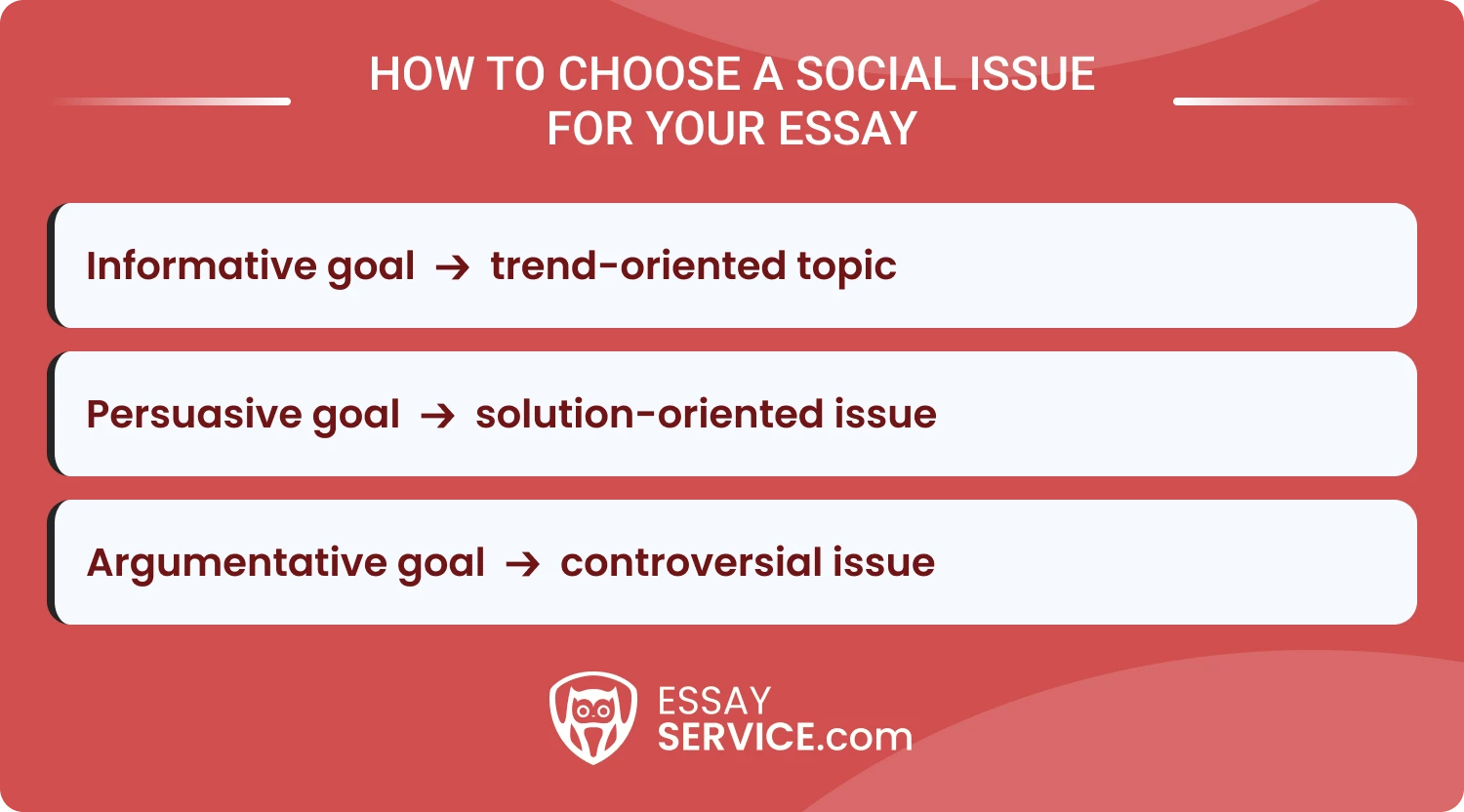
- If you need to persuade, choose a solution-oriented issue where change is realistic and measurable. Focus on policies or systems that can be improved, such as access to mental health services or gaps in affordable housing.
- If you need to inform, choose a trend-oriented topic. Look at patterns shaping modern society, like the growth of social isolation or shifts in public health behavior across different communities.
- If you need to argue, choose a controversial issue with clear opposing sides. Topics tied to the legal system, human rights, or economic inequality tend to create stronger debates and sharper arguments.
Final Thoughts
A solid social issues essay comes down to a clear thesis, focused body paragraphs, and evidence that actually supports your point. The examples in this article show how each section fits into that structure. When the topic matches the assignment, and the argument stays consistent, the essay feels complete and convincing.
Frequently Asked Questions
What Is a Social Issues Essay Example?
What Makes a Social Issues Essay Example Strong?
How to Write a Good Social Issues Essay Sample?

John spends his days studying the impact of language. He uses his deep understanding of linguistics and research experience to help students communicate more effectively and craft immaculate research-intensive papers.
United Nations. (2024). Global Issues. United Nations. https://www.un.org/en/global-issues


.webp)
New posts to your inbox
Your submission has been received!