
A song analysis essay asks you to examine one song and explain how its lyrics, music, and meaning work together to make an argument. The trouble most students (myself included, back in college) run into is just picking a track they adore, without giving much thought to whether an analysis can be written in the first place. Such papers collapse into plot summaries fairly quickly, without ever getting to analysis. And turns out nobody warned them what counts as evidence once the text has a melody attached.
If that sounds like you, good, because learning how to write a song analysis essay is mostly about knowing where to look. This guide covers what a song analysis essay is, what to listen for in the track to write an effective paper, along with specific writing steps and essay examples you can adapt.
What Is a Song Analysis Essay
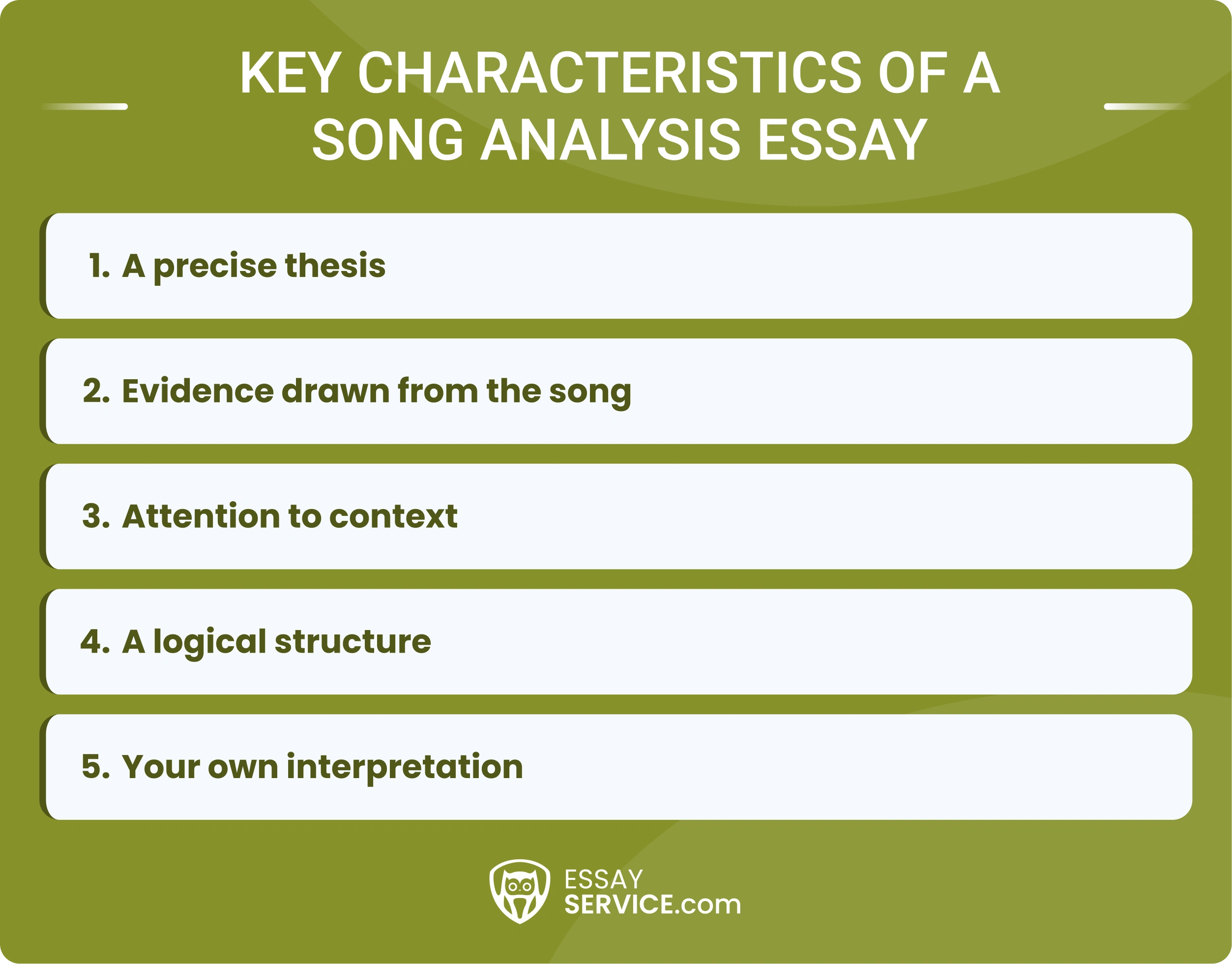
What is a song analysis essay, ultimately, comes down to a close reading of one track, followed by the task of arguing a specific claim about what the song means or how it works. Everything you write has to answer back to the track itself. It is, you would have probably noticed, similar to poetry analysis, but song analyses have one added layer of melody, which brings its own meaning. Your opinion counts only when the music gives you grounds for it. A solid song analysis essay tends to include:
- A precise thesis about the song's meaning
- Evidence drawn from the lyrics, the sound, and the vocal delivery
- Attention to context, such as the artist, the era, and the genre
- A structure that actually leads your reader somewhere
- Your own interpretation, with the track there to back it up
What to Analyze in a Song
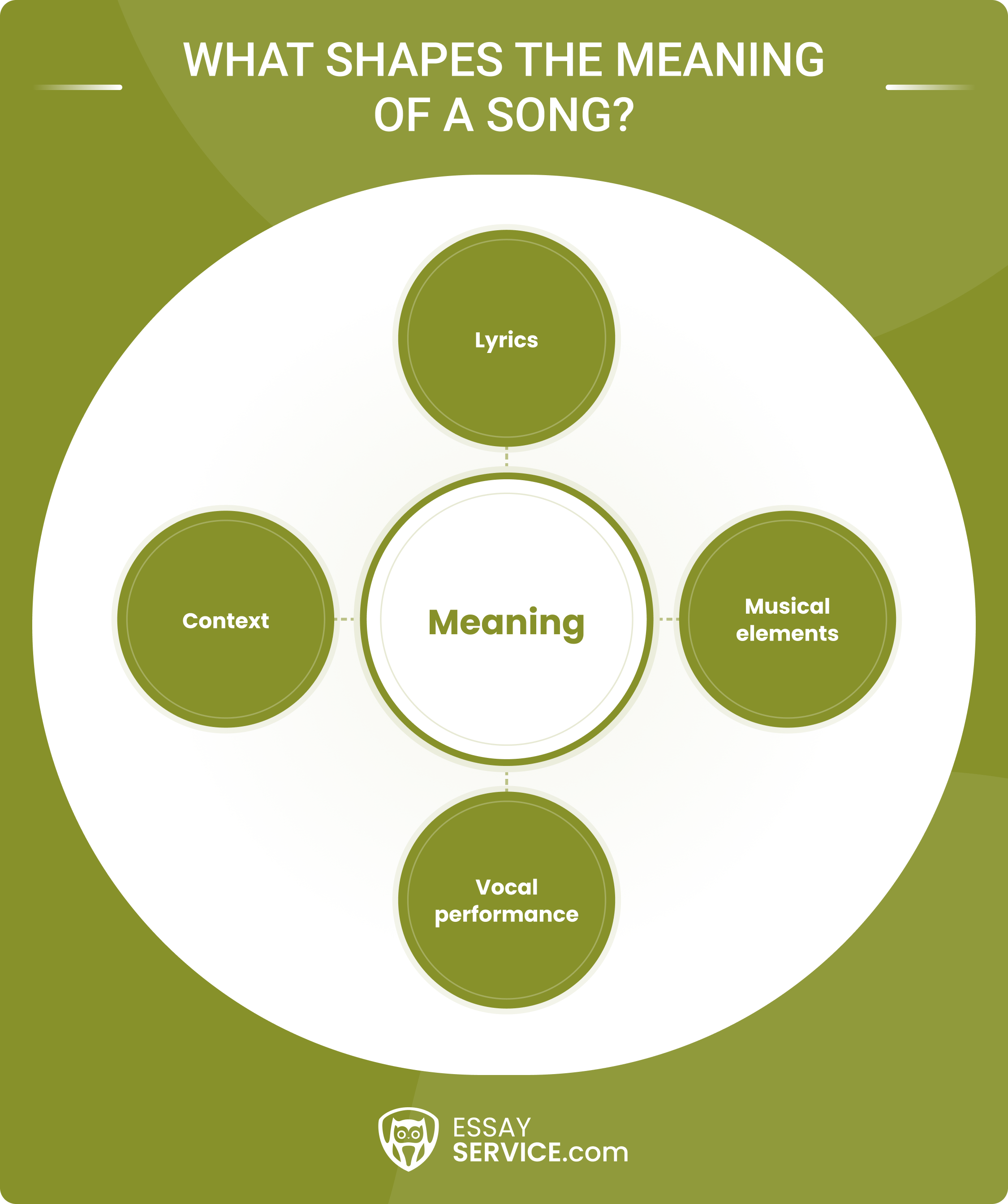
When you work out how to analyze a song, a general piece of advice I give everyone is to do it in layers, because you can’t bring the argument together unless you dissect the track into pieces:
Lyrics. The words and the story underneath them. Imagery, repetition, rhyme, arc.
- What is the song really about, once you get past the chorus?
- Which lines repeat, and why might that be?
- Is the speaker being honest with you?
Musical elements. Tempo, key, instruments, rhythm.
- Does it feel fast, heavy, or bright?
- How does the chorus shift energy against the verses?
Vocal performance. How the singer actually delivers the words (delivery, tone, phrasing).
- Is the voice raw, smooth, or strained?
- Where does the emotion spike?
Context. Everything around the track, including the author’s background and political context.
- When was it written, and what for?
- What was the artist living through then?
- How does the genre set your expectations going in?
Pro tip: Describe the music in plain words; you do not need overcomplicated terms. Then say what effect it has on the listener.


Stuck on Page One?
Our writers turn your topic into a finished, on-time, plagiarism-free essay.
Song Analysis Essay Outline
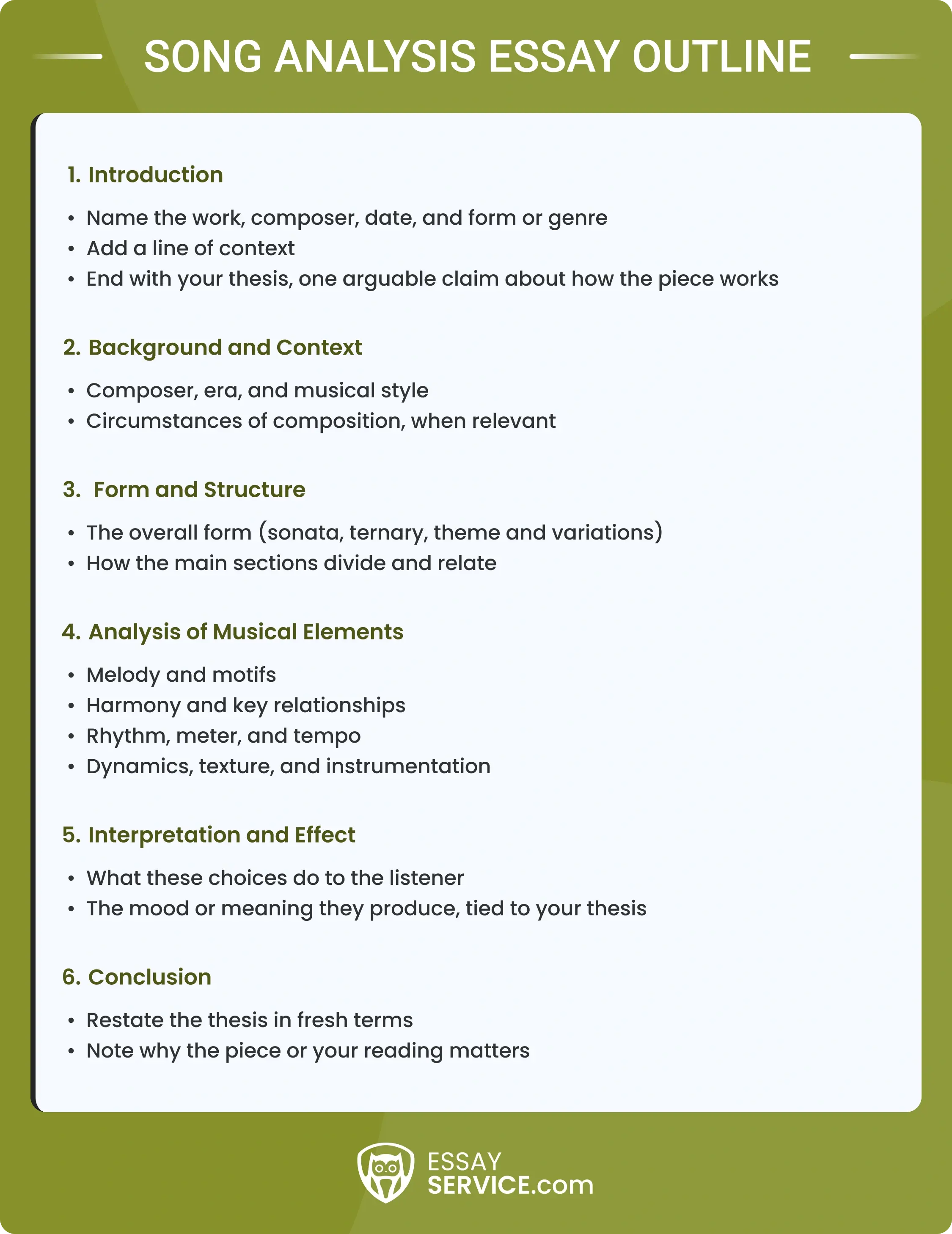
A song analysis essay outline saves you from wandering off mid-draft, so put one together before you write anything real. Here's the song analysis essay format I give my own students, section by section.
1. Introduction
- Name the song, the artist, and the release year
- Add one sentence of quick context
- Close with your thesis
2. Thesis
- A single arguable claim about what the song means or how it works
- Weak: "This song is about heartbreak." (Nobody would disagree, so there's nothing to prove.)
- Strong: "The song stages heartbreak as anger in its first half and grief only in the last verse, and the change in vocal delivery is what marks the turn."
3. Body Paragraph: Lyrics
- The key lines and what they reveal
- How the language supports your thesis
4. Body Paragraph: Musical Elements
- Tempo, instrumentation, dynamics
- The effect each choice produces
5. Body Paragraph: Vocal Performance and Context
- Delivery, tone, and the moments that land hardest
- Background that deepens the reading
6. Conclusion
- Restate the thesis in fresh words
- Say why the analysis matters beyond this one track
How Long Is a Song Analysis Essay
How long is a song analysis essay? For most courses, you're looking at between 750 and 1,500 words, which lands around three to five pages double-spaced. Check your assignment sheet before anything else, since your professor's stated number always overrides mine. A tight close reading of one track can come in near 500 words. A full research paper with sources might push well past 2,000.
How to Write a Song Analysis Essay in 7 Steps
Now for the actual process. These seven steps cover the entire thing in order, and the order genuinely matters, so don't jump ahead to writing before you've done the listening and the note-taking. This is how to write a song analysis essay without the stumbling starts that eat your first week.
Step 1: Choose a Song With Something to Argue About
Everything downstream depends on this one call. You want a track that resists a single easy reading, where the words and the music seem to disagree, or where one lyric could plausibly mean two opposite things at once. I had a student last term fight the same song for a full week before she realized it held exactly one idea, and by her second paragraph she'd already run out of things to say. Songs built on irony help. So do tracks that pivot halfway through, or ones where the distance between what a singer admits and how they sound leaves you room to work.
Pro tip: If one obvious sentence covers the whole meaning, there's nothing left to argue, and no essay to write.
Step 2: Listen at Least Three Times
One listen tells you how a song feels, and it tells you almost nothing about how the song actually works. Different jobs entirely. Play it three times at minimum, and hand each pass a single focus. First time through, don't analyze a thing, just take it in. Second pass, read the lyrics word for word as they go by. Third pass, ignore the words completely and follow what the instruments are doing, the drums, the bassline, the precise second something drops out and comes back. You'll catch details you would have sworn weren't there.
Pro tip: Use headphones. Panning, doubled backing vocals, small production touches, cheap speakers flatten all of it into nothing.
Step 3: Annotate the Lyrics
Pull up a complete lyric sheet and mark it up the way you would a poem, because that's essentially what it is. Circle the words that repeat. Underline the images. Flag every line where the meaning turns, doubles back, or contradicts what came before it. When a line confuses you, write the question in the margin instead of skimming past, since confusion tends to mark exactly where the best material hides. And don't trust your memory of the words, because we mishear lyrics constantly, and if you build a reading on a phrase the artist never sang, that's a rough way to lose marks.
Pro tip: Watch what changes between verses. Repetition with a small variation, one swapped word or a single added line, almost always flags where the song wants your attention.
Step 4: Consider the Background
Now step outside the track for a while. Find out when it was written, what the artist was living through at that point, and what the genre expected of a song like this back then. A protest track from 1968 lands very differently once you actually know the year and what surrounded it. Interviews earn their keep here because artists will often explain a specific lyric or a production decision in plain words. Their explanation, though, doesn't get to overrule your own ears.
Pro tip: Reach for an interview only when the song itself backs the claim. If the artist swears the track is hopeful and every musical choice argues otherwise, believe the music and say so.
Step 5: Build a Thesis From Your Notes
Go back through everything you annotated and dug up, then hunt for the pattern that runs under all of it. What keeps resurfacing? Your thesis should grow out of those notes, and it shouldn't get decided in advance and bolted on afterward, which is the error I see most. A workable claim points at something specific in the song and takes a position a reasonable person could argue against. "The song uses its silences as the loudest moments" gives you somewhere to go. "The song is emotional" gives you nothing.
Pro tip: A good thesis is one that can be argued with. If no one could reasonably disagree, what you've got is a face.
Step 6: Draft With Evidence, Not Summary
Here's where most essays fall apart. Every body paragraph runs on the same three-part spine:
- Make a claim.
- Give the evidence from the song.
- Explain the effect that evidence creates.
That third move, the explanation, is the one students drop, and it happens to be the whole point of the exercise. Don't just tell me the second verse gets louder. Tell me what the added volume does to the meaning. And keep tying every paragraph to the thesis.
Pro tip: If a paragraph could be swapped for "and then the song says…" without losing anything, that's a summary. Rewrite it as an analysis.
Step 7: Format and Proofread
First drafts exist to get the thing onto the page, nothing more. Revision is where the essay actually gets good. Read for logic that skips a step, paragraphs that drift off your thesis, and claims you asserted without ever proving them. Then handle your citations, because lyrics follow their own rules in MLA and APA, and professors do check. When you cite a song, include:
- the songwriter or artist
- the track title
- the album
- when it was released
Get the song analysis essay format right so a minor slip doesn't cost you marks you already earned.
Pro tip: Read the whole essay out loud. Your ear catches clumsy sentences and holes in your logic that your eyes slide straight past.
Song Analysis Essay Examples
Theory only takes you so far. The five song analysis essays below put every step into practice, and each takes a different song and a different structure. Read each song analysis essay example as a model to adapt, not copy.
Song Analysis Essay Example #1
Frank Ocean released "Bad Religion" in July 2012 as the emotional core of his debut album, Channel Orange, and the track landed just days after he posted an open letter admitting that his first love, a man, never returned his feelings. Plenty of listeners hear the song as a confession about unrequited love. They are right. The confession also stays fixed across the entire runtime, and that steadiness is the part worth examining. What actually moves is Ocean's voice. His early delivery stays guarded and tense, close to frustration, and he holds back the collapse until the final choruses. The timing of that collapse is the argument of the song. Ocean performs grief on a delay, and the delay is deliberate.
The song opens as a scene. Ocean climbs into a cab and asks the driver to act as his therapist for the length of the ride. A church organ holds under him, slow and solemn, and his phrasing runs long and spills past the bar lines, the loose cadence of a person who has held something in for too long. There is an edge here that people miss when they file the track under "sad." He sounds cornered. The voice stays controlled, almost clipped, and that control reads as a man managing something he does not yet want to let out. He confesses to a stranger precisely because a stranger is safe. The guardedness is the tell.
Song Analysis Essay Example #2
"Ob-La-Di, Ob-La-Da" is the sunniest three minutes on The Beatles' 1968 White Album, and that sunshine is exactly what should make a careful listener suspicious. Paul McCartney wrote it during the band's meditation retreat in Rishikesh as a ska-flavored number about a fictional couple, Desmond and Molly Jones, who marry, raise a couple of kids, and drift through ordinary life under a refrain about how life goes on. Everyone remembers the bounce. Here is the argument worth making. The cheer is a surface, and the story underneath it runs like a machine, the ordinary grind of a life on repeat. The gap between the giddy arrangement and that treadmill is the real subject of the track. The song sells contentment, and its own construction keeps leaking a plainer word, routine.
Consider first that the happiness had to be forced into being. The band spent roughly 42 hours on this one song across several remakes, and McCartney nearly gave up on it after days of slow, laborious takes. Lennon, who openly detested the tune and dismissed it as granny music, left in disgust, came back under the influence, went straight to the piano, and pounded out the intro much faster and louder than before, and that aggressive version is the one everybody knows. So the definitive "happy" recording exists because a resentful man attacked a piano. The cheer is a product. It was manufactured under duress. Nothing about that room fell naturally into a joyful mood. The origin matters, because a song about the easy flow of a normal life took brutal effort to sound effortless.
Song Analysis Essay Example #3
Björk's "Unravel," the third track on her 1997 album Homogenic, describes a love that comes undone across a distance while one lover is away, and the whole thing aches with longing. The lyric likens that fading love to a ball of yarn that unwinds whenever the man is gone. So here is a real puzzle. Why does a song about a relationship that is coming apart sound so still? Homogenic is a dense record that leans on orchestral strings and heavy electronic beats, and yet "Unravel" strips almost all of that away and leaves a church organ, a faraway pulse, and a voice with a lot of air around it. That emptiness is deliberate, and it is the argument. Björk stages the distance between two people by putting distance into the sound itself, and the space she leaves open is where the song makes its case.
Start with the beats. The electronic percussion on "Unravel" is set at the far edge of the mix, distant and muffled, so it reaches you faint and receding. I did not really register this for years, until one night on headphones I noticed how far off the rhythm actually is, so remote it barely reads as part of the same song. That placement is the whole point made audible. One lover speaks while the other is somewhere else, and the mix holds every heavy element at a remove, so you register the absence as a physical property of the recording. The pulse that should anchor a pop song stays out of reach, low and dim, and its distance tells you precisely how far the beloved has gone.
Song Analysis Essay Example #4
When Kendrick Lamar released "The Blacker the Berry" in February 2015 as the second single from To Pimp a Butterfly, the song's final three lines set off a fight that lasted most of the year. The track spends five furious minutes indicting American racism, and then the narrator turns the accusation on himself. He asks why he wept over Trayvon Martin's killing in the street while his own part in gang violence meant the death of another Black man, and he answers with a single word, hypocrite. A large share of listeners read that ending as a lecture. They heard Kendrick blaming African American communities for their own suffering, softening Trayvon's killing by pointing at Black-on-Black violence, and the charge of respectability politics trailed him for months. That reading is coherent. It is also, I think, a misreading, and the error is an error about who is talking.
The speaker of "The Blacker the Berry" is an unreliable narrator, and the song announces it out loud. Three separate times the narrator brands himself the biggest hypocrite of the year. In fiction, when a narrator declares that he cannot be trusted, a careful reader adjusts everything that follows. The furious voice that rails at white America is a constructed persona, and the closing confession is the trap the whole song was built to spring. There are, in effect, two speakers here. One accuses the world. The other accuses the first. They share a single mouth, and the friction between them is the meaning of the track.
Song Analysis Essay Example #5
"Fourth of July" appears in the middle of Sufjan Stevens' 2015 album Carrie & Lowell, and it stages an imagined deathbed conversation between Stevens and his mother, Carrie, who died of stomach cancer in December 2012. The song runs on almost nothing, a hushed vocal, a muted piano, and a low synthetic hum that widens as the track goes on. What holds it together is repetition. Two patterns return again and again, and in both the return is where the meaning gets made. One pattern is a frame of tender nicknames that fills with a new image every time. The other is a blunt four-word sentence about death that arrives without variation at the end. The words in the first keep changing and mean more with each return. The words in the second never change and mean something new with each return. That is the method of the whole song, and it is the reason a track this bare hits as hard as it does.
Consider the nicknames first. Across the song the two voices trade endearments that use one small template, a possessive plus a tender little image, a firefly, a hawk, a dragonfly, a dove. Each return uses the frame you already know and drops a fresh creature or object into it, so the device stays familiar while the content keeps surprising you. The effect is cumulative. A single pet name is sweet. A dozen of them across a dying woman's last hours build an intimacy so dense that the coming loss becomes almost unbearable. The repetition does the emotional labor. It convinces you that these two people knew each other down to a private vocabulary of nonsense names. Stevens has said the part of the song that undoes him is not the death line at all. It is the little nicknames.
Essays Due? We've Got You
Skip the all-nighter and let experts handle your next paper.
Common Mistakes to Avoid in Song Analysis Essays
Most weak song analysis essays fall down in the same few ways. Watch for these traps as you write, so your song analysis essay makes an argument rather than a summary.
- Summary in place of analysis. Retelling the plot is not an argument, so always explain what a detail means.
- A poem-only reading. The music is half the text, and any analysis that skips the arrangement throws away your best evidence.
- Technical facts with no follow-through. A tempo or a key proves nothing until you say what that choice does to the listener.
- Personal feelings as proof. Your reaction can launch a point, though the song itself must back it up.
- Too much quoting. A wall of quoted lines reads as filler, so interpret the words instead of reprinting them.
If you need help drafting your own analysis paper, you can reach out our essay writer service and ask our professionals for assistance.
Final Thoughts
A strong song analysis essay comes down to one habit. You treat the song as evidence and yourself as its interpreter. Pick a track worth arguing about, work across all four layers, and build a thesis someone could dispute. Draft with the claim-evidence-effect pattern, cite cleanly, and you move past summary into real analysis.
Frequently Asked Questions
How Do You Start a Song Analysis Essay?
What Should a Song Analysis Essay Include?
How Long Is a Song Analysis Essay?
Do I Need to Know Music Theory to Analyze a Song?
How Do You Cite a Song in an Essay?
What's the Difference Between a Song Analysis and a Song Review?

John spends his days studying the impact of language. He uses his deep understanding of linguistics and research experience to help students communicate more effectively and craft immaculate research-intensive papers.


New posts to your inbox
Your submission has been received!