Key Takeaways
- 92% of Gen Z use slang in daily conversation, the highest of any generation.
- Only 10% of people use slang with a boss, and 58% wouldn't use it in front of one at all.
- 56% wouldn't hire a candidate who used slang during the interview process.
- 53% of boomers, 30% of Gen X, and 25% of Gen Z say they struggle to understand other generations' slang.
Gen Z uses more slang than any working generation, with 92% of its members using it in daily conversation. But does informal talk translate well into office-appropriate language? More than half of the American workers (of all generations), 58% to be more precise, say they wouldn’t use slang in front of the boss, and 44% even avoid it in front of their colleagues. So, there’s your dissonance: the generation that is the most fluent in informal communication enters the workplace where the majority censors it.
So young professionals learn (have to learn, really) to speak in two dialects, one is the loose talk of group chats, and the other, measured “per my last email” and “touching base.” It would not be an overstatement to say that this code-switching is a survival skill for dodging being called inappropriate and unprofessional. In this article, we’ll talk more in detail about what the data says about Gen Z slang at work.


Your Papers, Done Right
Skilled writers craft your piece to connect with the audience you want to reach.
How Common Is Slang Among Gen Z?
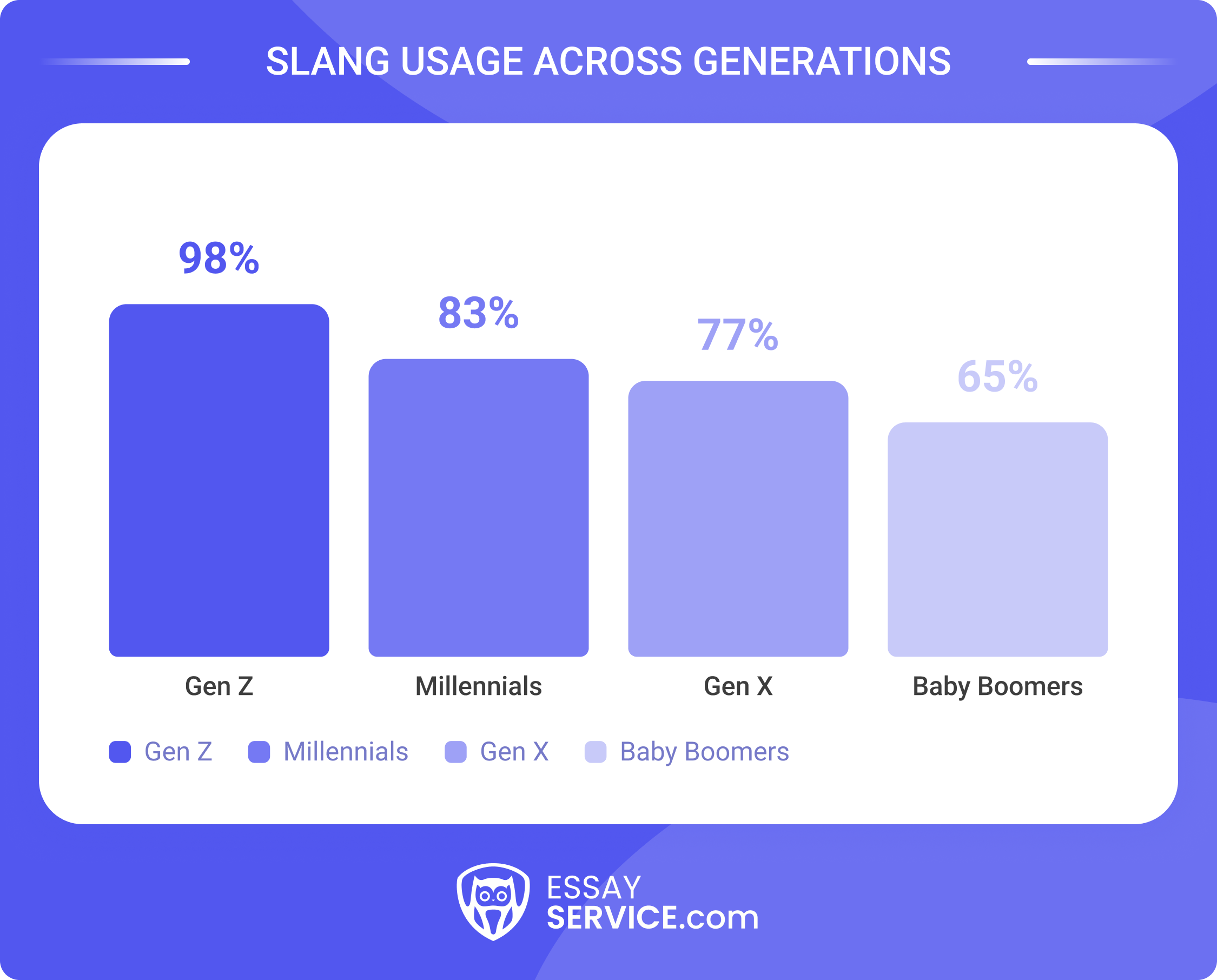
Slang is the default setting of everyday talk for most people, but even more so for Gen Z. We mentioned in the introduction that, according to the Preply survey, Gen Z slang in the workplace is more than prevalent, with 92% of the generation using it regularly, but we didn’t say that it’s the highest share of any other generation. Generally, the lower the age, the higher the slang use: the same survey shows that only 65% of baby boomers conversate with informal language, 77% of Gen X, and as for millennials, the number goes up to 83%.
The vocabulary itself changes far too fast for the older generations to easily catch up. Gen Z's most-used term in the survey was "low-key," while millennials leaned on "salty" and Gen X favored "ghosted." Day to day, you'll also hear "sus," "slay," "no cap," and "lit." Where do all these new words come from? TikTok. Then DMs and group chats.
What Gen Z Slang Is Considered Unprofessional at Work?
Slang does not automatically mean unprofessional, though. But in-group abbreviations and the expressive terms (think "iykyk," "no cap," "slay," "sus," and others more associated with Gen Z brain rot) typically fall under that category.
A UCLA sociolinguistics study asked Gen Z workers to write an email to a superior. The participants, surprisingly, rated their own communication style as unprofessional, although they still used emojis and exclamation points and didn’t deem them inappropriate.
went further and asked Gen Z workers to write to a superior; the participants rated their own slang and abbreviations as unprofessional, though emojis and exclamation points still passed when the tone called for warmth.
So which words fall on which side? These are common examples of Gen Z workplace slang and where they tend to land:
A single exclamation point doesn’t really read as a problem in Gen Z corporate communication. But even “low-key,” considered as one of the more desk-conversation-appropriate phrases, can still be perceived as too casual in a contract email or a note to the legal team. But there are still terms that are unprofessional, full stop. “Slay” and “no cap” sound awkward the second your audience changes from peers to a hiring panel, for example.
Does Using Slang at Work Make You Look Unprofessional?
The blunt answer is that, as much as we don’t want it to, it can. Over half of respondents (54%) call slang inappropriate in a professional setting, and the reluctance climbs as the setting gets more formal:
- 58% wouldn't use slang in front of a boss
- 44% wouldn't use it around colleagues
- Only 10% actually use slang with a boss, the lowest of any setting
- 56% wouldn't hire a candidate who used it during screening
The final stat says the most about Gen Z slang in job interviews. More than half of respondents count it against an applicant before the interview even starts. And this isn't only older workers reacting. The UCLA study we mentioned above further proved that Gen Z does worry about competence and credibility just as much as the older generations do. So this does hold across all different ages. So, in an interview or a first note to leadership, drop the slang, because the people evaluating you will certainly notice it.
If you’re looking to research the younger generation and their habits in more depth, here’s an article about the recent claim that Gen Z doesn’t drink.
Does Gen Z Slang Create a Generational Communication Gap?
Slang divides by generation, and that division rewrites ordinary conversations into small acts of translation. Over half of baby boomers (53%) admit they can't decode what their kids and grandkids are saying. On the job, 30% of Gen X report trouble following their younger coworkers. And the confusion is not one-directional. A full 25% of Gen Z say they can't follow older colleagues either, so the Gen Z communication style can leave a manager guessing, too.
People do try to bridge it, which is the encouraging part. Over a quarter of millennials report learning newer slang so they can talk with the younger people on their teams. Baby boomers and Gen X ask younger relatives, millennials search YouTube, and Gen Z scrolls TikTok for the current vocabulary. Some words handle the crossing without any help at all. "Chill" belongs to Gen X and millennials both, "OMG" connects millennials and Gen Z, and "bummer" still works for boomers and Gen X. The gap is genuine. It also tends to close, one borrowed word at a time.
How Gen Z Is Changing Workplace Communication?
Set the findings next to each other and the story stops being about slang alone. Gen Z arrives with the deepest slang fluency of any generation, older colleagues stretch to follow, and the youngest workers tune their language to whoever is across the table. That two-way tuning is the real headline for Gen Z workplace communication.
Three things the data actually supports:
- Formality is easing. A 2023 Barclays LifeSkills survey found 73% of UK workers now communicate less formally, and 70% have watched workplace language change across five years, a shift they credit largely to Gen Z.
- Adjustment runs in both directions. Over a quarter of millennials study younger slang, while Gen Z pulls its slang back around managers.
- Toning down is not abandoning. Just 10% use slang with a boss, yet 92% of Gen Z use it daily, so the words don't vanish; they relocate to an audience that wants them.
Yes, the office reads more casually than it did ten years ago. But the evidence describes context-based adjustment, and it stops well short of proving that Gen Z has overturned professional norms. The register adjusts to the listener. The underlying expectations mostly hold.
Our extended essay writing service can give you a hand when you’re struggling to catch up with your deadlines.
Final Thoughts
So, the short version: 92% of Gen Z use slang daily, yet only 10% use it with a boss. That distance is the whole point. Gen Z reads the audience, eases off the slang for managers and clients, and keeps it running with peers. The pattern is adjustment.
Frequently Asked Questions
What Are Examples of Gen Z Workplace Slang?
Is It Unprofessional to Use Slang at Work?
Can Slang Cause Miscommunication Between Generations at Work?

John spends his days studying the impact of language. He uses his deep understanding of linguistics and research experience to help students communicate more effectively and craft immaculate research-intensive papers.
.webp)

New posts to your inbox
Your submission has been received!