
Writing a book review pushes you past simple reactions and into real understanding. It teaches you how to track ideas as they develop, notice patterns in the plot or in the author’s argument, and explain why a book works the way it does. This article breaks that process down and shows how a free book review template can guide each step, from reading with intention to shaping a clear summary, analysis, and judgment.
When deadlines pile up or the structure still feels slippery, EssayService’s book review writing service gives students practical support with academic reviews that need focus, depth, and careful organization.
A Simple Book Review Template
This simple book review template keeps your thoughts organized without losing your personal voice.
I. Introduction
This section sets the tone and direction of the review.
- Bibliographic Information: Include the book title, author, publisher, publication date, and genre.
- Hook: Open with a line that pulls the reader in and hints at the book’s core idea.
- Context: Briefly explain the author’s background or the book’s place in its genre or series.
- Thesis Statement: State your overall opinion of the book.
II. Body Paragraphs: Summary and Analysis
Here, you show both understanding and critical thinking.
- Summary: Offer a clear, spoiler-free overview of the plot summary or main argument, introducing key characters or ideas.
- Strengths: Analyze one effective element, such as themes, writing style, or character development, using specific examples.
- Weaknesses: Discuss an area that felt less effective and explain why.
- Optional Paragraphs: Longer reviews can explore additional themes, style choices, or comparisons.
III. Conclusion
This section reinforces your evaluation.
- Restated Opinion: Rephrase your main judgment.
- Recommendation: Identify the intended audience.
- Final Remark or Rating: Close with a lasting thought or an optional score.
Formatting matters in academic work, so it helps to review how to write book titles correctly before you start drafting your review.
Printable Book Review Template
This free printable book review template PDF file is built to handle most academic tasks without forcing your thinking into a rigid box. It works for short reflections, formal book reports, and longer analytical reviews. The structure stays familiar, while the space inside each section lets you adapt the depth, tone, and length based on the subject or course expectations. Literature, history, psychology, sociology, or education classes all fit comfortably within this format.

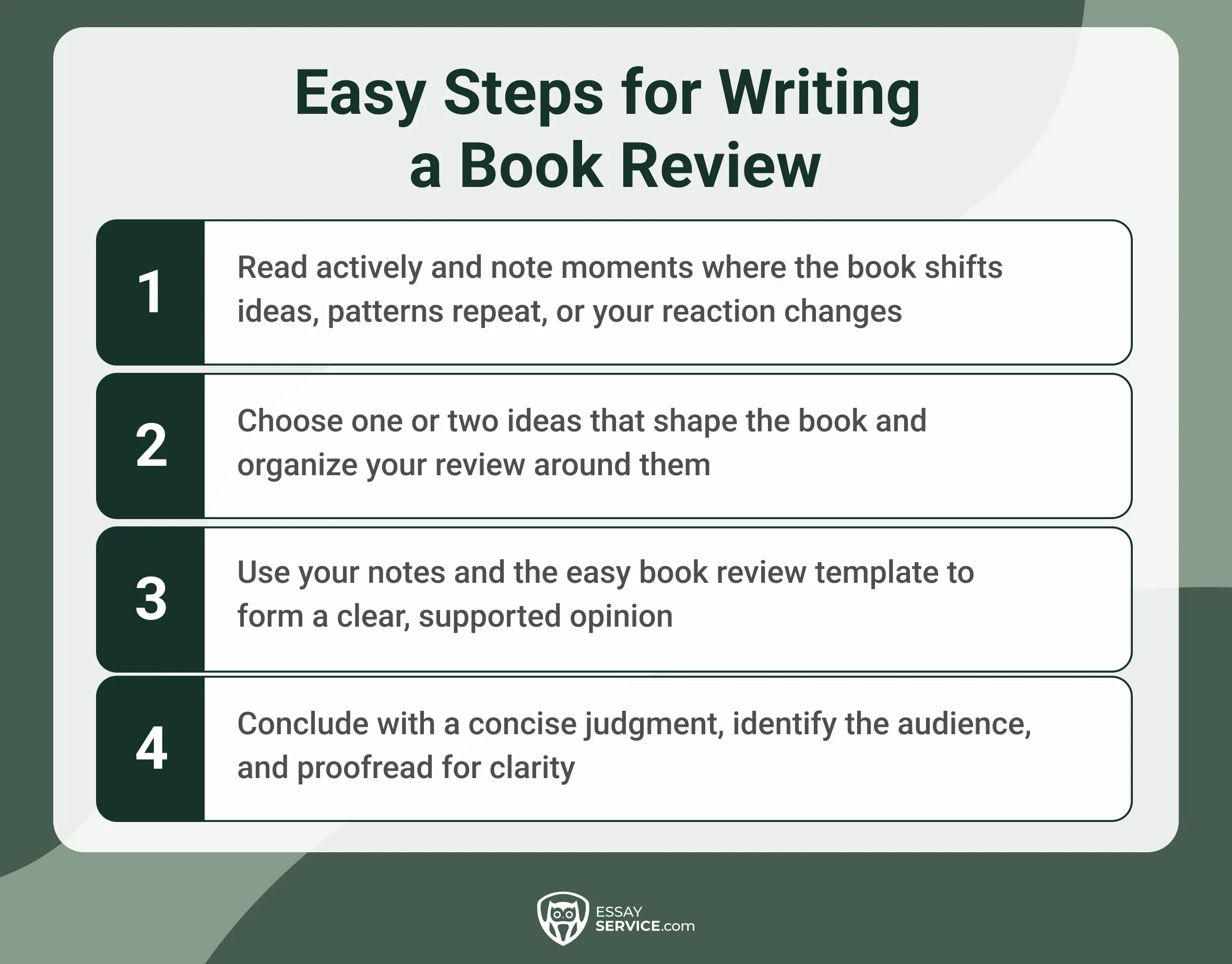
Easy Steps for Writing a Book Review
A strong review shows how well you followed the author’s choices, judged their effectiveness, and formed your own position as a reader. The steps below pair naturally with an easy book review template, helping you move from reading to analysis without losing your voice.
If you are one of those book lovers who enjoy reflective reading journeys, browse our list of books like Harry Potter to get useful comparison points for genre and structure.
Step 1: Read Actively and Take Notes
Read the book with purpose, not just for enjoyment. Pay attention to what the author is trying to do beneath the surface and how the story or argument develops.
- Identify the author’s main goal or central idea.
- Track key elements such as major plot points, character changes, themes, and writing style.
- Notice moments where the direction shifts or ideas repeat.
- Jot down reactions to scenes, quotes, or passages that stand out.
Step 2: Organize Your Notes Around Key Ideas
Before writing, step back. You do not need to cover everything. Strong reviews choose focus over exhaustiveness.
Identify one or two central ideas worth discussing. These might involve a theme, a character arc, or a structural choice that shapes the entire book. Once you know your focus, organize your thoughts into a clean progression: opening context, analytical discussion, and final evaluation.
Step 3: Start Writing Using Your Notes
Now the review takes shape. Use your notes and the easy book review template as a structural guide, not a set of rigid rules.
Open with the essentials and a line that signals perspective. Introduce the title, author, and genre, then make your stance clear early so the reader knows where you stand. Follow with a brief, spoiler-free overview that gives just enough context to support analysis.
Move into evaluation with evidence. Discuss strengths and weaknesses using specific moments from the text. Comment on pacing, language, character depth, or world design where relevant. Keep the tone steady and fair. Even a sharp critique carries more weight when it feels measured.
Share how the book connected to other works you know or experiences you recognize. Your interpretation is the added value. No one else reads the book exactly the way you did.
Step 4: Revise and Finalize Your Review
A good conclusion leaves the reader oriented. Restate your overall judgment in fresh language and explain who would appreciate this book most. A rating can appear here if the assignment allows it, though clarity matters more than numbers.
Finally, proofread with care. Check names, dates, and details. Then, tighten sentences and remove repetition. Precision shows respect for both the author and the reader. The strongest reviews feel intentional right down to the last line.
Checklist for Book Review
Before you submit your review, pause and run through this checklist. A strong academic book review should include the following:


A clear opening paragraph that explains what the book is about and places it in context
A brief note on who the book is written for and why that audience matters
A critical discussion of the book’s main argument, ideas, or narrative choices
Balanced comments on what the book does well and where it falls short
References to specific examples that support your evaluation
Mentions of any supporting materials, such as charts, images, or diagrams, if relevant
Academic sources cited where the review draws on outside research
A clear identification of the book’s author or editor
An accurate and complete book title
The correct edition and year of publication
Publisher details, including the place of publication
Information on the book’s format and overall length
The ISBN and price, when required by the assignment
The Bottom Line
A clear review grows out of focused reading, smart note-taking, and a structure that keeps your ideas focused and coherent. Using a book review template for students helps turn scattered thoughts into a review that shows understanding and control over the material.
When time runs short or the expectations feel higher than usual, EssayService fits naturally into the process by helping students shape stronger, more confident book reviews.
Frequently Asked Questions
How to Write a Good Book Review Template?
How Do You Structure a Book Review?
How Should I Use a Book Review Template for an Assignment?
Where Can I Find a Free Book Review Template PDF?
How Long Should a Book Review Be?

Essie isn’t just an educator with a Bachelor’s in English: she’s passionate about writing. She uses her experience in grading papers to write comprehensive guides for our blog.
- University of Guelph Library. (n.d.). Book reviews. University of Guelph. https://guides.lib.uoguelph.ca/BookReview
- Queen’s University Library. (n.d.). Writing book reviews. Queen’s University. https://guides.library.queensu.ca/bookreviews/writing
- University of Waterloo Library. (n.d.). How to write book reviews. University of Waterloo. https://subjectguides.uwaterloo.ca/book_reviews/write



New posts to your inbox
Your submission has been received!