Nursing capstone project ideas represent the specific subjects explored in culminating study. They typically focus on a subject student want to research in a clinical setting or a healthcare issue. Nurses can choose from many topics for their capstone projects, including Evidence-Based Practice, Quality Improvement, Education, Informatics, and Leadership. Every nursing student needs to make sure that topic is specific enough to complete within time frame and is supported by research. Also, program's capstone requirements need to be knoen, whether it's for a BSN, MSN, or DNP.
Below are over 100 nursing capstone topics with the information provided on how to select an idea and what to expect.
What makes a good nursing capstone project idea?
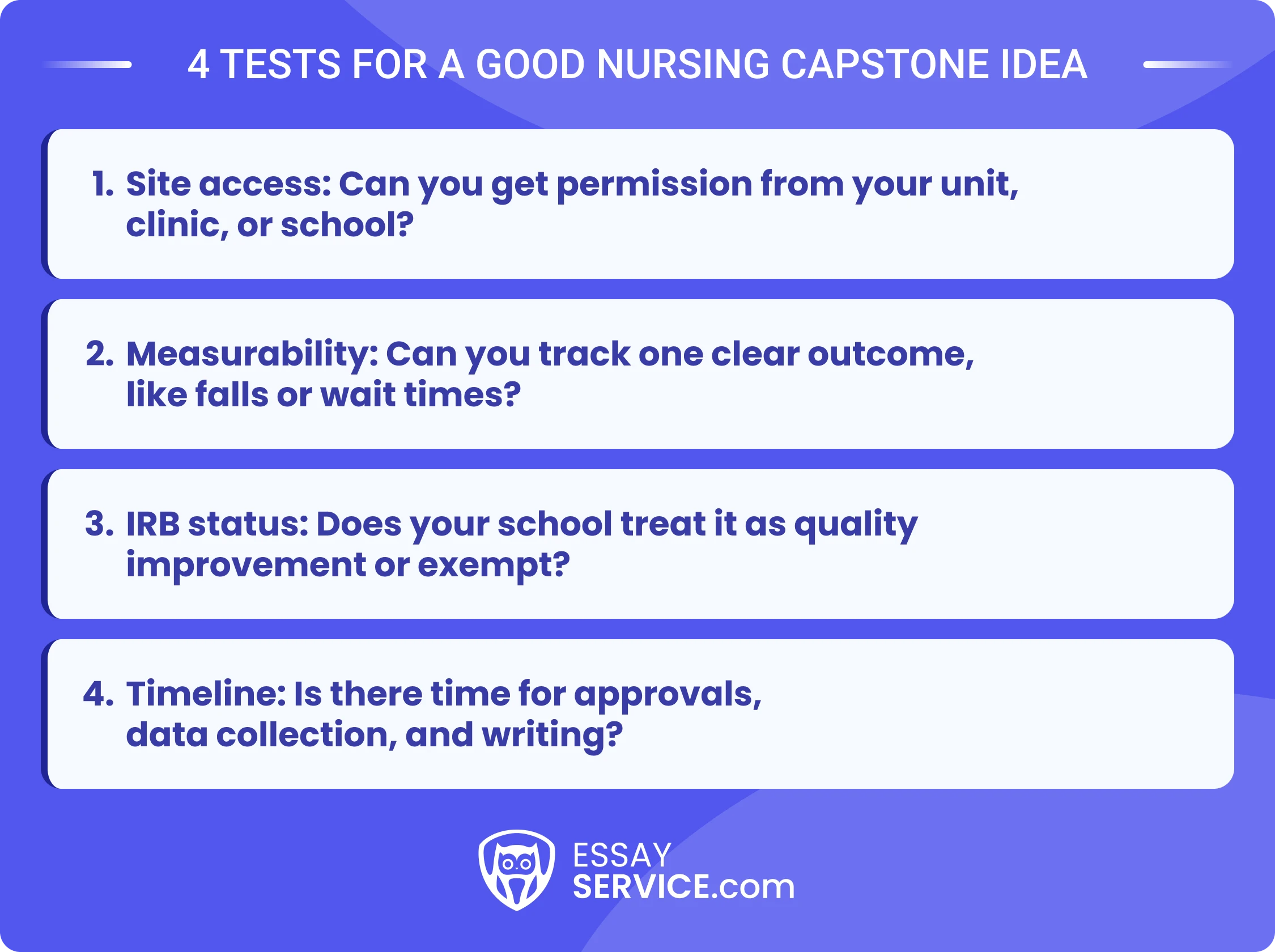
If you were wondering what is a capstone project in nursing, they could be about quality improvement, an educational intervention or practice change. Usually, good nursing capstone project ideas will allow you to use evidence on a practice issue. Here are 4 questions that your idea should be able to answer.
- Site access: Site: Are you able to obtain permission from your unit/clinic/school?
- Measurability: Can you measure an outcome (i.e. falls, time to see provider, etc.)
- IRB status: Will it require IRB approval? Does your school consider this quality improvement or exempt?
- Timeline: Do you have enough time to complete this? You will need time for the approval process, collecting information and writing up your project.
If your idea does not meet one of these criteria, find something that can or try to modify your current idea.
What is the difference between a capstone project and a research paper in nursing?
The nursing capstone project is taking what you already know and using that to create something for your practice setting. It could be a protocol, teaching or some type of quality improvement. When writing a research paper you ask a question and use literature/data to help answer that question and create new knowledge. Some schools will require you to write a paper about your capstone project as well.
If you're developing a capstone project, nursing essay writing services can provide expert support with research, writing, and formatting.


Complete Your Capstone
Get expert help with your nursing capstone from idea to final draft.
What are nursing capstone project ideas by specialty?
Here are some nursing capstone project ideas that are separated by specialty. Find one that relates to your practice area. When looking for capstone project ideas for nursing students, make sure you can find a site to complete your project and have an outcome that you can measure.
Patient safety and quality improvement
- Hourly purposeful rounding to reduce inpatient falls
- A bed and chair alarm protocol for patients at high fall risk
- Turn clocks and repositioning schedules to prevent pressure injuries
- A daily skin assessment standard to catch pressure injuries early
- A barcode medication administration compliance audit
- “Do not interrupt” zones during medication passes
- A bedside shift-report standard using I-PASS
- A handoff checklist for patient transfers between units
- Staff education on when to activate the rapid response team
- An early warning score to trigger rapid response sooner
Population Health and Community Care
- Social needs screening (food, housing, transportation) at primary care visits
- A community health worker program linking high-need patients to local resources
- A mobile health clinic serving unhoused adults
- A school nurse program to reduce health-related absences
- A produce prescription program for patients with food insecurity
- Caregiver training and respite referrals for families managing home care
- An interpreter workflow for patients with limited English proficiency
- A transportation voucher program to reduce missed appointments
- A faith-community nursing partnership for wellness outreach
- Disaster preparedness education for vulnerable neighborhoods
Infection prevention
- A nurse-driven catheter removal protocol to reduce CAUTI
- A central line maintenance bundle to reduce CLABSI
- A chlorhexidine bathing program for patients with central lines
- Competency validation for central line dressing changes
- Preoperative skin preparation education to reduce surgical site infections
- An intraoperative antibiotic timing and normothermia checklist
- Hand hygiene monitoring with peer observers and feedback
- Hand hygiene education for visitors
- An isolation precautions audit with redesigned signage
- PPE donning and doffing competency training
Medical-surgical nursing
- A multimodal post-operative pain management protocol
- Timely pain reassessment after opioid administration
- An early ambulation protocol after abdominal surgery
- Bedside mobility goal boards to prevent deconditioning
- Teach-back discharge education for patients with heart failure
- Pharmacist-supported medication teaching before discharge
- 48-hour follow-up calls to reduce 30-day readmissions
- Readmission risk screening at admission
- An incentive spirometry adherence program after surgery
- A preoperative education class to reduce anxiety and length of stay
Critical care and emergency
- A sepsis screening tool at triage to speed recognition
- Hour-1 sepsis bundle compliance audits with feedback
- Emergency Severity Index triage accuracy training
- Nurse-initiated protocols to shorten emergency department waits
- CAM-ICU delirium screening every shift
- A delirium prevention bundle focused on sleep and lighting
- A nurse-led early mobility protocol in the ICU
- Adherence to daily sedation interruption and awakening trials
- A structured family update routine in the ICU
- Stroke screening at triage to shorten door-to-needle time
Mental and behavioural health
- SBIRT substance use screening in the emergency department
- GAD-7 anxiety screening in adult primary care
- De-escalation training on an inpatient psychiatric unit
- A sensory room to reduce physical restraint use
- C-SSRS suicide risk screening on medical units
- A safety planning intervention for patients at risk of suicide
- A peer support program for patients with serious mental illness
- Trauma-informed care training for inpatient nurses
- Metabolic monitoring for patients taking antipsychotics
- A brief mindfulness group for outpatients with anxiety
Maternal and child health
- A lactation consultant referral pathway before discharge
- Baby-Friendly hospital practices to raise exclusive breastfeeding rates
- Postpartum depression screening with the EPDS at pediatric visits
- A referral pathway for positive postpartum depression screens
- A skin-to-skin (kangaroo care) protocol in the NICU
- Family-integrated care in the NICU
- Prenatal education on preeclampsia warning signs
- A postpartum hemorrhage risk assessment checklist
- Safe sleep education for new parents
- A doula support program for high-risk pregnancies
Pediatrics
- Standardized pain assessment (FLACC) for nonverbal children
- Distraction techniques to reduce pain during IV starts
- A reminder and recall system to raise childhood immunization rates
- HPV vaccine education for parents of adolescents
- Family-centered rounds with parent participation
- Asthma action plan teaching for parents
- Obesity prevention counseling at well-child visits
- Developmental screening to catch delays earlier
- A transition readiness program for teens with chronic illness
- Virtual reality to reduce needle fear
Looking beyond nursing? Explore capstone project ideas for other majors to compare interdisciplinary approaches and research topics.
Gerontology and long-term care
- A nurse-led medication review to reduce polypharmacy in nursing home residents
- A Beers criteria screening tool for potentially inappropriate medications
- Person-centered dementia care training for nursing assistants
- Nonpharmacologic approaches to reduce antipsychotic use in dementia
- A music program for residents with dementia
- Advance care planning conversations at admission
- Staff education on POLST and portable medical orders
- A hydration program to prevent dehydration in residents
- A social engagement program to reduce loneliness in assisted living
- A sleep hygiene program to reduce nighttime waking
Community and public health
- A diabetes self-management education program in a community clinic
- A home blood pressure monitoring program for adults with hypertension
- Nurse-led coaching to keep adults with prediabetes from progressing
- Text reminders to bring overdue women in for mammograms
- Mailed FIT kits for colorectal cancer screening outreach
- A tobacco cessation program in a community clinic
- Plain-language patient materials for a primary care clinic
- Redesigned medication instructions for patients with low health literacy
- Health literacy workshops at libraries and senior centers
- Blood pressure screening at local barbershops
Nursing leadership and workforce
- Stay interviews to improve nurse retention
- A recognition program tied to unit turnover
- A preceptor training program to improve orientation quality
- A standardized preceptor and orientee feedback tool
- Self-scheduling to improve nurse satisfaction
- A shift-length pilot (8-hour vs. 12-hour) and nurse fatigue
- A new graduate residency program to improve first-year retention
- Structured 30-60-90 day check-ins for new graduates
- A shared governance council to give staff a voice
- Workplace violence prevention training for nurses
Nursing education
- A simulation debriefing model to improve teamwork in nursing students
- Virtual patient simulations to prepare students for clinical placements
- A flipped classroom approach for pharmacology
- Case-based learning in a fundamentals course
- Next Generation NCLEX-style cases to build clinical judgment
- The Lasater rubric for clinical judgment evaluation
- A redesign of annual competency validation for staff nurses
- A test anxiety program for nursing students
- Peer tutoring to improve course pass rates
- Cultural humility training in the nursing curriculum
Nursing informatics and technology
- Streamlining EHR documentation to cut nurse charting time
- Removing duplicate documentation fields
- A clinical decision support prompt for VTE prophylaxis
- An alert override analysis to refine decision support
- Telehealth follow-up visits to reduce no-shows
- Remote patient monitoring for patients with COPD
- Customizing cardiac monitor alarm parameters to reduce nuisance alarms
- Alarm management education for telemetry nurses
- Patient portal education to improve engagement
- A voice-to-text documentation pilot
Need more inspiration? Browse our collection of nursing research topics covering evidence-based practice, patient care, leadership, and healthcare technology.
What are BSN, MSN, and DNP capstone project ideas?
Scope grows with the degree. BSN capstone project ideas are usually small, unit-level changes. MSN capstone project ideas add a leadership, education, or program focus. DNP project ideas are practice-focused: Johns Hopkins describes them as grounded in evidence translation, improvement science, and systems thinking.
- BSN (unit-level): a post-fall huddle template; a noise-reduction plan to improve patient sleep; a pre-colonoscopy bowel-prep education video
- MSN (program-level): a clinical ladder redesign for staff nurses; an interprofessional rounding model on a med-surg unit; a nurse-led diabetic foot-check clinic
- DNP (system-level): an opioid stewardship protocol across a clinic network; a cost and outcomes evaluation of a hospital-at-home program; a collaborative care model for depression in primary care
Which nursing capstone topics should you avoid?
Avoid nursing capstone topics that fail the four feasibility tests above. These are the most common traps.
- Topics that are too broad: “Improving patient safety” has no clear outcome. Narrow it to one problem, one unit, and one measure.
- Outcomes you can’t measure in time: Long-term mortality or multi-year readmission trends won’t fit your timeline. Choose a short-term measure, like process compliance.
- Projects that need a site you can’t access: A great idea fails if no unit or clinic will host it. Get a signed letter of support first.
- Full human-subjects research on a short timeline: Full IRB review can take weeks or months. Ask whether your school treats the work as quality improvement.
- Questions already settled: Asking whether hand hygiene prevents infection adds nothing new. Look for a gap in your own setting instead.
- Topics that need data you can’t get: Protected health information often requires approvals. Confirm access before you commit.
Where can you find data for a nursing capstone project?
When looking for nursing capstone project ideas, make sure to search here:
- Your unit’s QI dashboard: Data your unit already tracks, such as falls or pressure injuries. Ask your nurse manager or quality department.
- CDC NHSN: The nation’s most widely used tracker of healthcare-associated infections like CAUTI, CLABSI, and SSI.
- AHRQ Quality Indicators: Safety and quality measures built from hospital administrative data.
- HCAHPS: The national survey of discharged patients’ hospital experience.
- CMS Care Compare: Public hospital quality data on readmissions and infections. It replaced Hospital Compare in 2020.
- Magnet documentation: If your hospital is Magnet-designated, ask nursing leadership for its nursing-sensitive outcome reports.
- CINAHL and PubMed: Search both for the evidence base. CINAHL covers nursing literature, and PubMed is free.
Tip: The strongest capstones use data the unit already collects. New data collection triggers IRB review and blows your timeline.
Finish With Confidence
Work with nursing writing experts to submit a strong capstone project.
Last word
A strong nursing capstone starts with a narrow, measurable problem on a unit you can access. Check site access, measurability, IRB status, and timeline before you commit. Match the scope to your degree, since BSN, MSN, and DNP projects differ in size. Use data your unit already collects, and avoid topics that are too broad or already settled.
Frequently Asked Questions
What is a nursing capstone project?
What are good nursing capstone project ideas?
How long is a nursing capstone project?
What is the difference between a BSN, MSN, and DNP capstone?
Does a nursing capstone need IRB approval?
How do you write a PICOT question for a capstone?
What is the difference between a capstone and a thesis in nursing?
Can you do a nursing capstone without a clinical site?

Essie isn’t just an educator with a Bachelor’s in English: she’s passionate about writing. She uses her experience in grading papers to write comprehensive guides for our blog.


New posts to your inbox
Your submission has been received!