Key Takeaways
- PISA reading scores dropped to their lowest level since 2000, from 489 in 2015 to 466 in 2025, with 56 of 74 countries showing significant declines.
- Lower test scores don't automatically mean lower intelligence, motivation, testing conditions, and what's actually measured all matter.
- Digital environments appear to trade some skills for others: weaker sustained attention and deep reading, but stronger visual pattern recognition and adaptability.
- IQ has risen and fallen by similar margins before (the Flynn effect and its reversal), driven entirely by environmental factors, not biology.
Research continues to build around this hot topic. The OECD’s PISA 2025 results found that the average reading score across OECD countries fell from 489 in 2015 to 461 in 2025. They also continued to show declining scores in math and science over those years. In January 2026, Cognitive Neuroscientist Dr. Jared Cooney Horvath spoke to the US Senate Committee on Commerce, Science and Transportation about decreasing levels of attention, memory, reading, math, and executive functions.
Test scores can fall for reasons other than people becoming less intelligent. Many factors can affect testing and what is actually being measured. Here's a breakdown of what the data tells us about ‘is Gen Z smart’?, and what it leaves out regarding claims of intellectual decline.


Study Smarter Today
Get expert writing help while focusing on learning and academic success.
What Are Gen Z Cognitive Capabilities?
What's commonly understood as intelligence, and often summarized in shorthand as Gen Z IQ, is really a spectrum of specific abilities, each assessed individually.
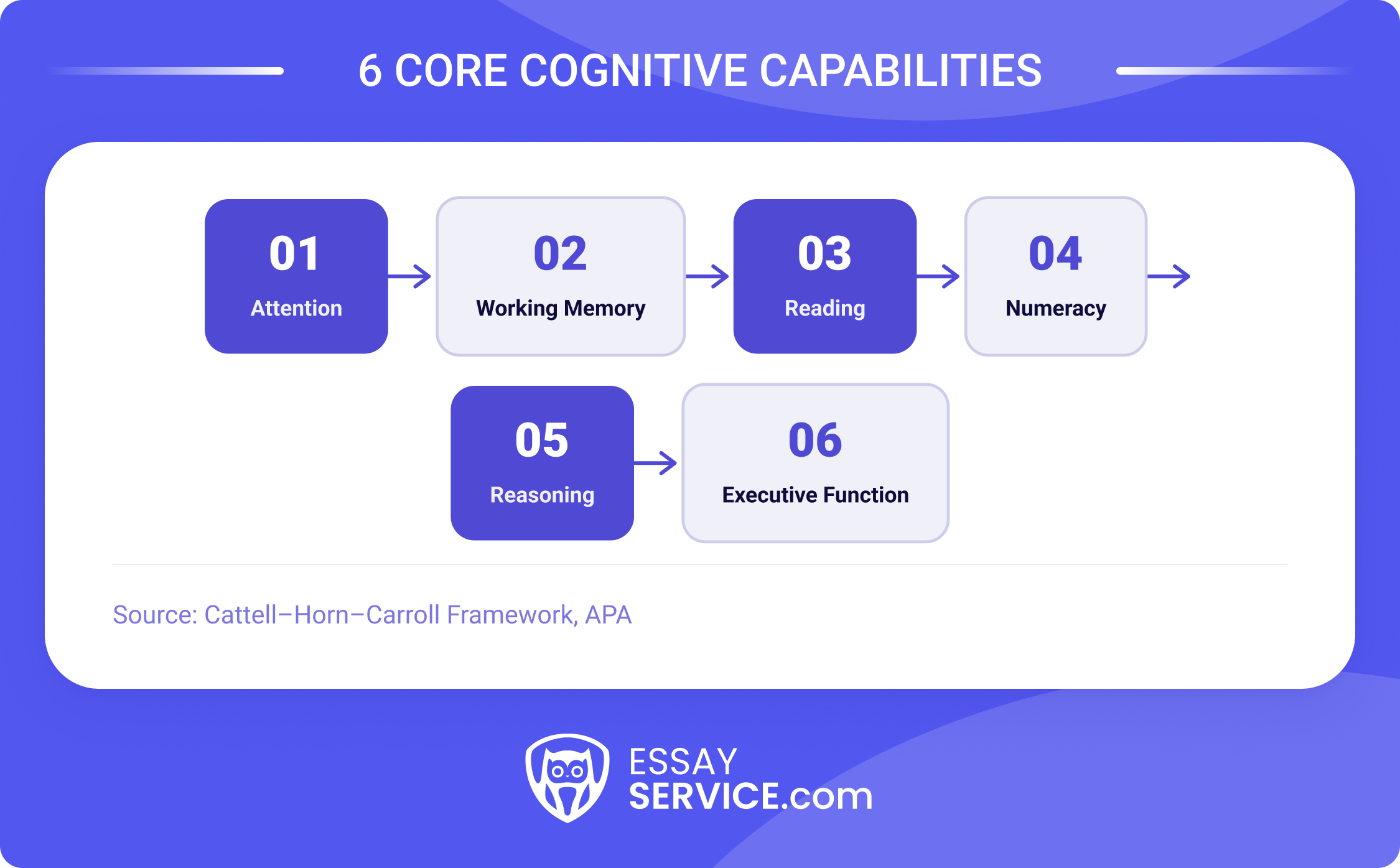
- Attention: How well someone can maintain focus on a given task and how many times they switch screens while doing so.
- Memory: Ability to learn and remember things. Both short-term memory and long-term memory.
- Reading Comprehension: Can read and understand an argument and analyze if it's valid or not.
- Reasoning: Solving problems you may not have known how to do before, and coming up with an answer.
- Math: Ability to do simple math equations and know how to reason about numbers.
- Executive Function: Higher-level functions such as Impulse control, planning, organization and memory.
Are Gen Z Cognitive Capabilities Declining?
The evidence for cognitive decline in Gen Z is genuinely substantial, at least on paper.
- The OECD data found reading scores among 15-year-olds dropped to their lowest level since testing began in 2000, falling from 489 points in 2015 to 466 in 2025, while math scores fell 22 points and science dropped 7 points over the same window.
- Of 74 countries with comparable data, 56 saw a "significant decline" in reading specifically.
- A peer-reviewed 2025 paper in the International Journal on Integrating Technology in Education links this to fragmented attention from digital environments, frequent interruptions and rapid content switching that weaken sustained focus, inhibition control, and goal-directed behavior.
However, while test scores can be an indicator of intelligence, treating them as proof of a genuine Gen Z IQ drop has real flaws. One being that PISA tests are not meant to measure IQ. As mentioned before, many students today may have less motivation to complete these tests. Studies have shown that many students aged 15 to 19 report being less likely to persist with problems. This can play into the decrease in PISA scores. Many students who would be taking these tests grew up before the pandemic as well. While we can say there is a decline in these scores, we can't directly correlate this decline with a loss of intelligence.
To better understand today's workplace culture, explore common Gen Z slang for work and how it reflects changing attitudes toward careers.
How Are Cognitive Capabilities Measured?
Most of the data behind the "cognitive decline" debate comes from a handful of measurement tools, each with real strengths and real blind spots.
- Standardized tests like PISA, TIMSS, and PIRLS assess reading, math, and science performance across large, internationally comparable samples, which are useful for tracking trends over time, but sensitive to test format, motivation, and curriculum differences between countries.
- IQ tests measure specific cognitive domains, such as verbal reasoning, working memory, and processing speed, and are designed to be relatively stable across time and culture, though they're still influenced by education, health, and test familiarity.
- Literacy and numeracy assessments measure functional skills in reading comprehension and mathematical reasoning and are often used to track basic competency levels within a population.
These measures can show performance on a specific task at a specific moment. What they can't show on their own is the full picture of intelligence, creativity, adaptability, or real-world problem-solving that goes beyond what a standardized test actually captures.
What Affects Gen Z Cognitive Capabilities?
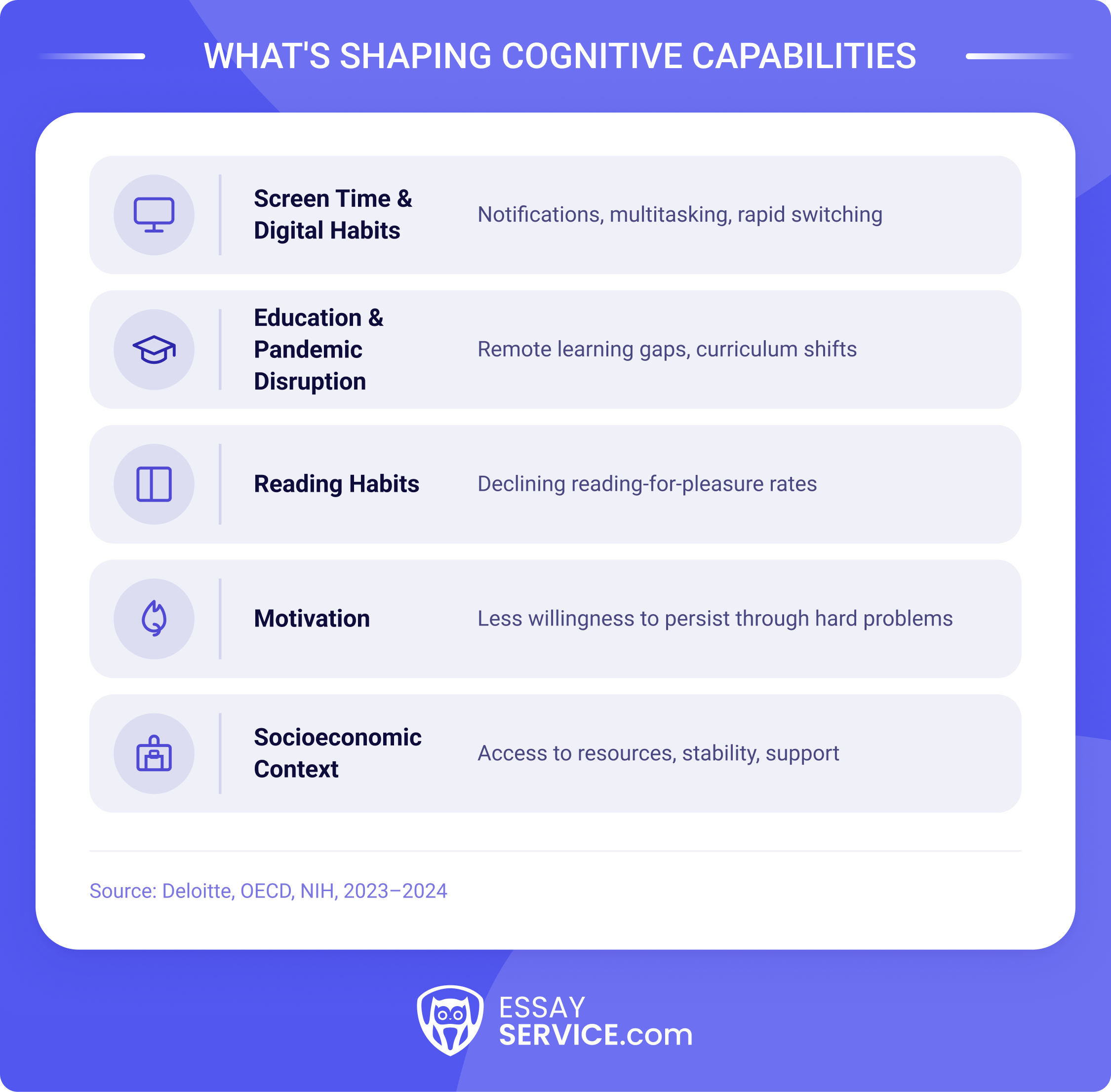
There have been many theories as to why people have noticed this pattern of Gen Z less cognitive development. Many believe that it has to do with technology and screen time. Lack of proper schooling and a change in reading habits are also believed to be causes. These can all play a factor into one another.
Screen Time and Digital Habits
It was shown in a 2025 study published in the International Journal of Technology Integration in Education that notifications, switching between content quickly and multitasking can all contribute to a scattered attention span, a lack of impulse control and difficulty focusing on your goals. The OECD’s data also show that PISA results are at their lowest for students across science, reading and maths. As well as testing them in a digital world, where students struggled to apply basic skills to problems. However, this can only be said to have some correlation with students falling behind. There may be something else that can explain students getting worse grades and spending more time on screens.
Education, Pandemic Learning, and Reading Habits
COVID-era remote learning disrupted schooling for millions of students, and the OECD's own PISA data show that reading scores across OECD countries fell by 28 points between 2015 and 2025, with 14 of those points lost between 2022 and 2025 alone, suggesting the decline predates and outlasts pandemic disruption rather than being caused by it alone. Reading habits have shifted too: the National Literacy Trust's own 2025 survey of nearly 115,000 UK children found just 32.7% of 8-to-18-year-olds said they enjoyed reading in their free time, a 36% drop from 2005 and the lowest level recorded in 20 years, a decline that could weaken the deep, linear reading skills standardized tests still rely on.
Growing up embedded in digital environments hasn't just eroded cognitive skills; it's actively reshaped some of them, strengthening certain abilities while weakening others.
How Digital Technology Is Changing Gen Z Cognitive Skills?
University of Rochester researchers Daphne Bavelier and C. Shawn Green found, in a landmark study published in Nature, that action video game players show enhanced visual selective attention, including a stronger ability to track and process rapid, cluttered visual information.
- Non-gamers trained on action games for just 10 days showed measurable gains in visual attention; a control group playing Tetris didn't.
- Bavelier's more recent research argues these gains generalize unusually broadly, transferring to tasks well beyond the original game.
Taken together, these points point to genuine strength in rapid scanning and pattern recognition, shaped by fast-paced digital environments, an important counterweight when discussing Gen Z cognitive performance as a whole rather than a single flattened trend.
UCLA reading researcher Maryanne Wolf's work on the "reading brain" found that digital reading inherently encourages skimming, a zigzag scan for keywords rather than the sustained, linear attention print reading cultivates. More than 80% of college educators report a "shallowing" effect on students' reading comprehension tied to screen-based reading, per unpublished research cited in Wolf's own work.
Our article on why doesn't Gen Z drink examines another trend shaping this generation's health and lifestyle choices.
Gen Z Cognitive Capabilities and the Flynn Effect
For most of the 20th century, IQ scores rose steadily across generations, roughly three points per decade, a phenomenon psychologists call the Flynn effect, named after researcher James Flynn. The rise was attributed to improved nutrition, expanded education access, smaller families, and increasingly complex, abstract modern environments.
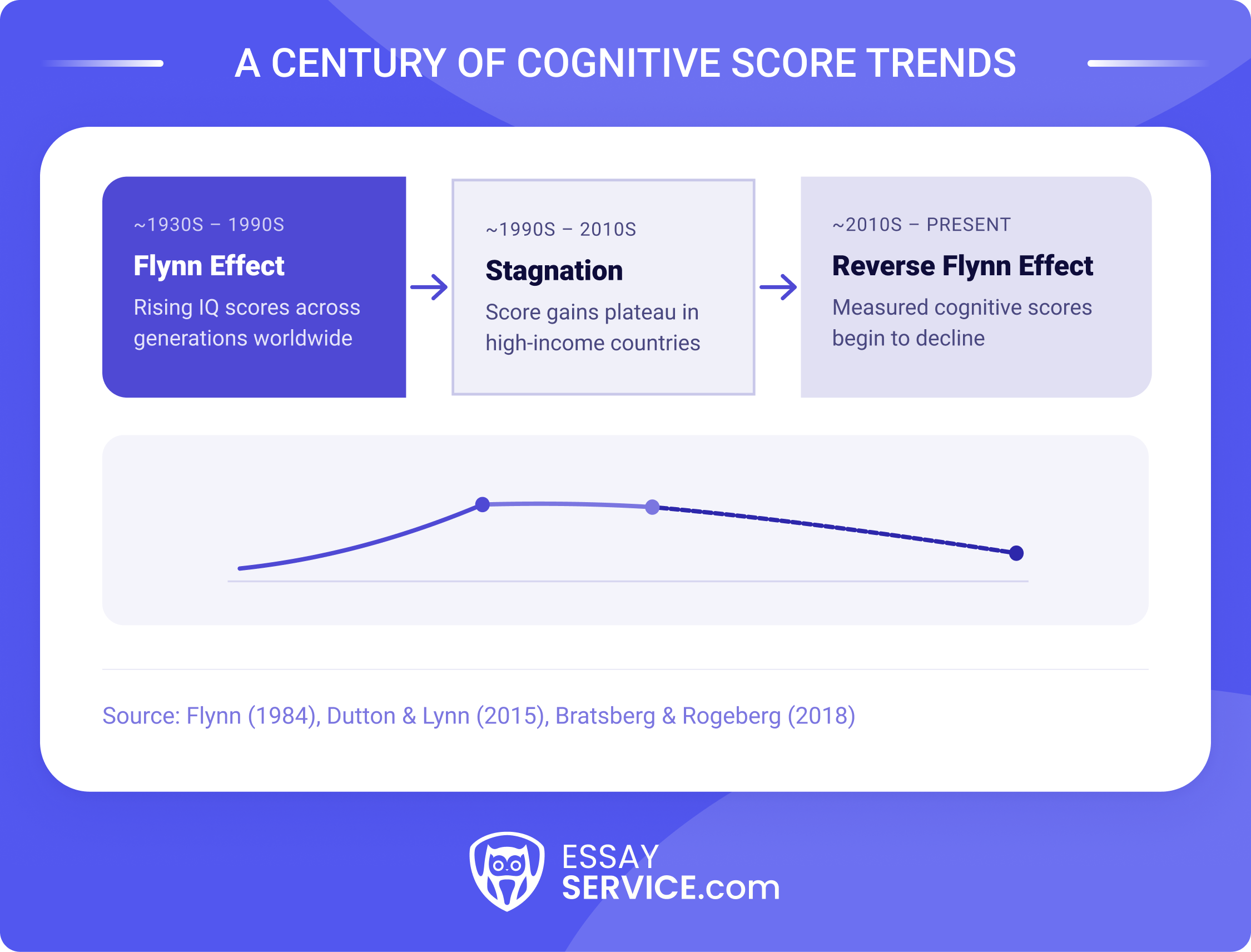
That trend has since reversed in several developed nations.
- A landmark 2018 study published in the Proceedings of the National Academy of Sciences by Norwegian researchers Bernt Bratsberg and Ole Rogeberg analyzed cognitive scores from more than 730,000 Norwegian male military conscripts born between 1962 and 1991.
- Scores rose steadily, peaked for the 1975 birth cohort, then began declining by roughly 0.2 IQ points per year afterward.
- Critically, the researchers found this pattern held even when comparing brothers within the same family, ruling out genetic shifts or immigration as explanations and confirming the cause was environmental.
This insight is significant for anyone analyzing Gen Z. If performance can change by three points per decade due to environmental factors like education, home life, and society, then cognitive test scores have always been shaped by the environments people live in. So it's important to know which environmental factors may be causing current-day scores to be where they are.
The discussion around Gen Z brain rot explores how excessive online content may affect attention, learning, and cognitive habits.
Gen Z Cognitive Abilities vs Previous Generations
Comparing Gen Z cognitive abilities to previous generations isn't really a story of "smarter" or "dumber." Different environments appear to strengthen different skills, and the research suggests genuine tradeoffs rather than a uniform decline.
The honest takeaway: Gen Z appears to be trading some depth of sustained focus for speed and adaptability, a shift shaped by environment, not evidence of a fundamentally less capable generation.
If you're writing about generational trends, our college essay writing service can help you organize research into a strong paper.
How Can Education Support Gen Z Cognitive Capabilities?
Technology doesn't destroy our minds, so we don't need to ban it from schools. Teach kids how to use it alongside other activities that challenge their thinking more deeply.
- Encourage deep reading sessions. Allowing your students time to read whole books will help them regain focus after skimming.
- Allow screen time in the classroom when it's needed. Don't let students have constant access to technology.
- Teach students how to determine if a source is credible. Don't expect this skill to come naturally.
- Allow no phone instruction time. Denmark will implement this in 2026, and its reading test scores are already higher.
- Have them solve problems using technology. Students learn more when they can interact with what they are learning about.
- Let them think through problems on their own before allowing AI to help. That way, they build stronger reasoning before using assistance.
Reduce Academic Pressure
Let professional writers handle assignments so you can stay focused.
Final Words
The debate over Gen Z's cognitive capabilities isn't as simple as "declining" or "fine." Test scores in specific domains, reading, math and sustained attention, have genuinely dropped, while other skills, rapid pattern recognition, digital adaptability, appear strengthened by the same environment. Rather than a verdict on intelligence itself, the evidence points to a generation whose cognitive profile has shifted, shaped by real, identifiable environmental factors that warrant direct attention.
Frequently Asked Questions
Does Gen Z Have a Lower Cognitive Ability?
Does Screen Time Affect Gen Z Cognitive Capabilities?
What Is the Reverse Flynn Effect?


New posts to your inbox
Your submission has been received!