
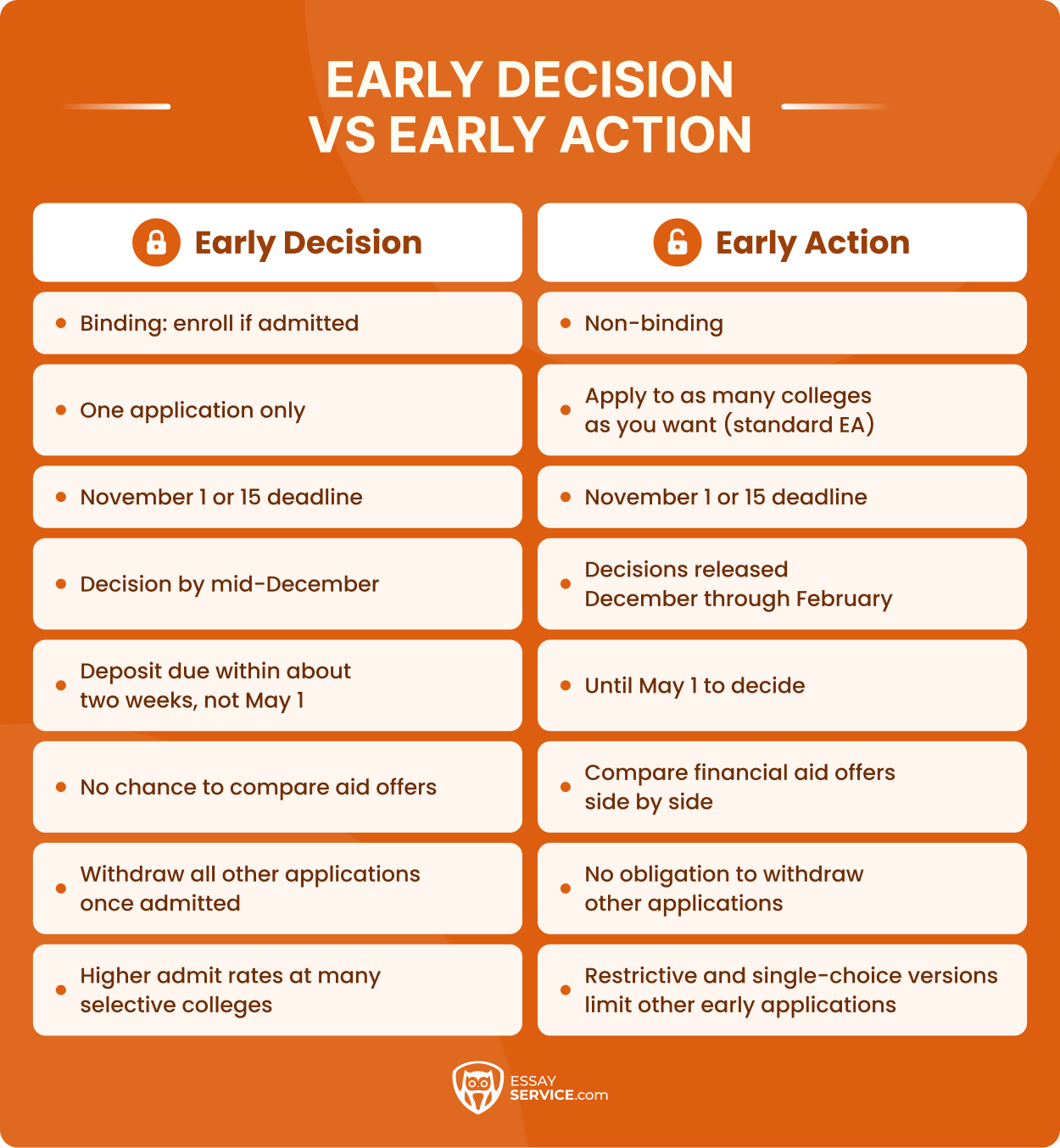
Early decision and early action are two early application plans with one core difference: early decision is binding and early action is not. A student admitted under early decision must enroll and withdraw other applications. Early action admits stay free to compare offers and decide by May 1. The early decision vs early action choice comes down to commitment: choose early decision only for a clear first-choice college.
What is the difference between early decision and early action?
The main difference between early decision and early action is commitment. Early decision binds a student to enroll if admitted, while early action does not. Early decision allows one application. Early action allows many and keeps the May 1 deadline to decide. The early action vs early decision choice turns on one question: commit now, or compare offers later.
What is early decision?
Early decision is a binding early application plan for one first-choice college, with a November 1 or 15 deadline and a decision by mid-December. Admission commits the student to enroll and to withdraw all other applications. In the early decision vs early action comparison, early decision asks for the most commitment and the earliest deposit.
- Three signatures. The agreement needs the student, a parent or guardian, and the school counselor to sign. The counselor’s signature is the operative one, because the counselor controls where transcripts are sent. Without that sign-off, the binding form and transcript never reach the college.
- Shared admit lists. Early decision colleges share admitted-student names with one another to enforce the one-binding-application rule. A student who tries to hold two binding offers risks having both admissions revoked.
- Early Decision II. A second binding round, with a January deadline and decisions in February, is available at dozens of selective colleges, including many liberal arts colleges. It suits a student deferred or denied from an early decision I or single-choice early action school who still wants a binding second attempt.
Read our article on Generation Z facts if you want to learn more about the young people’s abilities today.


Blank Page, Ticking Clock
Get help so you can easily turn that blank doc into a finished draft.
Is early action binding?
Early action is not binding. An early action admit has until May 1 to decide and can compare financial aid offers from other colleges first. One exception applies. A few colleges attach restrictions to their early action. Read the college’s own policy rather than a general definition, because the answer to is early action binding can vary by school.
What is restrictive early action?
Restrictive early action, also called single-choice early action, is a non-binding early plan that limits which other colleges a student may apply to early. Admission does not require enrollment, and the reply deadline stays May 1. The restriction blocks early applications to other private colleges, with named exceptions.
Most restrictive and single-choice early action policies still permit applications to:
- Public universities with non-binding early plans
- Colleges with rolling admissions
- Foreign universities
- Programs with early scholarship or honors deadlines
- Any college under regular decision
Does applying early improve your chances?
Applying early improves admission odds at most selective colleges, though the size of the edge varies. Early decision and single-choice early action applicants are admitted at two to four times the overall rate at many top schools. The gap reflects stronger, self-selected early pools as much as any plan-based advantage.
These rates do not isolate the effect of applying early. Early pools concentrate recruited athletes, legacy applicants, and students with the strongest academic profiles, all of whom would post high admit rates in any round. A borderline applicant does not inherit the headline early number. The honest read: early plans help a strong, decided applicant at the margin, and reward fit more than timing.
If you’re writing your final assignments for high school, you might need to learn different literary devices and how writers use them to convey a message.
Can you get out of an early decision agreement?
Early decision agreements release a student only for documented financial reasons, decided through the college’s financial aid office, not by the applicant alone. Changing one’s mind is not grounds for release. A student who simply declines risks losing the offer and other offers, because colleges share early decision admit lists.
The one accepted exit: financial aid. The agreement lets an aid applicant delay withdrawing other applications until the aid award arrives. If that award makes attendance impossible, the family may request release. The release comes only after the family consults the college’s financial aid office, and only genuine financial reasons qualify. A gap between the award and what a family hoped to pay is not automatic grounds.
How the release works in practice. An admitted student who applied for aid reviews the package, raises concerns with the aid office, and asks for release if the numbers do not work. Most colleges grant it when the need is real.
Backing out without cause. Walking away for a better offer has consequences that reach past the one school:
- Colleges share early decision admit lists to enforce the one-binding-application rule.
- The counselor signs the agreement and controls transcripts.
- A student who breaks the commitment can have the original acceptance and other acceptances rescinded.
The agreement is not a legal contract, but it functions as a binding ethical one that counselors and colleges enforce.
Before signing. Run the college’s net price calculator before committing, so the aid picture holds no surprises once the binding offer arrives.
What are early decision and early action deadlines?
Early decision and early action deadlines fall on November 1 or November 2 at most selective colleges, with regular decision due in early January. Early decision II, where offered, closes in early January and notifies in February. This early decision vs early action deadline table lists ten colleges with exact dates for the 2026-2027 cycle (fall 2027 entry).
Should you apply early decision or early action?
Choose early decision only when one college is a clear first choice and the cost works without comparing aid offers. Choose early action to gain an earlier answer while keeping every option open until May 1. The early action vs early decision decision turns on two factors: certainty about the college and the need to compare financial aid.
Get essay writing assistance and stop worrying whether or not you will submit your paper in time.
The Deadline Won’t Wait
Neither should you. Be quick to ask for help and let a writer take the essay off your plate.
Final thoughts
Early decision binds; early action does not. That single difference drives every other choice. Early decision suits an applicant with one clear first choice who can commit without comparing aid, and it can lift admission odds for a strong candidate. Early action keeps options open until May 1. Match the plan to certainty and cost, read each college’s policy, and apply early only when ready.
Frequently Asked Questions
What is the difference between early decision and early action?
Is early action binding?
Can you apply early decision to more than one college?
Can you apply early action and early decision at the same time?
Does early decision improve your chances of getting in?
What happens if you break an early decision agreement?
What is early decision II?
Can you compare financial aid offers under early decision?

Phil spends his working days teaching international trade. He contributes to our blog as a freelancer, leveraging his experience with MBA students to advise on academic writing, studying abroad, and securing funds.



New posts to your inbox
Your submission has been received!