Key Takeaways
- Digital activism reflects the tools and conditions each generation grew up with.
- About 68.7% of the global population uses social media, turning digital spaces into major sites of activism.
- Baby boomers favor structured, long-term organizing tied to institutions and workplaces.
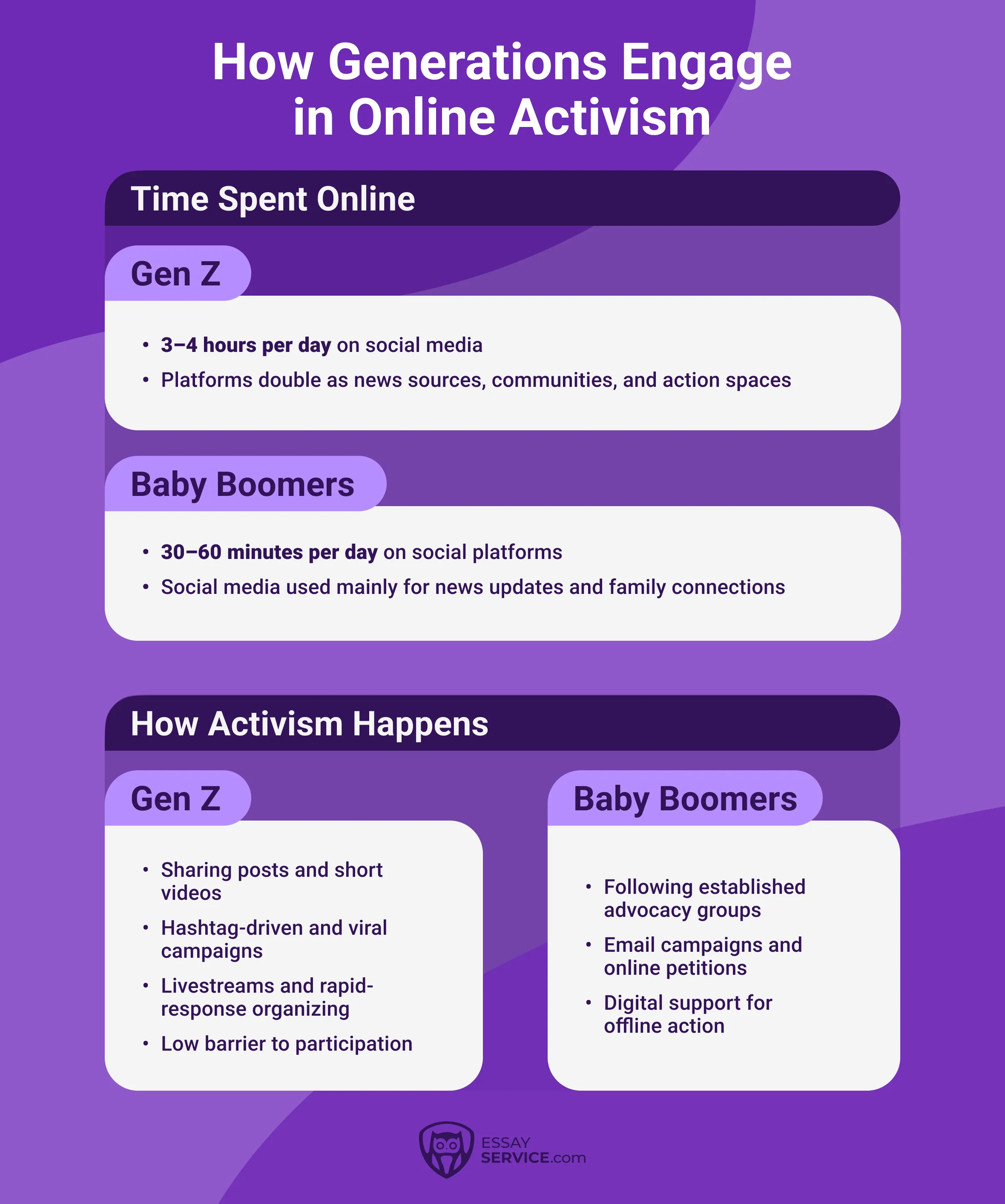
- The average person spends about 2.5 hours per day on social platforms, while Gen Z users spend roughly three times longer on social apps than people aged 65 and older.
- Online activism boosts speed and reach, while increasing emotional strain for younger users who are active every day
Digital activism refers to the use of digital tools and online platforms to promote social causes, shape public opinion, and coordinate political action. Across social media campaigns, online petitions, and fundraising links, activism movements now travel across borders at a speed previous generations never experienced. For Gen Z, activism usually begins online, formed through constant connectivity and daily social media use that blurs the line between expression and action. By contrast, baby boomers often rely on established organizing methods, with digital spaces added later as a supplement to offline efforts rather than the original engine of protest.
Because these differences matter in academic discussions, students often need help explaining how digital activism movements evolve across generations. EssayService supports that process by helping students turn complex social trends into clear, well-structured essays backed by credible research and careful analysis.


Get Direct Support From Human Writers
EssayService connects you with human writers who know how to shape analysis under real deadlines.
What Is Digital Activism?
Digital activism refers to the organized use of digital tools and online platforms to advance social or political change through collective action. Through networked communication, messages are amplified, supporters are mobilized, and campaigns are coordinated without reliance on physical gatherings. Individuals participate by sharing information, donating funds, or engaging with content that sustains visibility and pressure over time. Across these efforts, influence is often exercised through attention, reach, and sustained engagement rather than formal institutional access.
Statistical Insights: Gen Z vs. Baby Boomers in Digital Engagement
Social media now sits at the center of how the modern world communicates. Around 6.04 billion individuals, roughly two-thirds of the global population, actively use social media today. On an average day, users collectively spend more than 14 billion hours scrolling, watching, sharing, and reacting. That scale matters because it turns platforms into real spaces where opinions form, and pressure builds.
Usage is also scattered across platforms. Most people move between six or seven different apps each month, rather than staying loyal to one space. Phones dominate this behavior. About 98% of social media users access platforms through mobile devices, making smartphones the primary gateway to online interaction and digital activism. Facebook still leads with over 3 billion monthly users, while YouTube and Instagram follow closely behind. Meanwhile, faster-growing platforms like TikTok pull in younger audiences and shape how messages spread.
With that scale and access, it’s easy to see why digital activism spreads quickly. When millions of people carry a publishing tool in their pocket, attention itself becomes a form of influence.
Patterns of Activism Across Physical and Digital Spaces
Activism tends to mirror the tools people have at hand. Baby boomers came of age in a world where public space mattered most, and communication moved slowly through print and broadcast channels. Generation Z operates inside digital systems built for constant visibility, rapid sharing, and large-scale reach. The contrast comes from infrastructure and habit, rather than a difference in commitment.
For baby boomers, activism grew through direct, in-person coordination. Marches, sit-ins, and campus demonstrations required showing up, staying present, and organizing over time. News traveled through newspapers, television reports, flyers, and community meetings, which meant messages spread gradually and leadership structures stayed relatively clear. Common features of baby boomer activism include:
- Physical presence as the primary signal of commitment
- Organized leadership and clearly defined roles
- Slower information flow shaped by traditional media
Among Gen Z, activism usually starts on a screen. Typical characteristics of Gen Z digital activism campaigns include:
- Online platforms as the main coordination hub
- Low barriers to entry and fluid participation
- Rapid spread of information through peer sharing
Ideology and Motivation Shaped by Inherited Systems and Existential Threats
Earlier generations stepped into systems that were clearly imperfect, yet they still looked repairable: laws could be rewritten, and institutions could be pressured. Progress felt slow, but it felt possible, and that belief shaped how activism worked. For younger generations, the pressure feels different. Problems that once seemed separate now show up as tightly linked, from environmental damage to healthcare access to widening inequality.
Key differences in how problems are perceived include:
- Earlier generations saw issues as isolated and sequential
- Younger generations encounter overlapping crises all at once
- Visibility of failure increases through constant online exposure
Those conditions naturally reshape motivation. Individual effort once promised payoff. A degree opened doors, and loyalty to an employer offered stability. Shifts shaping motivation today include:
- Diminishing returns on education and long-term employment
- Persistent emphasis on individual responsibility
- Growing awareness of structural limits
Nowhere is this tension clearer than at work. Older generations often traded time for security, trusting that steady employment would return stability. That agreement has eroded. Short-term contracts, gig work, and shrinking benefits changed the calculation.
EssayService: Real Writers for Real Assignments
Get clear structure, original thinking, and writing that professors expect to read.
Common Critiques of Generational Activism
Public discussion often treats generational activism as a contradiction. Older critics question the depth of digital engagement, while younger activists view traditional methods as slow and out of step with current realities.
Generation Z is frequently criticized for slacktivism, where participation appears limited to posts, hashtags, or short bursts of attention. Decentralized organizing can weaken long-term coordination, but it also lowers barriers and allows fast, inclusive mobilization. The emotional cost is high.
Baby boomer activism draws criticism for its reliance on formal structures and institutional pathways. Organized leadership offers stability and strategic focus, yet slower timelines and physical participation requirements can restrict reach.
These contrasts become clearer when viewed side by side:
When deadlines pile up, request 'do my assignment' and let a professional handle the writing.
Digital Activism Examples
In 2025, digital activism showed up in different places, driven by different generations, reacting to very real pressure points. Some campaigns moved fast and loud, powered almost entirely by younger users online. Others moved more slowly, building on long-standing causes and adapting digital tools along the way. Together, they show how activism now lives on screens as much as it does in the streets.
Youth-Led Digital Justice Campaigns in Europe
This push came mostly from Gen Z. Young activists called out large tech companies for how platforms affect privacy, mental health, and public discourse. TikTok videos, Instagram posts, and coordinated hashtags carried personal stories that spread quickly across borders. Offline protests happened later, but the momentum stayed online. What made this movement stand out was how easily young people turned everyday social media use into sustained pressure without waiting for formal leadership.
Gen Z Protests and Online Repression in Kenya
In Kenya, Gen Z activists used social media to organize protests, share safety updates, and show the outside world what was happening on the ground. Posts and streaming services helped the movement grow fast. That same visibility came with risk. Surveillance, harassment, and digital intimidation followed closely behind. This case made something clear. Digital activism gives young people a voice, but it also exposes them in ways earlier generations rarely faced.
The UN Women UNiTE Campaign
The UN Women UNiTE campaign is a global effort to end violence against women and girls by treating it as a public, systemic issue rather than a private one. Launched by the United Nations, the campaign pushes governments to strengthen laws, fund survivor support, and invest in prevention. It also focuses heavily on visibility. Through global advocacy days, partnerships, and community action, UNiTE challenges social norms that allow violence to persist. The campaign connects policy reform with public pressure, recognizing that lasting change requires both institutional accountability and cultural shift.
Seen together, these examples of digital activism show that digital activism isn’t owned by one generation. Gen Z tends to lead fast, decentralized campaigns that spread quickly. Baby boomers often bring structure and persistence, using digital spaces to reinforce causes they’ve worked on for decades. Activism today works best when both instincts meet in the same space.
For context on digital fatigue and Gen Z, check out the brain rot study in a separate article.
The Bottom Line
Digital activism looks different across generations because the world that shaped each generation looks different. Baby boomers learned to push for change through institutions, long campaigns, and collective pressure built over time. Gen Z learned to act inside digital systems that reward speed, visibility, and constant response. Neither approach is shallow nor superior. Each reflects the tools, risks, and realities people live with.
For students unpacking these generational shifts, turning insight into a clear, well-argued paper can be challenging. EssayService helps bridge that gap by supporting research, structure, and writing when deadlines or complexity start to overwhelm the process.
Frequently Asked Questions
Is Digital Activism Effective?
How does Gen Z Approach Activism Compared with Baby Boomers?
What Is an Example of Digital Activism?
Does Digital Activism Work as Well as Traditional Activism?
What Does the Term Slacktivism Mean and Why Is It Linked to Gen Z?
.png)
Jaroslav specializes in helping students unlock their creative side and let it shine. Armed with his Bachelor’s degree in creative writing, he imparts his advice on making communication effective and engaging.
- Statista. (2024). Digital population worldwide.
https://www.statista.com/statistics/617136/digital-population-worldwide/ - BroadbandSearch. (2024). Average daily time spent on social media.
https://www.broadbandsearch.net/blog/average-daily-time-on-social-media - Statista. (2024). Leading social networks worldwide as of 2024, ranked by number of active users.
https://www.statista.com/statistics/272014/global-social-networks-ranked-by-number-of-users/ - Cambridge Dictionary. (n.d.). Slacktivism.
https://dictionary.cambridge.org/dictionary/english/slacktivism - Journal of Democracy. (2025). Why Kenya’s Gen Z has taken to the streets.
https://www.journalofdemocracy.org/online-exclusive/why-kenyas-gen-z-has-taken-to-the-streets/ - UN Women. (n.d.). Ending violence against women: UNiTE campaign.
https://www.unwomen.org/en/what-we-do/ending-violence-against-women/unite/theme - The Guardian. (2025, December 9). How a youth movement for digital justice is spreading across Europe. https://www.theguardian.com/media/2025/dec/09/youth-movement-digital-justice-spreading-across-europe
.png)

New posts to your inbox
Your submission has been received!