
A cliché is an overused phrase that no longer delivers clear meaning. It appears so frequently in writing or spoken language that it adds nothing specific to the point you want to make. Common versions include “time heals all wounds,” “last but not least,” and “only time will tell.” These expressions weaken your writing because they replace precise ideas with empty repetition. A simple check for repeated patterns helps you remove the overused cliches before they weaken the rest of your draft.
In this article, you’ll see various examples of cliches, along with a downloadable PDF list for students. You get practical steps that help you avoid vague phrasing in your own work. EssayService appears here as a reliable place where you can request writing support, get help shaping ideas, and receive guidance that keeps your sentences clear.


Don’t Risk AI Detection
Ask one of EssayService’s professionals for help and turn in authentic papers every time.
What Is a Cliché?
A cliché is a repeated phrase or idea that no longer adds meaningful information. The words appear so frequently that they provide no clear detail, and the sentence loses strength because of this. You will definitely benefit from replacing those vague lines with direct statements that better express the intended ideas. A cliche in a sentence usually appears when the writer uses a familiar shortcut instead of a precise description. A quick review identifies these places, and a small change improves readability immediately.
Identifying Clichés in Your Writing
Writers identify cliches by watching for phrases that appear in routine speech, casual advice, or general statements. You can use these simple tips to find cliché sayings in your papers:
- Look for phrases that provide no specific detail about your idea.
- Check for lines that could appear anywhere with no effect on meaning.
- Read each sentence and confirm that every phrase gives clear information instead of vague wording.
- Flag expressions that match common cliché sayings you hear in casual conversation.
- Mark phrases that repeat patterns you see in many texts rather than presenting a precise point.
Common Clichés on Different Topics
Many everyday phrases appear so often that they lose their impact. You’ll see these popular cliches in writing across different subjects, which makes them easy to miss unless you look closely.
- Time heals all wounds.
- Only time will tell.
- At the end of the day.
- Opposites attract.
- Every cloud has a silver lining.
- Ignorance is bliss.
- What goes around comes around.
- Easier said than done.
- Better safe than sorry.
- Practice makes perfect.
- The calm before the storm.
- The tip of the iceberg.
- Actions speak louder than words.
- Love conquers all.
- All that glitters is not gold.
- Rome was not built in a day.
- Every rose has its thorn.
- There is no place like home.
- Time flies.
- You win some, you lose some.
Plot Clichés
Storytelling often leans on familiar turns that readers recognize immediately. These patterns usually appear when a narrative follows well-worn paths instead of specific choices.
- The chosen one saves the world.
- The villain reveals the plan at the last moment.
- The mentor dies to motivate the hero.
- The main character wakes up and realizes it was a dream.
- The love interest appears at the perfect time.
- The group splits up and faces danger alone.
- The villain turns out to be a family member.
- The final clue appears in an old notebook.
- The hero wins because of a sudden realization.
- The main character survives against impossible odds.
- The story begins with a mysterious stranger.
- The lost artifact holds the answer.
- The team forms through pure coincidence.
- The hero defeats the enemy after a tense, drawn-out pause or standoff.
- The ending circles back to the opening scene.
- The villain returns after being presumed gone.
- The hero sacrifices something essential to succeed.
- The world resets after the final event.
- The last chapter introduces a new threat.
- The hero discovers a hidden power.
Examples of Clichés About Time
Time cliches show up whenever a writer wants to explain change, delay, or uncertainty without adding detail. These phrases look harmless, yet all they do is take up space without moving the point forward.
- Time heals all wounds
- Only time will tell
- Time flies
- A matter of time
- In the blink of an eye
- In the nick of time
- Time stands still
- Killing time
- Time waits for no one
- Better late than never
- Lost in time
- Time is of the essence
- A race against time
- No time like the present
- Ahead of your time
- Behind the times
- Borrowed time
- Third time’s the charm
- Set in stone
- Frozen in time
Skip Worrying about Your Studies
Delegate your tasks to a human professional and let them take stress off your shoulders.
Cliche Examples for Describing People
People-focused cliches replace real descriptions with general labels. They provide no insight into personality, behavior, or context. Instead, these lines flatten real traits and leave you with a general label that fits almost anyone.
- A jack of all trades
- A heart of gold
- A force of nature
- A people person
- A lone wolf
- Wise beyond their years
- Young at heart
- Larger than life
- A diamond in the rough
- The strong silent type
- Salt of the earth
- A loose cannon
- A breath of fresh air
- A chip on their shoulder
- A tough act to follow
- Set in their ways
- A natural leader
- A real go-getter
- An open book
- A bright spark
Clichés that Describe Feelings and Emotions
Emotional cliches appear when writers reach for quick phrasing instead of describing the actual reaction. These lines often mask the real feeling rather than express it.
- Bursting with joy
- Heart sank
- Heart skipped a beat
- Floating in the air
- Love at first sight
- On cloud nine
- Sick with worry
- Lost in thought
- Burning with anger
- Filled with dread
- Heavy heart
- A wave of relief
- Cold feet
- Butterflies in the stomach
- A gut feeling
- A broken heart
- Shaken to the core
- A spark of hope
- At peace with it
- A knot in the stomach
Funny Cliché Examples
Funny cliches appear in casual talk because they feel familiar and easy to repeat. They often show up in jokes or quick remarks when the speaker wants a shortcut instead of a clear line.
- You can’t make this stuff up
- I kid you not
- Don’t quit your day job
- Easier than falling off a log
- That ship has sailed
- I rest my case
- Hold your horses
- Slow as molasses
- Quick as a bunny
- Busier than a bee
- That went fast
- That escalated quickly
- A tough crowd
- You don’t say
- Welcome to my world
- Join the club
- Tell me something I don’t know
- That’s how the cookie crumbles
- Don’t hold your breath
- Like herding cats
A List of Cliché Examples in PDF
This section provides a long list of cliches in downloadable PDF form. Take a look below:

How to Avoid a Cliche in Creative Writing
Cliches slip into creative work when a line feels easy to write but says very little. You spot them faster once you notice what the sentence actually delivers (or whether it delivers anything at all). Follow these simple steps:
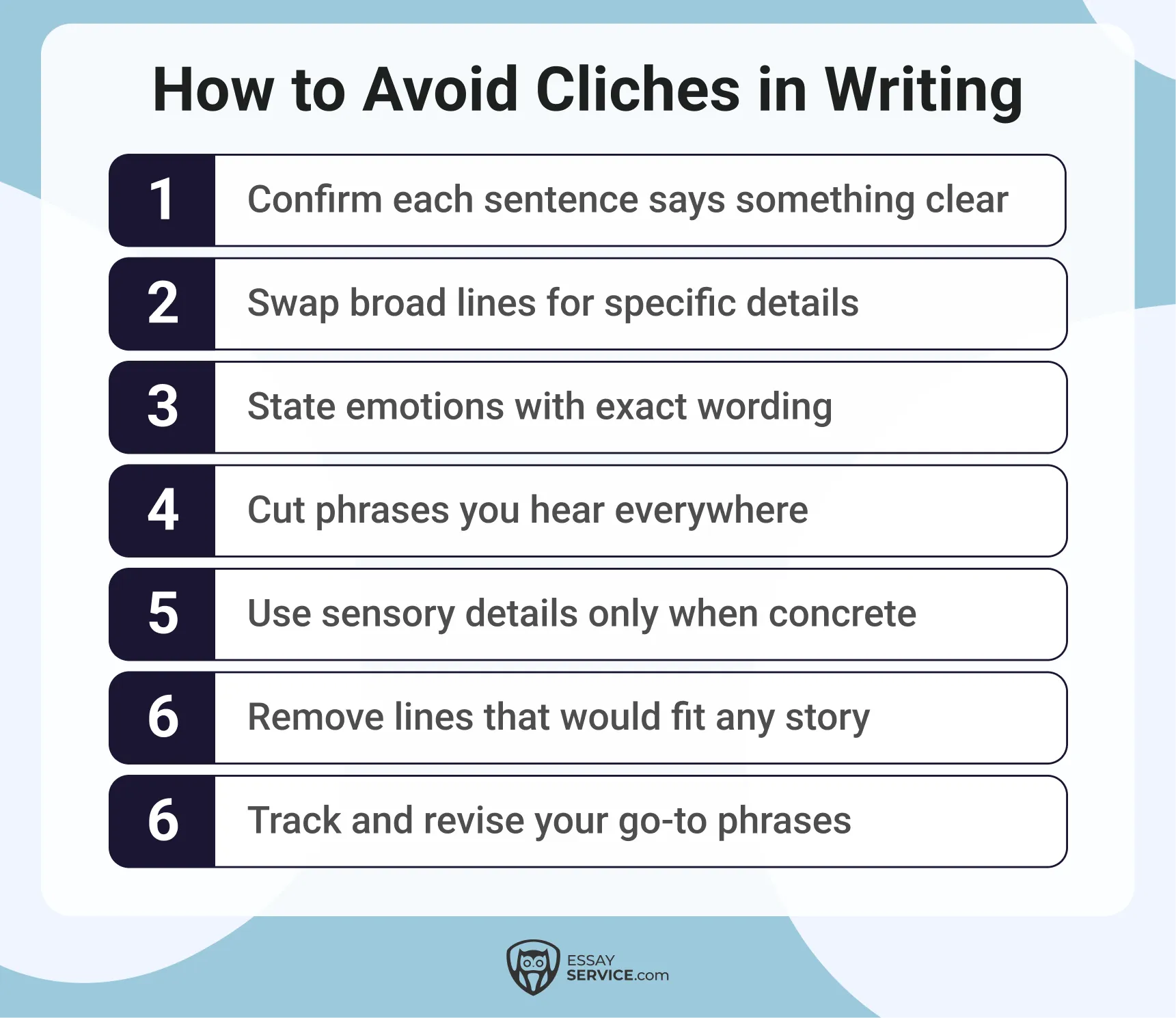
- Review each sentence and confirm that the reader gets a clear fact or action.
- Rewrite general lines with a direct observation that cannot fit anywhere else.
- Check emotional moments for default phrases and replace them with a specific reaction.
- Mark expressions you hear constantly in everyday talk and revise them with intention.
- Use sensory details only when they describe something concrete.
- Remove any sentence that keeps its meaning even when placed in a different story.
- Keep a short list of phrases you rely on too often and search for them at the end of each draft.
Bringing Everything Together
Cliches appear when a phrase is used so often that it no longer communicates anything specific. The goal is to recognize these moments quickly and replace them with precise language. This requires checking for vague wording, noticing sentences that could fit in any context, and clarifying emotional lines with concrete details. Reducing cliches leads to clearer writing and stronger control over your message.
Whenever writing feels overwhelming, and you start to think, 'I need someone to write my essay for me,' you can always count on EssayService to take over your writing tasks.
Frequently Asked Questions
What Is a Cliche in Writing?
What Is an Example of a Cliche?
What Is the Most Famous Cliché?
What Is the Most Overused Cliche?
When Is It Okay to Use Cliches?

Eugene has spent the past 15+ years editing and proofreading articles for academic journals, newspapers, and magazines. His attention to detail and experience power actionable advice on citations, tone of voice, and more.
- LibGuides: Guilford College Writing Manual: Avoiding Cliches. (2015). https://library.guilford.edu/c.php?g=111810&p=723919
- Cliché - Examples and Definition of Cliché. (2019, February 27). Literary Devices. https://literarydevices.net/cliche/
- Avoiding Clichés. (n.d.). Retrieved December 8, 2025, from https://www.ubishops.ca/wp-content/uploads/Avoiding-Cliches.pdf
New posts to your inbox
Your submission has been received!