
Key Takeaways
- Strong case studies focus on decisions, context, and constraints.
- Clear problem definition matters more than polished storytelling or perfect results.
- Trade-offs reveal strategy; easy answers usually signal weak analysis.
- Data supports reasoning, but interpretation drives insight and learning.
- The best cases produce reusable principles, not one-off conclusions.
Business case study examples span a wide range of real-life situations, including Spotify’s expansion into new markets, Microsoft’s brand and cultural shift under new leadership, the early funding barriers faced by founders like Daymond John, and Johnson & Johnson’s response to the Tylenol recall. These cases show how operations, marketing strategy, and leadership decisions play out in practice, usually framed around a clear problem, the actions taken, and the results that followed. Well-chosen examples help explain complex decisions, market changes, and management pressure across different industries.
If you need support working through business case study examples with solutions, or you are looking for structured explanations in PDF format, EssayService is a reliable platform to get professional guidance.


Human Help for Complex Case Studies
Real analysts help you make sense of data, trade-offs, and decisions.
What Is a Business Case Study?
A business case study is a detailed analysis of a real company situation that examines a specific business problem, the context around it, the decisions made, and the outcomes that followed. It uses factual data, documented actions, and measurable results to explain how strategy, operations, marketing, or leadership choices affected performance and to draw lessons that can be applied to similar business situations.
Core Elements of a Business Case Study
Below is a list of elements that help readers follow the situation as it unfolded, understand why decisions were made, and see how outcomes connect back to the original problem.
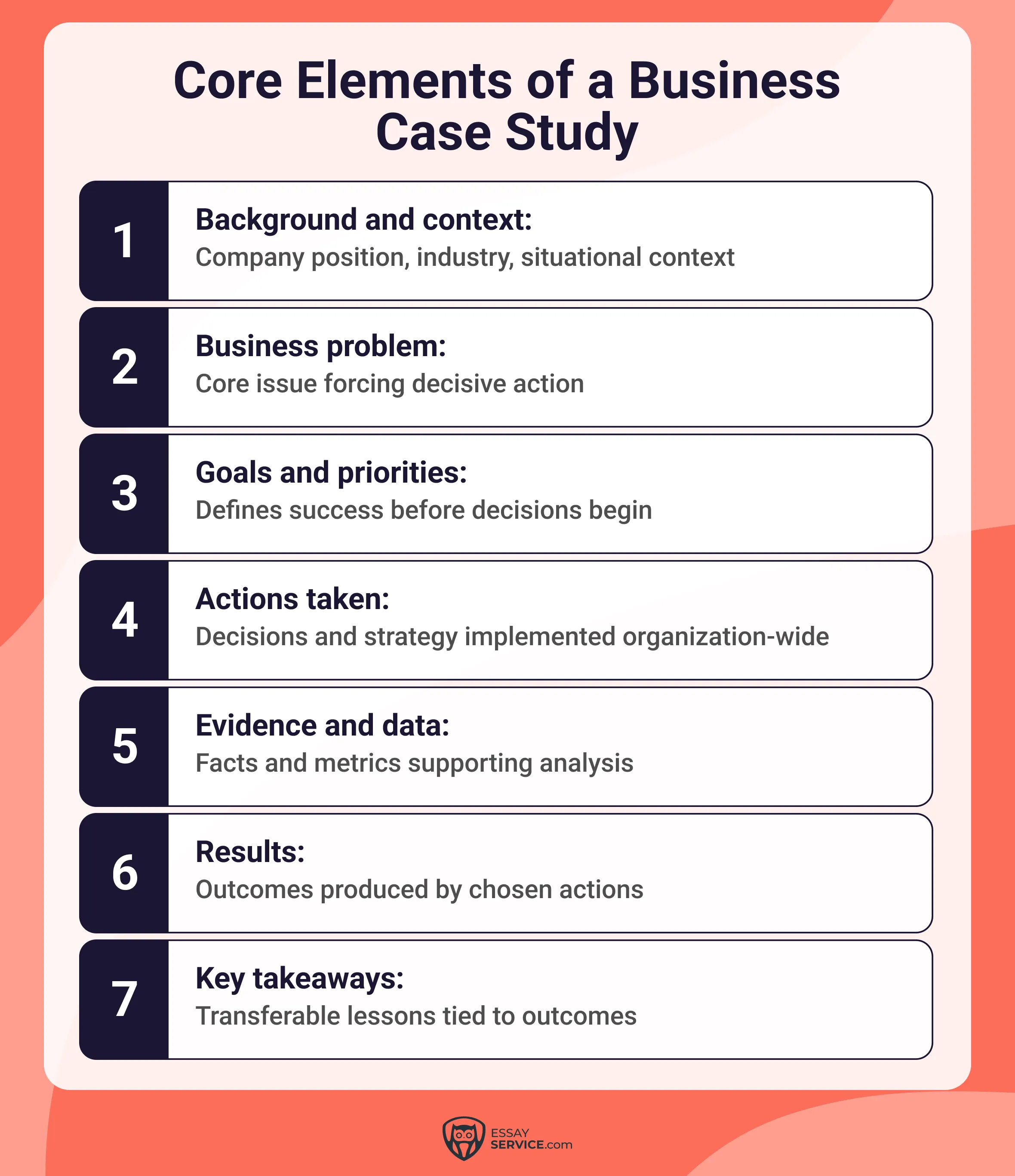
- Background and context: This part explains the company’s position, the industry landscape, and the circumstances surrounding the situation.
- Business problem or challenge: Here, the case narrows in on the specific issue that forced the company to act. It might be stalled growth, rising costs, competitive pressure, or internal breakdowns that made the status quo impossible.
- Goals and priorities: This section clarifies what the company hopes to change. It shows how leaders defined success before taking action, which later helps judge whether their choices worked.
- Actions taken: This is the heart of the case. It explains the decisions made, the strategy chosen, and how those ideas were put into practice across teams, operations, or marketing.
- Evidence and data: Relevant data, benchmarks, and timelines support the analysis and clarify the conditions the company was responding to.
- Results: This part shows the actual outcomes. Results can include measurable gains, missed targets, unexpected side effects, or longer-term shifts in direction.
- Key takeaways: The case closes by connecting the outcome back to the original problem. These insights explain what others can learn and why the case is worth studying in the first place.
If you’re considering where to study business, check out this overview of good universities for business for a thorough breakdown.
Business Case Study Examples
Each business management case study example below follows the same structure, so you can see how problems are defined, options are weighed, decisions are made, and results unfold. Each example is also supported by a PDF version that expands on the analysis, decision logic, and outcomes in more detail.
Business Case Study Example 1: Customer Experience
Company background:
Netflix is a global streaming company built around subscription-based access to on-demand entertainment. As competition increased, customer experience became central to retaining subscribers in a crowded market.
Problem statement:
Netflix began to see signs of subscriber churn as users canceled subscriptions after short viewing cycles. Customers cited limited perceived value, content fatigue, and pricing concerns.
Analysis:
Internal data showed that churn was often linked to weak content discovery rather than a lack of content itself. Viewing patterns revealed that users who failed to find relevant recommendations early were more likely to cancel. Competitive pressure from new streaming platforms intensified this issue.
Options:
Netflix could reduce prices, increase marketing spend, invest heavily in original content, or improve personalization and user experience through its recommendation system.
Decision or outcome:
The company focused on strengthening its recommendation algorithms, improving onboarding experiences, and prioritizing personalized content discovery over blanket marketing efforts.
Results and lessons:
Enhanced personalization increased viewing time and reduced short-term cancellations. The case highlights how customer experience improvements, driven by data and user behavior analysis, can be more effective than price cuts or aggressive promotions when addressing churn.

Business Case Study Example 2: Company Growth
Company background:
Starbucks grew from a simple idea in the US: coffee as an everyday ritual, paired with a consistent in-store experience. As domestic growth slowed, international markets became the obvious next chapter.
Problem statement:
Global expansion brought a tension Starbucks couldn’t avoid. A single brand promise had to work across cultures with very different tastes, habits, and expectations. Copying the US model everywhere risked rejection.
Analysis:
Early research showed that coffee culture varies widely. In some markets, tea dominated. In others, cafés served as social spaces rather than grab-and-go stops. Local competitors often understood these nuances better and moved faster.
Options:
Starbucks could standardize stores worldwide, fully localize each market at the risk of brand dilution, or find a middle ground that protected its core identity while allowing adaptation.
Decision or outcome:
The company chose selective localization. Core branding stayed intact, but menus, store layouts, and partnerships adjusted to local preferences. In some regions, food offerings mattered more than drinks.
Results and lessons:
Starbucks built a global footprint without losing its identity. The case shows that growth works best when consistency sets the frame and local insight fills in the details.
Business Case Study Example 3: Cost-Reduction
Company background:
Built over decades, Ford’s global manufacturing network and wide brand portfolio fueled long-term growth. Over time, that same scale reduced flexibility when the market shifted.
Problem statement:
The economic slowdown reduced vehicle demand, but Ford’s cost structure did not adjust at the same pace. Fixed costs, duplicated product lines, and underused plants put increasing pressure on cash flow.
Analysis:
Internal assessments showed that complexity had become a core issue. Multiple brands targeted similar potential clients, production capacity exceeded demand, and legacy cost structures limited flexibility. The downturn intensified these weaknesses rather than creating them.
Options:
The company could turn to outside financing, pursue limited cost reductions, or commit to a broader restructuring that reduced overhead and clarified strategic priorities.
Decision or outcome:
Restructuring became the chosen path. Non-core brands were divested, production capacity was scaled down, and product lines were consolidated to improve efficiency and focus.
Results and lessons:
Ford’s restructuring strategy is often discussed as an example of improving liquidity and operational control without filing for bankruptcy. The case illustrates that effective cost reduction depends on addressing structural inefficiencies rather than applying short-term cuts during periods of stress.
Business Case Study Example 4: Small Business Case
Company background:
Airbnb began as a small startup offering short-term lodging in private homes. The idea was simple, but the business sat at the intersection of travel, trust, and local regulation, which made early growth uneven.
Problem statement:
Growth brought pressure. As more users joined, Airbnb had to scale quickly while convincing people that staying in a stranger’s home was safe and reliable.
Analysis:
Early data showed that users hesitated when listings lacked reviews or clear standards. Growth depended less on marketing reach and more on whether people felt comfortable inviting strangers into their homes. At the same time, limited resources forced the team to prioritize carefully.
Options:
Airbnb’s options ranged from aggressive growth to early investment in trust mechanisms, stricter listing standards, or delaying platform improvements.
Decision or outcome:
Airbnb chose to invest early in trust mechanisms. Reviews became central, host verification improved, and customer support expanded, even though these steps increased small business operations costs.
Results and lessons:
As trust improved, users returned more often, and the platform held up better under growth. The case highlights how early attention to fundamentals can support long-term expansion.
Business Case Study Example 5: Operations and Process Improvement
Company background:
Toyota operates at a scale where minor inefficiencies add up quickly. For years, the company has viewed production as a system that requires ongoing attention rather than periodic fixes to stabilize its supply chain.
Problem statement:
Rising production exposed the limits of traditional manufacturing. Waste accumulated, delays became common, and large inventories concealed problems until defects surfaced late.
Analysis:
Toyota observed that many issues came from how work flowed, not from individual mistakes. Excess inventory, uneven workloads, and slow feedback loops made it harder to identify root causes. Fixing problems after the fact proved costly and unreliable.
Options:
The company could continue improving output through scale, invest in automation alone, or redesign production around continuous improvement and problem detection at the source.
Decision or outcome:
Toyota structured production to surface issues quickly through lean inventory, standardized processes, and worker authority to pause production. Continuous improvement was embedded into daily operations.
Results and lessons:
Efficiency increased, defects dropped, and flexibility improved across plants. The case shows that process improvement works best when it reshapes how work happens, not just how fast it moves.
How to Analyze Business Case Study Examples?
Analyzing business case study examples requires reading with intent rather than simply following the narrative. Here’s what to do:
- The first step is understanding the context in which the company operated, because strategy only makes sense relative to market conditions, constraints, and timing. A decision that appears weak in one environment may be reasonable in another.
- Next, define the business problem precisely. Many cases describe several difficulties, but usually only one issue actually drives the situation. Distinguishing root causes from visible symptoms is where analysis begins to matter.
- From there, concentrate on what decision-makers actually knew at the time. Separating available data from hindsight reduces distortion and clarifies how uncertainty influenced choices.
- When evaluating alternatives, focus on the trade-offs they create. Strong analysis compares imperfect options, each carrying distinct costs and risks, and judges decisions by how well those trade-offs match the company’s priorities.
- Finally, assess outcomes with care. Results alone do not validate or invalidate a decision. Strong analysis explains why an approach worked, partially worked, or failed, and under what conditions similar decisions might succeed elsewhere.
If you’re unsure how to open your paper or frame your main idea, read our blog post on how to start a business essay.
Human Analysis Still Wins
Get support from professional writers who understand case studies and academic expectations.
Final Thoughts
Ultimately, strong business case analysis comes down to disciplined thinking. Clear problem definition, careful attention to context, and honest evaluation of trade-offs turn case studies into practical learning tools rather than summaries of events. When analysis stays grounded in the information available at the time and focuses on decision logic instead of outcomes alone, case studies reveal patterns that can be applied across industries and situations.
For students who require additional support in working through case studies or structuring written analysis, we offer a business essay writing service and assistance with case-based assignments.
Frequently Asked Questions
How Long Is a Typical Business Case Study Example?
Which Sections Should a Strong Business Case Study Example Include?
What Makes a Business Case Study Example Effective?

Phil spends his working days teaching international trade. He contributes to our blog as a freelancer, leveraging his experience with MBA students to advise on academic writing, studying abroad, and securing funds.
- University of Potsdam. (n.d.). Anleitung case studies [PDF]. University of Potsdam. Retrieved January 8, 2026, from https://www.uni-potsdam.de/fileadmin/projects/professional-services/downloads/skripte-ss/Anleitung_Case_Studies.pdf
- Yale School of Management. (2017, December). Top 40 most popular case studies of 2017. Yale School of Management. Retrieved January 8, 2026, from https://som.yale.edu/news/2017/12/top-40-most-popular-case-studies-of-2017
- Stanford Graduate School of Business. (n.d.). Case studies. Stanford Graduate School of Business. Retrieved January 8, 2026, from https://www.gsb.stanford.edu/faculty-research/case-studies
New posts to your inbox
Your submission has been received!