“The media plays an important role in politics.” Everyone has read at least some version of this sentence. The relationship between the two is genuinely a lot more tangled than many of the politics essays try to convey, and understanding that is core to writing an insightful paper.
Newspapers, cable panels, even the feed you scrolled this morning before getting coffee all decide, in ways big and small, what reaches voters and what gets buried. So what is the role of the media in politics, really? This piece walks you through the intricacies, supplies you with potential essay topics, and even hands you a specific essay example to build from.
What Is the Role of Media in Politics?
Think of the media as the layer between citizens and whoever happens to be in charge, and it moves information in both directions at once. Where people pick up that information has shifted. Roughly half of the U.S. adults, 53%, get their news from social media at least sometimes, and as for the under-30s, that figure is 76%. While social media has definitely taken the reins, television hasn’t exactly vanished either, with 34% still naming it as their top platform for information.
All that reach becomes power over what voters notice and end up caring about. If it weren’t so, politicians wouldn’t pour so much energy (and money, too, let’s be honest) into shaping each day’s coverage. But do the viewers trust what they see? Gallup says they don’t, and that public trust in the mass media is at a record low, 28%, when it was 70%-ish in the 1970s. Influence at a high, credibility at a low. That contradiction is what a good essay should pick apart.


Skip The Late Nights
Hand off the writing to pros, and get a polished, plagiarism-free essay on time.
Positive and Negative Effects of Media on Politics
There is no single answer to whether the influence of media on politics is good or bad. So before I write any analysis, I sketch a two-column table. It keeps me honest.
Key Political Science Vocabulary Section
The part that can literally lift your grade is vocabulary. Your instructor has read a hundred papers that say "the media influences people," and the phrase no longer means much. These terms are the ones I reach for again and again, and each carries a precise sense worth getting right.
Essay Topics on the Role of Media in Politics
Stuck for a starting point? Here are thirty prompts I'd happily assign, some questions, some claims to defend.
- Does a healthy democracy actually need a free press, or would an informed public do?
- Algorithmic feeds have rewired which political issues we notice first.
- Why do two people watching rival networks end up living in separate realities?
- Trace one rumor as it climbs out of a fringe post and onto a network broadcast.
- Local newspapers keep closing, and civic accountability is paying the bill.
- How much of an election result can we honestly credit to media coverage?
- The fourth estate does its best work when nobody in power feels comfortable.
- Compare election-night coverage on two rival outlets, minute by minute.
- Are news influencers journalists, entertainers, or something we don't yet have a word for?
- A single frame can turn identical facts into two stories that barely resemble each other.
- What does political accountability even look like once the local paper is gone?
- Sensational headlines reliably distort how the public reads complicated policy.
- Should social platforms carry legal responsibility for election misinformation?
- Money, access, and clicks: how newsroom economics bends political coverage.
- Political satire shapes public opinion in ways most people underestimate.
- When does hard-hitting investigative reporting slip into cheap sensationalism?
- Consider the voter who trusts no outlet at all, and what drove them there.
- Cable news runs on conflict, and that conflict changes how politicians behave.
- Can a press funded by advertising ever be a real watchdog?
- Anonymous sources: indispensable tool, or a loophole for manipulation?
- Televised debates rarely change minds, and campaigns still pour fortunes into them.
- Who actually bears the blame when misinformation spreads during a campaign?
- Examine how recommendation systems decide which political stories ever reach you.
- Press freedom is eroding across democracies that long took it for granted.
- Celebrity endorsements move turnout in ways strategists can now measure.
- The old gatekeeping role has migrated out of the newsroom and into the code.
- How did a handful of platforms end up mediating an entire nation's politics?
- Partisan outlets and the widening gap between what rival voters believe is true.
- Weigh what the public gains and loses when reporters protect a source.
- Trust in the news keeps falling, and it now shadows every debate about informed voting.
How to Write an Essay About the Role of Media in Politics
Treat this one as a small investigation, the kind where you don't actually know your final answer until you've dug in. Here's the sequence I lean on, and it holds up because each step sets up the next.
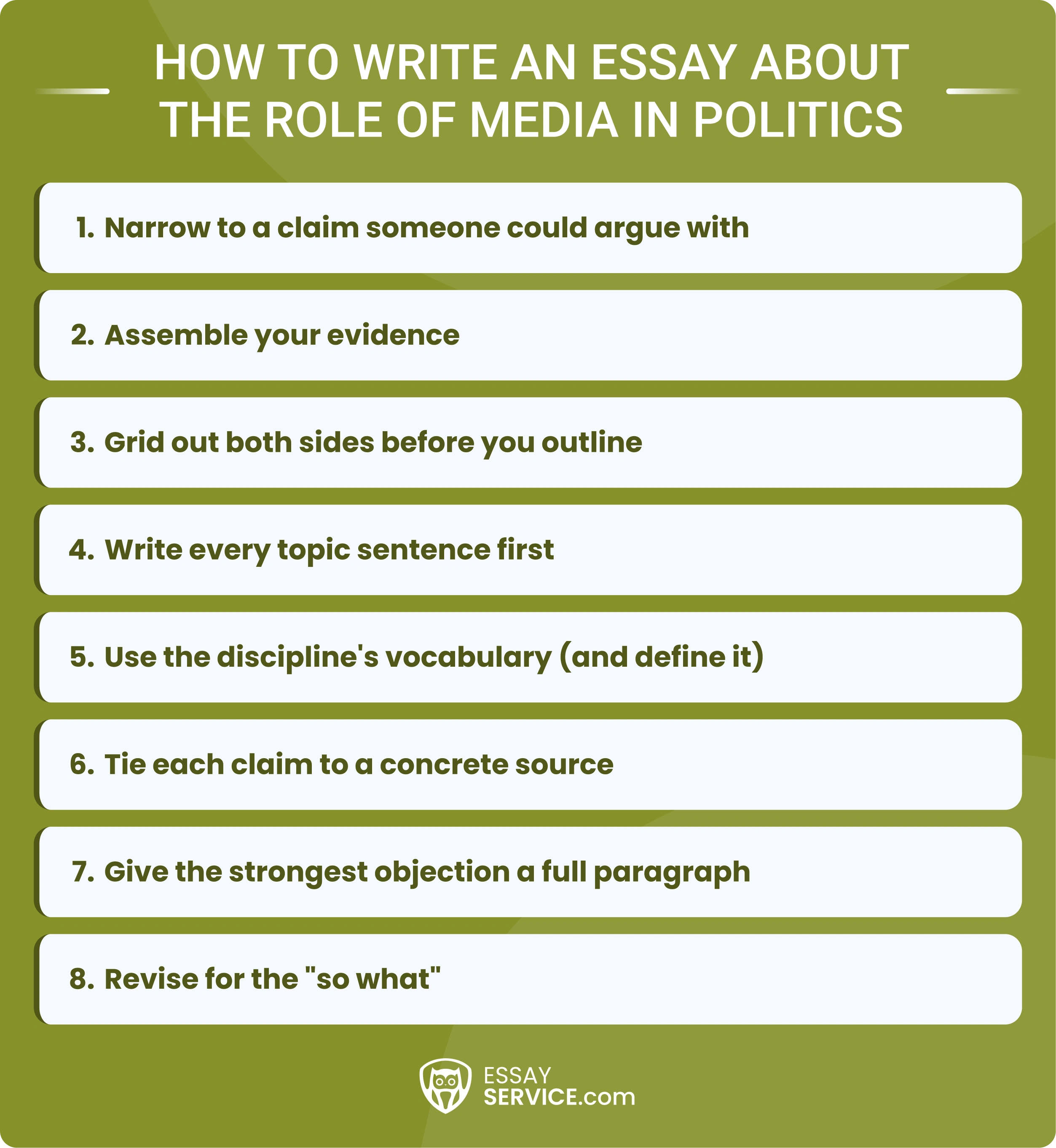
- Narrow to a claim someone could argue with: "The media informs voters" is a fact sitting there doing nothing. "Algorithmic feeds have hollowed out the press's watchdog role" hands you a fight worth having.
- Assemble your evidence before you draft a line: Gather six or so credible sources up front and jot each figure down with its source right beside it.
- Grid out both sides before you outline: Lay the benefits and their matching drawbacks in two columns, and do it early. The tension you're then forced to resolve is exactly what lifts a flat summary into a real argument.
- Write every topic sentence first, then read them alone: Draft the one-line claim for each body paragraph, stack them in order, and read only those lines. If they don't already build toward your thesis, the structure is broken, and catching that now saves you a brutal restructure later.
- Use the discipline's vocabulary, and define it on first mention: Work in the field's precise terms and pin each one down the moment it appears. It signals you know the material, and it trims a surprising amount of vague filler out of every paragraph.
- Bolt each claim to something concrete: Attach every assertion to a named outlet, a specific election, a real number. "Studies show media affects voters" convinces nobody.
- Give the strongest objection a full paragraph: Find the counterargument that genuinely threatens your thesis, then answer it head-on with evidence. Skip it, and your reader decides you never noticed it.
- Revise for the "so what": Close each paragraph by looping its point back to the thesis, and cut any sentence that only describes without pushing the case forward.
Role of Media in Politics: Essay Outline Example
Here's a complete outline I drafted for this exact prompt. Borrow the structure, then load in your own evidence and argument.
Title: What Is the Role of the Media in Politics?
I. Introduction
- Hook: open on the paradox that most people lean on the press for their politics, yet few say they trust it
- Context: give a one-sentence working definition of what the media actually does in political life
- Thesis statement: argue that the media shapes politics through four functions (informing citizens, moving opinion, raising the profile of certain issues, and checking those in power), and that its reach now outstrips public trust in it, which puts democracy under strain
II. Body 1: The media as the public's main information source
- Claim: most political knowledge now reaches people through screens
- Evidence: Pew Research Center (2025), with 53% getting news from social media and 34% still preferring television
- Analysis: draw out the buried tension of what coverage pushes to the front, and what it drops
III. Body 2: How the press moves opinion and steers attention
- Claim: the media lifts the perceived importance of some issues and shoves them up the public's list of worries
- Evidence: two outlets covering the same event from opposite angles
- Analysis: show how the angle itself, not just the facts, shapes what the audience takes away
IV. Body 3: The press as a check on power
- Claim: sustained coverage pressures officials to account for their decisions
- Evidence: a real investigation that forced a political response
- Analysis: tie it back to the accountability function the thesis named
V. Body 4 (counterargument): The failures and the costs
- Concession: the same tools spread misinformation and sort people into closed information circles
- Evidence: Gallup (2025), with trust at a record-low 28%
- Rebuttal: answer the objection, then explain why this very danger makes the thesis more urgent
VI. Conclusion
- Restatement: put the thesis back in fresh wording
- Stakes: informed voting depends on a press that the public can actually trust
- Closing thought: end on a forward-looking line, with no new evidence introduced
What Is the Role of Media in Politics: Essay Example
Ready to see it all come together? Here's a complete essay built straight from the outline above, with every part labeled so you can track how the structure works.
What Is the Role of Media in Politics?
[Hook] Most of us form our political opinions from sources we claim not to trust, and we do it every single day. [Context] The word "media" here covers the whole apparatus that carries political information to the public: the newspapers, broadcast networks, and social platforms that decide what a citizen sees and when they see it. [Thesis] The media shapes modern politics through four core functions, informing citizens, moving public opinion, raising the profile of particular issues, and holding officials to account, and its reach over voters now runs well ahead of the trust the public places in it, a gap that puts real strain on democratic life.
[Claim] For a growing share of the public, political knowledge now arrives almost entirely through a screen. [Evidence] Pew Research Center's 2025 data shows that 53% of U.S. adults get news from social media at least sometimes, and among adults under 30 that figure climbs to 76%, while 34% still name television as their preferred platform. [Analysis] This is where gatekeeping matters: editors once decided which events became news, and that power has largely passed to the platform algorithms that now rank, surface, and bury stories by the second. The practical effect is that a voter's sense of what matters gets shaped by whatever the feed chooses to elevate, and the events it leaves unranked may as well not have happened.
[Claim] The press also determines which issues feel urgent to the public in the first place. [Evidence] Consider two outlets that cover the same immigration hearing on a single night, where one opens on economic strain and the other on humanitarian cost. [Analysis] Two mechanisms are at work here. Agenda-setting is the media's capacity to raise the perceived importance of an issue and push it up the public's list of concerns, so heavy coverage alone can turn immigration into the question of the week. Framing works more quietly: it is the particular angle and word choice a story adopts, which steers how the audience reads the very same facts. Change the frame and you change the conclusion, even when not one fact has moved.
[Claim] The media's third role is the one that makes governments nervous, its work as a check on power. [Evidence] Journalists have long been called the fourth estate, an informal branch of public life that keeps watch on the three official branches of government. The clearest case is still Watergate, where two reporters' sustained reporting forced a sitting president out of office. [Analysis] That is the accountability function in its purest form, and it works only when officials genuinely believe someone is watching and ready to publish. Take away the watchdog, and the incentive to behave well weakens right along with it.
[Concession] None of this makes the media's influence a clean good, and an honest essay has to admit where it breaks down. The same platforms that inform can just as easily spread misinformation at speed, and their personalization engines quietly sort users into echo chambers, the closed information circles where people meet mostly the views they already hold. [Evidence] The cost shows up plainly in the numbers: Gallup recorded public trust in the mass media at a record-low 28% in 2025, far beneath the roughly 70% it held in the 1970s. [Rebuttal] A critic could read that collapse as proof the press has already failed its democratic purpose. I would answer it differently. Low trust does not cancel the media's power, and the influence I described above persists even without public confidence. A public that has lost faith in its watchdogs still absorbs their framing every single day, which leaves it wide open to manipulation. The danger, then, makes the thesis more pressing, since the stakes of media literacy only climb as trust falls.
[Restatement] The media, then, sits at the center of political life through four linked functions, feeding citizens their information, moving their opinions, deciding which issues rise to the top, and holding the powerful to account. [Stakes] Informed voting depends on a press the public can actually trust, and that trust is exactly what is eroding right now. [Closing thought] The task ahead is to build a citizenry sharp enough to use the media well, and that job now falls squarely to the next generation of voters.
If you prefer that someone else handle your papers, EssayService can write essays for money if you’re short on time or energy.
Deadline Creeping Up?
Our writers turn around original, carefully sourced papers without cutting a single corner.
Final Thoughts
So there it is. The media informs voters, moves opinion, decides which issues rise to the top, and holds power to account, and it now does all four while public trust is at a record low. A strong essay names that tension, backs each claim with real evidence, and handles the field's vocabulary with care. Now go write it.
Frequently Asked Questions

Essie isn’t just an educator with a Bachelor’s in English: she’s passionate about writing. She uses her experience in grading papers to write comprehensive guides for our blog.
New posts to your inbox
Your submission has been received!