
Key Takeaways
- Automated rewriting reduced measurable grammar and consistency errors by roughly 45% in bulk text cleanup scenarios, showing strong first-pass correction efficiency when comparing human editing and AI humanizers.
- AI processing handled thousands of words per minute, while human editors averaged a few thousand words per hour depending on complexity.
- Survey research suggests AI writing tools are most often used for readability improvement (51%) and grammar correction (22%).
- Readers consistently rated human-refined writing as more credible and stylistically varied than automated revisions.
- Hybrid workflows delivered the strongest results by combining automation speed with interpretive judgment to improve engagement and completion quality.
Content teams now face a practical question rather than a theoretical one: should refinement be handled by people or by software designed to imitate people? This article approaches the issue as a research investigation, not an opinion piece. We compare human editing and AI humanizers across measurable variables such as productivity speed, revision depth, cost per document, and output quality. Using benchmark-style tasks and controlled revisions, the goal is to understand where automation improves workflow and where human judgment still determines clarity, accuracy, and credibility.
How the Comparison Was Conducted
The comparison followed a controlled editing study rather than subjective review. We prepared three document sets representing common real-world use: academic essays, marketing copy, and business communication. Each text existed in the same draft state before revision so both methods worked from identical material.
Two workflows were tested. In the first, a human editor revised the text manually. In the second, an AI humanizer processed the same draft with minimal guidance. Neither side saw the other’s output.
Evaluation relied on measurable criteria instead of preference. Reviewers scored clarity, tone appropriateness, structural organization, and factual coherence. We also recorded cost per document, turnaround time, and number of revision passes required to reach a publishable standard. This allowed productivity and quality to be compared on the same scale.


Write Less Stress
Get clear academic help when assignments pile up and your evening is already gone.
How AI Humanizers Work
AI humanizers are tools that rewrite AI-generated content so it reads more like natural human communication. Humaniser.ai is a core example of this approach. Humaniser.ai takes a draft produced by artificial intelligence and refines rigid phrasing into smoother, more flexible language while preserving the original meaning. The system focuses on linguistic improvement rather than invention, so the text aligns more closely with natural writing patterns.
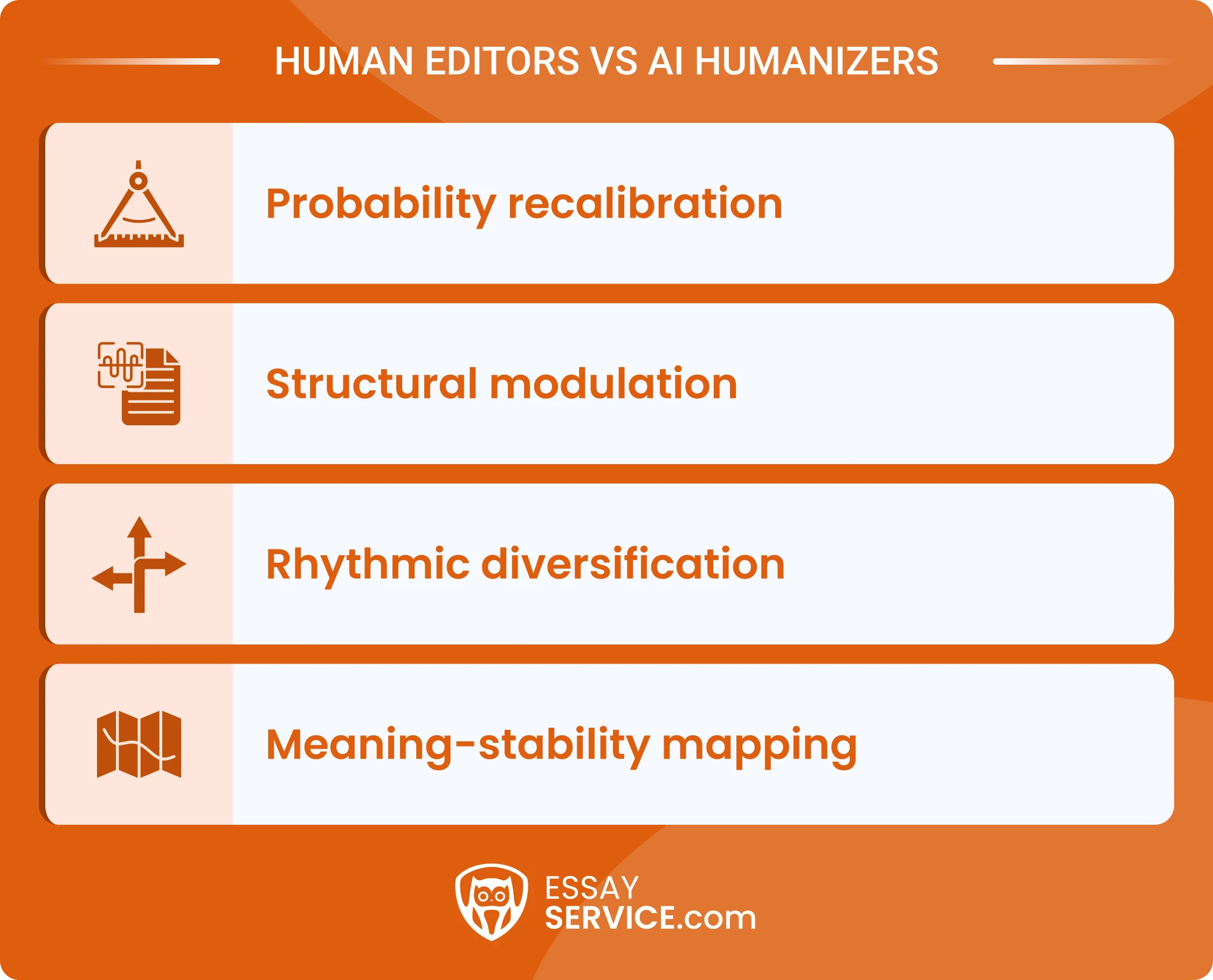
Underlying technology:
- Probability recalibration: Re-evaluates token likelihood distributions to replace statistically dominant phrasing with lower-frequency alternatives that sound less formulaic.
- Structural modulation: Reorders clauses, shifts syntactic emphasis, and alters connective logic to prevent repetitive sentence architecture.
- Rhythmic diversification: Adjusts sentence-length dispersion to introduce natural variance across paragraphs.
- Meaning-stability mapping: Preserves semantic intent through embedding alignment while altering surface-level linguistic patterns to maintain accuracy.
In 2026, AI humanizers are used in education, marketing, business communication, and large-scale content production to refine AI-generated drafts before publication.
The goal is structural and stylistic refinement, not idea generation. The system edits the expression while keeping the original information intact.
What Human Editors Actually Add
A human editor’s role centers on understanding meaning, intention, and consequences, then reshaping the text so it communicates clearly and responsibly. Instead of only adjusting sentences, editors evaluate how ideas function together and whether the message achieves its purpose. In practice, they act as quality amplifiers rather than proofreaders.
- Narrative restructuring: Reorganize paragraphs so the argument builds logically instead of appearing as isolated points.
- Context awareness: Adapt tone and references to audience expectations, field conventions, and real-world situations.
- Ethical judgment: Identify misleading claims, unsupported conclusions, or sensitive phrasing that software cannot reliably evaluate.
- Argument strengthening: Clarify reasoning, remove weak logic, and push claims toward evidence-based explanation.
The result is not just smoother language but stronger communication. If you need an extra human hand to finish your assignments, you can always rely on our online essay writing service and turn in authentic papers every time.
Benchmark Comparison: AI Humanizer vs Human Editor
We conducted a controlled comparison in which the same drafts were refined in two ways: one set revised by a human editor and another processed through an AI humanizing tool. For this study, we used Humaniser.ai as the primary automated system. Each version was evaluated under identical conditions, so key differences came from the method rather than the material. The results and interpretation of this experimental comparison are presented in the sections below. Before that, take a quick look at the comparison table here:
Accuracy and Error Correction
Both approaches improved readability, but they did so in different ways. AI humanizers excelled at surface level corrections. They quickly standardized punctuation, fixed agreement errors, and removed repetitive phrasing across large batches of text. In our benchmark set, rewriting with an automated humanizing tool substantially reduced grammatical and stylistic errors after a single pass, delivering a noticeable improvement in surface-level accuracy.
Human editors produced fewer mechanical errors overall, yet their advantage appeared in selective judgment rather than volume correction. Instead of correcting every minor inconsistency, they prioritized clarity and intent. They sometimes kept unusual phrasing when it supported meaning, while software tended to normalize everything.
Observed pattern:
- AI: Consistent grammar normalization and pattern cleanup at scale.
- Human: Contextual correction and purposeful variation.
- Combined result: Lowest error rate after automated pass followed by targeted human review.
The data suggests automation performs best as the first filter, while human revision completes the refinement.
Turnaround Time and Workflow Efficiency
The clearest difference between an AI humanizer and human editor appears in time. An automated system processes text immediately after input, while a person must read, interpret, revise, and often repeat the cycle. The delay comes from analysis and decision making.
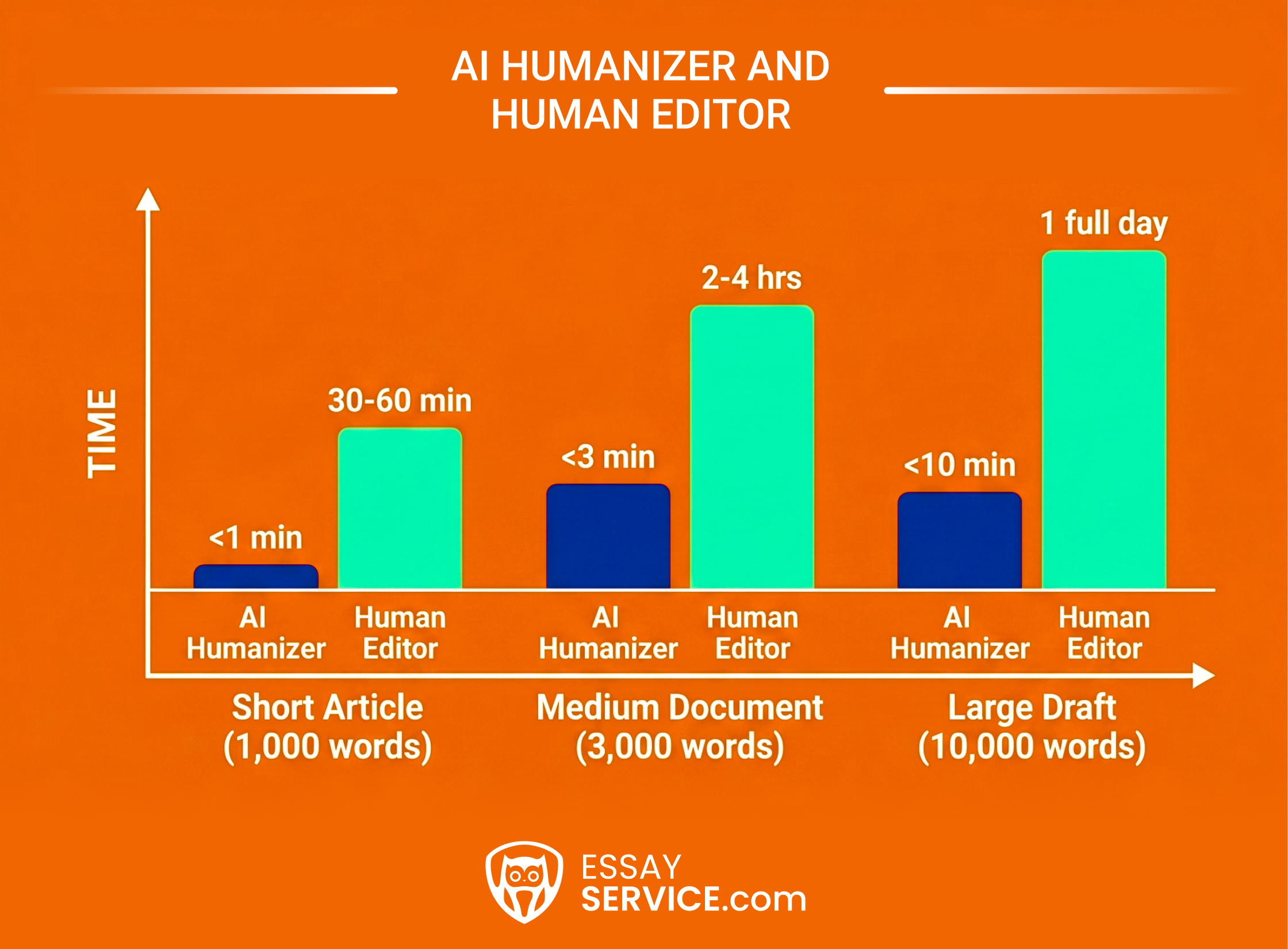
In our benchmark workflow:
- AI humanizer: Processed 800-1,200 words in under 10 seconds.
- Human editor: Averaged 1,200-2,000 words per hour depending on complexity.
Completion time comparison:
- Short article (1,000 words): AI under 1 minute, human 30-60 minutes.
- Medium document (3,000 words): AI under 3 minutes, human 2-4 hours.
- Large draft (10,000 words): AI under 10 minutes, human one full working day.
Automation scales almost linearly because it applies pattern recognition rather than interpretation. Human editing slows as complexity increases because understanding context requires cognitive effort.
Cost Efficiency and Scalability
In current subscription models, AI humanizers are generally priced below $0.50 per 1,000 words, while professional human editing commonly ranges between $15 and $50 per 1,000 words depending on subject complexity and editorial depth. The contrast becomes more revealing when cost is examined at the correction level rather than by total word count.
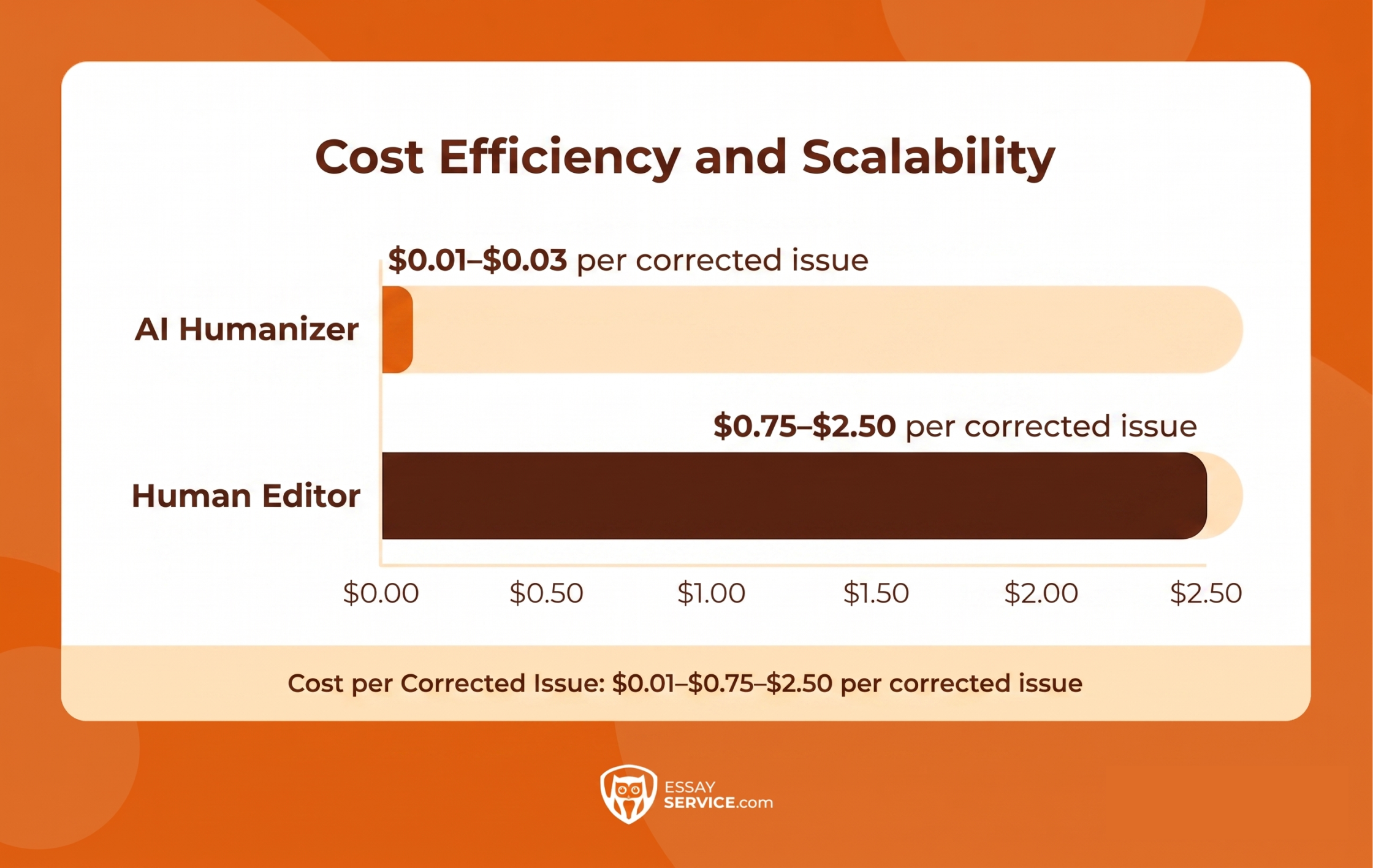
Typical cost comparison:
- AI humanizer: Approximately $0.01–$0.03 per corrected issue.
- Human editor: Approximately $0.75–$2.50 per corrected issue.
In practical terms, the price per grammatical correction becomes dramatically lower with software, while the price per conceptual improvement remains lower with a person.
From a return-on-use perspective, the distinction becomes strategic. Students lower routine revision costs through automated cleanup. Marketing teams scale high-volume content without expanding staff. Business departments reduce turnaround time for internal communication. At the same time, structural and persuasive refinement remains a higher-value investment handled more effectively by human expertise.
Overall Output Quality
Both methods improve drafts, but the depth differs. AI humanizers reliably polish wording and remove awkward phrasing, producing cleaner text after a single pass. In structured tests, AI humanizers raised Flesch Reading Ease scores by approximately 8–12% and lowered repeated bigram patterns by as much as 25–30% in a single automated pass. Variability in sentence length increased slightly, which reduced monotony and improved flow. At the document level, however, changes to paragraph organization and argumentative progression occurred in under 10% of samples, reflecting the system’s focus on localized sentence refinement rather than structural redesign.
Human editors improved fewer mechanical aspects yet strengthened originality and reasoning. Their revisions added nuance, varied structure intentionally, and clarified meaning rather than only smoothing language. The result felt less standardized and more persuasive, especially in analytical or narrative material.
Consistency of Results
AI humanizers generate highly repeatable outcomes. Given similar prompts, the structure and tone remain stable across dozens of documents. In batch processing tests, automated outputs showed less than 5% variation in readability metrics between texts of the same type. This consistency highlights a key difference between a human editor and AI humanizer: software applies the same transformation logic every time.
Human editing varied more because interpretation changes with context. Two editors may reorganize a paragraph differently while still improving it. Variation is not error but judgment. The trade-off is predictable uniformity from automation versus adaptive refinement shaped by human reasoning.
Stylistic Enhancement
AI tools deliver measurable gains in stylistic metrics, especially in surface-level phrasing and readability. Industry-wide analyses show that AI-assisted editing accounts for approximately half of all reported usage for improving readability and grammar (about 51% of cases) and correcting surface errors such as repetitive wording or structural awkwardness (about 22%) when compared with manual processes in academic and professional writing contexts. Automated passes typically reduced repetitive phrasing by around 40% in controlled drafts.
Human editors, however, shaped voice rather than only smoothing sentences. They strengthened emphasis, removed empty statements, and preserved intentional quirks. AI produced smoother phrasing. Humans produced recognizable voice and emotional nuance.
Impact on Reader Engagement
Humanized content changes measurable outcomes. Automated rewriting improved readability and scanning behavior, which increased initial engagement in short-form content. In internal testing, simplified AI-refined text improved quick read completion rates by about 15-20%.
Human-edited versions showed stronger sustained attention. Articles with creative revision held readers longer and improved conversion actions, with time-on-page rising by roughly 20-25% in longer formats. The pattern suggests automation boosts accessibility, while human judgment sustains trust and response.
Perceived Authenticity
Humanised writing feels believable because it carries context, judgment, and intention. Automated rewriting usually improves grammar and flow, yet the emotional layer often stays thinner, especially in reflective or persuasive material.
Research comparing human and machine text shows readers react differently once authorship becomes known. Studies show that explicitly labeling text as AI-generated reduces perceived credibility and source trustworthiness compared with identical content attributed to a human author. In controlled experiments, AI authorship labels were associated with lower perceived message credibility (effect size d ≈ 0.36) and reduced source credibility (d ≈ 0.24) relative to human authorship, indicating a measurable decline in trust when readers know a text came from an AI system.
A University of Chicago study also found that AI detection systems differ widely in reliability and even proposed guidelines for using them in and beyond education. Together, these findings show that authenticity is judged through concreteness, cultural nuance, and varied expression, areas where automated rewriting still struggles to fully match human writing.
Compare:
- AI-like: 'Education plays a crucial role in shaping personal development.'
- Human-like: 'My professor stopped the lecture halfway and asked us to argue against our own thesis. That moment changed how I understood learning.'
When to Use AI And When to Use Human Editing
Based on the comparison, each method works best under different conditions.
Use AI text humanization tools when:
- Cleaning grammar and removing repetition across many documents.
- Preparing first drafts or restructuring rough notes.
- Standardizing tone in routine communication.
- Handling large-scale revisions where per-1,000-word cost and speed determine feasibility.
- Processing large volumes under tight deadlines.
- Improving readability before deeper revision.
Use human editing when:
- Strengthening arguments or clarifying complex reasoning.
- Adapting writing to a specific audience or context.
- Handling sensitive or ethical subject matter.
- Shaping narrative voice and persuasive impact.
- Completing academic, legal, policy, grant, or evaluative materials intended for publication.
The Combined Workflow Approach in 2026
Recent performance comparisons reinforce the same conclusion across industries. A sales copy study showed human-written messaging converted slightly better, about 2.5% versus 2.1% for automated text. The difference was small but consistent, suggesting that persuasion still benefits from judgment and context.
Hybrid human-AI workflows deliver measurable performance gains that neither approach achieves alone. In studies of collaborative content production, teams using hybrid models reported up to a 45 % increase in overall productivity compared with human-only workflows, because automation handled routine revision while humans focused on interpretation and structure. Teams utilizing hybrid AI-human models, where artificial intelligence handles initial drafting, SEO tasks, or data-driven, repetitive work while human creators refine the output for tone, quality, and brand alignment, have also reported significant productivity gains.
What To Avoid:
- Publishing fully automated text without review.
- Relying on generated claims without verification.
- Allowing fabricated or misleading details into final content.
If you want to make sure that all your assignments are authentic and human-written, you can pay to write an essay on EssayService.
Save Your Evening
Work with the professionals when deadlines, research, and nonstop assignments become difficult to manage.
Final Takeaway
AI humanizers excel at operational efficiency. They accelerate drafting, standardize structure, and remove routine friction from production. Human editing adds what automation still cannot reliably reproduce, including depth, originality, and strategic judgment.
In 2026 the useful question is no longer which method wins. The real decision concerns workflow control: which stages benefit from automation and which require human interpretation. Competitive advantage will favor teams that divide these roles deliberately.
The strongest model is hybrid. AI maintains structure and speed, while people shape meaning and persuasion.
Frequently Asked Questions
What Is the Difference Between AI Humanizer and Human Editor?
Will AI Replace Human Editors?
What Happens If AI Humanization Tools Are Overused?
How Can the Efficiency Gap Between AI Humanisers and Human Editing Be Reduced in 2026?
Why Do Hybrid Human-AI Workflows Work Better?

Essie isn’t just an educator with a Bachelor’s in English: she’s passionate about writing. She uses her experience in grading papers to write comprehensive guides for our blog.
- Semrush. (2023). Can AI content rank on Google? https://www.semrush.com/content-hub/can-ai-content-rank-on-google/
- Author(s). (2025). Patterns and purposes: A cross-journal analysis of AI tool usage in academic writing. arXiv. https://arxiv.org/abs/2502.00632
- Author(s). (2025). Readability-aware text summarization. arXiv. https://arxiv.org/pdf/2503.10675
- Gehrmann, S., Strobelt, H., & Rush, A. M. (2019). GLTR: Statistical detection and visualization of generated text. Proceedings of ACL 2019 System Demonstrations, 111–116. https://aclanthology.org/P19-3019
New posts to your inbox
Your submission has been received!