

Statistics on depression among college students are hard to ignore: up to one-half of students in the U.S. experience moderate to severe depressive symptoms.
Colleges and mental health organizations are taking steps to address student depression, but these efforts are clearly not effective enough.
To understand what may be missing and how to improve the situation, let’s explore a few key points:
- The prevalence of depression among students
- Causes and symptoms of depression in students
- Majors and demographic factors linked to higher depression rates
- Individual and institutional approaches to addressing depression
Statistics on Depression Among College Students: What the Data Shows
- Data on the exact prevalence of depression in students varies from about 18% for severe depression all the way up to almost 50% for moderate depressive symptoms.
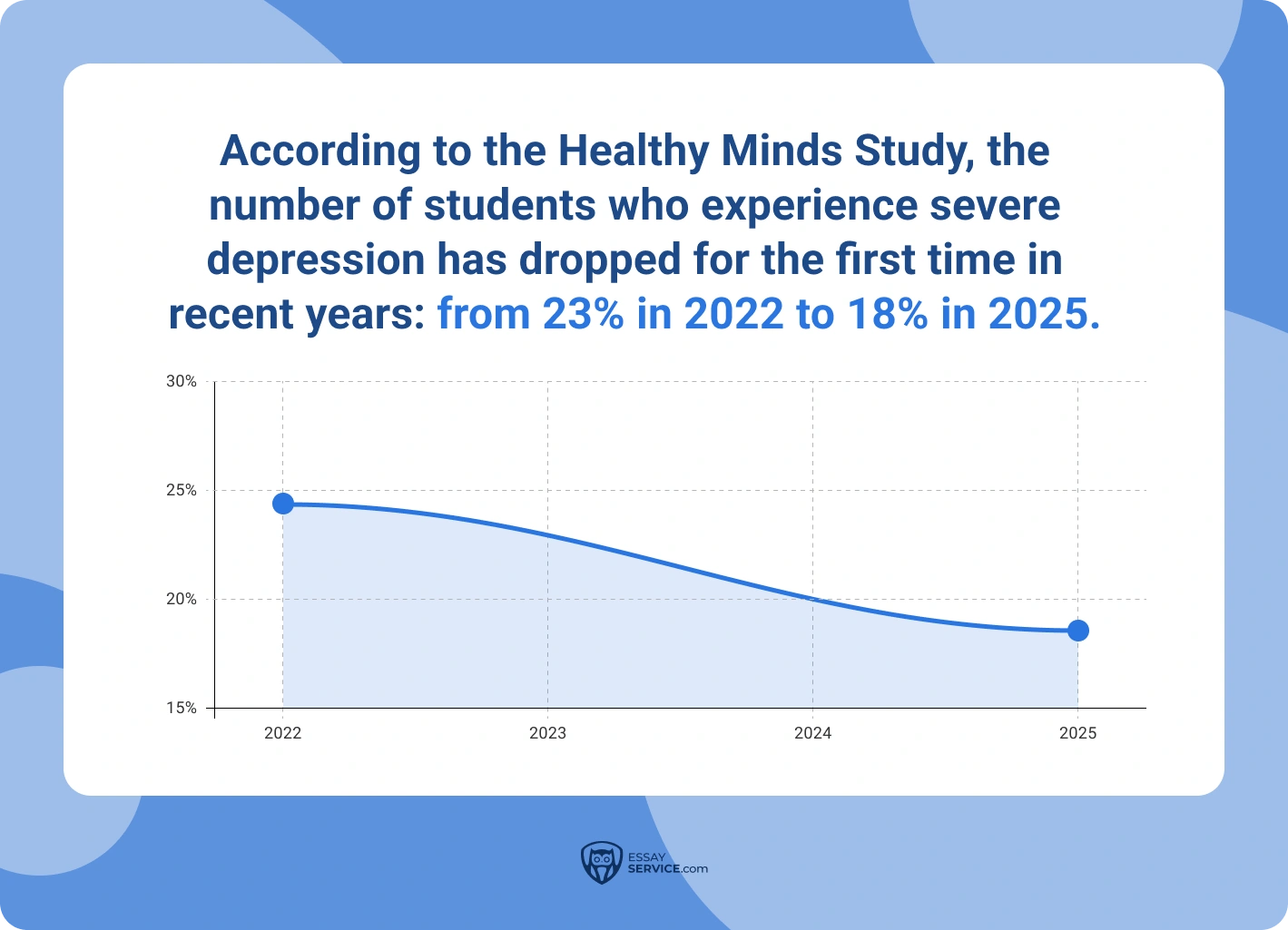
- According to the Healthy Minds Study, the number of students who experience severe depression has dropped for the first time in recent years: from 23% in 2022 to 18% in 2025.
- The prevalence of suicidal thoughts has also decreased from 15% in 2022 to 11% in 2025, as have high levels of loneliness (from 58% to 52%).
- However, the drop in the prevalence of severe depression doesn’t necessarily mean that more students are happier. According to the same 2025 study, only 36% of students meet the criteria for psychological well-being, down from 38% in 2024.
- Moreover, based on the faculty survey data, as many as 81% of current college staff members report that, overall, students’ mental health seems significantly worse now compared to the beginning of their careers.
- Multiple factors are found to correlate with depression in college students statistics, including socioeconomic status, lifestyle, history of mental illness, major, access to mental health services, social isolation, and even grades.
Why Are College Students Depressed? Key Causes and Trends
Based on research, depression in college students is associated with both structural and individual factors. One of the main external causes is financial stress due to high tuition and living costs, as well as uncertainty about future income.
Academic pressure is also heavily linked to depressive symptoms, which explains why high-performing students are more likely to struggle with depression. To maintain a high GPA, students often sacrifice sleep, physical exercise, and meaningful leisure, including socialization. As a result, their mental health suffers.
Internal factors, such as pre-existing mental health conditions and individual traits, matter too. In particular, a depressed student often shows high interpersonal sensitivity, meaning a sense of personal inadequacy and a tendency to compare themselves to others.
Recognizing the Alarming Signs: Symptoms of Depression in College Students
Depression manifests in a variety of ways, including emotional, cognitive, physical, and behavioral symptoms. Still, the following signs are commonly present in depressed students:
- Persistent sadness, emptiness, or low mood
- Emotional numbness
- Heightened irritability
- Constant guilt and self-blame
- Struggles with focus or decision-making
- Mental fog and slowed thinking
- Memory problems
- Changes in sleep patterns: insomnia or oversleeping
- Low energy and fatigue
- Changes in appetite and weight
- Withdrawal from family and friends
- Reduced productivity
- Neglected self-care
- Thoughts of suicide
Majors with the Highest Reported Depression Rates
Depression can affect anyone, regardless of their field of study. Yet, academic pressure and financial stress, which are linked to one’s major, are among the key contributing factors to depression among students.
According to research, the top three majors with the highest recent increase in depressive symptoms are:
1. Medicine – 35.3%
2. Nursing – 38.3%
3. Law – 29.9%
.webp)
Other majors with high rates of depression include engineering, business, pre-professional, natural sciences, mathematics, humanities, and social sciences.
Student Populations Most Vulnerable to Depression
Demographic and social factors are known to affect the prevalence of depression in specific populations, including minorities and other vulnerable populations. Unsurprisingly, the same is true for students.
Students with depression (as well as anxiety) are disproportionally represented among these groups:
- Students with lower socioeconomic status and income
- People of color
- Women
- The LGBTQ+ community
- Students who combine studies with caregiving responsibilities.
How to Deal with Depression in College: Coping Strategies
Everyday stressors faced by students, such as academic pressure and financial concerns, are hard to avoid. But with the right coping strategies, a strong support system, and access to mental health services, they are manageable.
Unfortunately, psychoeducation on healthy coping mechanisms remains limited. Although most young people have at least some knowledge of recommended strategies, many either struggle with implementing them or aren’t fully aware of the extent to which lifestyle and the choice of healthy coping mechanisms affect their mental health.
Some of the common unhealthy coping strategies that young people resort to include emotional numbing through excessive “doomscrolling,” withdrawal (which only exacerbates isolation and contributes to depression in college), and, most alarmingly, substance abuse. Studies show that the prevalence of substance abuse among students is about 14%, but the actual rate might be significantly higher, since research uses mostly self-report data.
At the same time, survey data from the Jed Foundation shows that many students do use healthy coping mechanisms, including the following:
- Listening to music – used by 71% of students
- Maintaining a strong support system, primarily friends – 48%
- Spending time outside and connecting with nature – 47%
- Getting 7 to 9 hours of sleep every night – 46%
- Getting emotional support from family – 39%
- Maintaining a healthy diet – 37%
- Using available mental health services – 30%
- Practicing mindfulness and meditation – 30%
- Using social media for emotional support and psychoeducation – 28%
- Exercising daily – 23%
As evident from these statistics, many students already practice healthy coping, though the numbers aren’t high enough yet.
Treating Depression in College Students: Psychoeducation and Mental Health Services
The three major elements of addressing college depression are:
- Psychoeducation about healthy coping. While many students practice healthy coping mechanisms, surveys reveal that some of the most essential strategies remain underutilized. For example, only 23% of students get enough exercise, despite regular physical activity being one of the best tools for preventing depression. Educating students on healthy coping and, wherever possible, integrating it as part of curricula, can help improve the numbers.
- Accessible counseling and therapy. One of the critical findings of the Jed Foundation study is that as many as 71% of students say they would use mental health counseling or therapy at school if such services were available. Currently, not enough schools have free on-campus or telehealth mental health services that students can use.
- Services for students struggling with substance use. College students are among the demographic groups most prone to “self-medication” with substances. For example, over 25% of students report alcohol abuse. Colleges should expand both substance abuse education and accessible treatment options for students to reduce the prevalence of addiction. Harm reduction approaches, while controversial, might also be helpful.
Conclusion
Despite the small improvement according to the 2025 statistics, depression in college students remains a huge problem, particularly among medicine, nursing, and law majors. Low-income students, women, and minorities are also at a higher risk.
To decrease depression prevalence, both individual and institutional efforts are required. Students can protect themselves by consistently implementing healthy coping mechanisms. In turn, colleges need to focus on psychoeducation and increase students’ access to on-campus mental health services.
FAQ

